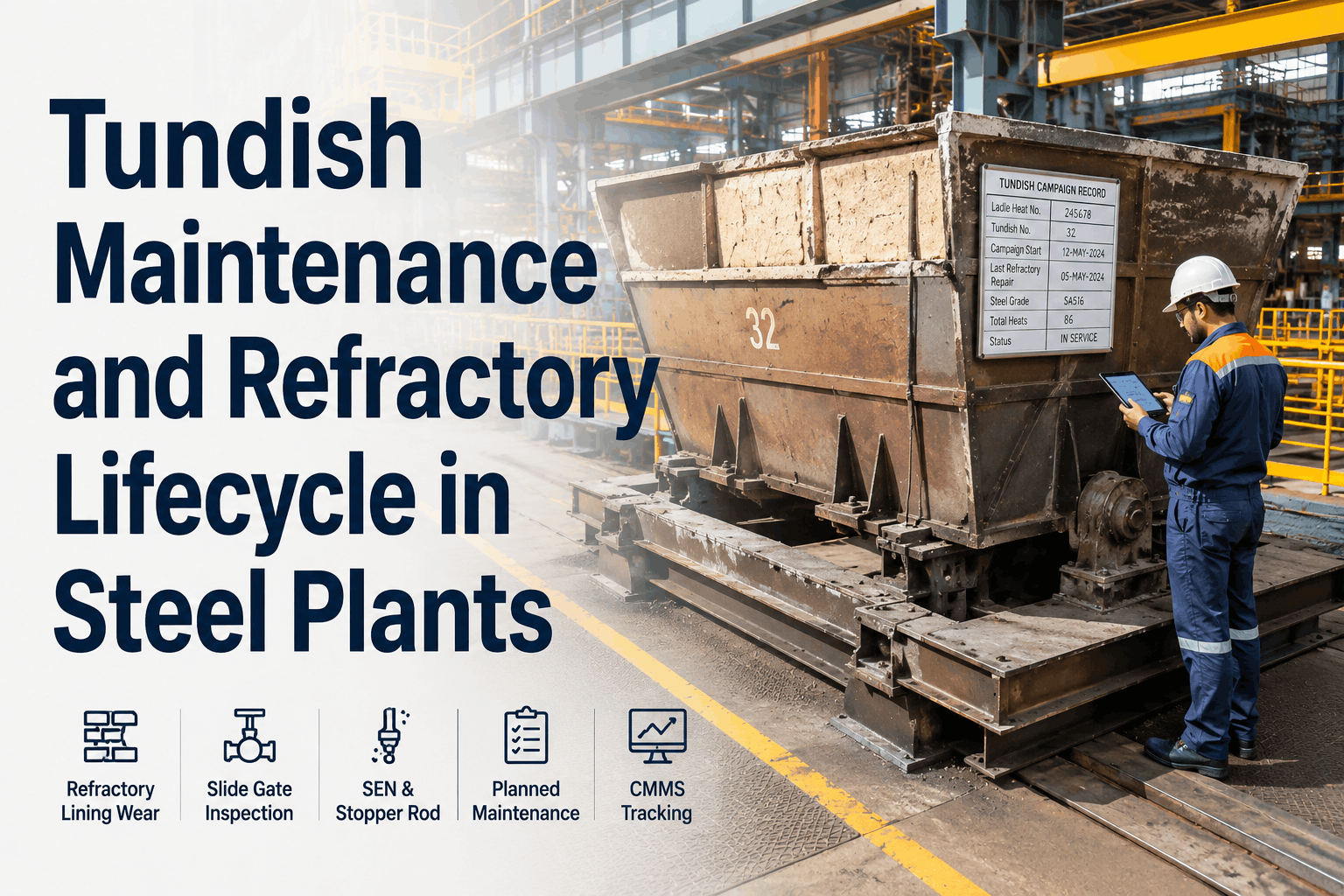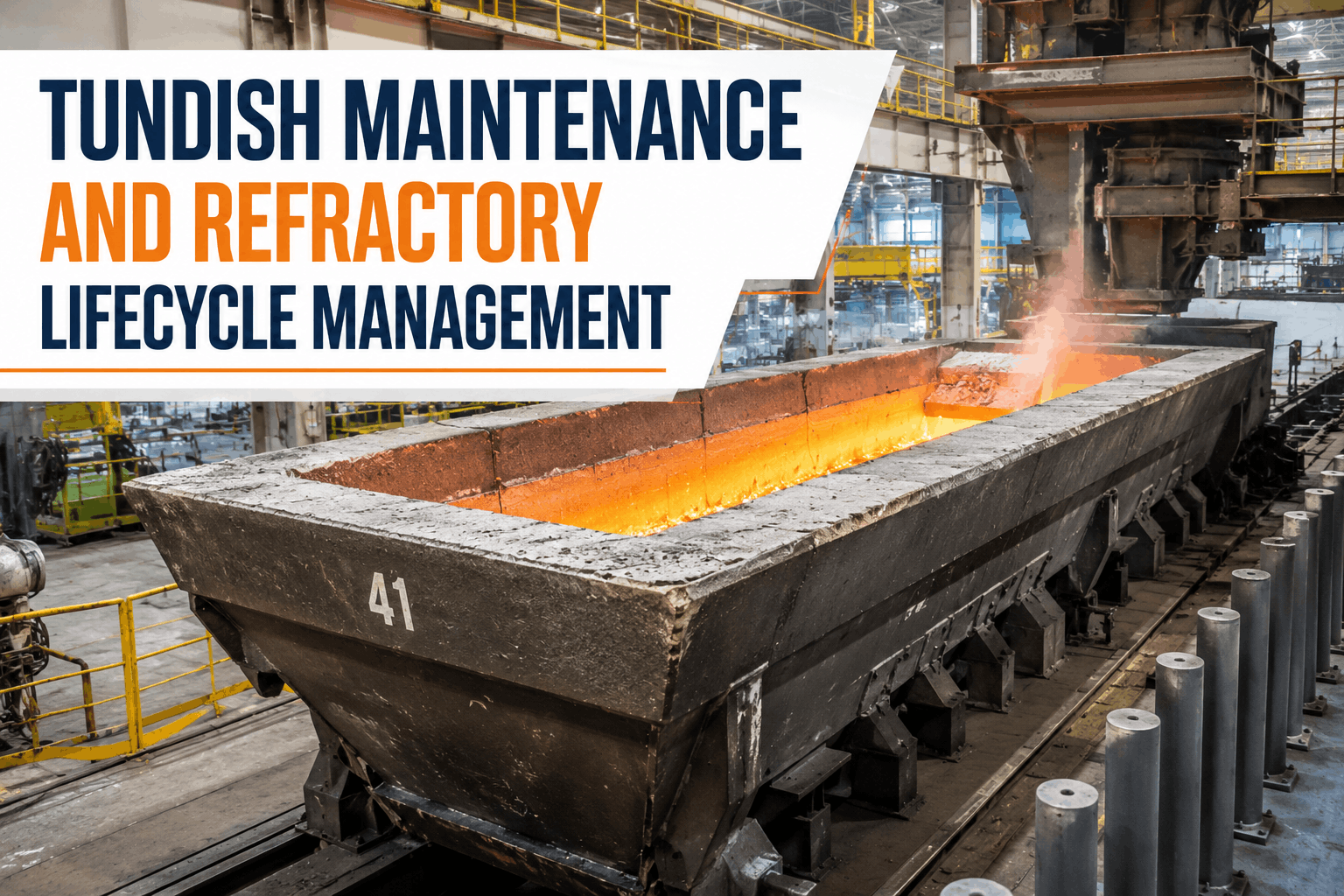
Tundishes are the final metallurgical vessels before molten steel solidifies into slabs, blooms, or billets. Every tundish lining failure — working lining erosion, well block cracking, nozzle clogging — directly impacts steel cleanliness, inclusion control, and caster productivity. A tundish breakout can cost $1.5M–$3M in lost production, equipment damage, and safety incidents. A single SEN (Submerged Entry Nozzle) clogging event can scrap 50–100 tons of steel before detection. World-class steel plants have extended tundish refractory life by 30–50%, reduced nozzle clogging by 60%, and improved steel cleanliness metrics through structured tundish maintenance programs. Start a free trial or book a demo to see how CMMS-tracked tundish refractory management works across your steel plant.
Tundish Maintenance and Refractory Lifecycle Management
Optimize tundish refractory life and prepare for clean steel production — working lining management, SEN installation, nozzle clogging prevention, and lifecycle tracking for steel plants.
Why Tundish Maintenance Is a Different Discipline
Tundish maintenance shares almost nothing operationally with ladle or mold maintenance — despite all being categorized as "refractory management." The service conditions are different, the failure modes are different, the steel quality implications are different, and the lifecycle economics are different. A maintenance engineer who transfers ladle refractory practices to a tundish without adaptation will systematically underperform on every metric — higher refractory consumption from incorrect zone targeting, more inclusions from poor flow control, shorter campaign life from missed wear measurements, and higher breakout risk from inadequate preheating. The disciplines that separate high-performing tundish operations from average ones are specific and learnable — and they are all data-driven.
Tundish Refractory Wear: Recalibrating Lifecycle for Clean Steel
The single most impactful change a steel plant can make to their tundish refractory program is switching from calendar-based replacement to condition-based measurement of working lining thickness, impact pad erosion, and well block wear. A tundish operating at 1,550°C for 8 hours accumulates refractory wear patterns that calendar-based intervals are not calibrated to capture — because wear rate varies significantly with steel grade, casting speed, and flux practice. The result: tundishes replaced too early (wasting refractory) or too late (risking breakout), and steel cleanliness compromised by eroded flow control components that alter fluid dynamics. Oxmaint's condition-based refractory tracking measures thickness after each campaign — so your tundishes get replaced when wear actually requires it, not when a calendar suggests.
Steel Cleanliness Impact: The Primary Cost-Per-Ton Lever
Steel cleanliness — measured by inclusion count, size distribution, and composition — is the single most powerful cost efficiency lever in tundish operations. A tundish optimized for inclusion flotation with proper dam/weir placement, impact pad condition, and flux cover reduces downstream rejection rates by 30–50%. The opposite — eroded flow control components allowing short-circuit flow — sends inclusions directly into the mold, generating surface defects that scrap product or require costly rework. In practice, the difference between an optimized tundish with 3.0 m/s flow velocity and a worn tundish with 5.5 m/s velocity is 18–24% higher inclusion count — generating $50–$100 per ton in quality-related cost.
SEN Management: Matching Nozzle to Steel Grade
Tundish nozzles are chronically mis-specified for their actual steel grade requirements. The default procurement bias toward standard alumina-graphite SENs ignores the operational reality that different steel grades — low carbon, high carbon, stainless, calcium-treated — have different clogging mechanisms. A SEN optimized for calcium-treated aluminum-killed steel with optimized bore diameter and argon flow delivers 6–8 hours of clog-free casting; a standard SEN on the same grade clogs in 2–3 hours, generating 50–100 tons of scrap. Right-sizing analysis using clogging frequency and steel grade data consistently identifies 20–30% of tundish operations using SENs that are not matched to their actual steel grade mix.
Preheating Strategy: Reducing Thermal Shock Breakout Risk
The preheating protocol — drying schedule, temperature ramp rate, hold time — is the most frequently mismanaged variable in tundish preparation. Inadequate preheating leaves moisture in the refractory, which turns to steam on contact with molten steel, generating explosive spalling that can propagate through the lining and cause a breakout. A proper preheating profile ramps from ambient to 1,100°C over 4–6 hours, with a 2-hour hold at 150–200°C for moisture elimination. The consequence of a shortened preheating schedule is a 30–50% increase in breakout risk on the first heat of the campaign — a risk that is entirely preventable with documented temperature tracking.
We were replacing tundish working linings at 8 campaigns, calendar-based. After implementing Oxmaint's condition-based thickness measurement, we discovered our actual wear rate allowed 11–12 campaigns on most tundishes — a 40% life extension saving $240,000 annually in refractory costs. We also reduced nozzle clogging by 58% after implementing SEN selection guidelines per steel grade and tracking argon flow rates. The inclusion count in our final product dropped from 0.28 to 0.12 mm² per 1000mm², moving us from Tier 2 to Tier 1 automotive sheet supplier status. The system paid for itself in refractory savings alone within 4 months.
CMMS Maintenance for Tundishes: What Needs to Change
A CMMS deployed on a tundish operation without configuration for refractory lifecycle tracking will generate replacement work orders at the wrong intervals, flag tundishes for replacement that still have useful life, and miss erosion that requires earlier intervention — because its trigger logic reflects calendar-based assumptions. Correct CMMS configuration for tundish refractory requires four changes from the standard setup: campaign-based thickness measurement triggers, impact pad erosion tracking, SEN condition logging with clogging event correlation, and a preheating profile compliance dashboard that flags temperature deviations before they cause breakout risk.
Key Performance Metrics for Tundish Operations
Frequently Asked Questions
Extend Campaign Life. Improve Steel Cleanliness. Prevent Breakouts.
Oxmaint's tundish refractory module combines campaign-based thickness tracking, impact pad erosion monitoring, SEN clogging correlation, and preheating profile compliance — giving steel plants the operational data to extend refractory life, reduce nozzle clogging, and produce cleaner steel at lower cost per ton.