COKE MAKING · BATTERY MAINTENANCE · FUGITIVE EMISSIONS · 2026
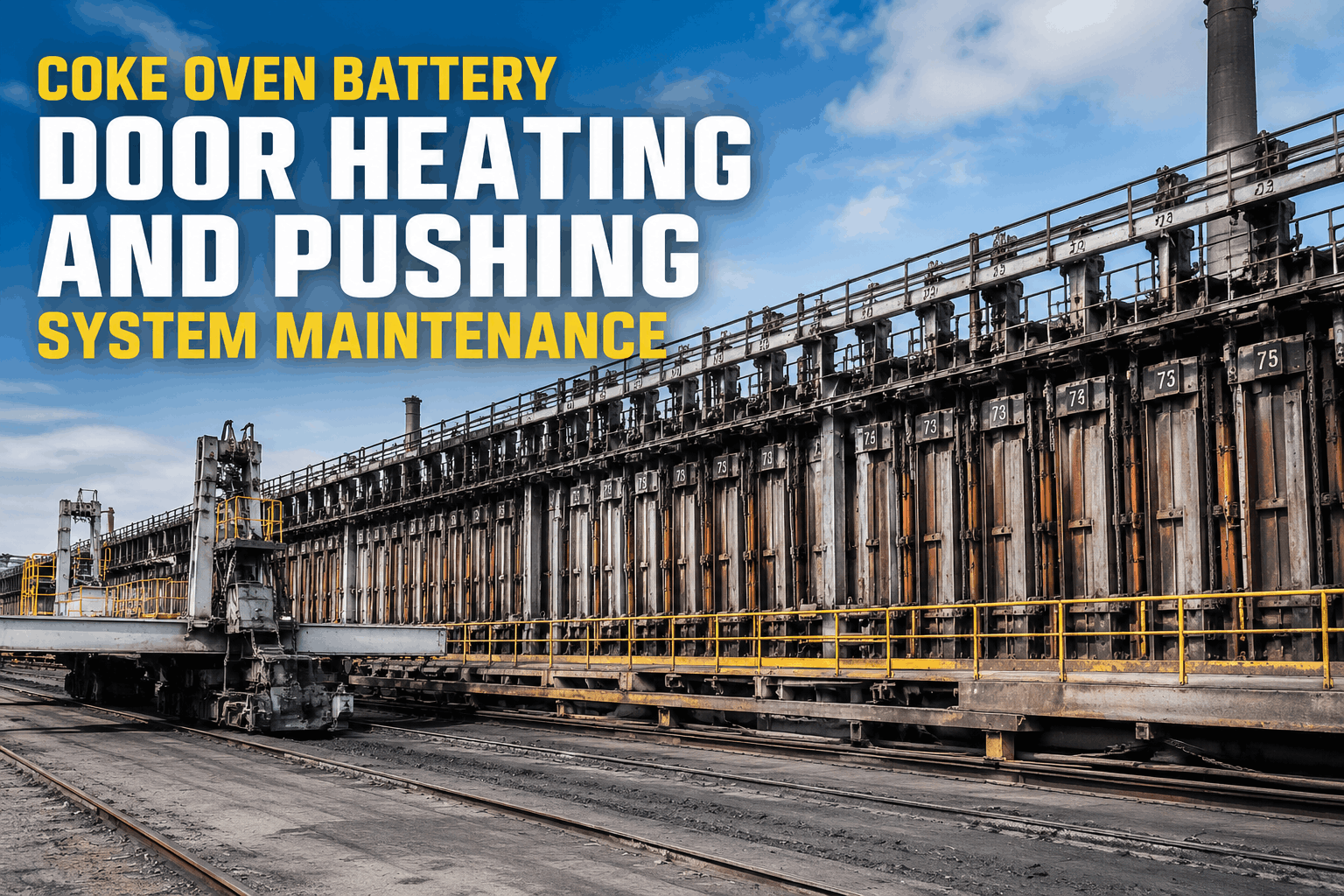
Coke Oven Battery Door Heating and Pushing System Maintenance
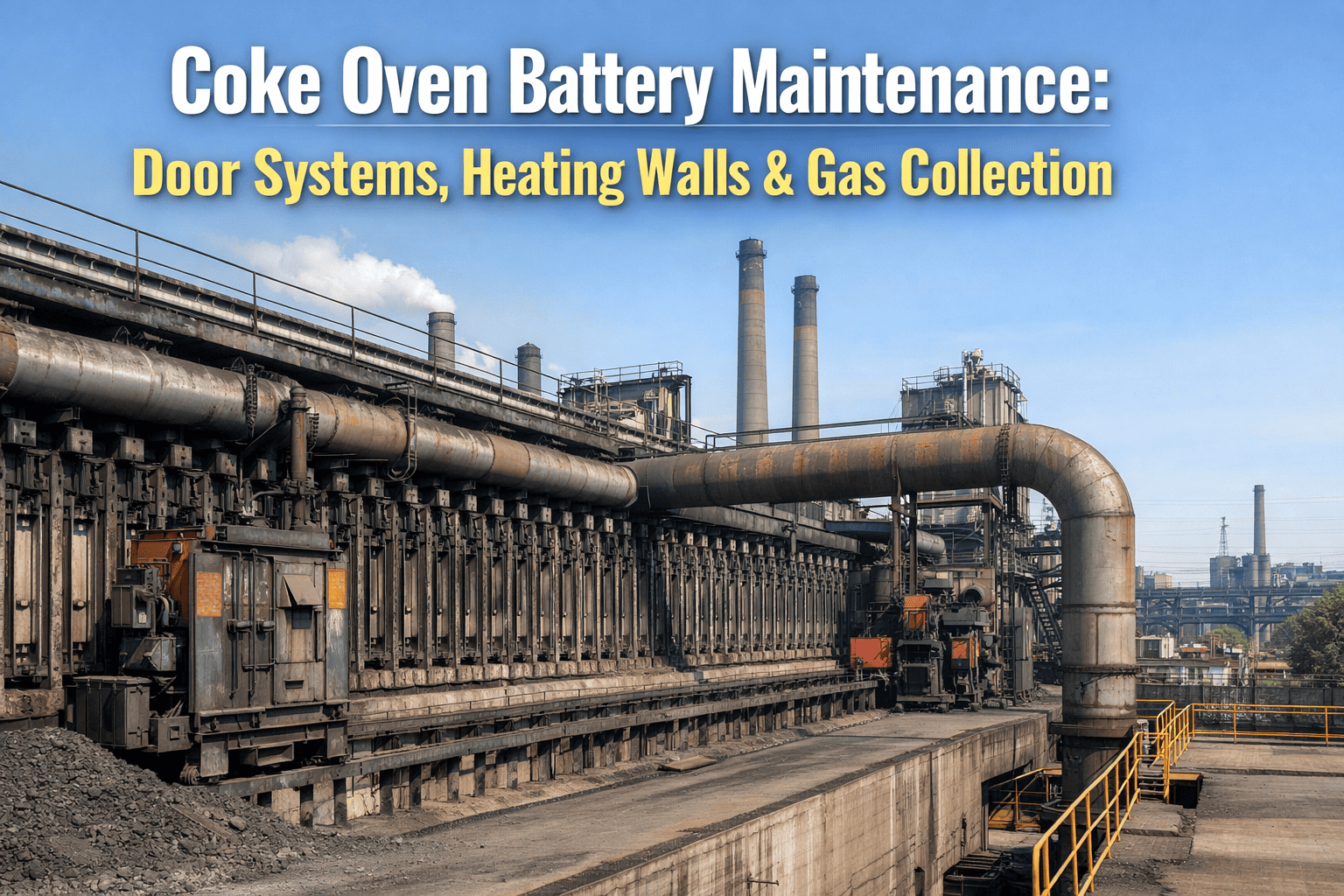
Maintain door seals, heating walls, ascension pipes, and pushing systems to reduce fugitive emissions, optimize coking cycles, and extend battery life — complete guide for coke plant maintenance engineers.
80%Reduction in fugitive door emissions with structured door sealing and jam cleaning program
2-5 kg/hrCOG leakage per leaking door — annual gas value loss $4,000–$10,000 per door
30 minTarget door sealing and jam cleaning time per oven — tracked and logged in CMMS
$4.2MPotential EPA penalty for fugitive emissions violations (per battery, per year)
How Coke Oven Maintenance Fails — The 6-Stage Coke Battery Degradation Chain
Coke oven battery degradation rarely starts with a catastrophic event. It begins with missed door sealing, delayed ascension pipe cleaning, or ignored heating wall temperature excursions. The degradation chain below shows the six stages from inadequate maintenance through to battery life reduction and environmental violations. Understanding each stage helps coke plant teams identify the specific controls that break the chain — scheduled door sealing, ascension pipe cleaning cycles, pushing system wear tracking, and oven heating wall inspection. OxMaint's coke oven module interrupts the chain at Stages 2, 3, and 4 — where most coke plants currently have no automated controls.
Coke Battery Degradation Chain — 6 Stages from Missed Maintenance to Battery Collapse
1
Inadequate Door Maintenance
Missed jam cleaning, delayed seal replacement, worn door frames
Leak Initiation
2
Fugitive Emissions
COG leaks at doors — visible smoke, EPA violations, lost gas value
Environmental
→
3
Ascension Pipe Blockage
Tar deposition, ammonia line failure, pressure buildup
Process
→
4
Pushing System Wear
Ram wear, guide misalignment, coke sticking
Mechanical
→
5
Oven Heating Wall Damage
Spalling, cracking, flue blockage
Structural
→
6
Battery Life Reduction
Premature reline, production loss, capital cost
Cost
The 6 Critical Coke Oven Maintenance Systems — Door, Ascension, Pushing, Heating
Coke oven battery reliability requires six integrated maintenance systems, each addressing a different failure mode. Door sealing prevents fugitive emissions. Ascension pipe cleaning maintains gas flow. Pushing system maintenance ensures reliable coke discharge. Heating wall inspections preserve battery life. OxMaint's coke oven module addresses all six — with scheduled work orders, condition tracking, and emission monitoring integration.
Door Sealing System
Critical
Door jam cleaning, seal replacement schedule, frame welding repair, spring adjustment. Each door requires jam cleaning every 30-60 pushes, seal replacement every 12-18 months.
Best practice: OxMaint tracks door cleaning frequency per oven, auto-schedules seal replacement based on hours or emissions trend.
Ascension Pipe System
Critical
Ammonia flushing, steam cleaning, tar removal, gas collecting main cleaning. Blocked ascension pipe causes pressure buildup and gas leakage at door.
Best practice: OxMaint schedules ammonia flush cycles, tracks pressure drop across each ascension pipe, flags blockages for immediate cleaning.
Pushing System
Mechanical
Pusher ram wear measurement, ram head replacement, coke guide shoe adjustment, coke car rail alignment. Worn ram head causes coke sticking and jammed pushes.
Best practice: OxMaint tracks pusher ram pushes, auto-schedules ram head inspection at specified intervals, logs wear measurements.
Oven Heating System
Structural
Flue temperature monitoring, oven pressure control, heating wall inspection. Uneven heating causes wall spalling and reduces battery life by 5-10 years.
Best practice: OxMaint tracks flue temperatures per oven, generates alerts when temperature deviates from target curve by >15°C.
Emission Monitoring
Compliance
Door leak detection (visual/IR), ascension pipe pressure monitoring, collecting main temperature tracking. Leaking doors must be logged and repaired within EPA-specified timeframes.
Best practice: OxMaint logs emissions observations, tracks leak duration, triggers repair work order before EPA violation deadline.
Coke Quenching
Operations
Quenching car maintenance, water system cleaning, coke wharf inspections. Poor quenching causes coke quality issues and increased emissions at wharf.
Best practice: OxMaint tracks quenching car cycles, schedules car rail and discharge door inspections at defined intervals.
Coke Oven Battery Maturity — Where Does Your Plant Stand?
Coke oven maintenance maturity exists on a spectrum from reactive emergency repairs to a fully predictive system with door emission tracking, ascension pipe pressure monitoring, and pushing system wear trending. The scoring framework below lets coke plant engineers assess their current posture — identifying the highest-priority gaps. OxMaint's coke oven module delivers Level 5 maturity by default — automated door cleaning schedules, ascension pipe blockage alerts, and pusher ram wear tracking.
Door cleaning scheduled by CMMS based on push count. Ascension pipe pressure monitored real-time. Pusher ram wear tracked. Flue temperatures trended for heating optimization. < 1% door emissions.
Profile: Meets EPA MACT standards. Battery life extended beyond design. No emissions-related fines.
4
Scheduled · Documented · Compliance Met
Door cleaning on calendar schedule. Ascension pipes flushed on time. EPA compliance achieved. Some pushing system wear tracking. < 5% door emissions.
Action: Add real-time pressure monitoring. Automate work order generation from conditions. Integrate emission observations into CMMS.
3
Occasional · Reactive · Compliance Risk
Door cleaning when visibly leaking. Ascension pipe cleaning only when blocked. Pushing system repaired after failure. 5-15% door emissions.
No formal maintenance schedule. Doors leak visibly. Ascension pipes block frequently. Pusher ram failures cause unplanned downtime. 15-30% door emissions.
Risk: EPA violation fines likely ($1M+ annually). Battery life significantly reduced. Immediate maintenance program required.
1
Critical — Near Operational Failure
No maintenance program. Multiple leaking doors. Frequent ascension pipe blockages. Pusher ram failures weekly. >30% door emissions.
Risk: EPA enforcement action likely. Battery life less than 50% of design. Emergency maintenance overhaul required.
Technology: Door Sealing Tracking, Ascension Pipe Monitoring, CMMS Integration
Modern coke oven battery maintenance is built on three technology layers — door sealing tracking for fugitive emission control, ascension pipe monitoring for gas flow management, and CMMS integration for work order scheduling. OxMaint's coke oven module connects all three layers — generating door cleaning tasks based on push count, receiving ascension pipe pressure data, and triggering work orders when conditions exceed thresholds.
Door Sealing Tracking
Push-Count Based
Auto-schedules jam cleaning at specified push intervals
Each oven door requires jam cleaning every 30-60 pushes. OxMaint tracks pushes per oven, auto-generates cleaning work order when interval reached. Technician logs completion with QR scan of door tag.
Ascension Pipe Monitoring
Pressure & Temperature
Real-time monitoring detects blockages before failure
OxMaint integrates with ascension pipe pressure and temperature sensors. Pressure drop or temperature deviation triggers cleaning work order. Prevents gas leakage and door emissions from pressure buildup.
Pusher Ram Wear Tracking
Condition Monitoring
Ram wear measurements logged and trended
OxMaint tracks pusher ram pushes, schedules ram head measurement at defined intervals. Wear trend indicates when replacement needed before failure causes stuck coke and extended downtime.
Emission Observation Log
EPA Compliance
Door leak observations logged with photo evidence
Technicians log door emissions observations during rounds. OxMaint tracks leak duration, auto-creates repair work order before EPA MACT compliance deadline (typically 24-72 hours). Photo evidence supports defense if cited.
"
We had 32 leaking doors on our 50-oven battery — visible smoke plumes at every push. Our EPA compliance officer was weeks from issuing a citation. After implementing OxMaint's door sealing tracking system, we established a push-count based jam cleaning schedule for every oven door. Each door now gets jam cleaning every 45 pushes. Leaking doors are logged immediately, and repair work orders are auto-created. Within 6 months, we reduced visible emissions from 32 doors to 3. Our annual gas loss from door leaks dropped from $180,000 to under $20,000. The EPA citation never came. Instead, our consent decree compliance audit passed with no violations — the first time in 8 years.
Coke Plant Manager · Integrated Steel Mill, 50-Oven Battery, USA
Every 30-60 pushes depending on oven age and coal moisture. Newer batteries with automated door cleaning can extend to 60 pushes. Older batteries with worn door frames may require cleaning every 30 pushes. OxMaint tracks pushes per oven and auto-generates cleaning work orders at the configured interval — no missed cleanings, no emission violations from overdue jam cleaning.
What causes ascension pipe blockages and how are they prevented?
Tar deposition from raw COG cools and solidifies in the ascension pipe. Ammonia flushing every 2-4 hours (at each push) dissolves tar before it accumulates. Steam flushing weekly removes stubborn deposits. OxMaint tracks flush frequency per oven, monitors pipe pressure drop, and alerts when pressure increases indicates blockage forming. Book a demo to see ascension pipe monitoring.
How does OxMaint track EPA compliance for fugitive emissions?
OxMaint logs each door leak observation with timestamp, severity, photo evidence, and technician ID. The system tracks leak duration and auto-creates repair work order before EPA MACT compliance deadline (typically 24 hours for major leaks, 72 hours for minor). Complete leak history exportable for EPA audit or citation defense. Plants using OxMaint report 80% reduction in emissions-related citations.
How often should pusher ram head be measured and replaced?
Ram head wear measurement every 5,000-10,000 pushes. Replacement typically at 25,000-40,000 pushes depending on coal type and ram design. OxMaint tracks pushes per ram, schedules wear measurement at defined intervals, logs measurement results, and forecasts remaining life based on wear rate trend. Prevents ram failure that would stop battery production for 8-12 hours.
How does heating wall condition affect battery life?
Heating wall spalling and cracking are irreversible. Once a wall is damaged, battery life is reduced by 5-15 years. Prevention is critical: maintain stable flue temperatures (±15°C per oven), control oven pressure (slightly negative), and avoid rapid heating/cooling. OxMaint tracks flue temperatures per oven, generates alerts for temperature deviations, and logs oven pressure readings. Early detection of heating anomalies allows correction before wall damage occurs.
What is the ROI of a structured coke oven maintenance program?
A 50-oven battery typically achieves $1.5M–$4M annual savings through: reduced gas loss from door leaks ($200K–$500K), eliminated EPA fines ($500K–$2M), reduced pushing system downtime ($300K–$800K), extended battery life (delayed reline cost $500K–$1M per year of extension). OxMaint's coke oven module typically pays for itself in 2-4 months through reduced gas loss alone. Start a free trial to calculate your battery's potential savings.
Reduce Fugitive Emissions. Extend Battery Life. Avoid EPA Fines.
OxMaint's coke oven maintenance module tracks door sealing schedules (push-count based), ascension pipe cleaning cycles, pusher ram wear, and emission observations — with work orders auto-generated from condition data. Free to start.