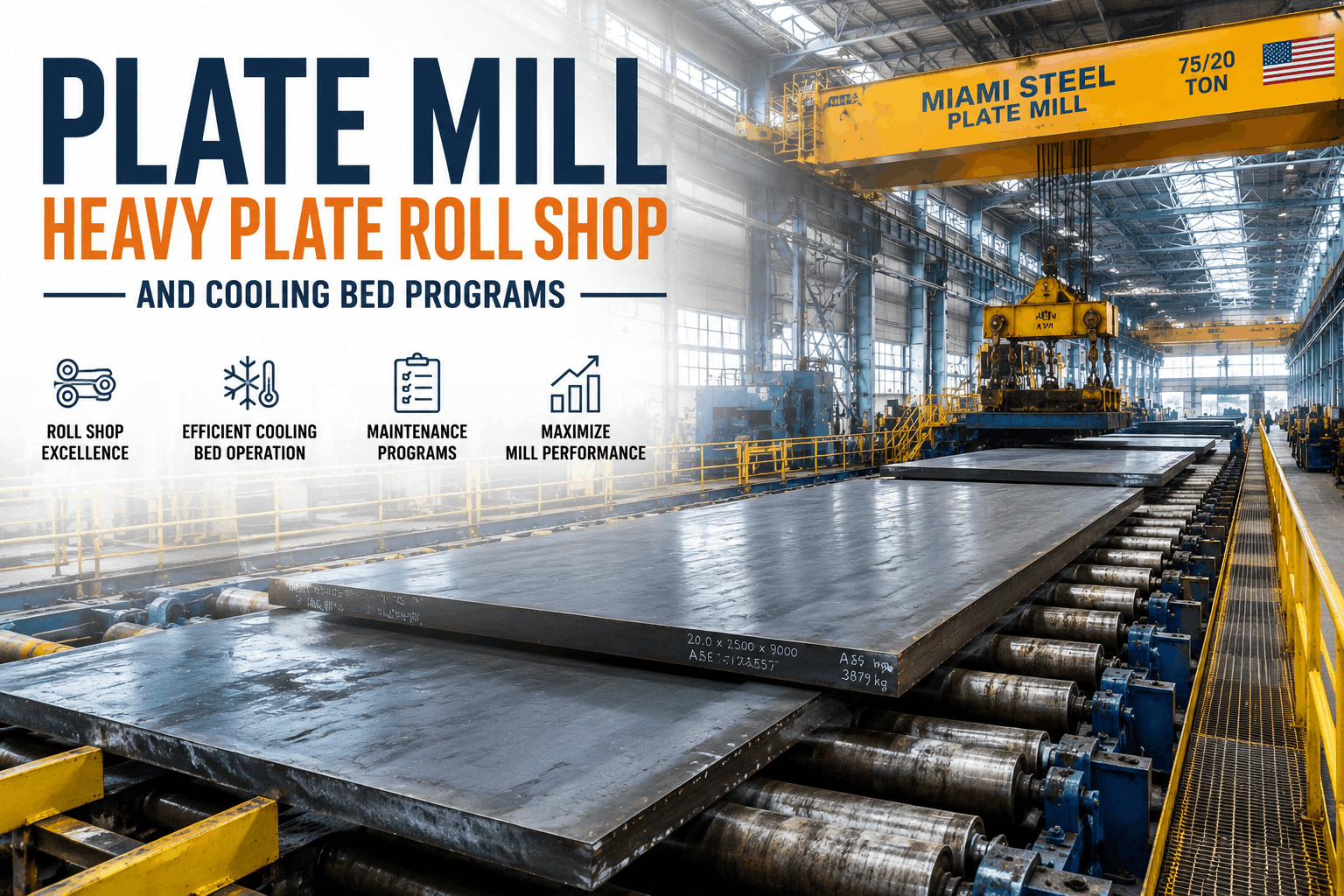
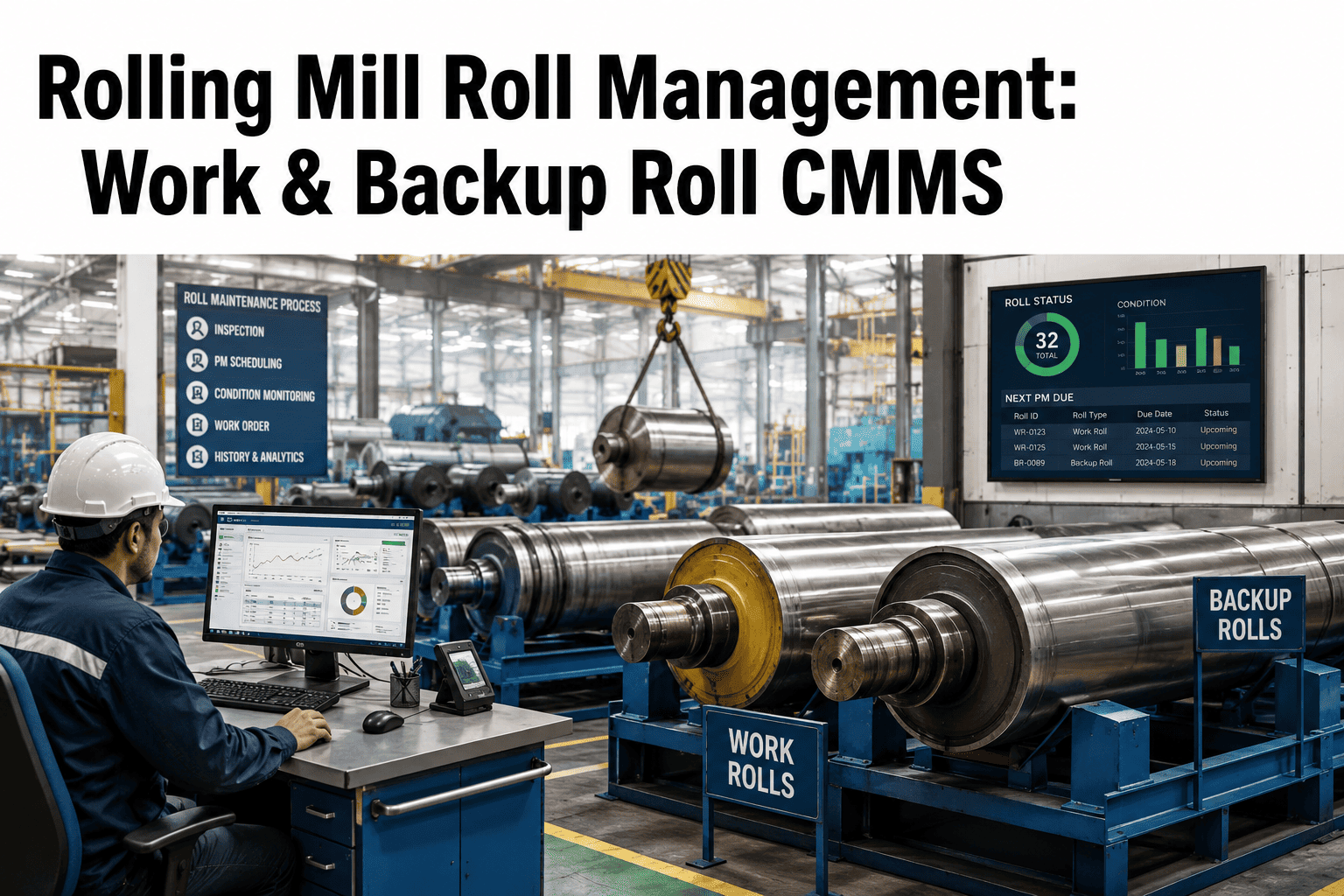
Plate Mill Heavy Plate Roll Shop and Cooling Bed Programs
By Alex Jordan on June 4, 2026
Heavy plate mills operating at 4,000–10,000 tons per month face a fundamental constraint: roll shop capacity and cooling bed throughput determine mill availability. A roll shop with insufficient grinding capacity creates a backlog that idles the mill while plates wait for work rolls. A cooling bed with inadequate plate handling capacity creates a bottleneck that stops the rolling mill when finished plates back up before shearing. World-class plate mills have reduced roll consumption by 25–35%, extended roll life by 40%, and eliminated cooling bed bottlenecks through structured roll shop and cooling bed management programs. Start a free trial or book a demo to see how CMMS-tracked roll shop and cooling bed programs work across your plate mill.
HEAVY PLATE MILL · ROLL SHOP · COOLING BED · MILL AVAILABILITY
Plate Mill Heavy Plate Roll Shop and Cooling Bed Programs
Optimize plate mill performance with roll shop management (grinding schedules, roll life tracking, chrome plating) and cooling bed maintenance (finger alignment, chain drives, walking beam operation) — complete guide for plate mill engineers.
25–35%Roll consumption reduction with structured roll shop management programs
40%Roll life extension with optimized grinding schedules
15–20%Mill availability improvement by eliminating cooling bed bottlenecks
$250KAnnual roll cost saving per heavy plate mill with optimized roll shop
Why Roll Shop and Cooling Bed Management Is a Different Discipline
Roll shop management shares almost nothing operationally with the rolling mill itself — despite both being part of the plate mill. The roll shop has different constraints (grinding capacity, roll inventory, chrome plating turnaround), different failure modes (grinding burn, roll surface fatigue, chock wear), and different productivity metrics (rolls ground per shift, roll life by application). Cooling bed management also operates on different constraints (plate handling rate, finger alignment, chain tension). A mill engineer who transfers rolling mill practices to the roll shop or cooling bed without adaptation will systematically underperform on every metric — higher roll consumption from incorrect grinding increments, shorter roll life from improper texturing, and cooling bed jams that stop the mill. The disciplines that separate high-performing plate mills from average ones are specific and learnable — and they are all data-driven.
Roll Shop vs. Cooling Bed — Critical Differences in Plate Mill Operations
Operational Factor
Roll Shop Management
Cooling Bed Management
Primary constraint
Grinding capacity, roll inventory
Plate handling rate, finger alignment
Failure mode
Grinding burn, surface fatigue
Finger binding, chain breakage
Key maintenance KPI
Rolls ground per shift, roll life
Plates per hour, jam frequency
Lead time impact
Roll prep time before mill startup
Plate cooling before shearing
Quality impact
Roll surface condition, texturing
Plate flatness, surface scratches
Roll Shop Management: Recalibrating Grinding Programs for Roll Life
The single most impactful change a plate mill can make to their roll shop program is switching from fixed grinding increments to condition-based grinding depth based on wear measurement. A work roll in a heavy plate mill accumulates different wear patterns depending on plate width, rolling force, and pass schedule — fixed grinding increments either remove too much material (wasting roll life) or too little (allowing subsurface fatigue to propagate). The result: rolls replaced too early at 2,500 tons of grinding capacity vs. 3,800 tons achievable with optimized incremental grinding. Oxmaint's roll shop module tracks wear per roll, grinding depth, and remaining life — so your rolls get ground when wear actually requires it, not on a fixed schedule.
Work Roll Life — Fixed Grinding vs. Condition-Based Grinding
Work Roll Life (tons)
Fixed grinding (1.0 mm/pass)
2,500 tons
Condition-based (0.4–1.0 mm)
3,800 tons
Backup Roll Life (tons)
Fixed grinding (0.8 mm/pass)
8,000 tons
Condition-based (0.3–0.8 mm)
13,500 tons
Roll Texturing Life
No Chrome Plating
1,500 tons
With Chrome Plating
4,000 tons
Condition-based grinding extends roll life by 30–50% — each additional 1,000 tons of roll life saves $15,000–$25,000 in roll consumption
Cooling Bed Throughput: The Primary Mill Availability Lever
Cooling bed throughput — the number of plates that can be cooled and transferred to the shear line per hour — is the single most powerful availability lever in plate mill operations. A cooling bed optimized with properly aligned fingers, tensioned chains, and adequate plate spacing handles 45–55 plates per hour without bottlenecking the rolling mill. The opposite — misaligned fingers causing plate jams, worn chains causing indexing errors — reduces throughput to 25–35 plates per hour, forcing the rolling mill to wait or slow down. In practice, the difference between an optimized cooling bed and a worn one is 15–20 plates per hour — generating 3–4 additional rolling hours per shift.
Cooling Bed Throughput — Plates per Hour at Different Maintenance States
Poor / Frequent Jams
Throughput: 25–35 plates/hr
Jam frequency8–12 per shift
Mill idle time45–60 min/shift
Annual loss$1.2–1.8M
Partial / Standard Condition
Throughput: 35–45 plates/hr
Jam frequency3–5 per shift
Mill idle time20–30 min/shift
Annual loss$500–800K
Optimized / Good Condition
Throughput: 45–55 plates/hr
Jam frequency<1 per shift
Mill idle time<5 min/shift
Annual loss$100–200K
Optimized cooling bed increases annual mill throughput by 8,000–12,000 tons — each additional ton contributes $250–400 in gross margin
Roll Shop and Cooling Bed Components — Matching Maintenance to Duty Cycle
Heavy plate mill roll shops and cooling beds are chronically mis-maintained for their actual duty cycles. The default maintenance approach — calendar-based inspections — ignores the operational reality that roll grinding demand varies with plate mix and cooling bed wear varies with plate temperature. A roll shop that manages grinding increments by actual wear extends roll life by 30–40%. A cooling bed that aligns fingers and tensions chains weekly eliminates 90% of plate jams.
Roll Shop and Cooling Bed Component Maintenance Guide
Work Rolls
Grinding increment: 0.3–1.0 mm
Best for: Condition-based grinding depth, chrome plating for texturing, hardness profile measurement
Typical life3,500–5,000 tons
Grinds/campaign8–12
Most Common
Backup Rolls
Grinding increment: 0.3–0.8 mm
Best for: Condition-based grinding, crown profile control, roll texturing for surface finish
Typical life12,000–18,000 tons
Rolls/set2–4 per stand
Cooling Bed Fingers
Inspection: weekly alignment
Best for: Finger straightness, pad condition, binding clearance, chain tension
Jam reduction90%
Inspection freqWeekly
Cooling Bed Chain Drive
Lubrication: daily
Best for: Chain tension, sprocket wear, lubrication scheduling, alignment check
Chain life3–5 years
Breakage riskModerate
"
Our roll shop was grinding work rolls at 1.0 mm per pass regardless of wear — consuming 40 work rolls per year at $18,000 each. After implementing Oxmaint's condition-based roll shop tracking, we reduced average grinding depth to 0.5 mm by measuring wear after each campaign. Roll consumption dropped from 40 to 28 rolls per year — $216,000 annual saving. The cooling bed was jamming 8–10 times per shift. After implementing weekly finger alignment checks and chain tensioning, jams dropped to 1–2 per week. Mill availability increased from 74% to 88% — adding 12,000 tons of annual production capacity without capital investment.
Plate Mill Manager — Heavy Plate Mill, 120,000 tons/year, Midwest USA
CMMS Configuration for Plate Mill Roll Shop and Cooling Bed
A CMMS deployed on a plate mill without configuration for roll shop and cooling bed tracking will generate maintenance work orders at the wrong frequencies, flag roll changes too early or too late, and miss cooling bed alignment issues until jams occur. Correct CMMS configuration for plate mill roll shop and cooling bed requires four changes from standard setup: roll life tracking by tons ground, condition-based grinding increment triggers, cooling bed finger alignment inspection schedules, and chain drive lubrication and tension monitoring.
Oxmaint CMMS — Plate Mill Roll Shop and Cooling Bed Configuration
01
Roll Life Tracking by Tons
Work roll and backup roll life tracked by tons rolled — triggers regrind or replacement based on actual wear, not calendar days.
Extends roll life 30-40%
02
Condition-Based Grinding Increment
Grinding depth determined by wear measurement after each campaign — light grinding for minor wear (0.3 mm), heavy for spalling (1.0 mm).
Optimizes roll consumption
03
Cooling Bed Finger Alignment
Weekly finger straightness and pad condition inspection — misalignment triggers immediate realignment to prevent plate jams.
Eliminates 90% of jams
04
Chain Drive Lubrication Schedule
Daily lubrication, weekly tension check, quarterly wear measurement — prevents unexpected chain breakage that stops the bed for 4-8 hours.
Prevents catastrophic failure
05
Plate Jam Tracking
Each jam logged with cause (finger misalignment, chain slip, plate warp) — recurring causes trigger preventive maintenance work orders.
Data-driven improvements
Key Performance Metrics for Plate Mill Roll Shop and Cooling Bed
Roll Consumption
Primary roll shop KPI — kg of roll metal consumed per ton of plate rolled
Target: 0.8–1.2 kg/ton. Gap between top and bottom quartile = $0.50–1.20/ton saving.
Roll Life (tons)
Average tons per work roll between regrinds
Target: 3,500–5,000 tons. Condition-based grinding achieves 30-50% longer life than fixed increments.
Cooling Bed Throughput
Plates cooled and transferred per hour
Target: 45–55 plates/hr. Sub-35 plates/hr indicates alignment or drive issues.
Jam Frequency
Number of cooling bed plate jams per shift
Target: <1 per shift. Each jam costs 5-15 minutes of mill downtime.
Frequently Asked Questions
How do I determine the optimal grinding increment for plate mill work rolls?
Measure roll wear (crown loss, surface condition, spalling depth) after each campaign. Light wear (0.1–0.3 mm) requires 0.3–0.5 mm grinding. Heavy wear or spalling requires 0.8–1.0 mm. Oxmaint tracks wear per roll and recommends grinding depth based on measured condition — no guesswork. Start a free trial to optimize your roll grinding program.
How does chrome plating extend work roll life in plate mills?
Chrome plating (0.05–0.1 mm thickness) provides a hard, wear-resistant surface that reduces roll consumption by 40–60% and improves plate surface finish. Plating also prevents roll texturing loss during grinding. Typical plating cycle: 6–12 months depending on rolling schedule. Oxmaint tracks plating history and schedules replating based on wear rate. Book a demo to see roll life tracking.
What causes cooling bed plate jams and how are they prevented?
Three primary causes: finger misalignment (80% of jams), chain tension loss (15%), and plate warpage (5%). Prevention: weekly finger straightness inspection, daily chain tension check, and cooling water uniformity across bed width. Oxmaint schedules all three inspections, tracks jam frequency by cause, and triggers corrective work orders when jam rate exceeds threshold.
How many work rolls are needed in a heavy plate mill roll shop inventory?
Minimum inventory: 2 full sets per stand (8 work rolls for 4-high mill) plus 1-2 spares per size. Grinding capacity should match consumption rate — typical heavy plate mill requires 3–4 work roll grinds per week. Oxmaint tracks inventory turns and alerts when stock falls below minimum required for continuous operation.
Reduce Roll Consumption. Eliminate Cooling Bed Bottlenecks. Increase Mill Availability.
Oxmaint's plate mill roll shop and cooling bed module combines roll life tracking, condition-based grinding, cooling bed finger alignment, chain drive monitoring, and jam tracking — giving plate mills the operational data to reduce roll consumption by 25–35%, increase mill availability by 15–20%, and add thousands of tons of annual production capacity.