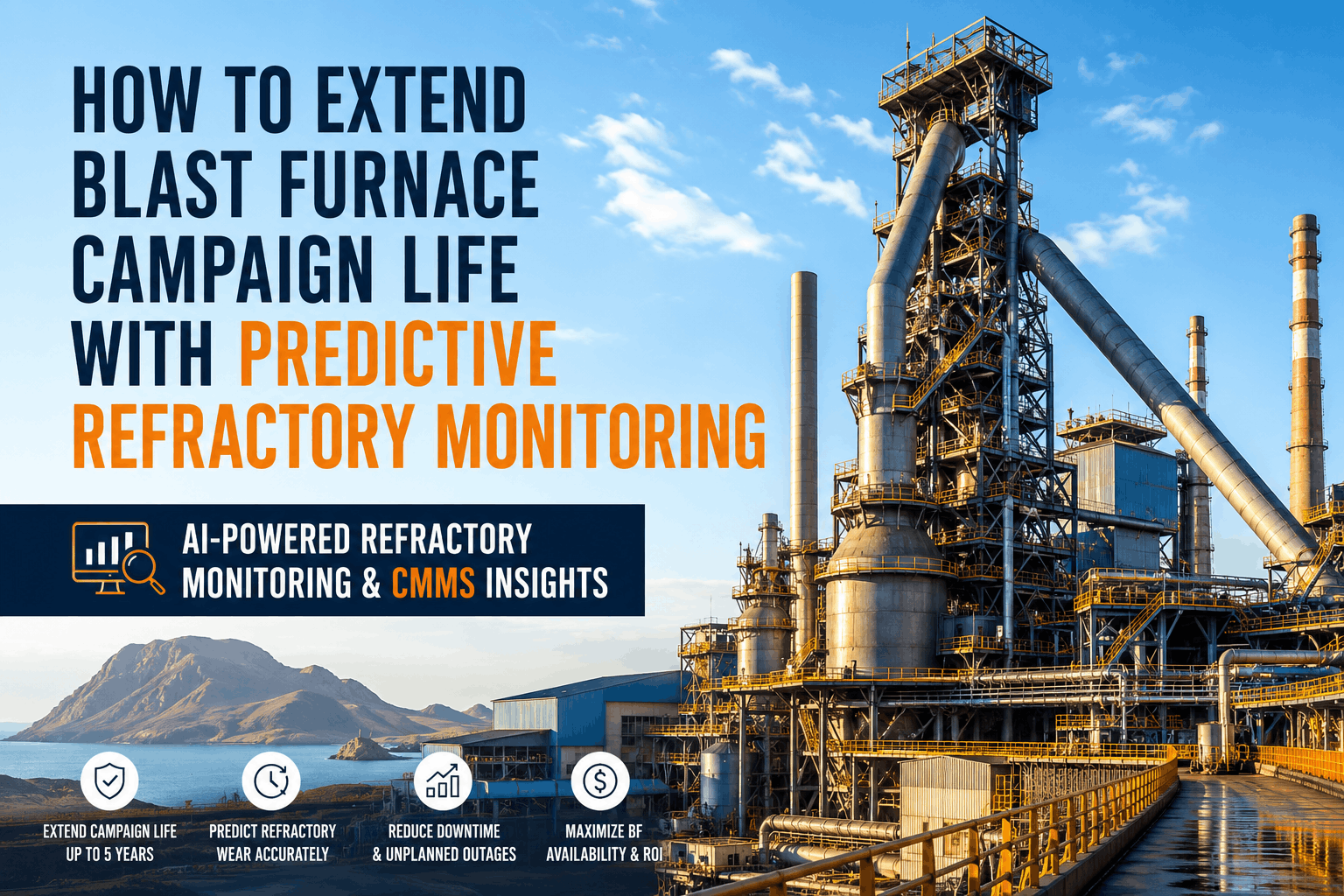
Every blast furnace shutdown that was not planned costs between $800,000 and $1.2M per day. Most of those shutdowns were predictable — preceded by weeks of thermal data no one trended, cooling water chemistry no one flagged, and tuyere temperatures no one tracked per unit. The difference between a 10-year campaign and a 15-year campaign is not the quality of the reline. It is the quality of daily maintenance decisions made on evidence, not instinct. Build that evidence base with Oxmaint — start free today.
Blast Furnace Maintenance Management: Complete CMMS Guide for Steel Plants
A practical guide for maintenance heads and plant managers on structuring a data-driven BF maintenance program — covering refractory monitoring, stave cooling, tuyere lifecycle, hot blast stoves, and campaign planning using CMMS software.
Why Blast Furnace Maintenance Programs Fail
A blast furnace is not a simple piece of equipment with a straightforward maintenance schedule. It is a continuously operating high-temperature reactor running at 2,000C internally, under positive gas pressure, processing thousands of tonnes of burden per day — one that cannot be stopped for non-emergency work without triggering a campaign restart costing millions in refractory preparation and heat-up time.
This operational reality makes blast furnace maintenance fundamentally different from every other industrial asset class. Maintenance work must be planned around a running furnace, executed in high-temperature environments, and coordinated across multiple concurrent systems: cooling circuits under thermal stress, tuyeres approaching the end of their individual service lives, refractory wearing at rates that vary zone by zone, and gas cleaning equipment operating under regulatory compliance requirements.
The result: most blast furnace plants manage maintenance reactively, not predictively. Inspections happen on fixed calendar schedules rather than condition-based triggers. Data from those inspections — stave outlet temperatures, tuyere cooling performance, chemistry readings — is recorded in shift binders and never trended. Warning signals accumulate unchallenged until they become failures. Oxmaint makes every data point visible, trended, and actionable without adding administrative overhead to your maintenance team.
We had 14 emergency tuyere replacements in one campaign. After deploying Oxmaint and tracking per-unit outlet temperatures, we had 3. The data was always available — we just had not been capturing it systematically.
— Maintenance Head, Integrated Steel Plant, Germany85% of cooling circuit failures show detectable early warning signals 30-60 days before failure. The gap is not technical — it is data infrastructure. Plants that capture and trend daily readings catch the signal. Plants that log to binders do not.
Start capturing BF data freeThe Five Maintenance Domains Every BF Program Must Cover
A complete blast furnace maintenance program operates across five parallel domains — each with its own inspection frequency, failure modes, and data requirements. Oxmaint manages all five simultaneously from a single platform, with cross-domain visibility and automated scheduling.
The cooling system is the primary life-extension mechanism for campaign duration. With 40+ individual stave circuits, each requiring shift-level temperature differential monitoring and daily water chemistry management, the data volume alone exceeds what any manual system can reliably track. Scale accumulation in circuits is the leading cause of premature stave burnout — detectable weeks ahead with proper trending.
Managing 20-40 tuyeres as individual asset records — each with its own installation date, service hours, cooling performance history, and failure mode classification — is the difference between planned and emergency replacements. Per-unit outlet temperature trending identifies failing units 7-14 days ahead. Spare parts inventory integration prevents the critical gap where a planned replacement is blocked by missing stock with 8-12 week lead times.
Refractory wear is the fundamental limit on campaign life. Shell temperature monitoring across 200+ zones provides the continuous wear-rate data that informs campaign extension decisions. Emergency reline events cost 4-8x more than planned relines — and are almost always preceded by weeks of thermal data that were recorded but never acted on.
Hot blast stoves cycle between combustion and blast modes thousands of times per campaign at temperatures up to 1,450C dome temperature. A failed stove valve on a 3-stove configuration cuts blast capacity by 33% — directly reducing furnace output. Stove maintenance must coordinate with blast scheduling, adding a planning dimension most CMMS systems cannot handle without work order sequencing.
The gas cleaning plant is a major hazard installation in most regulatory frameworks — maintenance records here are legal compliance documents, not operational notes. Gaps in CO detector calibration history, bleeder valve test records, or scrubber inspection logs constitute regulatory violations. Calibration expiry tracking and 30-day advance alerts are not optional features: they are the difference between a compliant operation and a reportable incident.
What Changes When You Replace Paper Logs with CMMS
The maintenance tasks are identical. The inspection intervals are the same. What changes is what happens to the data after it is collected — and whether it drives action or disappears into a binder.
Most blast furnace plants already have the inspection data they need to predict failures — they just are not capturing it in a system that surfaces the signal. Sign up free and start building your BF condition database in Oxmaint today.
Deploying CMMS for Blast Furnace Maintenance: 5-Step Path
The most common reason CMMS deployments stall in steel plants is over-scoping at the start. Oxmaint is built for fast deployment — most BF teams are running digital inspections within 48 hours of account setup. Start with what matters most, then expand.
Build the Asset Register
Register every monitored asset as an individual record: each stave circuit with its zone identifier, each tuyere position with its location code, each gas plant component with its maintenance classification. Include equipment criticality ratings — A (safety critical), B (production critical), C (standard) — so Oxmaint applies the right inspection priority automatically.
Configure PM Inspection Templates
Build digital forms for each inspection type — shift cooling check, tuyere daily monitoring, weekly thermal survey, monthly gas plant compliance inspection. Use your existing paper forms as the starting point. Add numeric threshold fields for all measured values — this is what enables automated alerting.
Activate Automated Scheduling
Set task creation frequencies — shift, daily, weekly, monthly, campaign. Assign each task type to the responsible role. Oxmaint creates and routes work orders automatically — no coordinator overhead required to issue daily task lists.
Configure Threshold Alerts and Escalations
For each numeric field, set alert limits: stave delta-T above 15C from baseline, CO detector in bypass without authorisation, tuyere outlet above 55C sustained, chemistry pH outside 7.5-9.0. Configure tiered escalation paths so safety-critical deviations route to the safety officer, operational items to the shift supervisor.
Build Campaign Planning from Inspection Data
After 4-8 weeks of consistent data collection, you have a baseline. Shell temperature trends reveal wear rate by zone. Per-tuyere temperature trends reveal position-specific service life patterns. Chemistry trending shows seasonal scale risk variation. This dataset becomes your campaign planning foundation — replacing calendar-based estimates with measurement-based forecasting for reline timing, tuyere replacement scheduling, and cooling system outage planning. Book a demo to see campaign planning in Oxmaint.
Oxmaint Capabilities Built for Blast Furnace Operations
Oxmaint is used by steel plant maintenance teams to manage inspection programs across entire ironmaking complexes — multiple furnaces, shared gas cleaning infrastructure, and campaign-scale reline planning — from a single platform accessible on any device.
Condition-Based PM Triggers
Configure tasks to trigger on runtime hours, shift count, or calendar — whichever fires first. High-load tuyere positions receive more frequent inspection than low-load zones without manual adjustment. Stave circuits with elevated historical delta-T scheduled at tighter intervals automatically.
Mobile Inspection on Any Device
Operators complete BF inspections on smartphone or tablet with numeric entry, photo capture, and pass/fail logic. Offline capability ensures data capture in areas without connectivity inside the furnace building, gas plant, or stove complex.
Real-Time Threshold Escalation
Every numeric inspection field has a configurable alert limit. When a reading breaches threshold, Oxmaint routes instant escalation to the designated responsible person — not a daily report that reaches the supervisor tomorrow morning.
Spare Parts Inventory Control
Tuyere stock, cooling components, refractory repair materials — tracked with minimum levels and automatic reorder triggers. When a replacement is scheduled, Oxmaint verifies inventory availability before issuing the work order.
Regulatory Audit Trail
Every inspection generates a timestamped, photo-verified record against a named person. Gas safety calibration certificates stored against the asset. PDF compliance reports generated on demand — no manual compilation before a regulatory inspection.
24/7 Shift Continuity
Incomplete tasks from an ending shift are visible to the incoming shift instantly on login. Threshold breaches and overdue inspections from the previous shift appear in the incoming supervisor dashboard — eliminating gaps that turn deferred problems into overnight emergencies.
Start Building the Maintenance Program That Extends Your Next Campaign
Most blast furnace teams are running digital inspections within 48 hours of Oxmaint account setup — no IT project, no integration requirement, no hardware. Build your BF asset register free today and have your first per-circuit temperature trends inside a week.