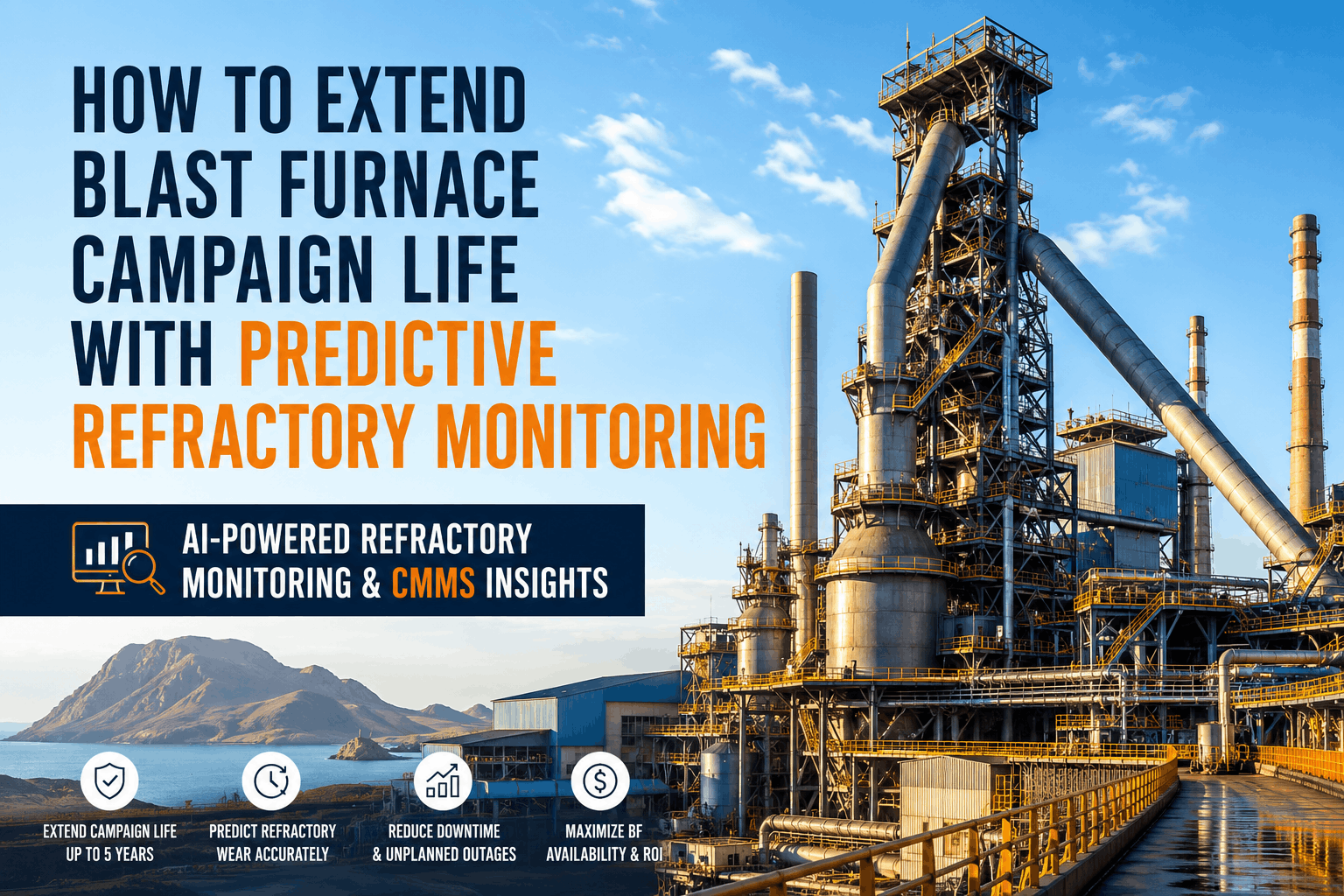
Blast Furnace Maintenance Management System for Steel Plants
By John Mark on February 24, 2026
A blast furnace doesn't break down the way other equipment breaks down. It doesn't stop running one Tuesday afternoon because a bearing seized. It degrades — silently, invisibly, across hundreds of components simultaneously — until a tuyere burns through and fills the casthouse with molten iron spray, or a stave cooling circuit fails and the shell reaches 600°C in a zone designed for 180°C, or the refractory lining wears to 40mm in a spot nobody measured because the last inspection accessed only 12% of the hearth surface. A blast furnace campaign runs 15–20 years between major relines. During that campaign, the furnace operates 24 hours a day, 365 days a year, at internal temperatures exceeding 2,200°C, pressures up to 5 bar, with molten iron at 1,500°C and liquid slag at 1,550°C pooling against a hearth lining that is simultaneously being eroded chemically, abraded mechanically, and attacked thermally — every hour of every day for two decades. The maintenance challenge isn't fixing things when they break. It's knowing — with precision, with data, with confidence — which of the furnace's 3,000+ monitored parameters are trending toward failure, how fast they're moving, and exactly when intervention is required to prevent a $20–$80 million unplanned reline, a $2–$15 million breakout event, or a safety incident that ends a career or a life. A blast furnace maintenance management system built on CMMS integrates predictive monitoring, asset lifecycle management, and safety-critical maintenance into a single platform where every thermocouple reading, every cooling water flow rate, every refractory thickness measurement, and every stave condition assessment feeds a unified model of furnace health — and that model generates the work orders, the PM schedules, the parts procurement, and the shutdown planning that keeps a $500 million asset producing 8,000–12,000 tonnes of hot metal per day for the full duration of its campaign.
Blast Furnace Maintenance Zones — From Throat to Hearth
Zone 1
Throat & Charging System
Bell/bell-less top, distribution chute, gas offtake, stock rods, armor plates
Chute wear, gas seal failure, burden distribution deviation, armor erosion
PM: Chute wear measurement (monthly), gas seal inspection (weekly), armor plate thickness (quarterly)
Zone 2
Shaft & Cooling Staves
Copper/cast iron staves, shell thermocouples, refractory lining, gas probes
Stave cracking, cooling circuit blockage, refractory loss exposing shell, scaffold formation
PM: Stave cooling flow/ΔT (continuous), shell temperature mapping (daily), refractory probe (quarterly)
Hot blast stoves, gas cleaning plant, casthouse ventilation, granulation plant, cooling water systems
Stove dome cracking, gas cleaning failure (environmental), cooling tower degradation, water quality drift
PM: Stove dome inspection (annual), gas cleaning efficiency (daily), water chemistry (8-hourly)
3,200+
monitored parameters on a single blast furnace feeding predictive maintenance models
$20–80M
cost of an unplanned major reline — vs. $8–15M for a planned reline scheduled with data
15–20 yr
typical campaign life between major relines — every month of extension worth $3–5M in deferred capital
Zero
acceptable number of unplanned shutdowns caused by preventable maintenance failures
Predictive Maintenance: Reading the Furnace Before It Speaks
A blast furnace generates more real-time data than any other single asset in a steel plant — temperature at 200+ thermocouple positions, cooling water flow and temperature differential across 80+ circuits, blast pressure and volume, top gas composition, burden descent rate, tuyere condition, and shell temperature at hundreds of measurement points. Predictive maintenance converts this data stream into maintenance actions — identifying degradation trends weeks or months before they become failures.
Predictive Maintenance — Real-Time Furnace Health Indicators
Hearth Wall Temperature — Sector 7
Current: 412°C ↑ 18°C/month
Alarm: 450°C · Trip: 500°C
At current trend: reaches alarm in ~2.1 months
CMMS Action: Work order generated — increase cooling intensity Sector 7, adjust burden distribution to reduce thermal load on hearth wall, schedule hearth thermocouple calibration verification.
Stave Cooling ΔT — Bosh Row 3, Position 12
Current: ΔT 14.2°C ↑ from 8.6°C baseline
Warning: ΔT >12°C · Critical: ΔT >18°C
Indicates partial blockage or refractory loss exposing stave to increased thermal load
CMMS Action: PM generated — flush cooling circuit, inspect water quality, thermal imaging of corresponding shell section during next scheduled slowdown.
Tuyere Condition — All 32 Tuyeres
Status: 30 normal · 2 monitoring — Stable
Tuyere #14 and #28 show elevated nose temperature — within acceptable range
No replacement predicted within next 30 days at current trend
CMMS Action: Increased monitoring frequency on #14 and #28. Spare tuyeres confirmed in inventory. Replacement procedure pre-loaded for rapid execution if conditions change.
Asset Lifecycle Management: From First Campaign to Final Reline
A blast furnace campaign represents a $500M+ asset operating continuously for 15–20 years. Every component within the furnace has its own lifecycle — tuyeres lasting 6–18 months, stave cooling circuits degrading over 5–10 years, hearth refractory eroding millimeter by millimeter over the full campaign. Asset lifecycle management tracks every component's position on its degradation curve and projects when each will require intervention — so shutdowns are planned months in advance, not forced by failures.
Plan intermediate repair during next scheduled shutdown
Tuyeres (fleet of 32)
6–18 months each
2 nearing EOL
30 of 32 healthy
Replace #14 and #28 at next cast window (10 days)
Throat Armor Plates
3–5 years
88% worn
~8 months
Replacement ordered — scheduled for Q3 shutdown window
Hot Blast Stove Refractory
20–25 years
40% life
~14 years
Annual dome inspection per schedule — no early concern
Taphole Drill & Gun
2–4 years between overhauls
72% cycle
~10 months
Overhaul parts on order. Scheduled for next mid-campaign shutdown.
Every Component Tracked. Every Degradation Curve Modeled. Every Shutdown Planned — Not Forced.
OXmaint manages the full blast furnace asset lifecycle — from thermocouple trending to tuyere replacement scheduling to campaign-end reline planning. Every sensor reading flows into predictive models. Every threshold breach generates a work order. Every shutdown is planned months in advance with parts, contractors, and procedures pre-positioned.
Hearth Monitoring: The Campaign-Defining Measurement
The hearth is the campaign-limiting component of a blast furnace. When the hearth refractory erodes to its minimum safe thickness, the campaign ends — regardless of the condition of every other component. Hearth monitoring is therefore the single most important predictive maintenance function on the furnace. Every millimeter of hearth life preserved is worth millions in deferred reline capital. Operations managing hearth life should book a free demo to see how hearth thermocouple trending integrates with campaign planning.
Safety-Critical Systems: The Equipment That Cannot Fail
A blast furnace contains multiple systems whose failure doesn't just stop production — it creates immediate danger to human life. These systems receive S1 (Life Safety) classification in the CMMS, with zero-tolerance PM enforcement, automatic escalation, and equipment lockout when maintenance goes overdue. Operations strengthening safety-critical maintenance should sign up to see S1 safety enforcement on blast furnace equipment.
S1 Life-Safety Equipment — Blast Furnace
S1
Cooling Water Systems (All Circuits)
Loss of cooling → shell overheating → potential breakout of molten iron through shell. Water contacting molten iron → steam explosion (1,600× volume expansion).
BF gas contains 22–28% CO — lethal at 1,200 ppm. Gas system leaks or detection failures create invisible kill zones around the furnace, stoves, and gas cleaning plant.
PM: Fixed detector calibration (monthly), portable detector bump test (daily), gas main integrity check (quarterly), bleeder valve function test (weekly)
Overdue enforcement: Expired gas detector calibration → area access permit automatically revoked. No entry without functioning, current-calibration gas detection.
S1
Casthouse Safety Systems
Taphole operations expose personnel to splashing iron (1,500°C) and slag (1,550°C). Runner refractory failure, taphole breakout, or iron/slag overflow creates immediate burn hazard across the casthouse floor.
Overdue enforcement: Failed emergency divert gate test → immediate repair before next cast. No taphole opening until gate function confirmed.
S1
Pressure Relief & Explosion Venting
Blast furnace operates at 3–5 bar internal pressure. Relief valve or explosion vent failure during a pressure excursion can cause structural failure of the furnace top or gas cleaning equipment.
PM: Relief valve function test (quarterly), explosion vent inspection (semi-annual), pressure transmitter calibration (monthly), bleeder valve response test (weekly)
Overdue enforcement: Overdue relief valve test → furnace pressure limited to 80% of normal until test completed. Plant manager notification on missed schedule.
Shutdown Planning: Turning Data Into Downtime Strategy
Blast furnace shutdowns are the most complex, expensive, and time-sensitive maintenance events in steelmaking. A mid-campaign shutdown for intermediate repairs typically lasts 10–21 days and costs $3–8 million in direct maintenance plus $15–30 million in lost production. Every hour saved is worth $60,000–$120,000 in hot metal value.
CMMS aggregates all predictive findings — stave conditions, refractory thickness maps, tuyere replacement queue, equipment PMs due during the window — into a unified shutdown scope. Every work item traced to a sensor trend or lifecycle position, not a guess.
3 months before
Resource & Material Procurement
Bill of materials generated from shutdown scope. Long-lead items (copper staves, specialized refractory, replacement tuyere assemblies) ordered. Contractor crews booked. Scaffolding and access equipment scheduled. LOTO procedures pre-built for every task.
1 month before
Day-by-Day Execution Schedule
Every task scheduled by day, crew, and prerequisite dependency. Critical path identified. Contingency plans for scope additions. Daily progress milestones defined. Real-time progress tracking dashboard configured.
During shutdown
Live Execution & Progress Tracking
Every work order tracked in real time on mobile. Completed tasks auto-close. Discovered work items added with immediate impact assessment on schedule and budget. Daily progress vs. plan reviewed at morning meeting with CMMS dashboard as the single source of truth.
Expert Perspective: The Blast Furnace Tells You Everything — If You're Listening
I've managed blast furnace maintenance at five integrated steel plants across three campaigns totaling over 45 years of furnace operation. The lesson that took me longest to learn — and the one I consider most important — is that a blast furnace never fails without warning. Every breakout, every stave failure, every hearth hot spot that forced an emergency shutdown was preceded by weeks or months of data that, in hindsight, clearly showed the degradation path. The problem was never a lack of data. It was a lack of integration. The thermocouple data was in the process computer. The cooling water data was in the utilities SCADA system. The refractory thickness measurements were in a spreadsheet on the BF superintendent's computer. The tuyere replacement history was in a logbook. The stave condition assessments were in inspection reports filed in binders. No single system could see the complete picture. When we implemented a CMMS that ingested all of these data streams — thermocouples, cooling circuits, inspection findings, equipment lifecycle positions, maintenance history — the picture became startlingly clear. We could see Sector 7 of the hearth trending exactly the way Sector 4 had trended 18 months before we had the hot spot incident in the previous campaign. But this time, we saw it 6 months early instead of 6 days late. We adjusted cooling, modified burden distribution, and managed that sector for another 4 years before the campaign ended on our schedule, not the furnace's.
Integrate Every Data Stream Into One Platform
Thermocouples, cooling circuits, inspection results, and equipment lifecycle data must live in one system. Fragmented data across process computers, spreadsheets, and filing cabinets is how hazards hide in plain sight.
Treat the Hearth as the Campaign Clock
Every other component can be repaired or replaced during intermediate shutdowns. The hearth cannot. Monitor it with the intensity it deserves — continuous thermocouple trending, quarterly review, and campaign end-date projections updated monthly.
Plan Shutdowns From Data, Not Calendar
Schedule intermediate shutdowns when the data says they're needed — when stave conditions, tuyere inventory, and throat armor wear converge on intervention thresholds — not because 18 months have passed since the last one.
Monitor Every Parameter. Predict Every Failure. Protect Every Life. Extend Every Campaign.
OXmaint manages the complete blast furnace maintenance ecosystem — 3,200+ monitored parameters feeding predictive models, asset lifecycle tracking from hearth to throat, safety-critical PM enforcement with zero-tolerance escalation, and shutdown planning driven by data instead of calendar. One platform. One source of truth. One system that keeps a $500M asset running safely for every day of its campaign.
What is a blast furnace maintenance management system?
A blast furnace maintenance management system is a specialized CMMS configuration designed to manage the unique maintenance requirements of blast furnace operations — integrating predictive monitoring data from thousands of furnace sensors, asset lifecycle tracking for components with lifespans ranging from months (tuyeres) to decades (hearth refractory), safety-critical PM enforcement for equipment whose failure creates immediate danger to human life, and shutdown planning that coordinates hundreds of maintenance tasks during compressed downtime windows. Unlike general-purpose CMMS implementations, a blast furnace system ingests real-time data from the furnace's thermocouple array (200+ positions), cooling water monitoring system (80+ circuits), process instrumentation (blast parameters, top gas composition, burden descent), and inspection findings (refractory thickness, stave condition, structural assessments) to create a continuously updated model of furnace health. This model generates predictive work orders when parameter trends approach intervention thresholds, tracks every component's position on its degradation curve for lifecycle planning, enforces zero-tolerance PM compliance on safety-critical systems, and builds data-driven shutdown scopes months in advance of planned outages.
How does predictive maintenance work on a blast furnace?
Predictive maintenance on a blast furnace works by continuously monitoring the 3,200+ parameters that indicate furnace component health and converting trend analysis into maintenance actions before failures occur. The primary predictive inputs include hearth thermocouple temperatures (200+ sensors tracking refractory erosion through temperature rise patterns), cooling water flow rates and temperature differentials across each circuit (indicating stave condition, blockages, or refractory loss), tuyere nose temperatures and visual condition (predicting burnthrough timing), shell temperature mapping (identifying hot spots indicating lining loss or cooling failure), top gas temperature and composition profiles (indicating burden distribution problems and gas flow anomalies), and hot blast stove dome temperatures (tracking refractory degradation). The CMMS ingests these data streams and applies trend analysis — calculating rates of change, comparing current values to historical baselines, and projecting when each parameter will reach its intervention threshold. When a threshold is approached, the system automatically generates a work order with the specific finding, the trend data, the predicted time to threshold, and the recommended maintenance action. This approach typically identifies degradation 2–6 months before it would become an unplanned failure, enabling planned intervention during scheduled windows rather than emergency response during production.
What are the most critical safety systems on a blast furnace?
The most critical safety systems on a blast furnace — classified as S1 (Life Safety) in the CMMS — include four categories. Cooling water systems across all circuits, because loss of cooling leads to shell overheating and potential breakout of molten iron, and because water contacting molten iron creates steam explosions with 1,600× volume expansion. Gas detection and BF gas recovery systems, because blast furnace gas contains 22–28% carbon monoxide which is lethal at 1,200 ppm, and detection system failures create invisible toxic zones around the furnace, stoves, and gas cleaning plant. Casthouse safety systems including runner refractory, taphole integrity, emergency divert gates, and casthouse ventilation, because taphole operations expose personnel to splashing iron at 1,500°C and slag at 1,550°C. Pressure relief and explosion venting systems, because the furnace operates at 3–5 bar internal pressure and relief valve or explosion vent failure during a pressure excursion can cause structural failure. Each of these systems receives zero-tolerance PM enforcement — overdue maintenance automatically triggers equipment restrictions, area access revocation, or operational limitations until the maintenance is completed and documented.
How does CMMS help extend blast furnace campaign life?
CMMS extends blast furnace campaign life through three mechanisms. First, continuous hearth monitoring with thermocouple trending enables precise tracking of refractory erosion rates by sector — allowing operators to adjust cooling intensity, burden distribution, and casting practices to manage wear in the most vulnerable sectors rather than accepting uniform degradation. Operations that manage hearth wear actively based on sector-specific data typically extend campaigns 2–4 years beyond operations that rely on periodic spot measurements. Second, predictive maintenance on cooling systems prevents the cascading failures where a cooling circuit degradation leads to stave damage, which leads to accelerated refractory loss, which leads to a hot spot that forces early campaign end. Catching cooling degradation early and maintaining full cooling system integrity protects the refractory that determines campaign length. Third, data-driven shutdown planning ensures that intermediate repairs address the right components at the right time — replacing staves before they fail catastrophically, managing throat armor before it exposes the shell, and timing tuyere replacements to prevent burnthrough damage to surrounding bosh staves. Each month of campaign extension is worth $3–5 million in deferred reline capital expenditure.
How does blast furnace CMMS integrate with shutdown planning?
Blast furnace CMMS integrates with shutdown planning through a four-phase process that begins 6 months before the shutdown. In the scope definition phase, the CMMS aggregates all predictive findings (stave conditions approaching intervention thresholds, tuyeres due for replacement, equipment PMs that require furnace offline, throat armor measurements, and cooling system repairs) into a unified shutdown scope where every work item is traced to a sensor trend or lifecycle position rather than a subjective assessment. In the procurement phase (3 months before), the system generates a bill of materials from the defined scope, identifies long-lead items requiring early ordering (copper staves, specialized refractory, replacement assemblies), schedules contractor crews, and pre-builds LOTO procedures for every task. In the scheduling phase (1 month before), every task is scheduled by day, crew, and prerequisite dependency with critical path identification, contingency plans, and daily progress milestones. During execution, every work order is tracked in real time on mobile devices — completed tasks auto-close, discovered work items are added with immediate schedule and budget impact assessment, and a daily progress dashboard provides the single source of truth for morning coordination meetings. This data-driven approach typically reduces shutdown duration by 15–25% compared to scope-based-on-experience planning.