Furnace downtime is the single most expensive failure mode in a steel plant — every hour a blast furnace or reheat furnace is offline can cost $200,000 to $500,000 in lost production, coke rate penalties, and downstream bottling. Yet most plants still manage refractory lifecycles, burner health, and cooling-circuit integrity through fragmented spreadsheets and reactive work orders, losing 8–15% of available furnace hours every year. A purpose-built CMMS shifts that curve by linking condition monitoring, predictive refractory tracking, and automated shutdown planning into one system. Plants that implement a structured furnace-reliability program inside a CMMS routinely cut unplanned downtime by 35–45% within 12 months. You can Start Free Trial to begin mapping your furnace assets today.
Every hour your furnace is cold, the meter is running.
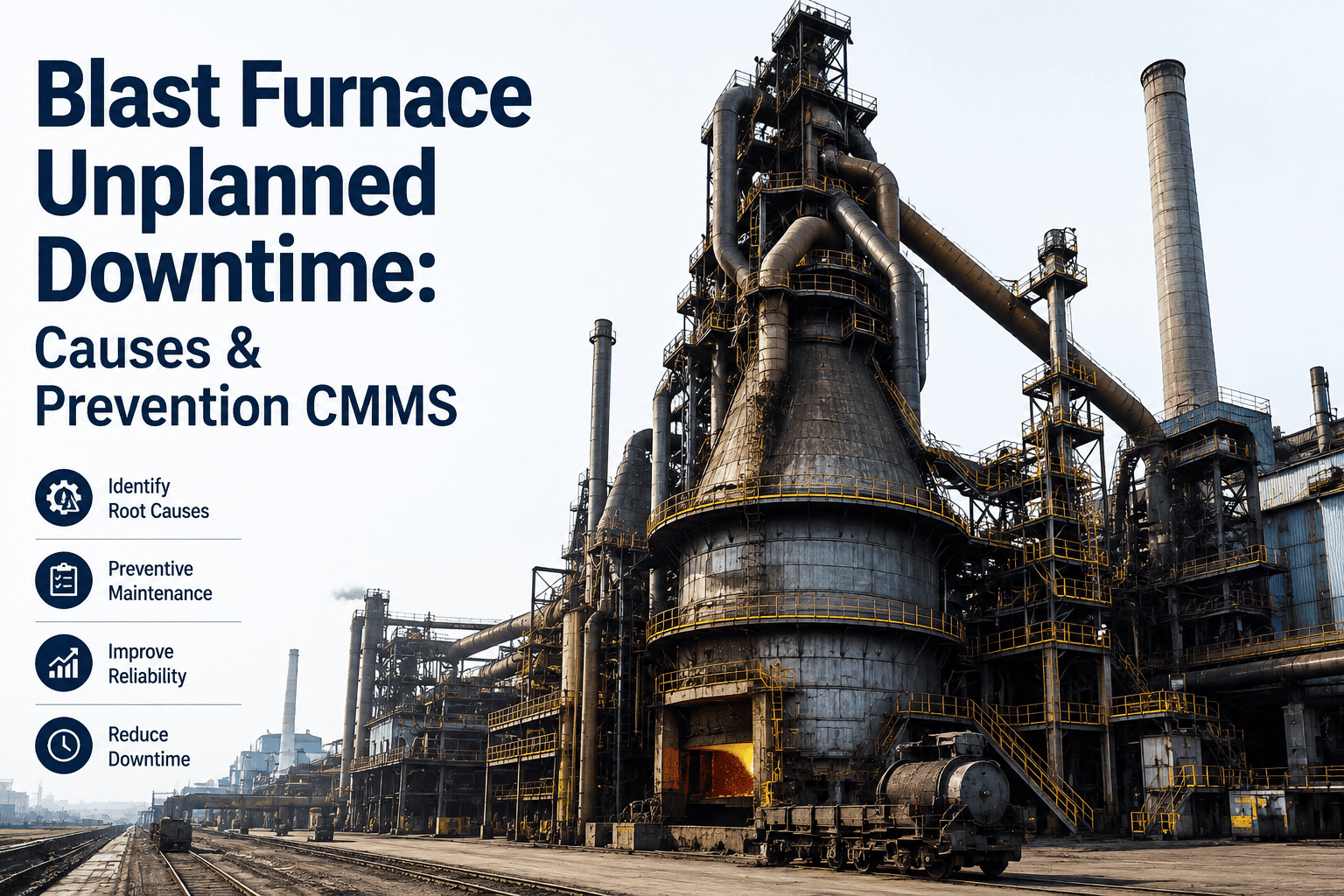
A single unplanned blast-furnace blowout can erase $4M in a week. A CMMS-driven downtime strategy targets the four failure modes that cause 80% of furnace outages — refractory, burners, cooling, and instrumentation — and converts them from surprises into scheduled events.
Why Furnace Downtime Swallows Steel-Mill Margins
A typical integrated steel plant operates 4–8 large furnaces (blast, EAF, BOF, reheat). At an average unplanned-downtime rate of 9.6%, a single 3,000 t/day blast furnace loses roughly 288 tonnes of hot metal per day — about $172,800 in contribution margin, before coke-rate and energy penalties.
At 3,000 t/day capacity and $57.6/t contribution, every cold day on a blast furnace is a direct margin write-off that the caster cannot recover.
Emergency refractory gunning runs 3× the cost of a planned campaign repair, and a full blast-furnace reline locks the asset out for 45–75 days.
When the BOF or caster starves, the entire mill chain idles. A 12-hour furnace outage cascades into 36 hours of lost throughput at the strand.
Each restart pushes coke rate and energy intensity above baseline for 18–30 hours, eroding the energy-management KPIs that ISO 50001 audits track.
Where Furnace Downtime Actually Starts
Industry failure data from 200+ integrated and mini-mill furnaces shows that 80% of unplanned outages cluster into four asset groups. A CMMS lets you tag each work order to the failure mode so reliability engineers see exactly where to spend the shutdown budget.
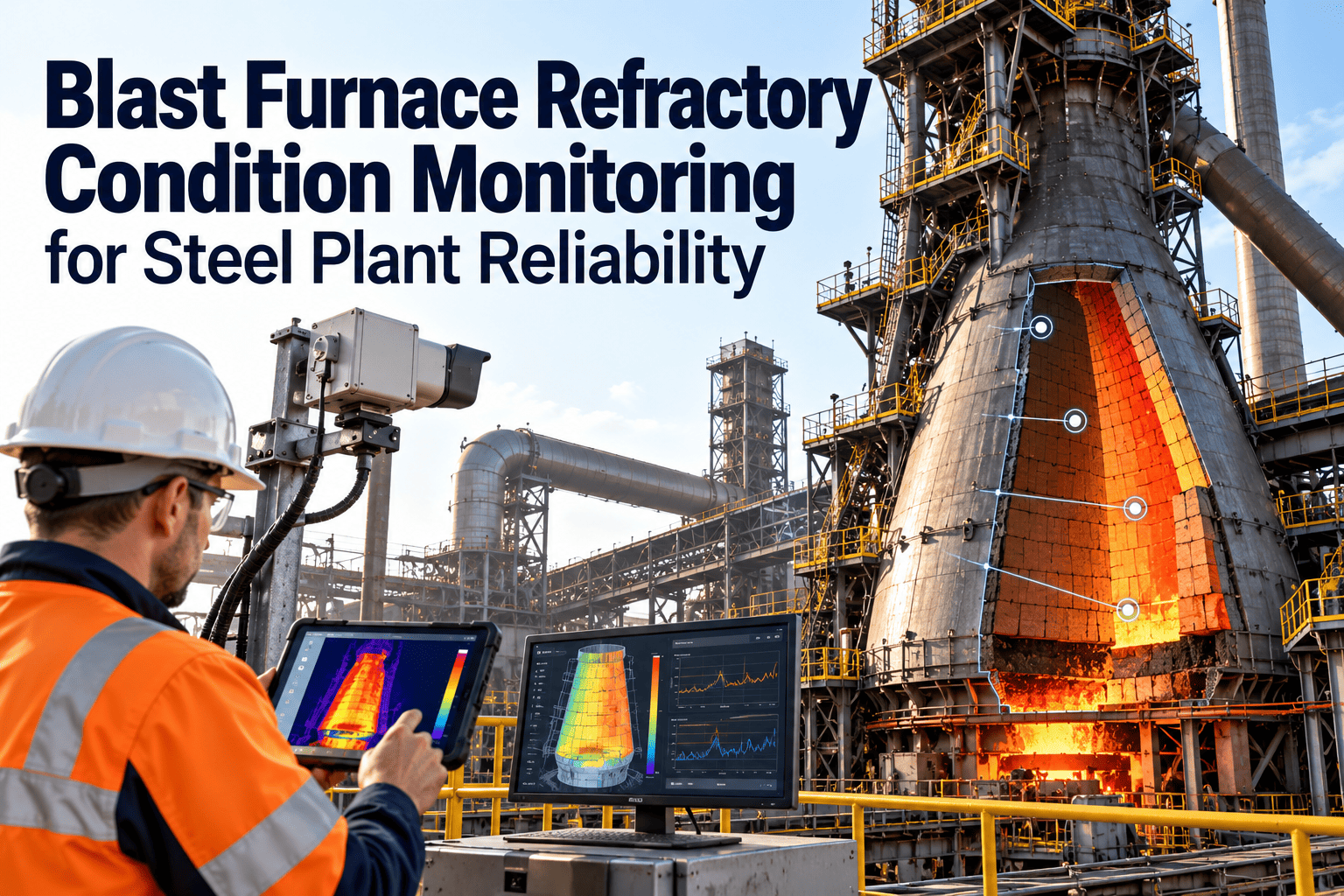
32% of outages. Thermocouple grids and acoustic-emission sensors track brick thinning, but without a CMMS the data sits in siloed historian trends. Linking skin-temperature alarms to refractory work orders turns a 6-hour blowout into a 90-minute planned gunning stop.
24% of outages. Flame-scanner drift, nozzle coking, and gas-air ratio imbalance degrade efficiency for weeks before a flameout. A CMMS schedules burner inspection on firing-hour cycles, not calendar guesses, catching degradation at 70% rather than 100% failure.
18% of outages. Stave-cooler or tuyere-water leaks are the fastest path to an emergency blowdown. Flow and delta-T alarms routed into the CMMS trigger tiered work orders — a Level-1 drip becomes a planned 4-hour stop, not a 36-hour catastrophe.
6% of outages — but 41% of "near-miss" events. Thermocouple, pressure-transmitter, and valve-position drift silently push the furnace out of its safe operating envelope. Auto-calibration work orders in the CMMS keep the loop within 1% of setpoint.
The Formula Behind 40% Fewer Outage Hours
Furnace uptime is not luck — it is a function of how early you detect, how fast you triage, and how precisely you schedule. The CMMS strategy compresses all three.
Where D = unplanned downtime hours/year, and P-factors are the probability that a developing fault is detected early, triaged to the right craft, and scheduled before failure. A CMMS lifts all three — pushing the combined probability from ~0.25 (reactive) to ~0.70 (optimized).
From Reactive to Predictive in Four Quarters
A furnace-focused CMMS rollout is not a big-bang IT project. The mills that hit 40% downtime reduction do it in staged 90-day waves, each one tying a new asset group into the work-order engine.
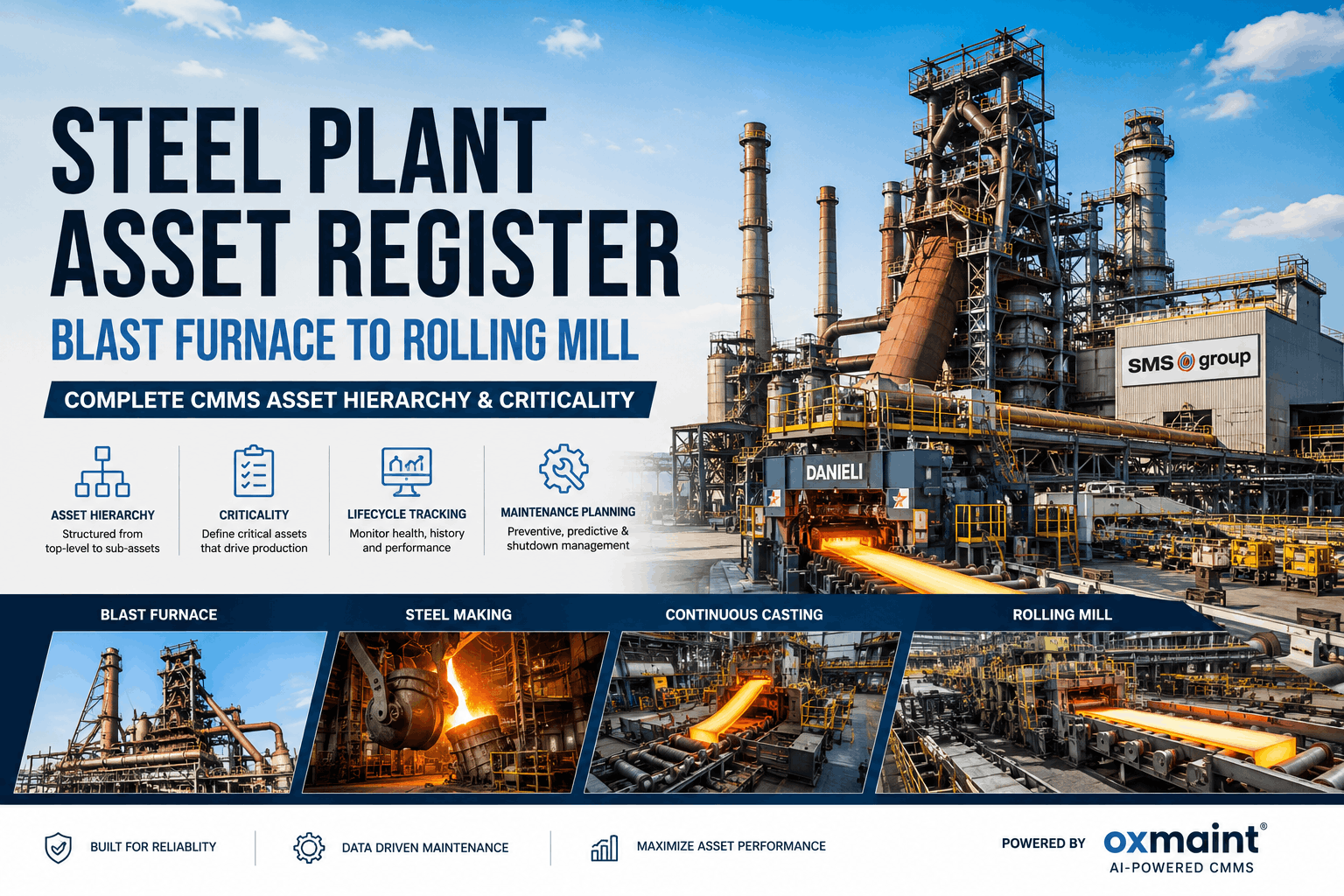
Map every furnace asset — from the blast furnace shell to the reheat-zone burners — into a single hierarchy. Run an FMEA to rank assets by risk priority number (RPN). Tag the top 20% of assets that drive 80% of downtime.
Integrate thermocouple, skin-temperature, and cooling-flow data streams into the CMMS. Set threshold-based auto-work-orders for Level-1 and Level-2 alarms. Begin predictive refractory campaign planning based on wear-rate trends.
Shift burner and tuyere inspections from calendar-based to firing-hour and cycle-based triggers. Link flame-scanner health and gas-ratio logs to the work-order engine. Tune combustion loops to within 1% of setpoint.
Roll out the shutdown planner: planned stops bundled into 4–8 hour windows, parts pre-staged, crafts pre-assigned. OEE and furnace-availability KPIs move to executive dashboards. Tie maintenance bonuses to availability targets.
What a CMMS Actually Returns to a Steel Plant
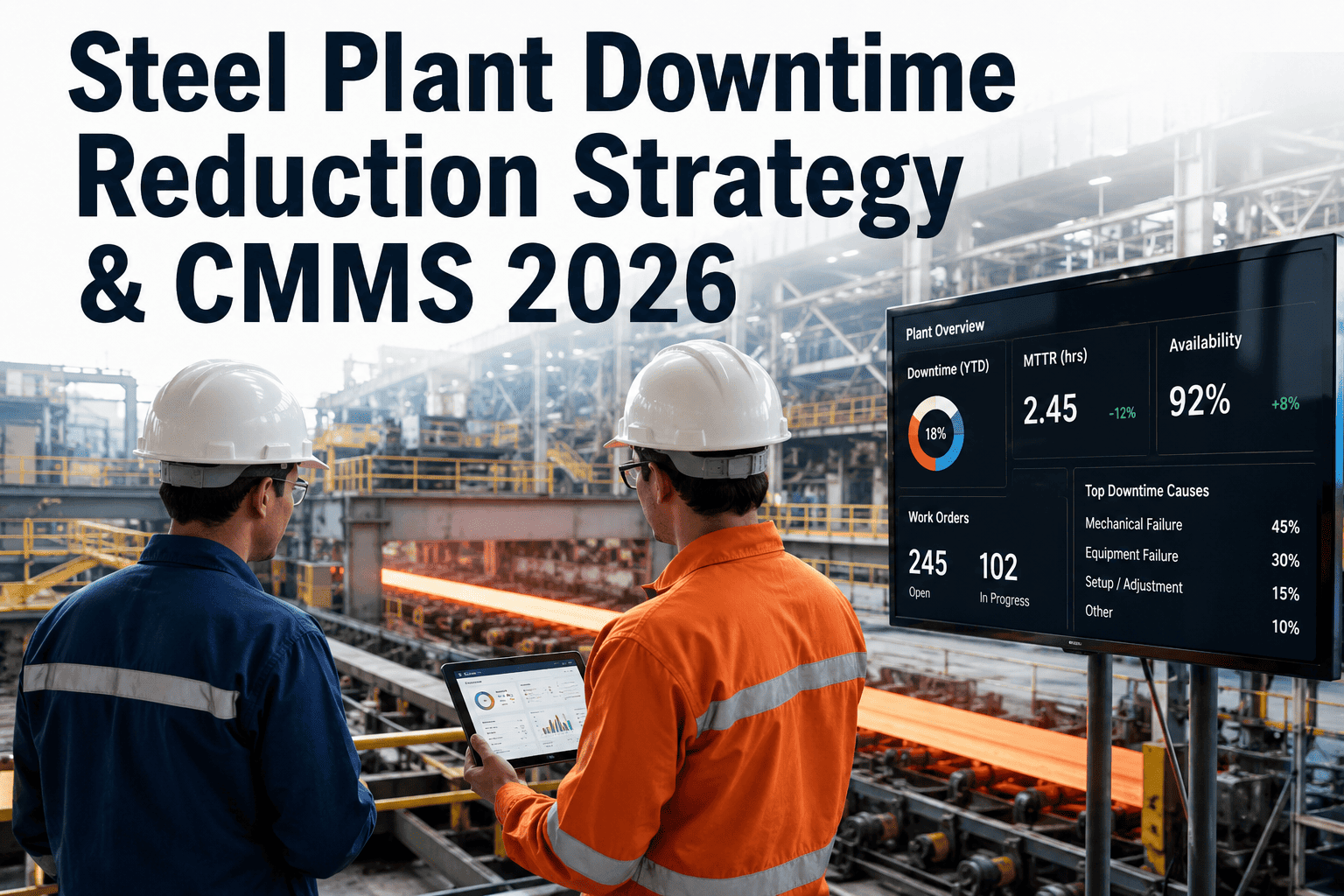
Based on data from 14 integrated and mini-mill deployments, the payback profile below assumes a mid-size plant running two blast furnaces, one EAF, and four reheat furnaces.
| Metric | Before CMMS | After CMMS (Year 1) | Annual Impact |
|---|---|---|---|
| Unplanned furnace downtime | 840 hrs/yr | 504 hrs/yr | −336 hrs |
| Furnace availability | 90.4% | 94.2% | +3.8 pts |
| Mean time to repair (MTTR) | 14.6 hrs | 6.2 hrs | −57% |
| Emergency work orders | 41% of total | 12% of total | −71% |
| Refractory campaign life | 11.2 yrs | 13.8 yrs | +23% |
| Energy intensity per tonne | Baseline | −4.2% | $610K saved |
| Maintenance cost as % of replacement asset value | 5.8% | 3.9% | −33% |
| Estimated total annual value | — | — | $2.0M–$2.4M |
Stop treating furnace outages as inevitable.
See how a CMMS built for steel maps every refractory brick, burner cycle, and cooling leak into one shutdown-ready system — in under 14 days.
How a 2.4M t/y Integrated Mill Cut Downtime 43%
Furnace Downtime & CMMS Strategy, Answered
Most plants see measurable improvement within 60–90 days, once the asset registry is built and the first condition-monitoring alarms are routed to work orders. The full 40% reduction typically lands between Months 9 and 12, after burner and shutdown-planner modules go live. You can Start Free Trial to begin the baseline audit immediately.
Yes — a modern CMMS pulls data from OPC-UA gateways, Pi System historians, and edge IoT sensors via REST or MQTT. The system does not replace your DCS; it sits above it, translating threshold breaches into prioritized, assignable work orders with the right parts and crafts pre-staged.
For a mid-size integrated mill running 2–4 furnaces, payback averages 4–7 months. The largest savings come from avoided emergency relines (each worth $8–14M) and recovered hot-metal throughput. Most plants report $1.5M–$2.4M in annualized value within the first year.
The strategy applies across the furnace family. For EAFs, the CMMS tracks electrode wear, water-cooled panel leaks, and refractory hot spots. For reheat furnaces, it manages skid-rail wear, burner efficiency, and scale buildup. The failure modes differ, but the detect-triage-schedule loop is identical. Book a Demo to see a configuration matched to your furnace type.
The CMMS enforces the asset-management lifecycle that ISO 55000 requires — registered assets, documented criticality, risk-based maintenance plans, and auditable work-order history. On the energy side, it logs every restart and coke-rate deviation, giving you the consumption trail that ISO 50001 auditors look for during EnMS reviews.
Your next furnace outage is already developing. Catch it before it costs you.
Deploy a CMMS strategy that turns refractory wear, burner drift, and cooling leaks into planned 4-hour stops — not $4M blowdowns.
Free 14-day trial · No credit card