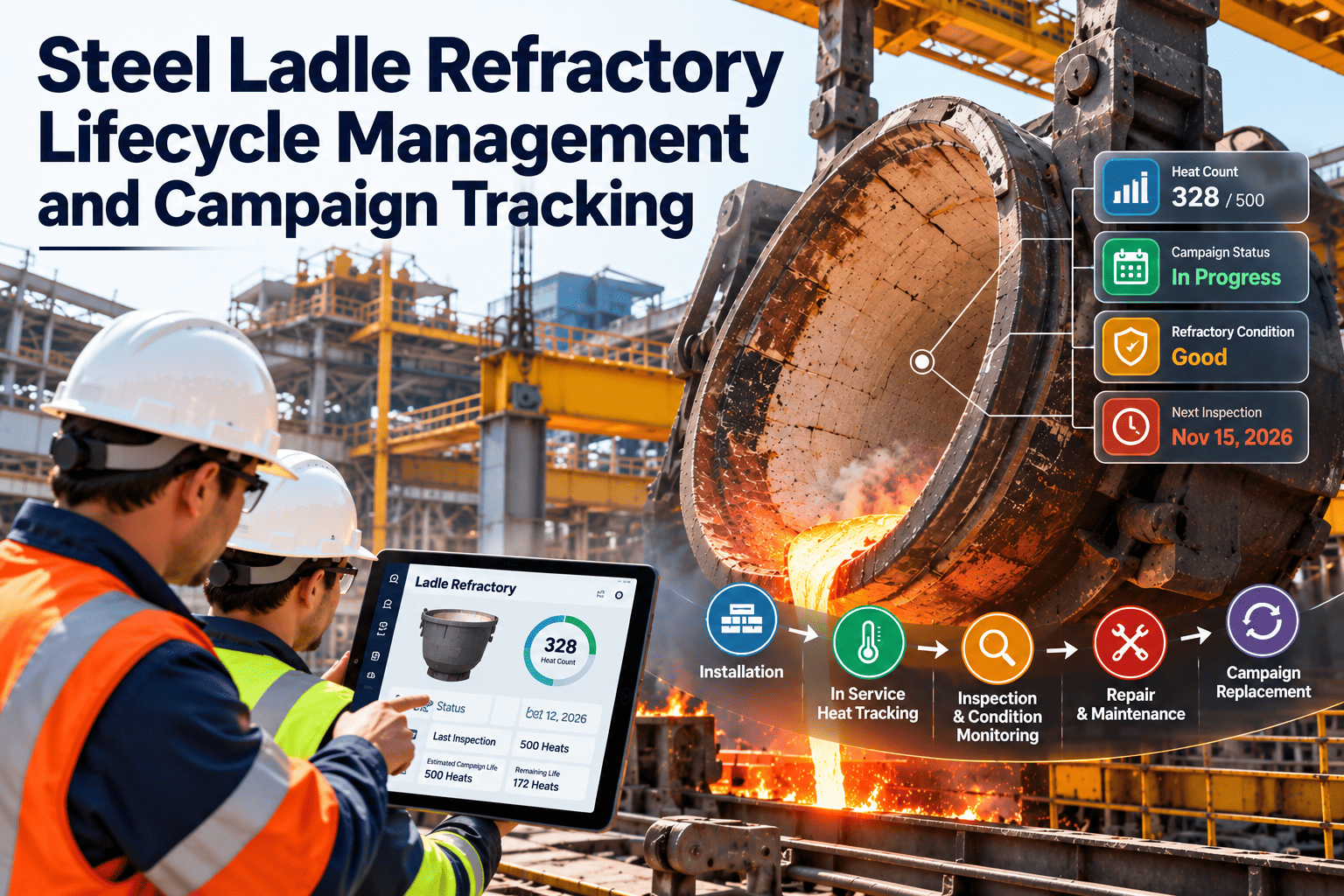
A steel ladle lining lives a hard life of repeated heating, molten steel contact, slag attack and thermal shock, and every campaign ends with a decision about repair, relining or retirement. Plants that manage those decisions from memory or paper logs struggle to explain why one ladle lasts far longer than another. Tracking each ladle from reline to teardown gives metallurgists and maintenance teams the evidence they need, and a connected asset and maintenance management platform keeps that evidence in one asset history.
Steel ladle refractory lifecycle management and campaign tracking
Follow every ladle lining from build to teardown, connect heat history to wear and repairs, and compare campaigns so relining decisions are based on data instead of habit.
What a ladle lining is made of and where it wears
A ladle is not one uniform lining. Each zone faces a different mix of heat, steel flow, slag and mechanical impact, so each needs its own tracking.
Why zone-level records matter
- A lining may be fit for more heats in the sidewall while the slag line is already near its limit.
- Repair methods differ by zone, so recording which zone was treated explains later performance.
- Material supplier comparisons are only fair when zone, grade and service conditions are comparable.
The real cost sits in the decisions around the lining
Refractory cost is more than the purchase price of bricks and monolithics. Lifecycle management looks at the whole campaign.
Materials
Bricks, castables, gunning mixes, flow control parts and consumables for each reline and repair.
Labour and contractors
Demolition, relining, drying, hot repairs and inspection effort across internal and external crews.
Ladle availability
Ladles out of rotation for repair reduce the fleet available to the melt shop and may force tighter scheduling.
Energy
Drying, preheating and holding temperature consume fuel, so poor ladle sequencing carries an energy cost.
Quality and safety risk
Operating too long risks breakthroughs, steel quality issues and dangerous events, while retiring too early wastes usable life.
What a campaign record should contain
A campaign begins at reline and ends at teardown. Everything that happens between those points should be attached to the same record.
- Ladle number and capacity
- Campaign number
- Reline date and contractor
- Lining design and materials
- Heat count and heat dates
- Steel grades produced
- Tapping and holding temperatures
- Time in service and idle time
- Thickness or wear measurements
- Visual inspection notes
- Shell temperature observations
- Flow control part condition
- Gunning or patch repairs by zone
- Part replacements
- Preheating or drying records
- Spares and labour used
- Retirement reason
- Teardown observations
- Total heats achieved
- Cost and lessons recorded
What shortens or extends refractory life
Lining life is shaped by both process conditions and maintenance practice. Campaign tracking makes the relationship visible.
Process conditions
- Steel grade and chemistry: some grades and treatments are more aggressive to the lining than others.
- Slag composition and volume: basicity, carry-over and slag line control change attack rates.
- Temperature profile: superheat, holding time and secondary metallurgy influence wear.
- Stirring and treatment intensity: argon stirring and vacuum treatment affect erosion patterns.
- Thermal cycling: cooling between heats, idle time and reheating create shock and spalling.
Maintenance and handling practice
- Installation quality: joint quality, curing and drying affect early life.
- Preheating discipline: inconsistent heat-up raises the risk of cracking and spalling.
- Timing of repairs: well-timed gunning extends life, late repair may not.
- Inspection frequency: hidden wear is found only if someone measures it.
- Cleaning and skull removal: rough handling can damage the lining between heats.
Turning inspection findings into lifecycle decisions
Every inspection should end in a clear decision. A simple decision table keeps judgement consistent across shifts and ladles.
| Finding | Typical meaning | Decision options | Record to keep |
|---|---|---|---|
| Uniform wear within expected range | Campaign progressing normally | Continue and schedule next inspection | Measurement, heat count at inspection |
| Localised slag line erosion | Slag attack concentrated in one zone | Repair the zone, review slag practice | Zone, repair method, slag observations |
| Cracking or spalling after temperature changes | Thermal shock or preheat problem | Assess depth, repair or restrict use, review heating sequence | Crack location, preheat history |
| Shell hot spot | Possible lining thinning or failure | Remove from service and inspect immediately | Location, temperature, action taken |
| Worn flow control parts | Replacement due on their own cycle | Replace parts, check stock for the next campaign | Part life, replacement date |
| Wear near retirement limit | Remaining safe life is small | Plan relining and book contractor and materials | Final measurements, retirement reason |
Comparing campaigns fairly
A longer campaign is not automatically a better one. Fair comparison needs context.
Managing the ladle fleet, not only single ladles
A melt shop needs enough ladles in the right condition at the right time. Lifecycle data helps schedule that fleet.
- Relining happens when a ladle fails inspection or a breakout scare occurs.
- Several ladles reach their limit in the same week.
- Refractory orders are placed late and shapes arrive after the need.
- Production planners learn about ladle shortages the same day.
- Remaining life is visible for every ladle in the fleet.
- Relining is staggered to protect ladle availability.
- Materials and contractor slots are booked ahead of need.
- Melt shop planning sees ladle status before it affects production.
Safety, compliance and waste considerations
Refractory work involves heat, dust, confined spaces and heavy handling, and spent lining material is a waste stream that needs a plan.
Work safety
Reline and demolition tasks need permits, access control, respiratory and dust controls, and lifting plans, all of which can be attached to the work order.
Quality records
Installation, curing and drying records support supplier discussions and show that the lining was built to specification.
Waste and reuse
Teardown quantities and disposal or recycling routes should be recorded to meet environmental requirements and cost reviews.
Measures for ladle lining performance
Choose a small set of indicators and review them after every campaign.
| Indicator | Why it matters |
|---|---|
| Heats per campaign | Basic life measure, to be read with grade mix and design |
| Refractory cost per heat | Connects material and repair spend to delivered service |
| Share of planned retirements | Shows whether relining is controlled or reactive |
| Unplanned ladle removal events | Measures how often condition problems disrupt production |
| Repair frequency by zone | Finds recurring weak areas worth a root-cause review |
| Inspection compliance | Checks whether scheduled measurements were taken on time |
| Ladle availability | Shows how well the fleet supports melt shop demand |
Flow control parts have their own lifecycle
Slide gates, nozzles, well blocks and porous plugs rarely last exactly as long as the main lining. Treating them as separate tracked components avoids surprises.
What to record for each component
- Part type, supplier and batch or reference number.
- Installation date and the heat count at installation.
- Number of heats or openings achieved before replacement.
- Reason for replacement, such as wear, blockage, leakage or planned change.
- Condition notes from the removal inspection.
What the record allows you to do
- Forecast replacement dates and align them with planned ladle stops.
- Reorder parts from real consumption instead of rough estimates.
- Identify batches or suppliers with repeated early failures.
- Separate flow control problems from lining problems when reviewing a campaign.
- Show maintenance and operations which components limit ladle availability.
A countdown for planned relining
Relining is a project in miniature. Working backwards from the expected retirement date prevents last-minute scrambling.
Forecast retirement window
Use heat count, measured wear and repair history to estimate when the lining will reach its planning limit, and state the uncertainty.
Secure materials and contractor
Reserve bricks, monolithics and flow control parts, and book the relining crew and any specialised equipment.
Adjust the ladle rotation
Confirm that enough ladles remain available while this one is out, and avoid retiring several together.
Remove, inspect and record
Take the ladle out of service, document teardown wear by zone, and capture photographs and remarks.
Build, cure and release
Complete lining installation, drying and preheating records, then close the old campaign and open the new one.
Lifecycle tracking mistakes that distort the picture
Even good data can mislead when the records are structured poorly.
Working with refractory suppliers and contractors on evidence
Lifecycle records change the conversation with suppliers from opinion to comparison.
- Trials with clear controls: record lining design, zone, grade mix and measurement method so trial results can be judged against comparable campaigns.
- Warranty and performance discussions: documented heats, repairs and retirement reasons support constructive technical reviews.
- Contractor quality: link installation records, drying data and early-life performance to the crew and method used.
- Specification improvements: teardown findings can show which zone deserves a different material or thickness in the next lining.
- Purchasing plans: consumption by campaign gives buyers a realistic basis for volume and delivery schedules.
Energy, preheating and thermal management across the lifecycle
How a ladle is heated, held and cooled between heats strongly influences refractory life and also drives fuel use.
Preheating discipline
Recording preheat start, duration and temperature for each ladle shows whether early-life cracking is linked to inconsistent heat-up.
Idle and holding time
Long idle periods let the lining cool and then reheat, adding thermal shock. Tracking idle time lets teams see which ladles suffer most.
Turnaround between heats
Cleaning, inspection and return to service times show where ladles wait and where better scheduling could reduce cooling.
Questions this data helps answer
- Do ladles with irregular preheating show earlier cracking or spalling?
- Does shorter turnaround between heats extend lining life without raising risk?
- Which ladles spend the longest idle, and could rotation reduce that?
What a good campaign review meeting covers
A short, regular review after each retirement turns raw records into practice improvements.
- Total heats and retirement reason
- Planned or unplanned end
- Limiting zone
- Wear against expectations
- Grade mix and slag practice
- Preheat and idle record
- Material and repair cost per heat
- Downtime and labour
- Changes for next lining
- Owner and due date
Quick checks before closing a campaign record
- Confirm the final heat count and retirement reason are recorded.
- Attach teardown photographs and thickness readings by zone.
- Link all repairs and parts used to the campaign so cost can be calculated.
- Record any process changes made during the campaign, such as new grades or slag practice.
- Write one specific recommendation for the next lining specification or operating practice.
How Oxmaint supports ladle lifecycle tracking
The same system that manages equipment maintenance can hold the ladle's complete campaign history.
Ladles as tracked assets
Register each ladle with its lining zones and flow control parts so history stays with the right asset.
Inspection and repair work orders
Schedule inspections and record measurements, repairs and parts used for every campaign.
Usage-based triggers
Configure meter or counter-based tasks so inspections and replacements follow heats, not only calendar dates.
Inventory and procurement links
Connect refractory materials and flow control parts to planned relines and reorder levels.
Reporting and dashboards
Compare campaigns, costs and retirement reasons to support supplier and practice reviews.
Ladle lifecycle management: frequently asked questions
What is a ladle campaign?
It is the service period of one lining, from reline to retirement, including all heats, inspections and repairs.
Is heat count enough to decide relining?
No, heat count is a key guide but should be combined with measured wear, grade mix, repairs and inspection findings.
Can we track repairs by lining zone?
Yes, work orders can record zone, method and materials. You can book a demo to see a ladle record.
How does tracking help supplier trials?
It gives comparable data on heats, wear and repairs, so trial results are judged against similar service conditions.
Where should we begin?
Start with one ladle line and its current campaign. You can sign up and build the record from there.
Know the full life story of every ladle lining
Connect heats, inspections, repairs and retirement decisions in one campaign record.