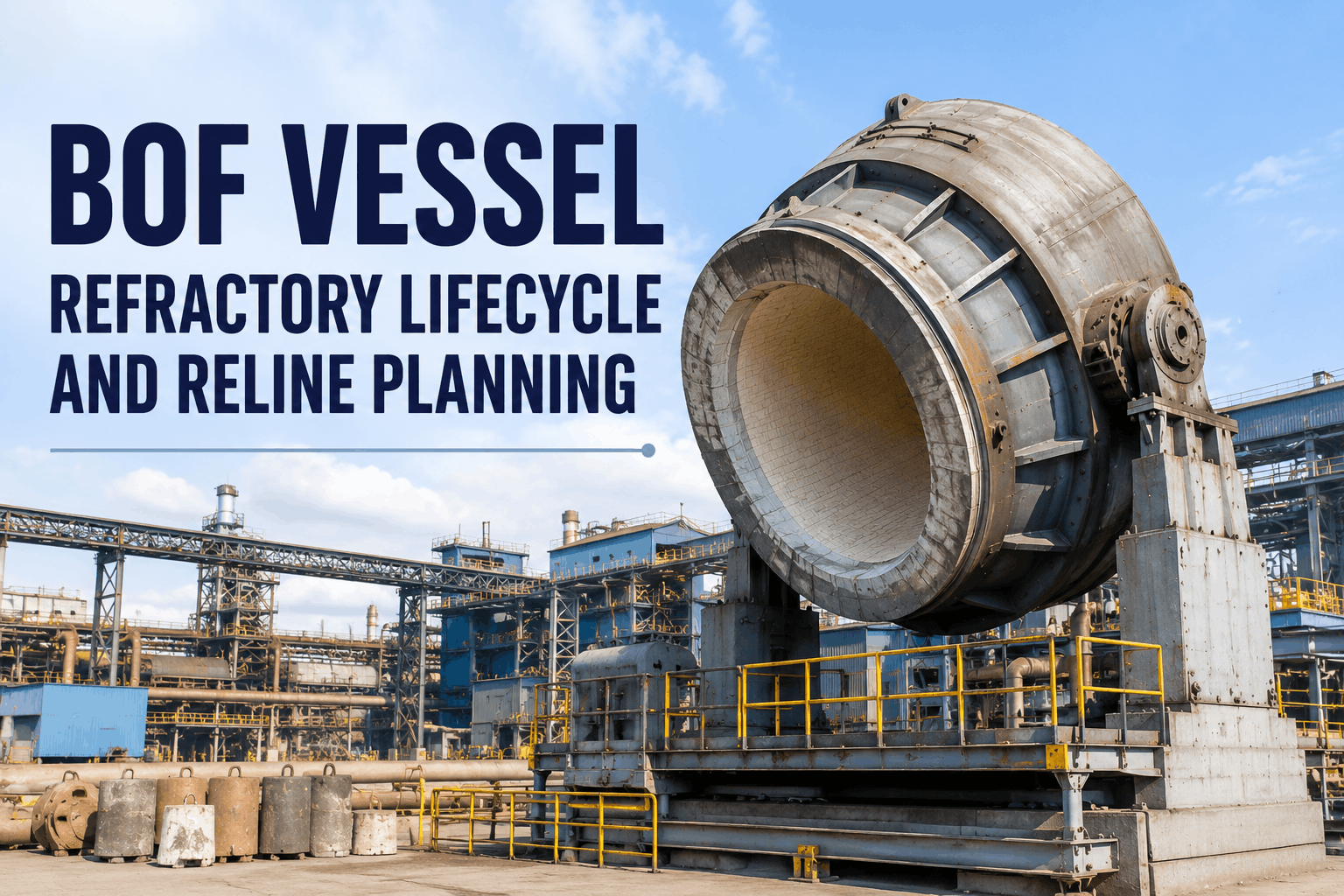
A BOF vessel reline costs between ₹2.5 crore and ₹12 crore in refractory materials and contractor labour, takes 15–25 days of production downtime, and happens — in a plant without structured campaign management — unpredictably. The difference between a campaign that runs 3,000 heats and one that runs 5,000 heats is not the quality of the refractory bricks: it is the precision of the slag splashing program, the frequency and accuracy of lining thickness measurements, the discipline of targeted gunning and hot patching at the fastest-wearing zones, and the ability to read the wear trajectory and make a data-driven decision on campaign extension versus timely reline. When a BOF vessel relines unplanned, the steel plant loses ₹1.5 to 4 crore per day in lost production in addition to the reline cost itself. When it relinesone campaign too early — because the maintenance team cannot see the remaining lining thickness and elects to reline conservatively — tens of millions of rupees in potential production revenue are abandoned. OxMaint's CMMS gives BOF melt shop maintenance teams zone-by-zone lining wear tracking, slag splashing effectiveness records, gunning event history, campaign economics, and automated reline planning work orders — all connected in a single platform that converts the BOF campaign from a countdown to a managed, data-driven program. Register your BOF vessels in OxMaint and start tracking campaign wear data today.
Blog · BOF · Vessel Refractory Lifecycle Management
BOF Vessel Refractory Lifecycle and Reline Planning for Steel Plants
BOF Lining Wear Tracking · Slag Splash Program · Hot Patching Records · Gunning Event History · Zone-by-Zone Wear Rate · Reline Planning CMMS · Campaign Economics · Lining RUL · BOF Refractory Audit · Vessel Rotation Planning
BOF Vessel Campaign Status
BOF-1
Converter 1 — Heat 2,840
Tap Zone 320mm · Campaign Active
BOF-2
Converter 2 — Heat 4,210
Charge Pad 180mm — Gunning Scheduled
BOF-3
Converter 3
Reline Planned — Heat 4,850 Target
BOF-4
Converter 4 — Standby
Relining Complete · Ready at Heat 1
4,000–50,000
BOF campaign life range depending on vessel size, slag splashing program quality, and refractory grade — data-managed campaigns consistently reach the upper range
40–60%
Reduction in net lining wear rate in barrel and trunnion zones when slag splashing with MgO-saturated slag is optimised — the most cost-effective campaign extension intervention available
₹8–15Cr
Cost of a BOF vessel full reline in a 200–300 tonne converter — the investment that every structured campaign management program exists to defer and optimise
200 heats
Value of a single campaign extension of 200 heats at a large BOF: ₹40L–₹1.2Cr added value through deferred reline cost — with incremental gunning cost of ₹15–40L
BOF Vessel Wear Zones — Why Zone-by-Zone Tracking Is the Foundation of Reline Planning
BOF Converter — Refractory Zone Wear Rate and OxMaint Tracking Points
Mouth / ConeLow–Med
Upper BarrelMedium
Trunnion ZoneHigh
Charge PadVery High
Tap Hole AreaHighest
BottomMedium
Tap Hole Area
Wear: 5× barrel rate
Highest erosion from molten steel flow at tapping. OxMaint tracks taphole sleeve replacements and surrounding lining measurements every 50 heats.
Charge Pad
Wear: 3–4× barrel
Scrap impact and oxygen jet impingement. First gunning typically at heat 400–800. OxMaint tracks gunning material volume and wear recovery per event.
Trunnion Zone
Wear: 2–3× barrel
Chemical attack from slag at maximum contact. Slag splashing most effective here. OxMaint tracks splashing events and slag MgO saturation per session.
Upper Barrel
Wear: 1–2× reference
Thermal cycling and intermediate slag contact. Shell temperature monitoring is the non-intrusive condition indicator. OxMaint tracks shell hotspots monthly.
Bottom / Mouth
Wear: Low–Medium
Variable — depends on gas stirring and tapping practice. OxMaint tracks bottom measurement at configured heat intervals and slag splash effectiveness on bottom zone.
OxMaint tracks lining thickness measurements independently per zone — not as a vessel average. The campaign end decision in OxMaint is driven by the fastest-wearing zone reaching minimum safe thickness, with a wear-rate trajectory that projects the crossing heat number weeks in advance.
Five Failure Modes That End BOF Campaigns Prematurely — and How OxMaint Prevents Them
01
Tap Zone Lining Breach
Warning Signal
Shell thermocouple behind tap zone rising above baseline; tapping time increasing (larger opening from erosion); thickness measurement below minimum at tap zone survey
Root causes: inadequate taphole sleeve replacement frequency, slag attack on surrounding lining at high basicity, delayed response to thickness measurement results
OxMaint tracks tap zone thickness every 50 heats and shell thermocouple trend — generates priority repair work order when thickness approaches minimum safe limit or shell temperature rises
02
Charge Pad Collapse
Warning Signal
Charge pad thickness below minimum on measurement survey; shell temperature elevation behind charge pad; visual refractory spalling visible during vessel inspection
Root causes: excessive scrap drop height, missed gunning interval, inadequate slag splashing coverage in charge pad zone, delayed measurement leading to late gunning intervention
OxMaint schedules charge pad gunning work orders at configurable heat intervals (typically 300–800 heats) with material volume and post-gunning thickness verification recorded
03
Shell Hotspot and Lining Burnthrough
Warning Signal
Shell thermocouple or infrared scan showing temperature above 200°C surface; shell glow visible externally; shell deformation detectable on monthly inspection
Root causes: untracked lining thinning below safe minimum in a zone without recent measurement, incorrect wear rate model, missed repair opportunity at last gunning window
OxMaint tracks shell temperature continuously and trends — a shell temperature alert fires at 10°C above baseline well before the emergency alarm, allowing inspection before breach occurs
04
Ineffective Slag Splashing from Under-Saturated Slag
Warning Signal
Lining thickness measurements showing faster-than-expected wear in barrel and trunnion zones despite regular slag splash; slag chemistry records showing MgO below 8% target
Root causes: slag MgO content below 8–12% saturation range — slag dissolves the lining instead of coating it; nitrogen pressure below optimum for effective splash coverage
OxMaint records slag chemistry at each splash event — MgO% trended against lining wear rate allows correlation between ineffective splashing periods and accelerated zone wear
05
Reline Scope Surprise at Shutdown
Warning Signal
Not a failure at shutdown — a failure of the campaign tracking program that arrives as unexpected repair scope, missing materials, and an extended outage duration when the vessel finally comes down
Root causes: zone-by-zone wear data not accumulated systematically, reline scope estimated rather than calculated from measurement history, materials and contractors not pre-planned
OxMaint generates reline planning work orders 6–8 weeks ahead of the projected campaign end heat — scope is built from measurement history, materials ordered, contractors scoped before the vessel is down
BOF Refractory Lifecycle PM Schedule — Tracked by Zone and Heat Count in OxMaint
| Zone / Component |
PM Task |
Interval |
Predictive Indicator |
Risk if Missed |
| Tap Zone Thickness |
Laser profile or sonic measurement — thickness recorded per zone position |
Every 50 heats |
Wear rate acceleration above historical average; tapping time increasing |
HIGH — tap zone breach → steel leak at tap, emergency campaign end |
| Full Vessel Thickness Survey |
Zone-by-zone lining profile — all zones measured, wear rate updated per zone |
Every 100–200 heats |
Fastest-wearing zone reaching minimum thickness projection date |
HIGH — undetected thin zone → unplanned reline, shell damage |
| Slag Splashing (post-tap) |
Splashing event log — nitrogen pressure, duration, slag volume, MgO% recorded |
Every heat (post-tap) |
Slag MgO% below 8% saturation target — coating ineffective |
HIGH — ineffective splash → 40–60% faster lining wear in barrel and trunnion zones |
| Charge Pad Gunning |
Gunning event — material volume, water content, post-gunning thickness verification |
Every 300–800 heats as required by measurement data |
Charge pad wear rate trending — thickness vs gunning material rebuild balance |
HIGH — charge pad collapse → scrap drops directly on worn lining, shell contact |
| Shell Thermocouple / Hotspot |
Shell temperature log — each thermocouple position trended against baseline |
Continuous during heats; trend work order monthly |
Temperature rising >10°C above baseline at any thermocouple position |
HIGH — shell hotspot → breakthrough risk, forced emergency shutdown |
| Taphole Sleeve |
Sleeve replacement — condition of removed sleeve recorded; surrounding lining check |
Typically every 25–50 heats depending on design |
Tapping time deviation; sleeve outer diameter wear at removal |
HIGH — sleeve failure → uncontrolled tap flow, tap zone lining damage |
| Vessel Shell (Mechanical) |
Shell deformation measurement, shell plate thickness, weld inspection at critical joints |
Every reline |
Shell temperature history indicating thermal cycles above design range |
MEDIUM — shell deformation → refractory installation problems at next reline |
| Gunning and Patch Records |
Volume of material, zone treated, pre- and post-thickness, material type recorded |
Per event |
Diminishing thickness recovery per unit of gunning material — lining too worn to hold gunite |
MEDIUM — untracked gunning → no way to calculate net lining thickness or wear rate |
Every Measurement. Every Gunning Event. Every Slag Splash Record — Feeding One Campaign Model That Tells You When to Reline.
OxMaint builds the BOF vessel's refractory campaign model from accumulated measurement data. Every thickness survey is recorded against the zone position. Every gunning event adds material back into the model. Every slag splash records the nitrogen pressure and slag chemistry. The result is a continuously updated projection of which zone will reach minimum thickness first and when — giving the melt shop team 6–8 weeks of advance notice to plan the reline outage with correct scope, materials ordered, and contractors engaged. No estimates, no surprises, no extended outage from scope discovered at shutdown.
Start building your BOF campaign model in OxMaint — free trial.
Campaign Economics — How OxMaint Calculates the Value of Every 200 Additional Heats
BOF Campaign Extension Value vs. Incremental Maintenance Cost
For a 250-tonne BOF producing 250,000 tonnes/year — indicative values per campaign extension block
Incremental Maintenance Cost
Additional slag splashing nitrogen (200 heats)
₹2–4L
Additional gunning material and labour
₹8–18L
Taphole sleeve replacements
₹4–8L
Total incremental cost (200 heats)
₹15–40L
Value of 200-Heat Extension
Deferred reline cost (amortised 200 heats)
₹40–80L
Avoided production loss (reline deferral)
₹60–1.2Cr
Reduced ramp-up losses after reline
₹10–20L
Total value of 200-heat extension
₹1.1–2.2Cr
Return on incremental maintenance investment for a 200-heat extension: 16–55× the cost of the additional maintenance. OxMaint provides the measurement data, gunning records, and wear trajectory that make this extension safe and achievable.
Before vs After — What CMMS-Managed BOF Campaign Tracking Changes
Lining thickness measurements taken every 200 heats and filed as measurement reports — no cumulative wear trajectory model, no campaign end projection, no zone-specific wear rate
Slag splashing performed every heat but slag chemistry not recorded — periods of under-saturated slag (below 8% MgO) are invisible in the maintenance record and cannot be correlated with accelerated lining wear
Charge pad gunning scheduled by calendar month — not heat count or measurement data — resulting in gunning events where the zone doesn't yet need it, and missed events where accelerated wear has occurred
Shell thermocouple alarm fires at emergency threshold — no systematic review of thermocouple trends between heats, so the first indication of a developing lining problem is the alarm, not the preceding trend
Reline scope discovered at vessel shutdown — refractory materials have 6–12 week lead times, so unexpected scope in a zone not on the planned material list extends the outage by 1–2 weeks
Campaign end decision made by melt shop manager experience — the decision to run-or-reline has no data basis, leading to either premature reline or an anxious final 200 heats with insufficient confidence in remaining lining
Every 100-heat measurement survey updated in OxMaint — zone wear rates recalculated, campaign end heat projected with ±200 heat precision, reline planning work order triggered 8 weeks ahead of projection
Slag chemistry (MgO%) recorded per splash event in OxMaint — correlation report shows that three consecutive weeks of under-saturated slag in month 14 caused accelerated wear in BOF-2's trunnion zone; slag chemistry adjusted, wear rate recovers
Charge pad gunning scheduled by OxMaint at the heat interval derived from charge pad wear rate data — material used where needed, when needed, with post-gunning thickness confirming rebuild achieved
Shell thermocouple trend alert fires at 10°C above baseline — investigation work order raised before emergency alarm, repair planned at next maintenance window, no emergency shutdown
OxMaint reline work order generated 8 weeks before projected campaign end — full zone-by-zone repair scope from measurement history, materials ordered, contractors scoped; reline completes in planned 18 days, not 26
Run-or-reline decision made on OxMaint's wear trajectory data — when minimum thickness in the tap zone is projected at heat 4,850 with 95% confidence interval, the decision is made at heat 4,600, not under pressure at heat 4,840
"We were relining our BOF vessels at approximately 3,800 heats because that was what experience told us was safe — the measurement data existed but wasn't being used to calculate a projection. After implementing OxMaint and building a zone-by-zone wear model with every measurement entered into the campaign record, we saw clearly that our tap zone was reaching minimum thickness at heat 4,600 but every other zone had significant life remaining. We redesigned our taphole sleeve maintenance program based on the OxMaint data, reduced tap zone wear rate through more frequent sleeve replacements, and extended our last three campaigns to an average of 4,950 heats — 30% longer than before. The incremental maintenance cost was less than 5% of the additional production value captured."
— Melt Shop Manager, BOF Steelmaking Complex, Chhattisgarh
Frequently Asked Questions — BOF Vessel Refractory Lifecycle and Reline Planning with OxMaint
How does OxMaint build a zone-by-zone wear model for a BOF vessel campaign?
Each BOF converter is registered in OxMaint as a parent asset with its refractory zones — tap hole area, charge pad, trunnion zone, upper barrel, lower barrel, and bottom — as sub-assets, each with their own thickness measurement history and wear rate calculation. At every measurement survey interval (typically every 100–200 heats for a full survey, every 50 heats for the tap zone), the measured thickness values are entered against each zone's record in OxMaint via the mobile interface or desktop. OxMaint calculates the wear rate per zone from consecutive measurements and updates the campaign end projection — the heat at which the fastest-wearing zone will reach the configured minimum safe thickness. When gunning or patching events add material back to a zone, the added thickness is entered and the wear model is recalculated. The result is a continuously maintained projection of campaign remaining life, by zone, updated with every measurement entered.
Set up your BOF vessel campaign model in OxMaint — free trial.
How does OxMaint track slag splashing effectiveness and correlate it with lining wear rates?
Each slag splashing event after tap is recorded in OxMaint as a production event against the vessel record, with the nitrogen pressure, splashing duration, residual slag volume, and slag chemistry (specifically MgO%) captured. The slag chemistry entry is particularly important: slag splashing is only effective as a lining protection mechanism when the slag is MgO-saturated (typically 8–12% MgO). Under-saturated slag at the splashing stage attacks the lining rather than coating it. OxMaint trends MgO% across successive splashing events and correlates it with the zone-by-zone wear rates from measurement surveys. When a period of under-saturated splashing is followed by accelerated wear in the barrel or trunnion zones in the next measurement survey, the correlation is visible in the OxMaint data — enabling the melt shop team to adjust slag conditioning practice for the next campaign period with data to support the decision.
Book a demo to see slag splashing effectiveness tracking in OxMaint.
How does OxMaint generate reline planning work orders from campaign data?
When the campaign end projection in OxMaint reaches a configured planning horizon — typically 6–8 weeks ahead of the projected minimum thickness crossing heat — the system automatically generates a reline planning work order. This work order is pre-populated with the zone-by-zone repair scope derived from the measurement history: zones at minimum thickness require full working lining replacement; zones with moderate wear receive safety lining refresh; zones with limited wear may be retained. The work order drives the material specification (MgO-C brick grades per zone, castable specifications for the taphole area, gunning mix specifications for in-campaign maintenance), the contractor scope, and the outage duration estimate. Because the reline scope is built from 6–8 weeks of advance data rather than discovered at shutdown, materials with 4–6 week lead times are ordered on time, contractors are engaged for the correct duration, and the outage completes in the planned window rather than extending for unplanned scope.
Can OxMaint track hot patching and gunning events with material volume data?
Yes. Every gunning or hot patching event is recorded as a maintenance work order in OxMaint against the relevant vessel zone, capturing: zone treated, gunning material type and specification, total material volume applied in tonnes, water content percentage (critical for density and adhesion quality), pre-treatment thickness at the zone, post-treatment thickness verification, and technician/contractor identity. OxMaint calculates the net thickness added per gunning event and tracks the cumulative gunning material consumed per zone across the campaign. This cumulative record serves two purposes: it feeds into the wear model to maintain accurate net thickness tracking, and it provides the data to calculate cost-per-heat for gunning maintenance in each zone — enabling comparison between campaign periods and identifying when diminishing thickness recovery per unit of gunning material indicates that the zone is too worn to hold gunite effectively and reline planning should begin.
Configure your BOF gunning event records in OxMaint — free trial.
How does OxMaint manage shell thermocouple monitoring as part of the campaign tracking program?
Shell thermocouples behind the BOF vessel refractory are the only continuous, non-intrusive lining condition indicator available during production. Each thermocouple position is registered as a measurement point in OxMaint, with its baseline temperature from the start of the campaign stored as the reference value. A daily summary work order captures each thermocouple's reading and stores it against the vessel record. OxMaint trends each thermocouple's reading and generates a preliminary alert work order when temperature rises 10°C above the commissioning baseline — this alert precedes the emergency alarm level by a significant margin and triggers an investigation and early measurement survey rather than an emergency shutdown. When temperature rises 20°C above baseline, OxMaint escalates to a priority investigation work order regardless of the heat count. This systematic trending converts the thermocouple system from a binary alarm into a continuous wear trajectory indicator.
How does OxMaint compare across a multi-vessel BOF shop with multiple campaigns running simultaneously?
In a BOF shop with three or four vessels — where one may be in relining, one in the final 500 heats of its campaign, and two in active mid-campaign operation — OxMaint's multi-vessel dashboard shows the complete campaign status for every vessel simultaneously: current heat count, thickness status by zone, next scheduled measurement, next gunning event, and projected campaign end heat. The maintenance manager can see at a glance which vessel is the planning priority and when each vessel's reline window is projected. Vessel rotation planning — scheduling relining on Converter 3 while Converters 1, 2, and 4 maintain production — is managed through OxMaint's outage planning calendar, ensuring the reline contractor and refractory materials are aligned with the production schedule across all vessels.
See OxMaint's multi-vessel BOF dashboard in action — book a demo.
What reports does OxMaint generate for BOF refractory campaign performance analysis?
OxMaint generates comprehensive BOF refractory performance reports including: campaign heat count per vessel across all historical campaigns with comparison to target and best-ever, zone-by-zone wear rate comparison across successive campaigns (to identify whether refractory improvements or operational changes have affected wear rate), gunning material consumption per zone per campaign, slag splashing MgO% compliance rate and correlation with barrel zone wear rate, taphole sleeve replacement frequency and tap zone wear rate correlation, and reline outage duration vs planned duration across campaigns. The cross-campaign comparison is the most valuable long-term output — it allows the maintenance team to identify which refractory grade changes, operational practice modifications, or gunning schedule adjustments have demonstrably improved campaign life, building an evidence base for continuous improvement in refractory specification and maintenance practice.
Does OxMaint require laser profiling hardware integration to track lining thickness?
No. OxMaint is designed to accept measurement data by any input method — manual entry of values from laser profiling reports, sonic gauge measurements, or visual inspection assessments via the mobile interface or desktop. Many BOF plants use contracted laser profiling services for full vessel surveys and enter the zone measurement results into OxMaint manually after the survey report is received. This delivers the full benefit of OxMaint's wear model, projection, and reline planning automation without requiring direct integration with the profiling hardware. Plants that do have direct measurement hardware with digital output — such as continuous sub-lance based lining measurement systems — can connect that data to OxMaint via API for automated entry. In both cases, OxMaint's campaign model and reline planning value are fully available; the integration route is a convenience, not a prerequisite for the maintenance program to function.
Start your BOF campaign model in OxMaint without hardware integration — free trial.
Every BOF Campaign Should End When the Data Says — Not When the Shell Forces the Decision. OxMaint Makes the Difference.
OxMaint gives your BOF melt shop team zone-by-zone wear tracking, slag splash effectiveness monitoring, gunning event records, shell thermocouple trending, campaign economics calculation, and automated reline planning work orders — all in a mobile CMMS that requires no hardware installation and delivers value from the first measurement entered.