Tundish Maintenance and Refractory Lifecycle in Steel Plants
By Alex Jordan on May 14, 2026
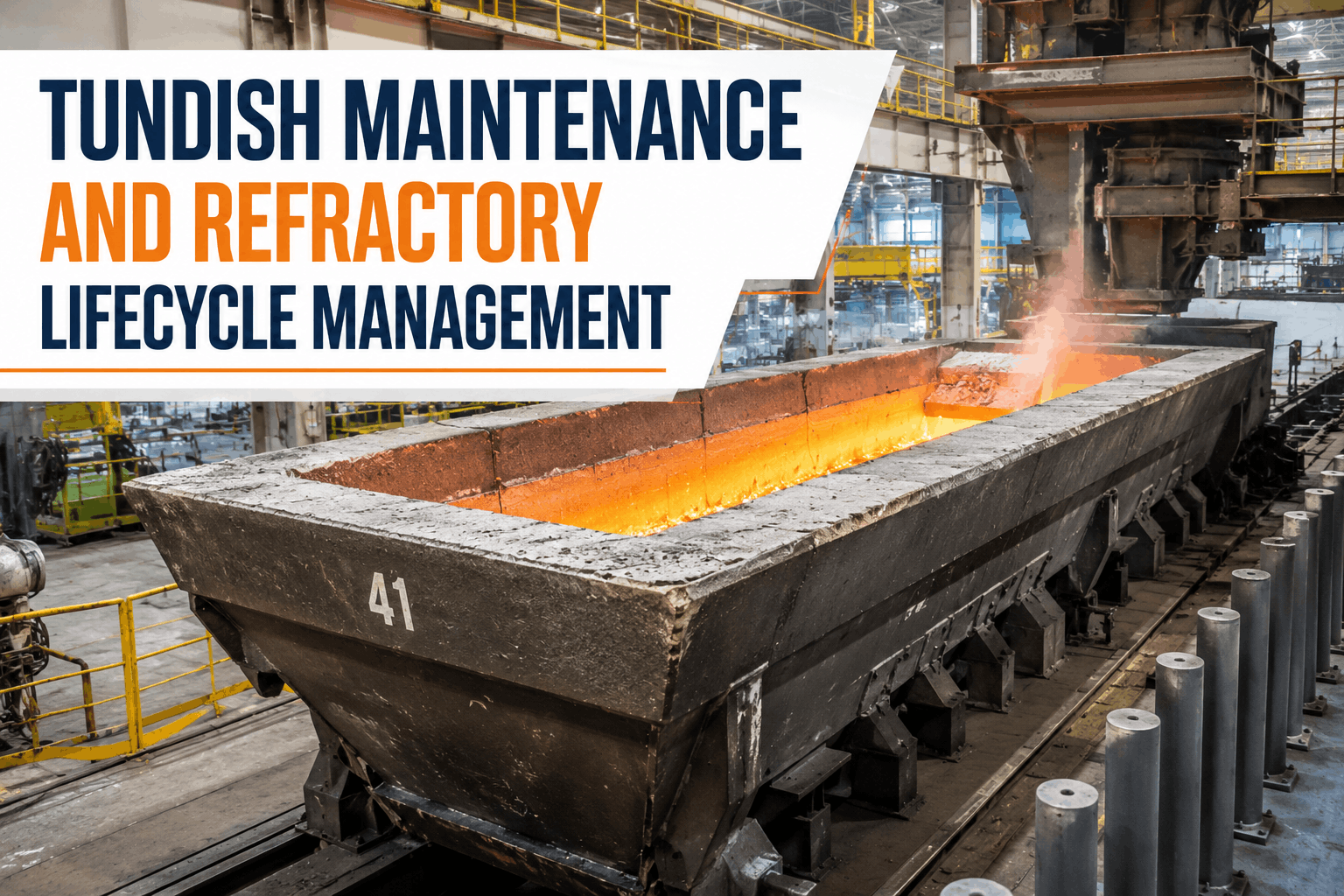
The tundish is the last refractory vessel that liquid steel passes through before it enters the mold. It is an intermediate buffer, a metallurgical refining vessel, and a flow control system simultaneously — and every one of those roles depends entirely on the condition of its refractory lining, its flow control components, and the reliability of the inspection program that monitors them. A tundish lining failure during a casting sequence is not a recoverable event. Steel contaminated by refractory skull fragments cannot be rerouted. A breakout triggered by a degraded SEN or a failed slide gate during a long sequence produces losses measured in tonnes of scrapped product, caster downtime, and potential safety incidents.
Yet in most steel plants today, tundish refractory management is driven by heat count rules-of-thumb, visual assessments at the end of a campaign, and paper records that are disconnected from caster scheduling and maintenance planning. There is no systematic trending of lining wear against process parameters, no automatic trigger linking heat count to PM inspection schedules, and no campaign audit trail that enables data-driven decisions about lining quality, preheat performance, and flow control component life. Schedule a demo to see how Oxmaint manages tundish refractory campaigns in a live CMMS dashboard.
Tundish Campaign Module
Track Every Tundish Component — Heat Count, Wear Rate, Preheat Compliance — in One CMMS
Oxmaint manages tundish working lining, SEN, slide gate, stopper rod, and impact pad as individual asset records — each with independent heat count tracking, PM schedules, and campaign audit trails that persist across every relining and refractory change.
Heat count per working lining campaign in most slab caster tundishes before relining is required — varies by lining type and steel grade mix
15%
Improvement in tundish working lining life reported by Nippon Steel after optimising metal fibre addition from 2% to 3% — measurable only with per-campaign CMMS tracking
3–5×
More refractory elements per tundish than any other casting vessel — working lining, SEN, stopper, slide gate, impact pad, dams, weirs — each requiring individual CMMS tracking
<2 hr
Time from CMMS-generated PM alert to maintenance team notification when tundish refractory records are integrated with caster scheduling in Oxmaint
Core Reliability Principle
Tundish refractory management requires simultaneous tracking of five independent component families — working lining, flow control (stopper rod or slide gate), SEN, impact pad, and furniture (dams, weirs) — each with different failure modes, inspection intervals, and campaign limits. Managing all five against a single heat count record in a CMMS eliminates the scenario where a new working lining is paired with an SEN that has already accumulated 70% of its maximum heat count from the previous sequence.
REFRACTORY LAYERS
Tundish Refractory Structure — Layer by Layer
A tundish refractory system comprises multiple layers, each serving a distinct thermal and mechanical function. Effective CMMS management requires tracking wear and condition for each layer independently — not just the vessel as a single asset.
Tundish Lining Cross-Section (from shell inward to steel contact)
Steel Shell
Structural vessel. Shell temperature monitoring detects lining breakthrough before it reaches this point
Shell
Insulation Layer
Ceramic fibre board — reduces heat loss to shell; inspected at each reline for compression and damage
10–25mm
Permanent Lining
High-alumina (70–80% Al₂O₃) castable or low-cement castable — multi-campaign life; inspected for spalling, cracks at each working lining change
80–150mm
Working Lining (Replaceable)
MgO board, spray mass, or dry vibro mass — the sacrificial layer in direct contact with steel. Tracked per campaign: heat count, residual thickness at turndown, wear rate, consumption per heat
20–50mm
Skull / Residual Layer
Frozen steel skull remaining after turndown. Thickness and skull removal efficiency affect preheat time and next-campaign startup quality — logged in Oxmaint as campaign closure record
Variable
COMPONENT FAMILIES
Primary Failure Modes Across Tundish Component Families
01
Working Lining Erosion and Penetration
The working lining experiences continuous chemical attack from liquid steel and slag, thermal cycling at each heat start and end, and mechanical erosion from steel stream impact at the pour point. In tundishes without an impact pad, the bottom working lining can erode through to the permanent lining within 30–40 heats. Tracking residual thickness at campaign turndown and calculating wear rate per heat is the only reliable method to predict campaign end before a breakthrough occurs.
02
SEN Clogging and Erosion
The submerged entry nozzle is the most failure-prone consumable in the tundish system. Alumina buildup inside the nozzle bore reduces flow area and creates asymmetric steel flow into the mold — directly causing longitudinal surface cracks, meniscus disturbance, and breakout risk. Zirconia bore linings reduce clogging but still require systematic heat count tracking, argon flow verification, and inspection at every sequence change.
03
Slide Gate Plate Wear and Sticking
Slide gate plates experience severe erosion at the bore from high-velocity steel flow. Progressive wear enlarges the bore diameter beyond its designed flow control range — producing uncontrolled flow rates that cannot be compensated by plate position adjustments. Plate sticking during opening or closing, caused by steel infiltration into the gate mechanism, creates a complete flow control emergency. CMMS heat count tracking with configurable plate change thresholds prevents both failure modes.
04
Stopper Rod Cracking and Skull Buildup
Monoblock stopper rods made from alumina-graphite with zirconia tips are subjected to extreme thermal shock at sequence start, continuous erosion from steel flow, and chemical attack from slag components. Cracking across the stopper body — typically at the argon injection port area — is the primary failure mode and develops progressively over multiple heats without becoming visible until the crack propagates to the point of control loss. Ultrasonic inspection at each sequence change, with results logged in the CMMS, is the standard detection approach.
DONUT CHART: FAILURE CAUSE DISTRIBUTION
Tundish Refractory Failure Cause Distribution
Tundish-related casting quality issues and forced sequence ends are traceable to a predictable set of root causes — the majority of which are detectable through systematic CMMS-tracked inspection before they become production events.
Tundish Sequence-Limiting Failure Origins
SEN clogging / erosion / breakage
32%
Working lining erosion / breakthrough
26%
Slide gate plate wear / sticking
20%
Stopper rod cracking / skull buildup
14%
Impact pad failure / dam/weir breakage
8%
Source: Oxmaint steel plant maintenance data synthesis; IspatGuru tundish technical literature
PARAMETER TABLE
CMMS-Tracked Parameters by Tundish Component
Component
Key Tracked Parameters
Alert / Change Trigger
CMMS Action
Working Lining
Heat count, residual thickness at turndown, wear rate per heat, steel grade mix, preheat temperature and duration
Residual thickness <20mm or wear rate >baseline + 20%
Relining WO; refractory supplier notification
SEN (Submerged Entry Nozzle)
Heat count, argon purge flow rate, mold level deviation pattern, bore diameter at each change, clogging incidents
Oxmaint treats the tundish as a multi-component asset system — not a single vessel record. Each tundish in your caster fleet gets its own asset hierarchy: the vessel itself, each refractory component family, the flow control system (stopper or slide gate), and the preheat burner assembly. Every campaign event is recorded against the specific component that experienced it, creating a per-component history that makes wear rate trending, campaign life prediction, and PM scheduling genuinely data-driven.
PM Compliance Rate
Paper System
Typical PM compliance without CMMS tracking. 38% of scheduled tundish inspections missed or undocumented
PM Compliance Rate
With Oxmaint
CMMS-triggered inspection schedules with real-time escalation for missed PMs across all tundish components
Campaign Life Gain
Average Uplift
Increase in average tundish working lining campaign life when wear rate is tracked per campaign and lining mix is optimised using CMMS data
Tundish Campaign Module
Track Every Tundish Component — Heat Count, Wear Rate, Preheat Compliance — in One CMMS
Oxmaint manages tundish working lining, SEN, slide gate, stopper rod, and impact pad as individual asset records — each with independent heat count tracking, PM schedules, and campaign audit trails that persist across every relining and refractory change.
"We had three forced sequence terminations in two months traced back to SEN clogging — every one of them happened in the 55–65 heat range. When we set up Oxmaint with heat count tracking per SEN and configured a mandatory SEN change at 50 heats, the forced terminations stopped entirely. The SEN cost per tonne went up slightly but our unplanned downtime cost per tonne dropped significantly. We couldn't have proved that case without the campaign data in the CMMS."
What is the difference between a working lining and a permanent lining in a tundish?
The permanent lining is the thick structural refractory layer (typically 80–150mm of high-alumina castable) that supports the vessel over multiple campaigns and multiple years of service. It is only replaced during major overhauls and is inspected for spalling and cracking at each working lining change. The working lining is the thinner sacrificial layer (20–50mm of MgO board, spray mass, or dry vibro mass) that is in direct contact with liquid steel and is replaced at every campaign end. The working lining is the primary campaign-limiting consumable — and the one that requires per-campaign wear rate tracking in Oxmaint to predict campaign end before a breakthrough occurs.
How does nozzle clogging develop in a tundish SEN and how is it detected?
Alumina (Al₂O₃) inclusions in the liquid steel deposit on the cold inner bore surface of the SEN in a process called build-up clogging. The deposit gradually reduces the effective bore area, increasing the pressure drop across the nozzle and forcing the operator to open the stopper rod further to maintain mold level — eventually reaching the point where full stopper opening cannot compensate for the restriction. Secondary signals include asymmetric mold level fluctuations and erratic steel flow patterns visible in the mold. Argon purging through the SEN reduces clogging by physically disrupting deposit formation. Oxmaint tracks argon purge flow rate trends and mold level deviation patterns as early warning signals, generating an investigation work order before the clogging reaches critical levels. Talk to our team about SEN heat count and clogging threshold configuration.
What preheat temperature and duration are required before opening a new tundish campaign?
Preheat requirements vary by tundish size and working lining type, but the standard target for a slab caster tundish is exit lining temperature of 1050–1100°C before the first ladle open. Below 1050°C, thermal shock at steel entry causes lining spalling and generates inclusions that compromise first-heat steel quality and reduce campaign life. Typical preheat durations range from 4–8 hours depending on vessel size and burner capacity. Oxmaint logs preheat temperature profiles and duration against each campaign start, enabling correlation between preheat quality and working lining wear rate in subsequent heats — a relationship that is invisible without per-campaign data records.
How does Oxmaint handle the transition from one tundish campaign to the next?
At campaign closure, Oxmaint records the turndown event against all active component records: residual working lining thickness, SEN heat count at removal, slide gate plate condition assessment, stopper rod inspection result, and skull removal outcome. This multi-point closure record creates the starting point for the next campaign's wear rate calculation. When the refurbished tundish is recommissioned, the working lining, SEN, and flow control components are re-entered as new component records with their installation dates — while the vessel-level history, including all previous campaigns, is preserved and searchable. See how campaign transition records work in a live demo.
Can Oxmaint track tundish refractory by supplier and lining type to compare performance?
Yes. Each tundish working lining installation record in Oxmaint captures the refractory type (MgO board, spray mass, dry vibro mass, basic spray), supplier name, batch number, and material specification. At campaign end, the consumption data — heats cast, residual thickness, wear rate per heat — is recorded against that specific material and supplier. Over time, Oxmaint accumulates statistically significant performance data by lining type and supplier, enabling data-driven procurement decisions rather than supplier selection based purely on unit cost per tonne. This is the analysis that justifies specification upgrades and identifies underperforming material batches before they become a campaign-reliability issue.
What shell temperature thresholds should trigger a tundish inspection or campaign end?
Shell temperature monitoring is the primary non-intrusive indicator of working lining remaining thickness. Most operational guidelines use 150–180°C as an advisory threshold and 200–220°C as a mandatory campaign-end trigger on the tundish bottom shell. A 10°C rise per heat above baseline should trigger an investigation work order — not just monitoring — because at that rate the shell will reach the mandatory stop threshold within 5–10 heats. Oxmaint integrates with handheld pyrometer readings or continuous thermocouple data to track shell temperature trends per campaign zone, generating work orders at both the advisory and mandatory thresholds with the trend chart attached to distinguish progressive wear from step-change events.
How does Oxmaint support tundish slide gate versus stopper rod operations differently?
Slide gate and stopper rod are fundamentally different flow control mechanisms with different maintenance parameters. For slide gates, Oxmaint tracks plate heat count, bore diameter measurements at each change, actuator pressure and response time, and plate inspection findings (cracking, edge chipping, infiltration). For stopper rods, Oxmaint tracks heat count, argon flow rate through the rod, ultrasonic inspection results at each sequence change, visual assessment of tip erosion and skull buildup, and response time from the control system. Both record types feed the same work order generation logic — a threshold exceedance or inspection finding triggers an automatic replacement work order — but the specific parameters, alert thresholds, and inspection procedures differ for each mechanism.
Does Oxmaint connect tundish refractory records with continuous caster scheduling?
Yes. Oxmaint's tundish campaign records integrate with caster sequence scheduling through two key links. First, when a tundish's working lining heat count approaches its campaign limit, Oxmaint generates a pre-scheduled relining work order with a lead time matching your typical turnaround cycle — enabling the relining to be planned into the caster schedule rather than forced by a campaign-end event during production. Second, component change work orders (SEN, slide gate plate) are linked to planned sequence breaks in the caster schedule, ensuring the physical activity is resourced and timed to coincide with a window that does not require sequence interruption. Contact our support team to discuss caster scheduling integration.
FINAL CTA
Every Campaign. Every Component. Every Heat Count — Tracked in One Tundish CMMS Record.
Oxmaint gives steel plant teams per-component tundish asset records, automatic heat count triggers, preheat compliance tracking, and complete campaign audit trails — turning tundish refractory management from a reactive discipline into a predictive one.