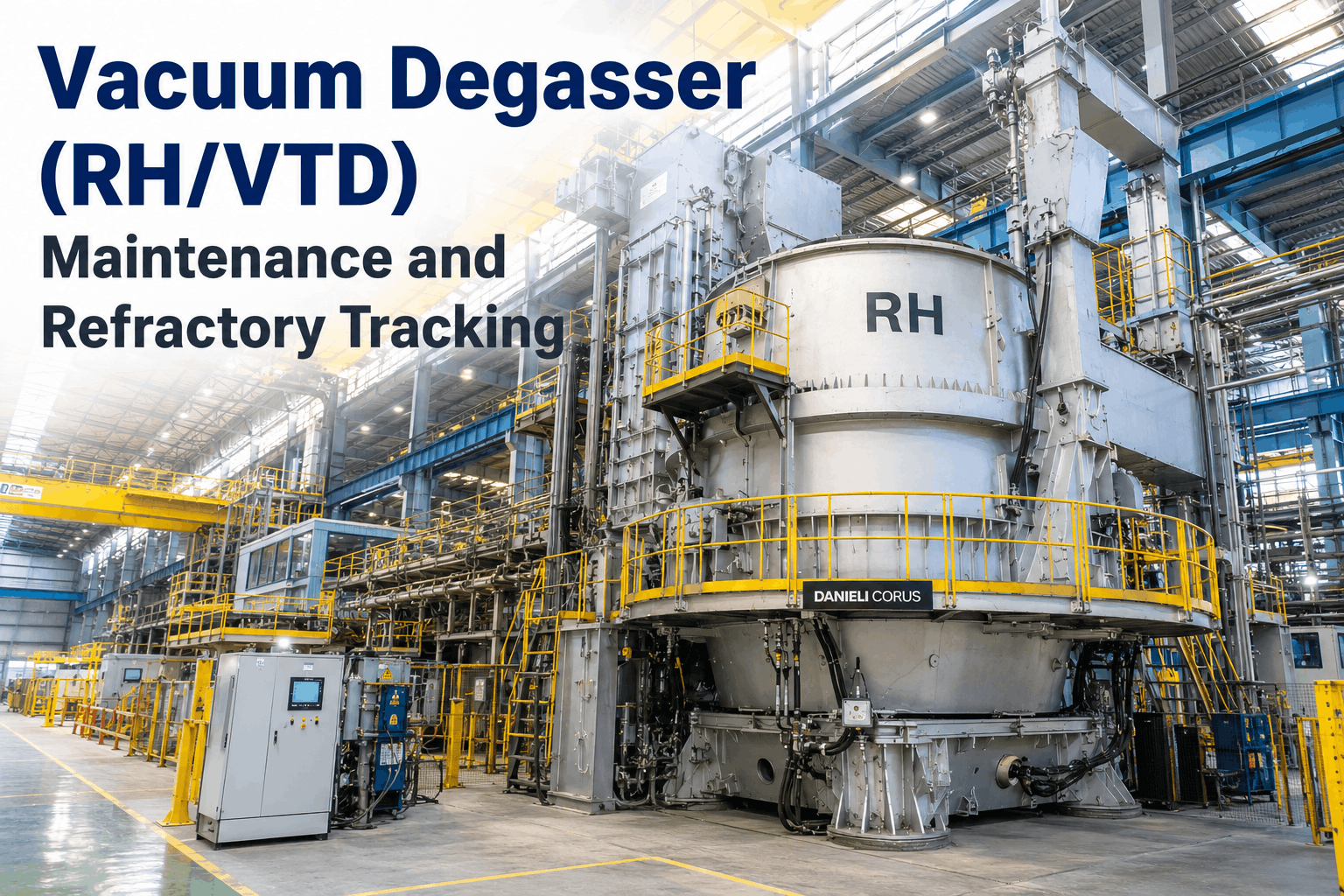
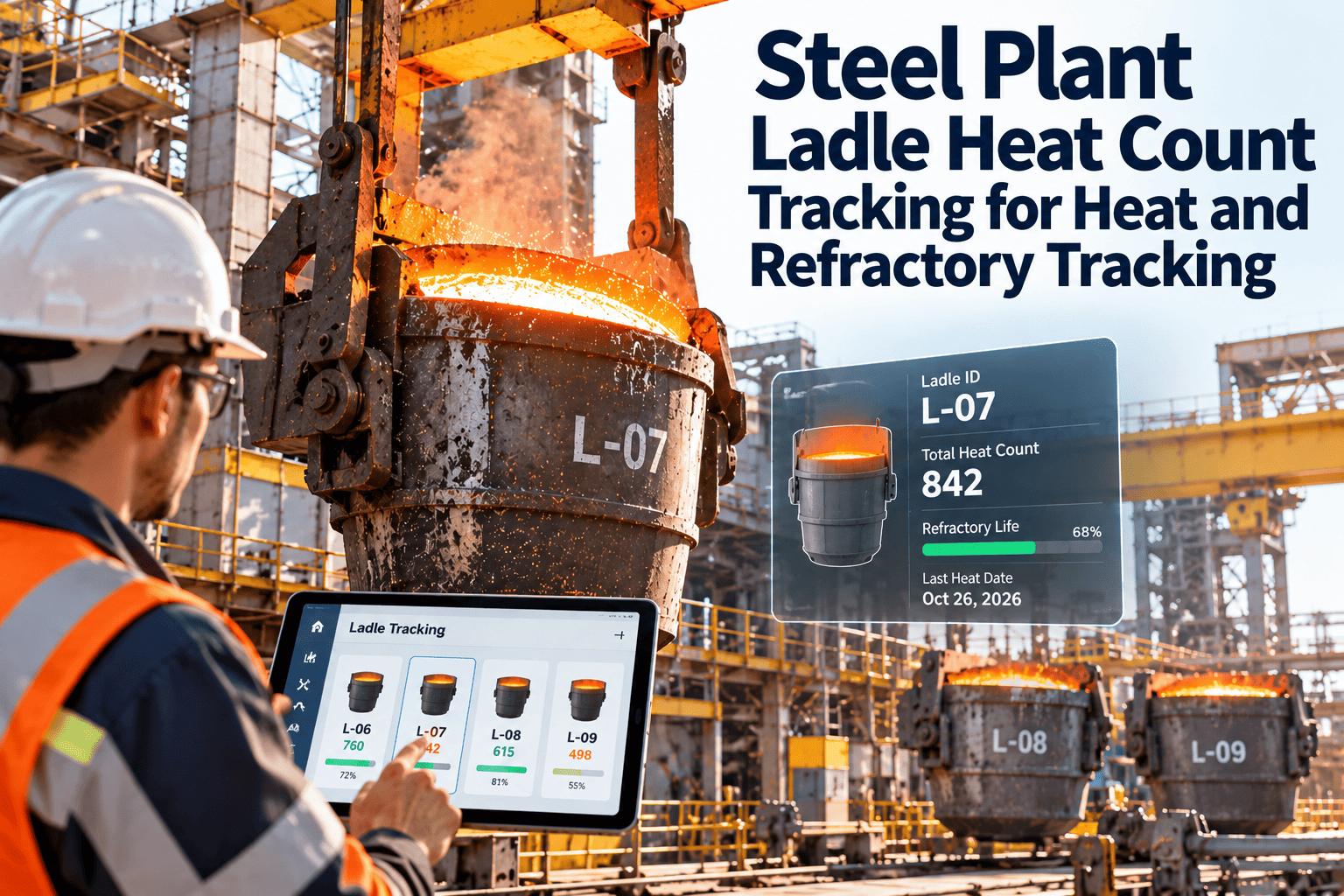
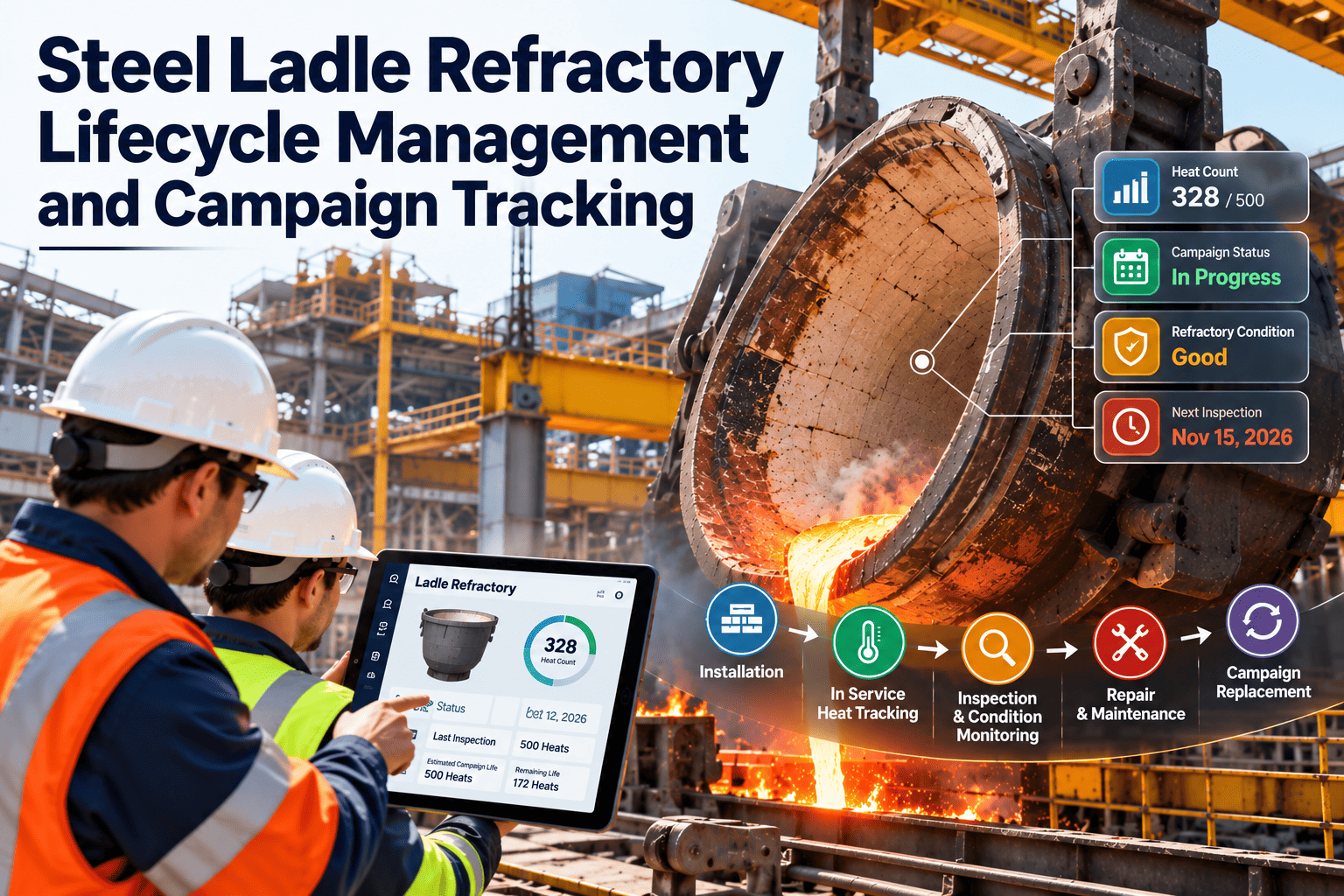
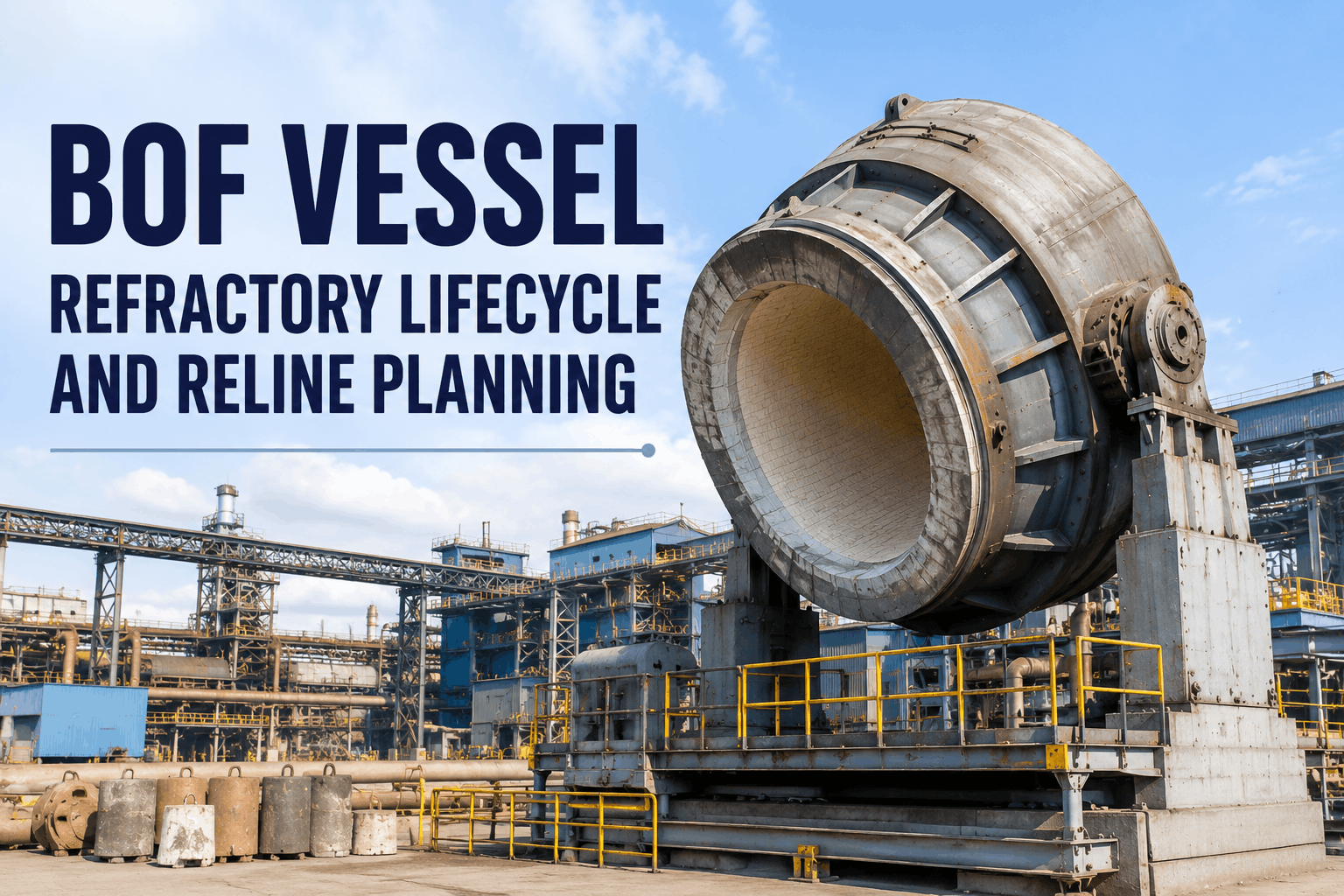
Vacuum Degasser (RH/VTD) Maintenance and Refractory Tracking
By Alex Jordan on May 14, 2026
The vacuum degasser is the most process-critical and maintenance-intensive piece of secondary metallurgy equipment in an integrated steel plant. For flat products requiring ultra-low carbon content (<30 ppm C), ultra-low hydrogen (<2 ppm), or high cleanliness for automotive and electrical steel grades, the RH or VTD degasser is a non-negotiable process step. When a vacuum degasser goes offline for an unplanned maintenance event — a snorkel refractory failure, a vacuum system leak, a skull-blocked circulation path — the production consequence ripples through the entire steelmaking sequence from BOF to caster. Heats cannot be held at the ladle furnace indefinitely; sequence timing collapses; quality commitments fail.
The refractory challenge in an RH degasser is severe even by steelmaking standards. The snorkels — the two tubular extensions that are immersed in liquid steel during treatment — experience simultaneous chemical erosion from molten steel and slag, thermal shock at each dip-in and dip-out cycle, and mechanical turbulence from the high-velocity steel recirculation driven by argon lift gas. RHI Magnesita's documented research shows that snorkel condition and hot-face vessel zones are the primary determinants of total RH campaign life. Schedule a demo to see how Oxmaint tracks RH snorkel campaigns and vacuum system PM in one dashboard.
RH / VTD Degasser Module
Manage Your Vacuum Degasser Campaign — Snorkel Wear, Vacuum Integrity, and Alloy Additions — in One CMMS
Oxmaint tracks RH and VTD degasser campaigns across all three maintenance domains — refractory, vacuum system, and mechanical — as independent but linked asset records, with automatic PM scheduling and heat count thresholds configurable per vessel and steel grade.
Minutes per RH treatment cycle — short cycle time enables high heats-per-day throughput, making PM window scheduling critical
300–600
Heats per snorkel campaign — with lower limit determined by snorkel wear rate and higher limit achievable only with systematic gunning and repair tracking
<0.5 mbar
Required vacuum level for ultra-low carbon decarburization — any vacuum system leak above detection threshold compromises ULC steel grade production
3 zones
Critical refractory zones requiring independent CMMS tracking: snorkel inner lining, hot-face lower vessel, and splash zone upper vessel
Core Reliability Principle
RH degasser campaign management requires simultaneous tracking of three independent maintenance domains: refractory wear (snorkel, vessel zones, and bottom), vacuum system integrity (vessel seals, off-gas duct, water-cooled panels), and mechanical systems (lifting mechanism, alloy hopper, argon gas circuit). A failure in any one domain can end a campaign or compromise steel quality — but they operate on completely different inspection intervals, failure modes, and PM schedules. Oxmaint manages all three as separate but linked asset families under a single vessel record.
RH vs VTD
RH vs. VTD: Maintenance Profile Comparison
RH (Ruhrstahl Heraeus) and VTD (Vacuum Tank Degasser) are both vacuum treatment processes for secondary metallurgy, but they have fundamentally different equipment configurations, refractory profiles, and maintenance requirements. Oxmaint tracks both, but the specific PM schedules, wear zones, and alert parameters differ significantly between the two.
Gunning frequencyAs needed — less intensive than RH
Key advantageLower capex; better for alloy fine-tuning
CMMS priorityVessel lining, vacuum seal, alloy records
FAILURE MODES
Primary Failure Modes and Maintenance Domains
01
Snorkel Refractory Erosion and Bore Enlargement
The inner lining of RH snorkels — typically magnesia-chrome bricks or alumina-magnesia bricks — erodes progressively under combined chemical attack from liquid steel and slag and mechanical erosion from high-velocity steel recirculation. As the bore enlarges, circulation rate decreases, treatment time increases, and energy consumption rises. CFD research shows that increasing argon flow rate to compensate for bore enlargement accelerates erosion in the upper snorkel area, creating a wear acceleration cycle. CMMS heat count tracking with bore diameter measurement at each campaign end enables wear rate modelling and gunning repair scheduling before the bore reaches the replacement threshold.
02
Vacuum System Leak and Seal Failure
The vacuum system in an RH degasser must achieve pressures below 0.5 mbar for ULC steel production. Leaks develop at vessel flanges, inspection port seals, alloy hopper gate seals, off-gas duct joints, and water-cooled panel connections. A vacuum leak that prevents reaching the target pressure level either forces regrading of the heat (scrapping the ULC classification) or extends treatment time significantly — both with major production cost consequences. Leak check procedures before each treatment campaign and vacuum pump performance trending in the CMMS are the primary preventive measures.
03
Skull Buildup Blocking Circulation Path
Steel skull accumulates at the snorkel inner bore, the vessel bottom, and around the alloy addition chutes between treatments. Significant skull buildup reduces the effective circulation cross-section of the snorkels — acting similarly to bore enlargement but developing faster and unpredictably. Skull must be removed by oxygen lancing or torch cutting at defined intervals (typically every 30–50 heats). If skull removal is delayed, the restriction can reach the point where a heat cannot be adequately treated — triggering an emergency de-skulling event that consumes a planned treatment slot.
04
Alloy Hopper and Addition System Failure
Alloy addition accuracy is the core quality-control function of the RH unit for many steel grades. Alloy hopper weighing cell drift, addition chute blockage from skull buildup, gate valve failure, and carrier gas circuit problems all create scenarios where actual alloy additions deviate from target. In a CMMS without alloy system records, these deviations are only discoverable at final product analysis — after the heat has been cast. CMMS-integrated alloy addition logs (target weight, actual weight, timing) provide the traceability to identify systematic weighing cell drift before it affects product quality.
CAMPAIGN ZONES TIMELINE
RH Campaign Lifecycle — Heat Count Zones and Actions
A well-managed RH campaign follows a predictable progression from initial commissioning through the active production phase to gunning repair cycles and eventual campaign-end relining. Oxmaint tracks each zone boundary as a scheduled PM milestone — not a reactive event triggered by a failure.
RH Campaign Phase Map (300–600 Heat Campaign)
Commissioning Phase
Heats 1–30
Snorkel conditioning; baseline bore measurement; vacuum system leak check; all systems performance-logged in CMMS
Active Production Phase
Heats 31–200
Full throughput; bore diameter checked every 50 heats; gunning at first hot-face wear signal; vacuum system daily check
Gunning / Repair Phase
Heats 201–400
Increased gunning frequency (every 30–50 heats); bore measurements more frequent; de-skulling every 40 heats; vacuum pump capacity monitored
Campaign-End Phase
Heats 401–600+
Snorkel bore approaching replacement limit; relining planned with 30-heat lead in CMMS; refractory procurement confirmed; vessel cool-down scheduled
Heat count ranges are indicative. Actual phase boundaries depend on steel grade mix, argon flow regime, and refractory material specification. Oxmaint calculates individual phase boundaries from measured bore wear rates per campaign.
PARAMETER TABLE
CMMS-Tracked Parameters by RH/VTD Maintenance Domain
Hydraulic pressure deviation or safety device failure
Mechanical inspection WO; emergency stop if safety
Alloy Addition System
Weighing cell calibration (monthly), addition deviation (actual vs target per heat), gate valve operation, carrier gas flow
Addition deviation >±3% on any single heat
Weighing cell check WO; gate valve inspection
De-Skulling
Heat count since last de-skulling, skull thickness estimate, lancing gas usage, bore restriction assessment
Heat count >configured de-skulling interval
De-skulling WO; oxygen lance scheduling
RH / VTD Degasser Module
Manage Your Vacuum Degasser Campaign — Snorkel Wear, Vacuum Integrity, and Alloy Additions — in One CMMS
Oxmaint tracks RH and VTD degasser campaigns across all three maintenance domains — refractory, vacuum system, and mechanical — as independent but linked asset records, with automatic PM scheduling and heat count thresholds configurable per vessel and steel grade.
"Our RH had three vacuum-related quality incidents in six months where we couldn't achieve the target carbon level. Each time we traced it back to a seal or flange issue that had been leaking for multiple heats before we caught it. The seal inspection was supposed to happen every shift but it kept getting deferred because there was no formal work order in the system. After setting up Oxmaint with per-shift vacuum check work orders and a pump-down time threshold alert, we have not had a single undetected vacuum leak in over a year."
AK
A. Krishnamurthy
Secondary Metallurgy Manager — RH Degassing Unit, Integrated Steel Plant
FAQ
Frequently Asked Questions
What refractory material is used in RH snorkels and why does it wear so fast?
RH snorkel inner linings are typically made from magnesia-chrome (MgO-Cr₂O₃) bricks or, increasingly, alumina-magnesia bricks. The wear mechanisms are simultaneous and severe: chemical dissolution of the refractory by liquid steel and entrained slag, mechanical erosion from high-velocity steel recirculation at up to 80–120 tonnes per minute, and thermal shock at each dip-in and dip-out cycle as the snorkel moves between ambient and 1,600°C conditions. CFD research confirms that increasing argon lift gas flow to maintain circulation rate as the bore enlarges accelerates erosion in the upper snorkel area — meaning the wear rate is not linear but self-reinforcing if gunning repair is delayed. Proper snorkel bore measurement at defined intervals and gunning at the first detectable enlargement phase is the only effective mitigation. Talk to our team about configuring snorkel bore measurement PM in Oxmaint.
How is a vacuum leak detected and confirmed in an RH or VTD system?
The primary operational indicator of a vacuum leak is pump-down time — the time from vessel sealing to target vacuum level. A vacuum leak increases pump-down time in proportion to its size. For small leaks, the target vacuum may still be achievable but with extended treatment time; for large leaks, target pressure may be unreachable entirely. Confirmation is done by vacuum decay testing: seal the vessel, stop the vacuum pumps, and measure how fast the pressure rises — a high rate of rise indicates a significant leak path. Common leak locations include flange seals between vessel sections, inspection port cover seals, alloy hopper gate seals (which experience both mechanical wear and thermal distortion), and water-cooled panel connection joints where corrosion creates pinholes. Oxmaint schedules vacuum decay test procedures as recurring PM work orders against each vessel, with recorded test results trended to identify progressive seal degradation before it affects production.
What is the optimal de-skulling interval for an RH snorkel?
De-skulling intervals vary by plant based on steel grade mix (high-carbon grades produce more skull than ULC grades), argon flow regime, and treatment temperature. The industry range is typically 30–60 heats between de-skulling events. Delayed de-skulling has a compounding effect: as skull thickness increases, the effective bore area decreases, circulation rate drops, treatment time extends, and the argon flow must be increased to compensate — which in turn accelerates refractory erosion. Oxmaint tracks heat count since last de-skulling as a real-time metric with a configurable trigger that generates a de-skulling work order at the defined interval — ensuring the activity is always scheduled into the production calendar rather than deferred until the bore restriction is visually obvious.
How does Oxmaint track alloy addition accuracy in the RH alloy hopper system?
For each treatment heat, Oxmaint records the target weight and actual dispensed weight for each alloy addition — FeSi, FeMn, Al, CaSi, and any other material additions made through the vacuum hopper. The deviation (actual minus target in kg and as a percentage) is calculated automatically and trended per weighing cell over time. When a weighing cell shows systematic positive or negative bias across multiple consecutive heats, Oxmaint generates a calibration work order for that specific cell before the drift affects product chemistry compliance. This is the key distinction from sensor-only platforms: the alloy addition record is linked to the maintenance record — when the calibration work order is closed with a new calibration certificate, that fact is attached to the asset record and the deviation trend resets from the calibration date. Schedule a demo to see alloy addition tracking in the RH module.
What is the difference in CMMS approach for RH versus VTD maintenance?
The key CMMS difference between RH and VTD management is the snorkel dimension. VTD units do not have snorkels — the ladle sits inside the vacuum tank — so there is no snorkel bore wear tracking requirement. VTD CMMS focus is on vessel lining thickness (particularly the slag line zone where ladle slag contacts the vessel wall), vacuum tank door and flange seals, and the argon stirring circuit in the ladle. RH maintenance, by contrast, centres on snorkel wear rate, de-skulling intervals, and lift gas circuit condition. Oxmaint provides separate PM templates and asset hierarchies for RH and VTD units — with each template pre-configured for the specific inspection parameters, measurement points, and alert thresholds relevant to that equipment type.
Can Oxmaint track RH-OB (Oxygen Blowing) lance condition separately from the main vessel?
Yes. RH-OB units that include an oxygen blowing lance for forced decarburization and temperature control are tracked in Oxmaint as a separate sub-asset under the RH vessel record. The OB lance has its own heat count record, water cooling flow rate and differential temperature monitoring (for cooling water leak detection), lance tip wear assessment schedule, and hoist mechanism PM schedule — all mirroring the approach used for BOF oxygen lance management but calibrated to the lower thermal load of the RH environment. When the lance tip reaches its configured heat count limit, Oxmaint generates a change work order linked to the next planned vessel cool-down window in the production schedule.
How long does it take to set up Oxmaint for an RH degasser with 2 vessels?
A standard Oxmaint setup for a 2-vessel RH degasser — including asset hierarchy creation for each vessel and subsystem, PM template configuration for snorkel, vacuum system, lifting mechanism, and alloy addition system, heat count tracking integration, and operator and maintenance team onboarding — typically runs 2–3 weeks. This includes a parallel-run validation period against existing paper or spreadsheet records to ensure the transition is seamless. Contact our support team to discuss your specific RH or VTD configuration and setup timeline.
Does Oxmaint support RH vessel hot-spare management when two vessels are operated on a rotation?
Yes. Multi-vessel RH operations — where two vessels share a common treatment stand and are rotated between active service and relining/repair — are managed in Oxmaint through a vessel rotation record that links both vessel asset records to the shared stand. When a vessel enters the repair/relining phase, its asset status is updated to "off-service" and the active vessel takes over the heat count accumulation. Gunning volume, bore measurements, and inspection records are segregated by vessel — so campaign performance comparison between the two vessels is available directly from the CMMS without manual data compilation. This multi-vessel management capability is a core Oxmaint feature that distinguishes it from simpler maintenance tracking tools that manage only single-vessel records.
FINAL CTA
Every Snorkel Campaign. Every Vacuum Check. Every Alloy Addition — Tracked in One Degasser CMMS Record.
Oxmaint gives secondary metallurgy teams per-vessel RH and VTD asset records, snorkel bore wear trending, vacuum system PM scheduling, alloy addition deviation alerts, and complete campaign audit trails — closing the maintenance information gap that drives unplanned degasser downtime.