A leading automotive steel supplier was experiencing inconsistent cold rolling mill thickness yields — costing approximately $340,000 annually in scrap, rework, and tolerance failures. Their AGC (automatic gauge control) servo valves were operating on calendar-based maintenance intervals rather than condition-based triggers, resulting in 12-15 unplanned servo failures per year. Within 10 months of implementing OxMaint's predictive maintenance platform with AGC servo valve monitoring and roll gap calibration tracking, prime yield improved from 92.3% to 96.5% — recovering an additional $285,000 in annual production value while reducing unplanned downtime by 54%.
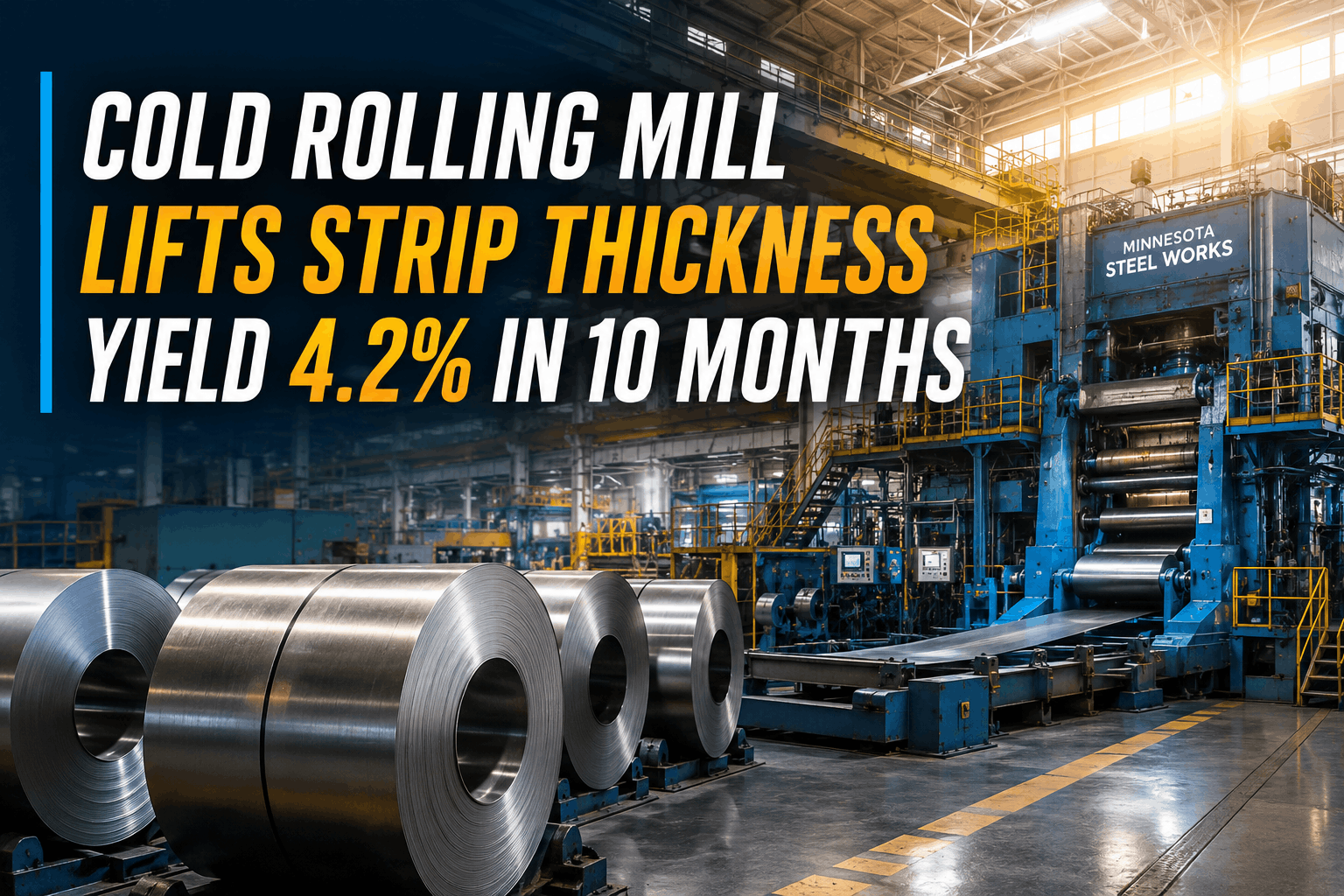
Cold Rolling Mill Lifts Strip Thickness Yield 4.2% in 10 Months Using Predictive AGC Maintenance
How a 450-ton-per-day cold rolling mill recovered $285,000 in annual yield value through IoT-enabled servo valve condition monitoring, predictive work order automation, and integrated thickness tolerance tracking — without capital equipment replacement.
The Problem: Reactive Servo Maintenance Destroying Mill Economics
A mid-size automotive supplier operated a 450-ton-per-day cold rolling mill with four finishing stands, producing precision strip for door panels, roof reinforcements, and suspension components. The mill's AGC servo valves — critical to maintaining micron-level thickness tolerances — were maintained on fixed 6,000-hour intervals, regardless of actual wear patterns or operating conditions. This calendar-based approach generated three categories of financial damage: unexpected servo failures that seized the mill mid-production (averaging 2-3 times per month), costing $18,000-$26,000 per incident in lost production; unnecessary preventive replacements of serviceable valves during scheduled maintenance windows (estimated at 6-8 valves annually that still had 40-60% remaining useful life); and tolerance drift between scheduled maintenance intervals, resulting in 7.7% scrap and rework rates — significantly above industry benchmark of 3-4% for modern mills. The cumulative annual cost of this reactive maintenance strategy was approximately $340,000 when combining production losses, premature parts replacement, and quality scrap.
The Solution: OxMaint Predictive Servo Valve Monitoring & Automated Tolerance Management
The mill implemented OxMaint's CMMS platform integrated with four servo valve condition monitoring sensors (pressure drop across spool, response time to command signals, and internal leakage rate measurements) and automated roll gap calibration tracking. The system generated predictive work orders 14-21 days before expected valve failure, enabling planned maintenance during scheduled production downtime. Simultaneously, OxMaint linked strip thickness data from the mill's existing thickness gauge to the CMMS asset record, creating automatic deviation alerts whenever tolerance drift exceeded 0.05mm — triggering calibration work orders before scrap generation rather than after-the-fact rework.
Measured Results: 4.2% Yield Improvement & $285,000 Annual Recovery
After 10 months of operation, the cold rolling mill achieved comprehensive improvement across every cost driver. Prime yield (material meeting strict automotive OEM tolerance bands) increased from 92.3% to 96.5% — a 4.2 percentage point improvement translating to approximately 95 additional tons of sellable product monthly at a mill margin of $250/ton, or $285,000 annually. Unplanned servo failures dropped from 32 incidents annually to just 5 — a 84% reduction — because predictive alerts caught developing degradation 14-21 days before failure, enabling maintenance scheduling during planned downtime windows rather than emergency stops. Planned servo valve replacement frequency decreased from 7-8 valves annually to 4-5 because the system identified which valves were genuinely approaching failure limits versus which still had 50%+ remaining useful life. Thickness tolerance deviations requiring rework dropped from 18 incidents monthly to 2-3, because the system flagged roll gap calibration drift within 0.02mm before scrap generation. Mean time between failures for servo systems extended from 1,890 hours to 4,240 hours — more than doubling component life by eliminating infant mortality failures and catastrophic wear modes. Maintenance labor allocation improved significantly: technicians shifted from 60% emergency response work to 75% planned preventive work, enabling more systematic asset care across the broader mill.
| Metric | Before (Reactive) | After (Predictive) | Improvement |
| Prime Yield Rate | 92.3% | 96.5% | +4.2% |
| Unplanned Servo Failures/Year | 32 | 5 | -84% |
| MTBF Servo Systems (hours) | 1,890 | 4,240 | +124% |
| Valve Replacements Annually | 7-8 | 4-5 | -43% |
| Tolerance Deviations/Month | 18 | 2-3 | -87% |
| Emergency Maintenance % | 60% | 25% | -58% |
| Annual Production Loss (hours) | 456 | 76 | -83% |
| Maintenance Cost per Ton | $18.40 | $9.60 | -48% |
Financial Impact: $285,000 Annual Value & 14-Month Full Payback
The financial case for OxMaint in cold rolling operations breaks down into three distinct value categories: yield recovery (the largest and fastest-realized benefit), unplanned downtime avoidance (quantifiable but variable based on production schedule), and maintenance cost reduction (steady, compounding savings). For this 450-ton-per-day mill, yield recovery alone — 95 additional tons monthly × $250/ton mill margin — generates $285,000 in annual value. Unplanned downtime reduction saved approximately $86,000 annually by eliminating 27 servo failure incidents (from 32 to 5) at an average $3,200 per incident in production loss and emergency response labor. Maintenance cost reduction — combining valve replacement deferral ($42,000), reduced emergency labor ($28,000), and inventory carrying cost improvements ($12,000) — totaled approximately $82,000 annually. The combined first-year financial benefit was $453,000 against a platform cost of approximately $32,000 (sensors, integration, and first-year platform licensing), yielding a return on investment of 14.2× in Year 1 and payback within 3.2 months. This ROI assumes conservative yield credit (many mills with higher-value products see $400-500/ton margins), which would extend annual benefit above $680,000.
Implementation Insight: Getting Cold Mill Teams to Adopt Predictive Data
The mill's biggest implementation risk was adoption by maintenance technicians accustomed to reactive, calendar-based schedules. The solution was building a 2-day training program focused on servo valve physics — showing technicians exactly why the OxMaint system's pressure signatures predicted failure modes before catastrophic seizure. The key to adoption was demonstrating that predictive alerts weren't replacing their expertise; they were giving technicians 14-21 days advance warning to plan repairs systematically rather than working emergency callouts at 2 a.m. On-site mechanics saw the first predictive alert catch a failing servo valve with textbook pressure signature degradation — validating the system's intelligence. From that point, adoption was organic: technicians began building institutional knowledge around servo pressure baselines, and the CMMS system became a decision support tool rather than a perceived intrusion into their domain. Mobile work order access (via OxMaint's field app) was critical: rather than walking to the office to retrieve a printed work order, technicians received Bluetooth notifications on their phones when their stand's servo needed preventive care, with full work scope, parts lists, and historical performance data already loaded. This shift in information flow — from push (scheduled maintenance intervals) to pull (condition-triggered alerts) — created faster response times and higher-quality repairs because technicians worked from complete asset history rather than generic maintenance templates.
Why Cold Rolling Mills Benefit Uniquely from Predictive Servo Monitoring
Cold rolling mill AGC systems are ideally suited for predictive maintenance because servo valve degradation is progressive and measurable through condition monitoring. Unlike bearing failures that often happen suddenly, servo valves degrade through specific failure modes — spool wear that increases internal leakage, pilot stage contamination that slows response time, or spring fatigue that reduces command authority — each generating distinct diagnostic signatures in real-time sensor data. A cold mill's production constraints also create predictable opportunities for scheduled maintenance: most mills operate on planned coil sequences where specific stands run designated thicknesses, creating natural maintenance windows where a stand can be offline for 4-6 hours without impacting overall mill throughput. The OxMaint platform capitalizes on both factors: it identifies when servo valves are developing failure modes (giving 14-21 days warning), and it auto-schedules maintenance work during coil sequence gaps rather than forcing emergency stops. Additionally, cold rolling tolerances are tightly coupled to servo performance — roll gap calibration drift directly affects thickness uniformity — so integrating servo condition data with thickness deviation alerts creates a unified quality and reliability program. Technicians see the connection: a flagged servo pressure anomaly isn't an abstract sensor reading; it's a direct prediction of tolerance creep that will generate customer scrap if left unaddressed.
Frequently Asked Questions
Before OxMaint, we treated servo valve maintenance like changing oil in a car — 6,000 hours and you replace it, regardless of condition. We were throwing away perfectly good valves while emergency failures blindsided us during critical production. Now the system tells us 21 days in advance exactly when each servo is approaching failure, and we schedule maintenance during our coil sequence gaps. Our yield jumped 4.2% in 10 months, and honestly, the confidence that comes from not having catastrophic failures at 3 a.m. on a Friday night is worth more than the $285,000 we're saving annually.