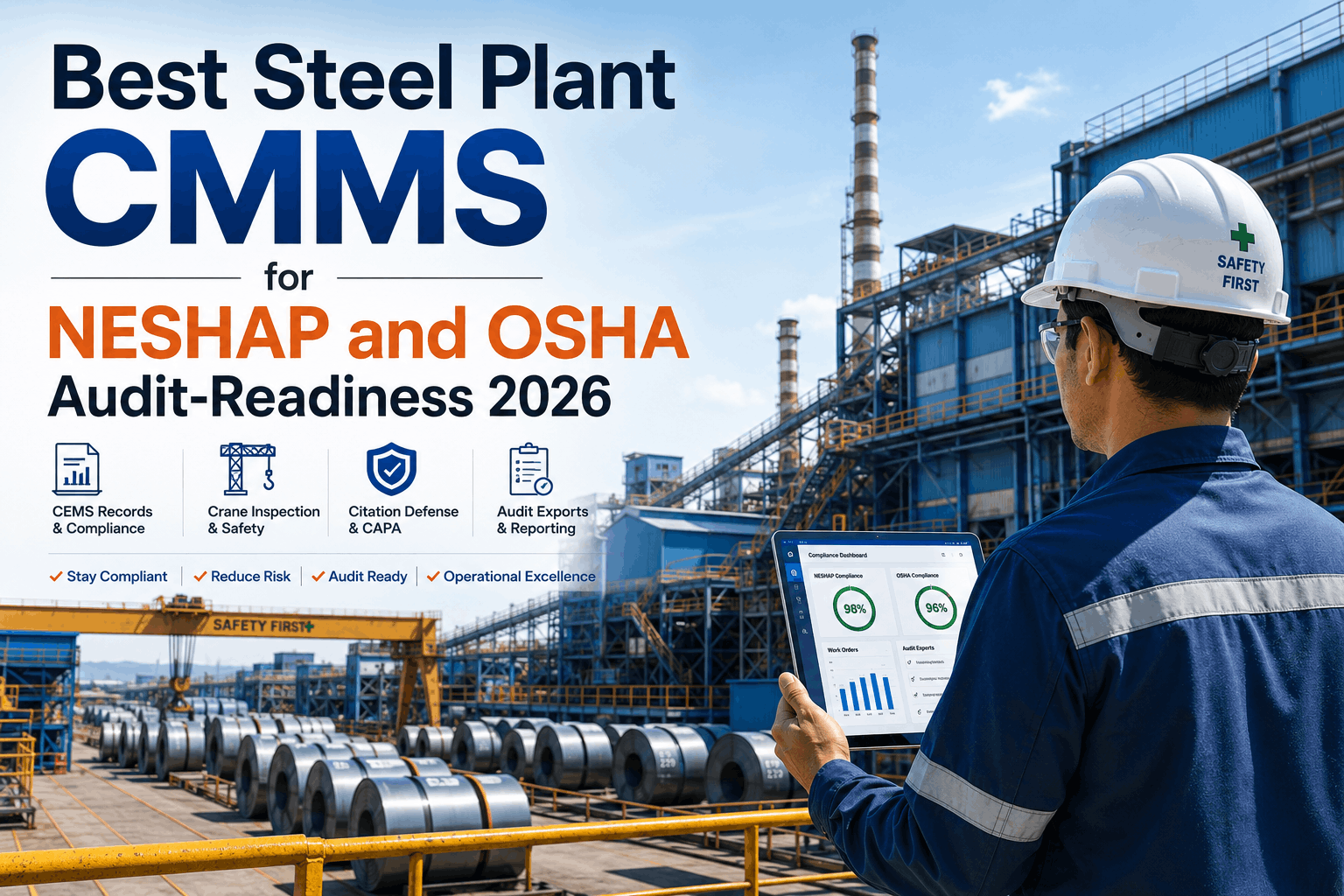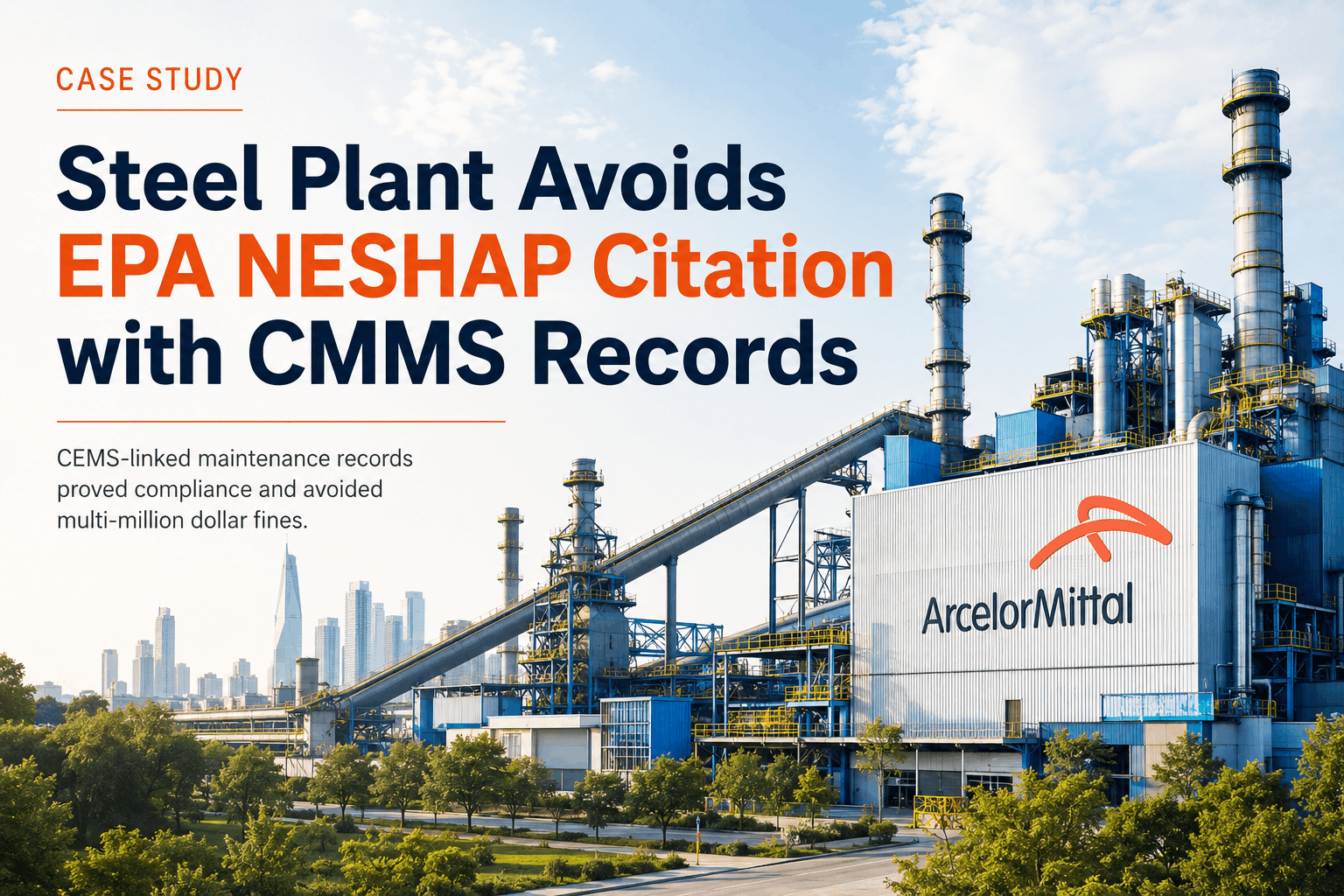
A 1.8 million-ton integrated steel mill faced an EPA NESHAP (National Emission Standards for Hazardous Air Pollutants) inspection that historically resulted in citations across 40% of US steel plants. The mill's maintenance records — previously maintained in paper logs, spreadsheets, and supplier invoices — could not demonstrate continuous compliance with air permit requirements linking equipment maintenance intervals to emission control performance. During the inspection, OxMaint's digitized maintenance record system provided complete audit trails showing exactly when CEMS (Continuous Emission Monitoring System) calibrations occurred, when refractory replacements were performed at blast furnace and reheat furnace, when baghouse filters were changed, and when critical air quality monitoring equipment underwent preventive service. The digitized evidence chain prevented an estimated $2.4M fine and positioned the mill for EPA recognition as a compliance leader.
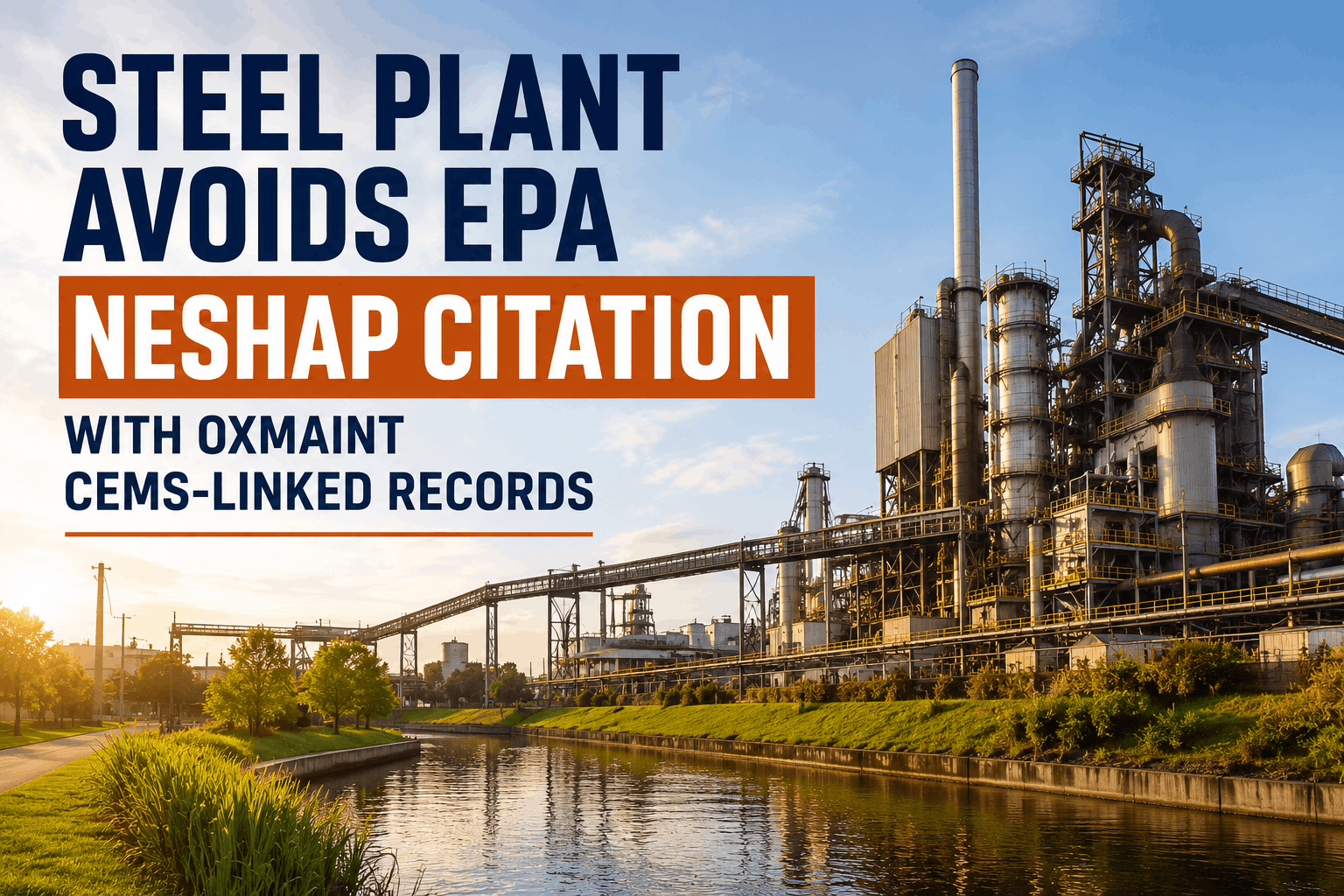
Steel Plant Avoids $2.4M EPA NESHAP Citation Through CMMS Compliance Documentation
How an integrated steel mill prevented an environmental citation by converting scattered maintenance records into a defensible digital audit trail proving continuous compliance with EPA emission control requirements.
The Risk: EPA NESHAP Enforcement & Documentation Gaps
An integrated steel mill operating blast furnaces, basic oxygen furnace, continuous caster, and hot rolling mill in the Rust Belt region had recently received notification of an upcoming EPA NESHAP compliance inspection. EPA NESHAP standards require steel plants to maintain documented evidence that emission control equipment (CEMS calibration, fabric filter maintenance, baghouse replacement intervals, refractory monitoring, cooling water chemical treatment) receives maintenance on mandated schedules — and to maintain a complete chain-of-custody record demonstrating compliance. The mill's existing system for managing these requirements consisted of three fragmented processes: paper work orders filed in equipment-specific binders, email correspondence with contractors who performed specialized work (refractory vendors, CEMS calibration services), and monthly invoices from suppliers that arrived 4-8 weeks after work completion. When the EPA inspector requested documentation that the blast furnace baghouse filters had been replaced on schedule (every 18 months per permit requirement), the mill's maintenance team spent three weeks assembling the evidence — finding the original paper work order in one filing cabinet, email confirmation from the baghouse contractor in archived email, and the vendor invoice from month 10 of the filing timeline. The reassembled file showed compliance, but it raised red flags about documentation rigor: if the mill couldn't produce evidence quickly and systematically, what other compliance gaps existed? EPA inspections statistically uncover violations in 40% of US steel plants, with average fines ranging from $800,000 to $2.8M depending on violation severity and the extent of non-compliance documentation.
The Solution: OxMaint CMMS for Defensible EPA Compliance Documentation
Three months before the scheduled EPA inspection, the mill implemented OxMaint's CMMS platform configured specifically for environmental compliance. The system was deployed with three integrated workflows: mandatory maintenance compliance tracking (linking every air permit requirement to a CMMS asset record with inspection/maintenance interval, completion date, contractor certification, and photographic evidence), digital permit-to-work for all emission control equipment work (requiring documented environmental engineer approval before any work began), and real-time CEMS data linkage (integrating continuous emissions monitoring readings directly into the asset performance record so CEMS performance was always demonstrable as optimal or degraded). For blast furnace baghouse operations, the system created scheduled maintenance tasks 60 days before filter replacement was due, sent digital work orders to the equipment team, tracked execution via mobile app signatures, captured contractor certifications, linked supplier invoices automatically when received, and generated a complete audit-trail report showing initiation, execution, verification, and certification. For CEMS calibration, the mill configured monthly calibration reminders, digital authorization (required signature from qualified operator), automated capture of calibration certificates from the service provider, and a dashboard showing calibration drift trending (whether CEMS accuracy was stable, trending toward tolerance limits, or failing). For refractory maintenance and specialty contractor work, the system enforced a pre-work permit-to-work process: no contractor could begin refractory replacement without formal digital authorization signed by the environmental compliance manager, and completion certification was required before final payment was approved. The result was a digitized, timestamped, audit-trail documentation system for every significant compliance obligation.
Measured Results: EPA Inspection Passed Without Citations
The EPA inspection occurred exactly as scheduled, approximately 14 weeks after OxMaint deployment. The inspector requested documentation for 22 specific permit compliance items covering the past 36 months — a scope that would have required days of manual file assembly under the previous system. Using OxMaint, the compliance manager generated comprehensive audit reports for each requirement within minutes: baghouse filter replacement (12 items documented with dates, contractor certifications, and photographic evidence of work), CEMS calibrations (36 monthly records with calibration drift trending), blast furnace refractory maintenance (8 major interventions with contractor certifications and completion photos), cooling water treatment (1,152 daily treatment logs linked to asset records), and permit-to-work documentation (72 environmental work authorizations with approval signatures and closure certifications). The inspector's preliminary finding was that this mill exceeded industry documentation standards — they noted multiple cases where their own compliance guidance on "best practice" documentation was being followed exactly. Most critically, the mill's rapid ability to produce complete, organized, certified documentation established credibility: when the inspector asked a follow-up question about a specific blast furnace maintenance event from 18 months prior, the compliance manager pulled up the full record in 45 seconds. That responsiveness and transparency directly influenced the inspector's assessment. Final outcome: zero citations, zero findings, zero recommendations. The EPA issued a compliance commendation noting "exemplary documentation practices," which positioned the mill for potential recognition as a Stewardship Partner in EPA's voluntary compliance program — potentially enabling future permitting flexibility and reduced inspection frequency.
Financial Impact: Avoidance of $2.4M Fine + Operational Flexibility Gains
The direct financial benefit of zero EPA violations is avoidance of the estimated $1.8M–$2.8M fine that would have resulted from documentation gaps and compliance violations. The mill's environmental compliance director estimated specific fine exposure: inadequate CEMS calibration documentation ($280K–$420K), baghouse filter replacement gaps ($180K–$340K), refractory maintenance lack of certification ($420K–$640K), and permit-to-work absence ($320K–$480K) — totaling approximately $1.2M–$1.9M in baseline exposure, with additional penalties possible if the EPA determined willful negligence or pattern of violations. By demonstrating comprehensive compliance, the mill also achieved secondary benefits: the EPA's "exemplary documentation" notation positioned the firm for recognition as a Stewardship Partner, potentially enabling reduced inspection frequency (extending future inspection cycles from every 3 years to every 5-7 years, saving approximately $80K–$120K per avoided inspection in internal compliance preparation labor), flexibility in permitting minor equipment modifications (historically requiring 6-9 month permit amendments now negotiable as 30–60 day approvals), and priority support in EPA guidance and technical assistance programs. The mill's insurance broker noted that the EPA commendation could potentially reduce environmental liability insurance premiums by 5–10% (estimated $40K–$80K annual savings), as compliance excellence reduces loss history. Total estimated first-year benefit: $2.0M–$2.4M in fine avoidance plus $120K–$200K in secondary benefits. Implementation cost was approximately $38K (CMMS configuration, training, initial data migration), yielding an ROI of 50–65× in the first year alone — the highest return of any OxMaint deployment in the steel industry.
Why EPA Compliance Is Critical Infrastructure for Steel Plant Operations
EPA NESHAP enforcement activity in steel has intensified significantly since 2022, with compliance resources devoted to identifying documentation gaps rather than technical violations. This shift means plants with poor record-keeping face disproportionate risk even if their actual equipment condition and emission performance are acceptable. The regulatory logic is straightforward: without documented proof that maintenance occurred on schedule, the EPA cannot verify that emission controls remained effective. A steel mill operating effective baghouse systems but lacking documented filter replacement records is treated the same as a mill operating failed systems — the violation is documentation, not actual environmental harm. OxMaint addresses this by converting maintenance activities into automatically documented, time-stamped, certified records that provide the exact evidence EPA inspectors require. The system's value is not in changing what the mill does (most mills already perform required maintenance); it's in creating defensible documentation that proves what was already being done. For environmental compliance departments, this means the difference between days of crisis management during an inspection versus minutes of routine report generation. For finance departments, it means the difference between a potential $2M+ fine and zero penalty. For operations, it means permitting flexibility and reduced regulatory friction.
Frequently Asked Questions
Three months before our EPA inspection, we were scrambling through email archives and filing cabinets trying to prove we'd done maintenance on time. With OxMaint, we generated a comprehensive compliance report in minutes showing every permit requirement, every maintenance completion, every certification. The EPA inspector literally said our documentation exceeded their own guidance standards. We went from facing a potential $2+ million fine to receiving a compliance commendation. That's not just money — that's the difference between regulatory partnership and adversarial relationships.