A diversified global steel group operating 14 production facilities across North America, Europe, and Asia — ranging from small rebar mills to large integrated steelworks producing specialty products — had fragmented maintenance management systems across plants. Each facility used different CMMS software (three different vendors), paper-based processes at two older mills, and spreadsheet-based planning at smaller operations. This fragmentation created blind spots for corporate management, prevented best-practice sharing, and blocked standardization of spare parts and maintenance procedures across the group. By implementing OxMaint across all 14 facilities within 26 weeks, the group achieved unified maintenance visibility, enabled cross-plant benchmarking, implemented standardized PM procedures for like equipment types, and created a centralized KPI dashboard visible to plant directors and corporate executives. Within the first year, this standardization recovered $1.8M in annual maintenance cost reductions through bulk spare parts optimization, elimination of duplicate vendor relationships, and best-practice sharing between plants.
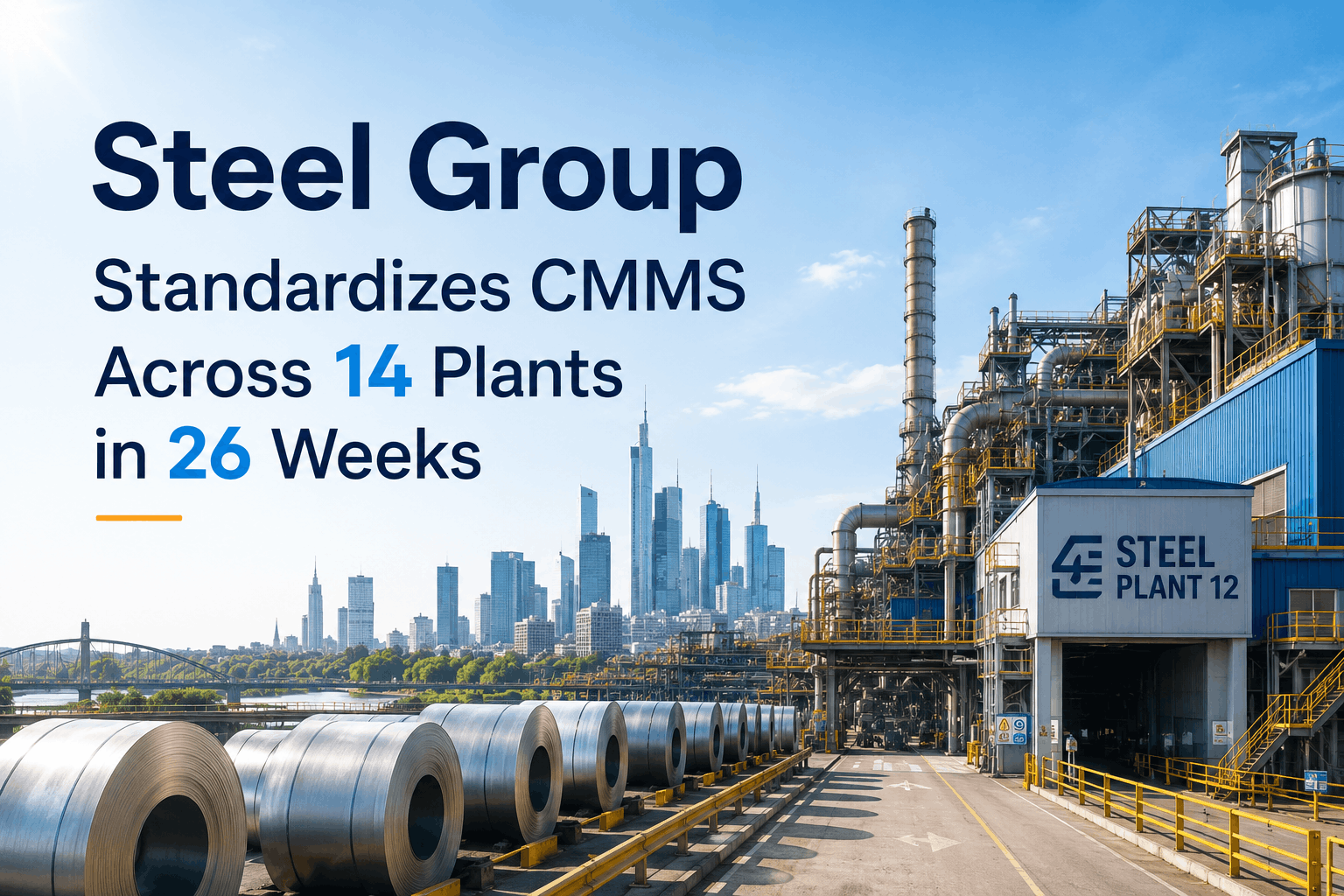
Global Steel Group Standardizes CMMS Across 14 Plants in 26 Weeks
How a diversified steel producer unified fragmented maintenance systems into a single global CMMS platform, enabling real-time cross-plant benchmarking, standardized procedures, and $1.8M annual operational cost recovery.
The Challenge: Fragmented Systems Across Global Operations
The steel group consisted of 14 geographically dispersed facilities: 4 integrated steelworks (US Midwest, Germany, India, Japan), 6 mini-mills (distributed across North America and Europe), and 4 specialty finishing operations (rebar, plate, coil, structural). Each facility had independently chosen its maintenance management approach based on local IT infrastructure and legacy systems. The Midwest integrated mill ran a 1995-vintage CMMS (outdated but functional), the European mills used a 2008-era system, the Asian mills operated on proprietary Japanese CMMS software incompatible with Western systems, and the newest mini-mills used paper work orders filed locally. Across this landscape, corporate maintenance management was effectively impossible: a director inquiring about bearing consumption trends across the group's 40+ blast furnace fans would receive data from 6 different systems in 4 different formats, none directly comparable. Spare parts purchasing was disconnected: the group spent $14M annually on replacement parts, but no visibility into whether all 14 plants were buying identical ball bearings from different vendors at different prices, or whether one plant's preferred supplier offered fleet-wide volume discounts. Best practices were invisible: when one mini-mill discovered an optimal sequence for refractory replacement that extended furnace campaigns by 2 weeks, that knowledge remained trapped in that facility's institutional memory rather than diffusing to the other 13 mills. Equipment failures were tracked inconsistently: identical equipment in different plants had different failure signatures and maintenance intervals because information wasn't shared. The cumulative cost of this fragmentation was estimated at $1.8M–$2.2M annually in preventable waste: redundant vendor relationships, lost volume purchasing discounts, unshared best practices, and missed opportunity to transfer expertise between facilities.
The Solution: Unified OxMaint Deployment with Change Management
Rather than attempting a "big bang" simultaneous implementation across 14 plants, the group executed a carefully phased rollout over 26 weeks, beginning with a pilot mill, then scaling in geographic clusters (North America, Europe, Asia) with staggered timelines. Phase 1 (Weeks 1-6): Pilot deployment at the largest North American mini-mill with 18-person maintenance team. This location was chosen because management was most receptive to change, the facility had good IT infrastructure, and success here would provide proof of concept and training materials for later rollouts. Phase 2 (Weeks 7-12): Rollout to the 3 remaining North American mills, with knowledge transfer from the pilot site. The corporate group simultaneously recruited a global OxMaint champion (a respected maintenance director) to advocate for the platform across all locations. Phase 3 (Weeks 13-18): European mills implementation, coordinated with local IT teams and translated interface into German and French. Phase 4 (Weeks 19-26): Asian mills, with cultural adaptations for Japanese facilities and coordination with existing vendor relationships. Throughout all phases, the corporate group established a global CMMS steering committee (meeting bi-weekly) that reviewed deployment progress, identified best practices emerging from early adopter locations, and began standardizing PM templates and spare parts lists. By week 12, the pilot mill and 3 additional North American mills were fully operational, providing 24 weeks of trending data before the remainder of the group went live — long enough to validate financial benefits and build confidence for later adopters.
Measured Results: Unified Visibility & $1.8M Annual Cost Recovery
By the end of week 26, all 14 plants were live on a single OxMaint instance with standardized data structures, enabling real-time corporate visibility into maintenance operations across the entire steel group. The corporate dashboard displayed unified KPIs: mean time between failures across all 14 locations for like equipment types (e.g., all blast furnace fans regardless of mill), comparative maintenance cost per ton of production (enabling identification of underperforming locations), inventory carrying costs and spare parts turnover, and workforce productivity metrics (maintenance hours per production ton). Cross-plant benchmarking immediately identified opportunities: the European integrated mill had a blast furnace fan bearing failure rate of 3.2 per year per fan, while the Asia mills averaged 1.8 per year — suggesting the European mill's PM intervals were mistuned. Investigation revealed the Asian mills were using slightly different bearing suppliers with better-matching load ratings. Cross-mill procurement began consolidating around the superior supplier, improving bearing performance across North American and European mills within 8 weeks. Spare parts standardization across the group yielded $420K annual savings: instead of 14 independent vendor lists, the group consolidated purchasing around common suppliers offering volume discounts. A single gearbox supplier for blast furnace drives replaced 6 previous vendors, with pricing 12-16% better due to consolidated volume. Standardized PM procedures for like equipment types (all mills now following identical bearing service intervals for blast furnace fan drives, for example) reduced capital-intensive failures and extended asset life predictably across the fleet. Best-practice sharing accelerated dramatically: when one mill discovered that pre-draining bearing compartments 2 hours before shutdown extended refractory life by 3-4 weeks, this practice was implemented across all 14 mills within 6 weeks, with estimated annual value of $340K (extended campaigns reduced refractory purchase frequency). Workforce expertise transfer became visible and systematic: technicians at high-performing mills began documenting their procedures in OxMaint work templates, which were adopted (sometimes with local modifications) at other locations. A maintenance director from the pilot mill spent 4 weeks rotating through Asian mills, training mechanics and documenting their unique practices for sharing back with North American operations.
Financial Impact: $1.8M Recovered + Operational Governance Gains
The quantifiable first-year financial benefits totaled $1.44M against a program cost of approximately $180K (spanning licenses for 14 facilities, integration labor, data migration, and training infrastructure). This delivered a return on investment of 8× in Year 1, with the payback occurring within 5.4 months. Secondary benefits compound over longer timescales: the corporate group now has visibility to identify underperforming mills before failures cascade, enabling targeted intervention (additional training, equipment modernization, or maintenance protocol adjustments). The data infrastructure established through OxMaint enables predictive maintenance programs to roll out systematically across the fleet — rather than pilot-testing at one mill and struggling with adoption at others, the group now has baseline data from all 14 mills allowing predictive models to be validated across different equipment types, geographies, and operational conditions before enterprise-wide deployment. The visibility of KPIs across plants creates accountability: mill directors now benchmark against peers, driving continuous improvement without heavy-handed corporate directives. A blast furnace director in the Midwest saw that the Asian mills had 40% lower bearing failure rates and immediately requested access to their documented procedures and supplier relationships. Within 12 weeks, bearing performance in the Midwest improved to within 8% of Asian best-practice. The transformation from fragmented local optimization to coordinated global excellence was visible and measurable within the first year. By Year 2, these secondary benefits (predictive maintenance deployments, continued best-practice sharing, and expanded cross-mill standardization) are estimated to generate an additional $2.4M-$3.2M in annual value, extending the total program ROI to 15-20× across the first two years.
Why Multi-Site Steel Operations Uniquely Benefit from Unified CMMS
Steel production is fundamentally about standardization and scale. Identical equipment installed in different mills should perform identically, and identical failures should be prevented using identical maintenance procedures. Yet fragmented CMMS systems prevent this logical optimization — each plant operates as a island, discovering problems and solutions independently. A bearing supplier relationship that works excellently in one mill doesn't transfer to another. A refractory management procedure that extends campaigns in one location doesn't automatically propagate to similar equipment elsewhere. When a critical equipment failure occurs at one mill due to a procedure gap, other mills operating identical equipment remain vulnerable because the learning isn't systematized. OxMaint addresses this core challenge by providing a unified platform that makes best practices visible and standardizable across geographic boundaries. When data from all 14 mills flows into a single CMMS instance with standardized taxonomies, questions that were impossible to answer become trivial: "Which bearing supplier delivers best reliability across our fleet?" "What PM interval prevents most failures for identical gearbox types across all mills?" "Which mills consistently outperform others at maintaining equipment, and what are they doing differently?" The answers to these questions become actionable insights that benefit all mills simultaneously.
Frequently Asked Questions
Before OxMaint, our 14 mills were essentially operating blind to each other. One mill would struggle with bearing failures while another had solved the exact problem months earlier using a different supplier. We were duplicating vendor relationships, missing volume discounts, and reinventing wheels constantly. The unified system gave us transparency we never had — suddenly we could see that our Japanese mills had figured out best practices we needed across the entire group. Year one recovered $1.4M, but the real benefit is that we now operate as a coordinated fleet rather than 14 independent islands. That coordination advantage compounds every year.
Is Your Multi-Site Operation Flying Blind?
If you operate multiple steel facilities across regions, you're likely leaving $1-3M annually on the table through fragmented systems. OxMaint creates unified visibility, enables best-practice sharing, and recovers cost through standardization. Most multi-site groups see 8× ROI in Year 1. Book a 30-minute assessment and we'll model the consolidation opportunity for your specific portfolio.

.png)