Permit-to-Work (PTW) systems are the critical control layer between hazard identification and actual maintenance execution in steel plants. While Lockout/Tagout (LOTO) controls energy, Permit-to-Work controls the HUMAN risk environment: hot work (welding, cutting, grinding at >400°F) can ignite furnace insulation or residual gas; confined space entry (blast furnace belly pans, closed cooling tanks, pipeline internals) creates asphyxiation and engulfment hazards; and working at height on blast furnace stoves, cathead structures, or bridge cranes exposes technicians to falls. OSHA standards govern each: NFPA 51B (hot work), OSHA 1910.146 (confined space), and ANSI A92 (fall protection). A steel plant without a rigorous PTW system—or worse, one relying on paper forms that get lost or improperly completed—has catastrophic liability exposure. Each year in the U.S., occupational fatalities in steel/metal manufacturing average 40–50 deaths and 2,500+ serious injuries, with confined space, hot work, and falls accounting for roughly 60% of fatalities. A CMMS-integrated PTW system enforces permit sequencing: a technician cannot begin hot work until an air quality monitor confirms no explosive gas is present, a confined space entry cannot proceed until rescue equipment is staged and a rescue team is on standby, and fall protection work cannot start until anchor points are verified and tested. Oxmaint's Permit-to-Work module auto-generates permits tailored to equipment type and hazard severity, enforces permit sign-offs by authorized supervisors, and digitally timestamps permit execution—creating immutable audit trails for OSHA inspections.
Master Permit-to-Work Systems.
Download our complete hot work, confined space, and height work permit templates. Get NFPA 51B checklists, OSHA 1910.146 confined space procedures, and CMMS integration guides instantly.
The Three Critical Permit Categories in Steel Plants
Permit-to-Work is an umbrella system covering three major hazard categories: hot work permits (NFPA 51B), confined space entry permits (OSHA 1910.146), and working-at-height permits (ANSI A92). Each has distinct permit requirements, approval authorities, and pre-work safety controls. A blast furnace refractory repair might trigger all three simultaneously: hot work (furnace interior temperature), confined space (closed brick chamber), and height work (technician standing on scaffolding 80 feet above grade). A CMMS that can issue comprehensive multi-hazard permits—combining all three control measures into a single coordinated work authorization—eliminates the gaps that paper-based systems create when technicians miss one hazard category.
STEEL PLANT PERMIT-TO-WORK APPROVAL AUTHORITIES
Hot Work Permit (NFPA 51B)
Safety Officer
Confined Space Entry Permit (OSHA 1910.146)
Competent Person
Work at Height Permit (ANSI A92)
Supervisor
Electrical Work Permit
Electrical Supervisor
Excavation/Digging Permit
Operations Manager
Line Breaking/Depressurization Permit
Operations Lead
Hot Work Permits (NFPA 51B - Oxygen-Cutting & Welding)
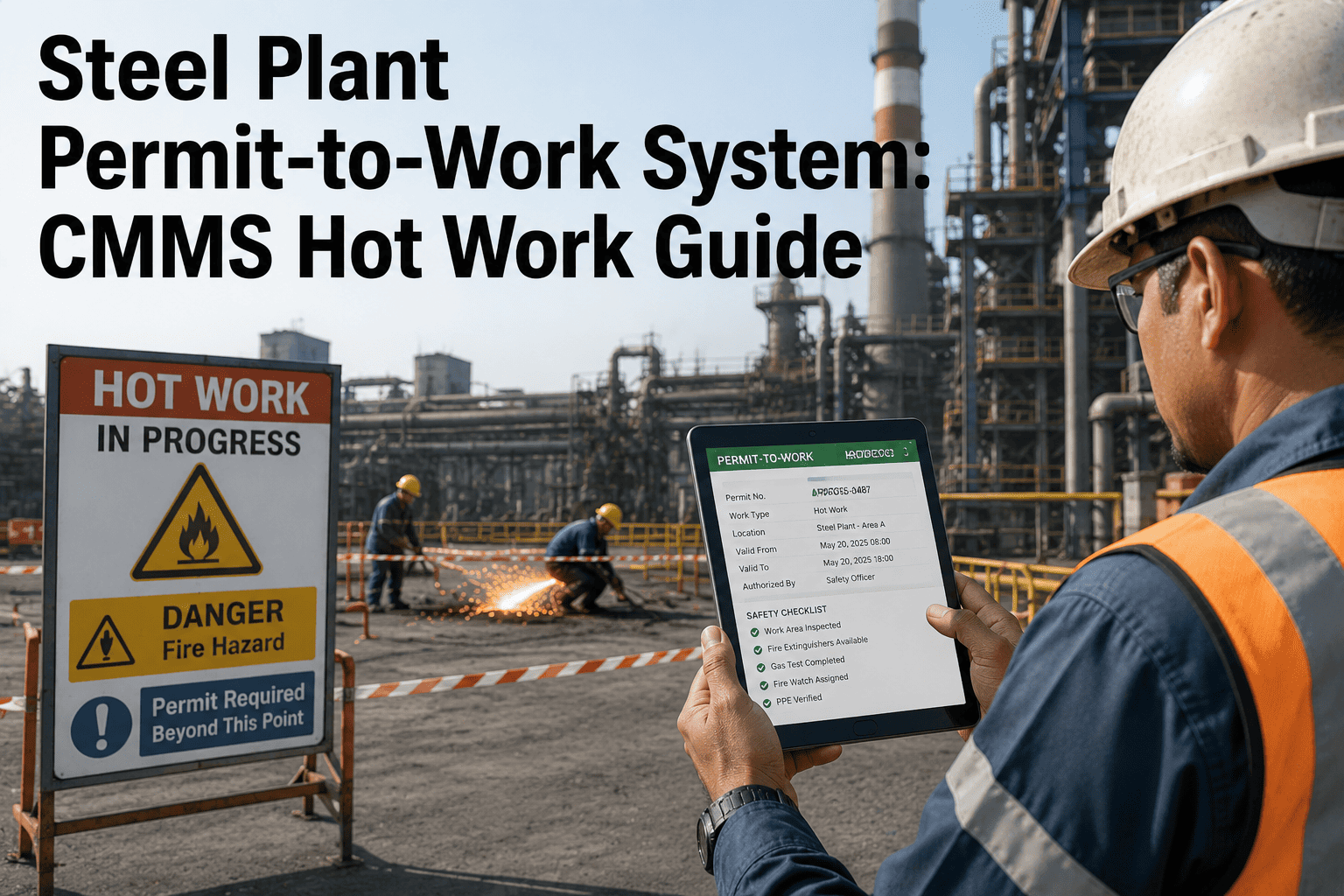
Hot work—welding, oxy-fuel cutting, grinding, torch-cutting, or any spark-generating activity—requires a NFPA 51B hot work permit whenever work occurs within 35 feet of combustible materials. In a steel plant, this covers nearly every location: furnace insulation contains combustible materials, pipe lagging is flammable, and even "inert" settings can contain hidden combustibles. A hot work permit requires: (1) hot work zone inspection confirming no combustibles within 35 feet, (2) fire watch assignment for the duration of work and 30 minutes after completion, (3) portable extinguisher placement, and (4) continuous atmospheric monitoring confirming no explosive gas accumulation. A CMMS-integrated hot work permit auto-generates based on work location, pulls up site-specific combustible material maps, and enforces fire watch assignment before permit issue. If a technician completes welding at 2:45 PM, the CMMS timer automatically extends fire watch duty until 3:15 PM—preventing the premature clearance that often leads to fires.
Hot Work Permit Checklist
Pre-Work Requirements (NFPA 51B)
1. Hot work area inspected within 8 hours of work start—no combustibles within 35 feet documented via photo. 2. Portable fire extinguisher (minimum 5 lbs ABC powder) staged within 25 feet of work zone. 3. Fire watch assigned: competent person stationed entire duration + 30 min after work ends. 4. Atmospheric monitoring: continuous monitor deployed measuring O₂ (18.5-23%), LEL (flammable gas <10%), and H₂S (<10 ppm). 5. Work confined to designated hot work zone with temporary barriers if necessary. 6. LOTO completed on all energy sources (if equipment is being cut/welded). 7. Permit signed by Authorized Welding Supervisor and acknowledged by fire watch and welder. A CMMS checklist enforces every item—permit cannot be issued until all boxes are checked and photos attached.
Confined Space Entry Permits (OSHA 1910.146)
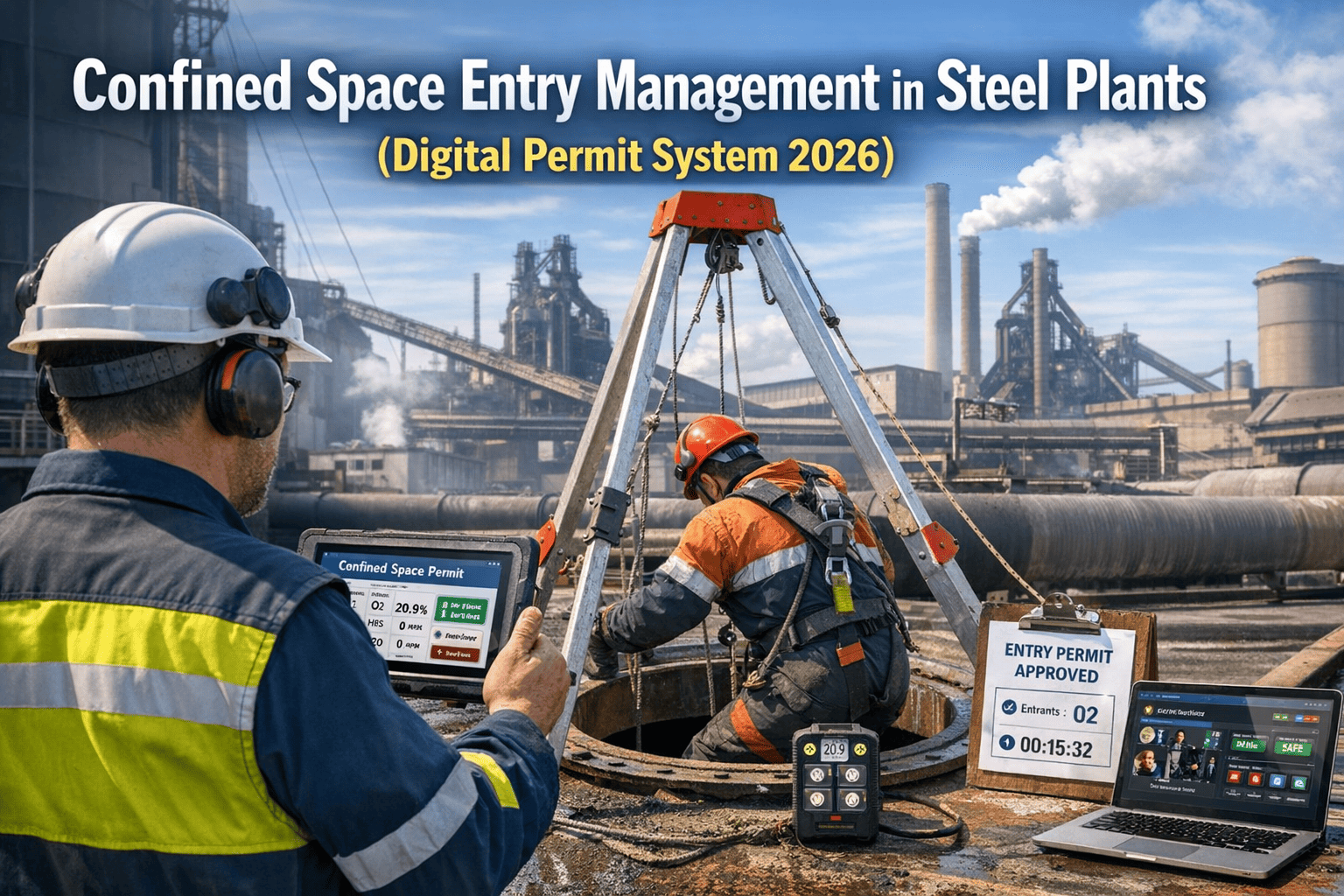
A confined space is defined by OSHA as: (1) large enough to enter, (2) limited means of entry/exit, (3) not designed for continuous occupancy. In steel plants, common confined spaces include: blast furnace belly pans, water cooling tanks, pipeline segments, chemical storage tanks, and dust collectors. Confined space entry kills approximately 60 workers annually in the U.S. because the hazards are invisible: oxygen-deficient atmospheres (from inert gas purging or consumption by corrosion), hydrogen sulfide (from water treatment or residual process chemicals), and engulfment risks (suddenly filling with liquid or material). An OSHA 1910.146 permit requires: (1) atmospheric testing confirming safe conditions, (2) mechanical ventilation to maintain safety, (3) rescue equipment staged outside the space, (4) rescue team on standby, (5) continuous attendant monitoring, and (6) entrant training certification on file.
✓ Critical Control
Atmospheric Testing (The Most Important Step)
Before ANY person enters a confined space, a qualified person must test the atmosphere using a 4-gas monitor: Oxygen (19.5-23.5%), LEL (flammable gas <10%), H₂S (≤10 ppm), and CO (≤35 ppm). The CMMS records monitor readings, technician ID, timestamp, and monitor serial number. If readings are outside safe ranges, the permit is automatically rejected and ventilation must be deployed.
✓ Critical Control
Rescue Team Standby (Non-Negotiable)
Before entry, a trained rescue team must be staged OUTSIDE the confined space with rescue equipment (tripod, harness, retrieval rope). The CMMS permit cannot be finalized until rescue team members are named and their rescue certifications are verified in the system. This prevents the "we'll figure it out if something goes wrong" mentality that leads to fatalities.
✗ Mistake to Avoid
Assuming "It's Always Safe" in Familiar Spaces
A technician who's entered a water tank 50 times before might skip atmospheric testing on the 51st entry—and that's when oxygen deficiency from a malfunctioning ventilation system kills them. A CMMS-enforced permit makes atmospheric testing mandatory every single time, no exceptions.
✓ Critical Control
Continuous Attendant Monitoring
A trained attendant must remain OUTSIDE the confined space during entry, monitoring the entrant via two-way communication and watching for signs of distress. The CMMS permit designates the attendant by name and confirms they've received training in confined space entry/rescue procedures.
✓ Critical Control
Continuous Ventilation During Entry
Mechanical ventilation must run continuously during entry to maintain safe atmosphere. The CMMS timer tracks ventilation start time and ensures continuous operation. If ventilation stops mid-entry, the system alerts the attendant to pause work immediately.
✗ Mistake to Avoid
Permitting Multiple Entrants Without Individual Harnesses
If two technicians are entering the same confined space, each must have their own harness and retrieval rope—not a shared system. A CMMS permit specifies individual entrants and requires each to be equipped independently, preventing the "buddy system" misconception.
Working at Height Permits (ANSI A92 & OSHA Fall Protection)
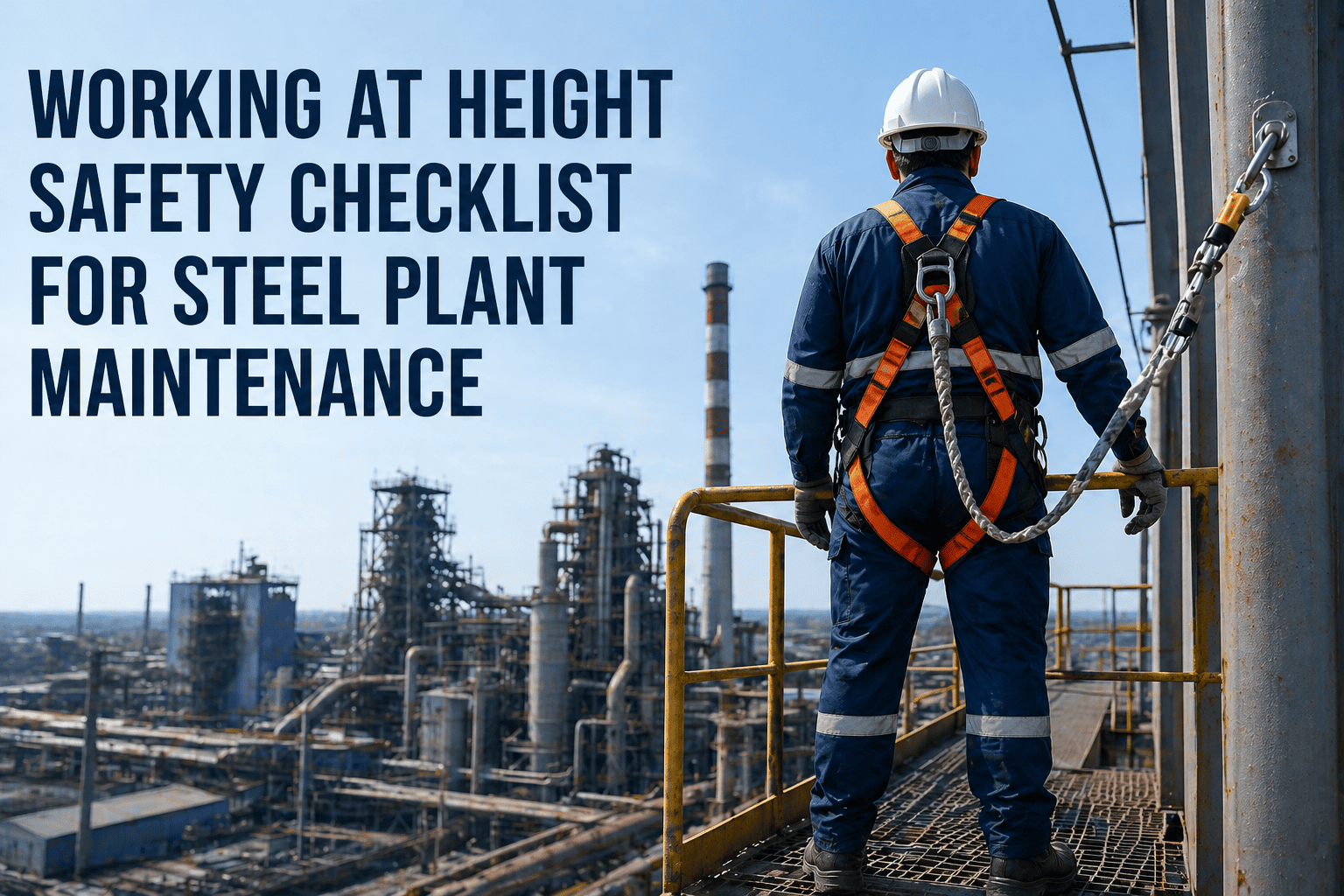
Any work performed 6+ feet above ground or water (or above a hazardous surface at any height) requires fall protection and a working-at-height permit. In steel plants, this includes work on cathead structures, bridge cranes, furnace stoves, water tank tops, and elevated platforms. The permit must specify: (1) fall hazard assessment, (2) fall arrest system type (harness class, anchor point strength), (3) anchor point identification and strength rating (must support minimum 5,000 lbs per ANSI), (4) rescue plan if a worker falls and becomes suspended in a harness, and (5) competent person authorization. A CMMS permit auto-calculates fall hazard severity based on height, surface material, and proximity to hazards, then prescribes the appropriate fall protection system.
Step 1: Hazard Identification
Work location assessed: height, work type, duration, environmental conditions (wind, temperature). CMMS retrieves site-specific hazard maps and equipment drawings showing anchor points and fall zones. Photo required showing work location and identified hazards.
→
Step 2: Control Selection
Based on hazard severity, CMMS recommends fall control hierarchy: fall arrest system preferred. Specify harness type (full-body vs. positioning), lanyard length (prevent free-fall >6 feet), and anchor point. Rescue plan confirmed: rescue team equipped with tripod and descent device if worker becomes suspended.
→
Step 3: Equipment Verification
Harness and lanyard inspected on-site: no tears, defects, or expired components. CMMS records inspection date and equipment serial numbers. Anchor point tested: supervisor confirms anchor can withstand minimum 5,000 lbs (certified equipment or on-site load test documented).
→
Step 4: Competent Person Approval
Supervisor (meeting ANSI A92 Competent Person definition: trained on fall hazard recognition, equipment inspection, rescue procedures) reviews the permit and signs approval. CMMS verifies supervisor's current competent person certification (annual retraining required).
→
Step 5: Work Execution & Monitoring
Work proceeds under permit. CMMS timer tracks work duration and automatically expires the permit at the specified end time. Supervisor or designated watcher continuously monitors workers during work (not intermittent check-ins).
CMMS-Integrated PTW: Enforcement, Not Just Documentation
A paper-based permit system allows technicians to work without a permit, then fill out the form afterwards—completely defeating compliance. A CMMS-integrated system BLOCKS unauthorized work: a technician cannot log a work order as "in progress" unless the required permits are digitally attached and approved. If a work order involves hot work (detected via work description keywords or equipment tags), the CMMS automatically routes to the safety officer for hot work permit generation. If the work location is flagged as confined space, the CMMS demands atmospheric test results before work can proceed. This enforcement—preventing work initiation without proper permits—is what separates an audit-ready PTW system from performative paperwork.
"Before Oxmaint, our permits were issued but rarely enforced. A technician would start refractory work in a blast furnace cavity (confined space + hot work + height) without completing atmospheric testing or confirming fire watch assignment. Now our CMMS simply won't allow the work order to transition from 'Ready for Dispatch' to 'In Progress' unless the hot work permit AND confined space entry permit are digitally attached, signed by the appropriate authorities, and atmospheric tests are documented with readings. We've gone from a 40% permit completion rate to 100% because the system doesn't allow shortcuts. OSHA auditors have noted our permit compliance as exemplary—this is what risk mitigation looks like."
Plant Manager, Regional Steel Finishing Facility
Frequently Asked Questions: Permits-to-Work
Q1 How long is a hot work permit valid?
A hot work permit is typically valid for a single shift or until work completion (whichever comes first). If hot work extends into multiple shifts, a new permit must be issued for each shift. A CMMS automatically expires permits at the end-of-shift and generates alerts if work is incomplete.
Q2 Can a single fire watch cover multiple hot work locations?
No. Each hot work location requires a dedicated fire watch assigned to that specific zone. If two welders are working 100+ feet apart, two fire watches are required. A CMMS permit specifies fire watch assignment 1:1 with work location to prevent this common gap.
Q3 What atmospheric gas readings make a confined space entry unsafe?
Unsafe conditions: O₂ <19.5% or >23.5%, LEL >10%, H₂S >10 ppm, CO >35 ppm. If any reading is outside safe range, entry is prohibited until ventilation restores safe atmosphere and re-testing confirms improvement. A CMMS automatically rejects permits if atmospheric readings are unsafe, blocking entry.
Q4 How often must fall arrest equipment be inspected?
ANSI A92 requires harnesses and lanyards to be inspected before each use by the worker (visual check), and formally inspected annually by a qualified inspector. A CMMS tracks inspection dates and prevents equipment from being used if annual inspection is overdue.
Q5 Can a confined space entry permit be issued without atmospheric testing?
Absolutely not. Atmospheric testing is mandatory—there are no exceptions per OSHA 1910.146. A CMMS enforces this: if atmospheric test data is missing or readings are unsafe, the permit cannot be finalized, blocking entry.
Q6 What training is required for a confined space attendant?
Attendants must receive training on confined space hazards, entry/exit procedures, communication signals, and rescue operations. Training should include permit requirements and recognition of signs of distress. A CMMS verifies attendant training certification is current before assigning them to a permit.
Q7 Can work begin while atmospheric monitors are being deployed?
No. Work cannot start until continuous monitoring is running and safe readings are confirmed. For confined spaces, monitoring must be continuous throughout entry and exit. A CMMS timer enforces this sequence—entry is blocked until monitoring start time is logged and readings are acceptable.
Q8 What happens if a technician becomes suspended in a fall arrest harness?
A suspended worker in a harness can only survive 15–30 minutes before circulation loss becomes critical. Rescue must be immediate. Permits must specify rescue plan (tripod + descent device onsite before entry, trained rescue team staged). A CMMS permit checklist mandates rescue team confirmation before height work approval.
Implement Enforced Permit-to-Work.
Download complete hot work (NFPA 51B), confined space (OSHA 1910.146), and height work permit templates. Get CMMS integration guidance and OSHA audit-ready documentation examples.

.png)