Every steel executive knows their cost per tonne. It's the number that determines whether a plant is profitable or operating at a loss, whether a contract is worth bidding on, and whether a mill survives the next market downturn. What most executives don't know — or choose to ignore — is how much of that cost per tonne is determined not by raw material prices or energy tariffs, but by how well or poorly their equipment is maintained.
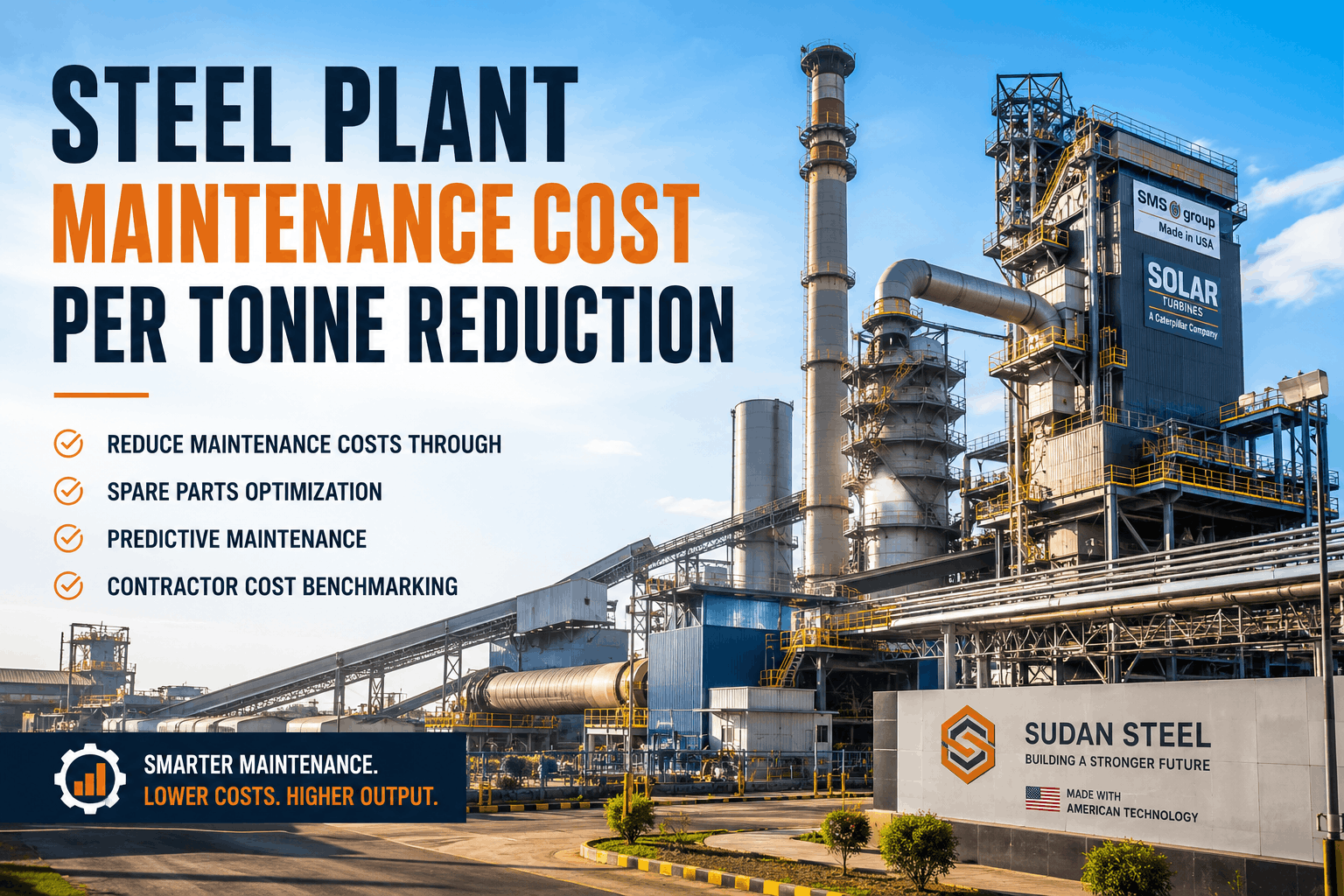
Maintenance accounts for 10–15% of total steel production cost. In an integrated BOF mill producing hot-rolled coil at $380–$650 per tonne, that's $38–$97 per tonne directly attributable to maintenance. But the indirect costs — lost production from unplanned downtime, quality defects from degraded equipment, excess energy consumption from poorly maintained systems, wasted spare parts from reactive procurement — can double or triple that figure. When you add it all up, maintenance-related inefficiency can add $80–$150 per tonne to your true cost of production. In a market where margins are often $30–$60 per tonne, that's the difference between profit and loss.
Anatomy of Cost Per Tonne: Where Maintenance Hides
Steel production cost is typically broken into raw materials (55–65%), energy (15–20%), and fixed costs including labour, maintenance, depreciation, and overhead (20–30%). Maintenance sits inside that fixed cost bucket — which is exactly why it's so often overlooked. It doesn't fluctuate with iron ore or scrap prices, so it doesn't get the same attention. But unlike raw material costs, maintenance cost is almost entirely within management control.
That "hidden maintenance cost" is the number that separates top-quartile mills from bottom-quartile mills. It doesn't appear on any single line item — it's scattered across production losses, quality downgrades, energy waste, and emergency procurement. Here's where it accumulates:
The 5 Ways Maintenance Adds Hidden Cost to Every Tonne
Unplanned Downtime: The Biggest Cost You Don't Track Per Tonne
When equipment fails unexpectedly, production stops. In a steel mill producing 5,000–10,000 tonnes per day, every hour of unplanned downtime eliminates 200–400 tonnes of output. The cost isn't just the repair — it's the production that never happened. If your fixed costs are $120 per tonne and you lose 2,000 tonnes per month to unplanned stops, that's $240,000 per month in unabsorbed overhead spread across every remaining tonne.
Quality Defects from Degraded Equipment
Worn rolling mill rolls produce strip with thickness variation. Misaligned stands create camber. Degraded furnace controls cause inconsistent heat treatment. Every quality downgrade — from prime to secondary or scrap — directly increases your effective cost per tonne. If 3–5% of output is downgraded because of equipment condition, and the downgrade costs $50–$100 per tonne in price reduction, that adds $1.50–$5.00 to every tonne you ship.
Excess Energy Consumption from Poorly Maintained Systems
Energy is 15–20% of production cost. Poorly maintained equipment consumes more of it — fouled heat exchangers reduce thermal efficiency, worn bearings increase motor loads, leaking compressed air systems waste electricity, and degraded refractory linings increase fuel consumption. Industry data shows that well-maintained plants consume 5–12% less energy per tonne than poorly maintained ones. On an energy cost of $60–$130 per tonne, that's $3–$16 per tonne in avoidable waste.
Reactive Procurement: Paying 3–5x for Emergency Spares
When a critical component fails unexpectedly, the procurement team has no choice: pay whatever the supplier demands, expedite shipping at premium rates, and accept whatever is available rather than what's optimal. Emergency spare parts cost 3–5x more than planned procurement. If spare parts are 25% of your maintenance budget, and 30% of parts are purchased reactively, you're paying a significant premium on every tonne produced.
Reduced Equipment Life: Capital Destruction
Equipment that isn't properly maintained doesn't just break more often — it wears out faster. A rolling mill backup roll designed for 15 years of service may need replacement in 8–10 years without proper maintenance. Bearings, gearboxes, motors, and refractories all have design lifespans that are shortened by neglect. This accelerated depreciation and premature capital replacement adds a hidden cost to every tonne that doesn't show up until the capital expenditure bill arrives.
A 10% reduction in maintenance spend can generate a 30% increase in profitability. In steel, where margins are thin and volumes are enormous, every dollar saved per tonne compounds across millions of tonnes per year.
Industry benchmark — maintenance cost to profitability ratioKnow Your True Cost Per Tonne
Oxmaint tracks maintenance cost per asset, per section, and per tonne — giving you the visibility to identify exactly where hidden costs accumulate and the tools to eliminate them systematically.
Reactive vs. Proactive: The Cost-Per-Tonne Gap
The difference between a reactive maintenance culture and a proactive one is not just operational — it's financial, and it shows up in every tonne of steel produced. Here's how the same mill looks under both approaches:
The Cost-Per-Tonne Impact by Mill Section
Different sections of a steel mill contribute differently to maintenance cost per tonne. Understanding where the cost concentrates lets you target improvements where they generate the most savings:
Cost estimates represent industry benchmarks for integrated BOF mills. EAF mini-mills typically have lower absolute costs but similar proportional distribution. Reduction potential assumes transition from reactive to optimized proactive maintenance.
See Your Maintenance Cost Per Tonne — by Section, by Asset
Book a demo and we'll show you how Oxmaint breaks down maintenance cost per tonne across your entire operation — so you know exactly where to focus for maximum savings.
How to Reduce Your Maintenance Cost Per Tonne
Reducing maintenance cost per tonne requires a systematic approach — not just spending less, but spending smarter. Here's the roadmap, presented in the sequence that delivers the fastest ROI:
Make Maintenance Cost Visible
You can't reduce what you can't see. Deploy a CMMS that tracks every work order, every spare part, and every labour hour — by asset, by section, and per tonne of output. This single step typically reveals 15–20% of maintenance spend that's invisible in current accounting.
Eliminate Unplanned Downtime on Critical Assets
Identify your top 20 cost-driving assets and move them from reactive to scheduled and condition-based maintenance. This alone can reduce unplanned downtime by 30–50% and is the single highest-ROI maintenance improvement in any steel mill.
Optimize Spare Parts to Eliminate Procurement Waste
Link spare parts to specific assets. Set data-driven min/max levels based on actual consumption. Auto-reorder at minimum stock levels. Stop paying 3–5x premiums on emergency parts while simultaneously carrying millions in dead stock.
Increase Workforce Productivity
Give technicians mobile digital tools — work orders on their phones, QR-code access to equipment history, digital checklists with photo capture. Eliminate the 65–70% of time currently spent on non-repair activities. Double effective wrench time without adding headcount.
Correlate Maintenance with Quality and Energy Data
Connect maintenance events to quality defects and energy consumption. Identify which equipment conditions cause which problems. When you can prove that a specific bearing condition causes 2% more rejects, the business case for timely replacement becomes undeniable.
Measure, Benchmark, and Compound
Track cost per tonne monthly. Benchmark against industry standards. Set annual reduction targets. The best steel mills achieve 10–15% year-over-year maintenance cost reduction for the first 3–5 years of optimization — compounding savings that fundamentally change their cost position.
How Oxmaint Reduces Your Cost Per Tonne
Oxmaint is built for steel mills that want to understand, track, and systematically reduce maintenance's impact on production cost:
Cost-Per-Tonne Dashboard
Track maintenance cost per tonne in real time — broken down by mill section, equipment type, and cost category. See exactly where your money goes and where the savings opportunities are.
Predictive PM Scheduling
Cycle-based, condition-based, and meter-based triggers that prevent unplanned failures. Auto-generated work orders with escalation. Stop paying for breakdowns — schedule every intervention.
Smart Inventory Control
Parts linked to assets with automatic reorder alerts at min levels. Track consumption, eliminate dead stock, and end emergency procurement at premium prices.
Mobile Workforce Tools
Digital work orders, QR-code asset access, offline-capable checklists, and photo evidence. Double technician wrench time and eliminate paper-based inefficiency.
API Integration Layer
Connect Oxmaint to SAP, Oracle, Level 2 automation, and quality systems. Correlate maintenance events with production output, quality data, and energy consumption in one unified view.
Shutdown Optimizer
Plan outages from real condition data, not guesswork. Scope, assign, sequence, and track every shutdown task. Reduce duration 20–30% and eliminate scope creep that inflates cost per tonne.
Frequently Asked Questions
How do you calculate maintenance cost per tonne?
Total maintenance expenditure (labour + parts + contractors + overhead) divided by total tonnes produced in the same period. Oxmaint calculates this automatically, broken down by mill section, equipment type, and cost category — giving you granular visibility instead of a single blended number.
What's a good benchmark for maintenance cost per tonne in steel?
For integrated BOF mills, top-quartile plants achieve $40–$60 per tonne total maintenance cost (direct + indirect). The median is $70–$100. Bottom-quartile plants exceed $120 per tonne. EAF mini-mills typically range $25–$50 at top quartile. The key metric isn't the absolute number — it's the ratio of planned to unplanned work, which should be at least 80/20.
Can a CMMS really reduce cost per tonne, or does it just track it?
Both — but tracking is what enables reduction. When you can see that Section A costs $18/tonne versus Section B at $8/tonne, you know where to focus. When you can see that Asset X has 12 unplanned breakdowns per year at $45K each, the PM investment becomes obvious. Visibility drives action, and action drives cost reduction — typically 10–15% per year for the first 3–5 years.
Does this apply to EAF mini-mills as well as integrated mills?
Absolutely. While the absolute cost numbers differ, the proportional relationships are the same. EAF mills are even more sensitive to maintenance cost per tonne because they typically operate on thinner margins and shorter production cycles. Oxmaint scales from single-furnace mini-mills to multi-site integrated complexes.
How fast can we see cost-per-tonne improvements?
Most plants see measurable improvements within 60–90 days. Early wins come from eliminating missed PMs (reducing reactive failures), improving parts availability (eliminating rush procurement), and increasing technician productivity (more completed work orders per shift). The compounding effect of these improvements typically delivers 10–15% cost reduction in year one.
Every Tonne You Produce Carries Your Maintenance Efficiency
The mills winning on cost per tonne aren't the ones spending the least on maintenance — they're the ones spending the smartest. Oxmaint gives you the visibility, scheduling, and analytics to turn maintenance from a hidden cost adder into a competitive advantage. Deploy in weeks, measure in months, compound for years.