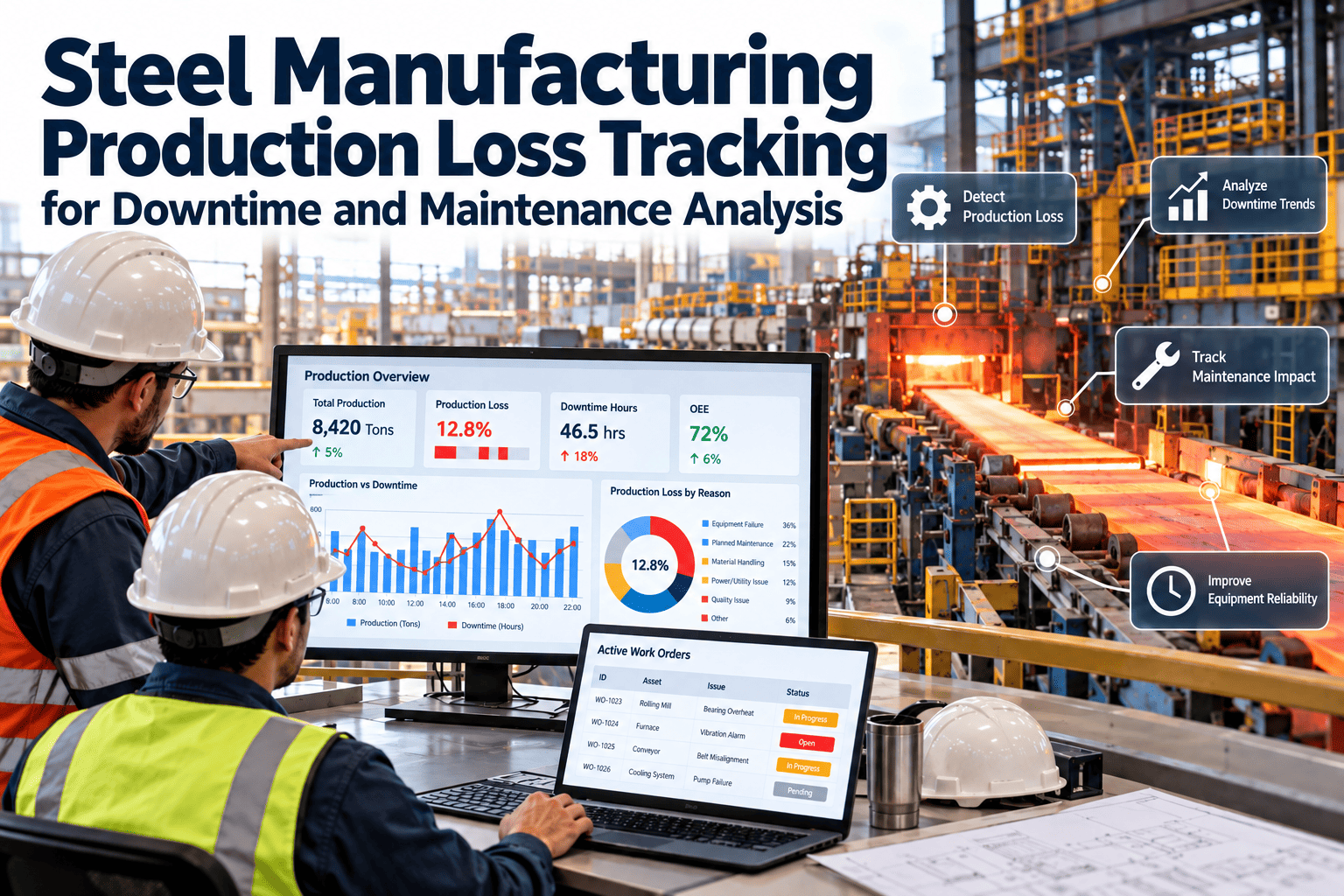
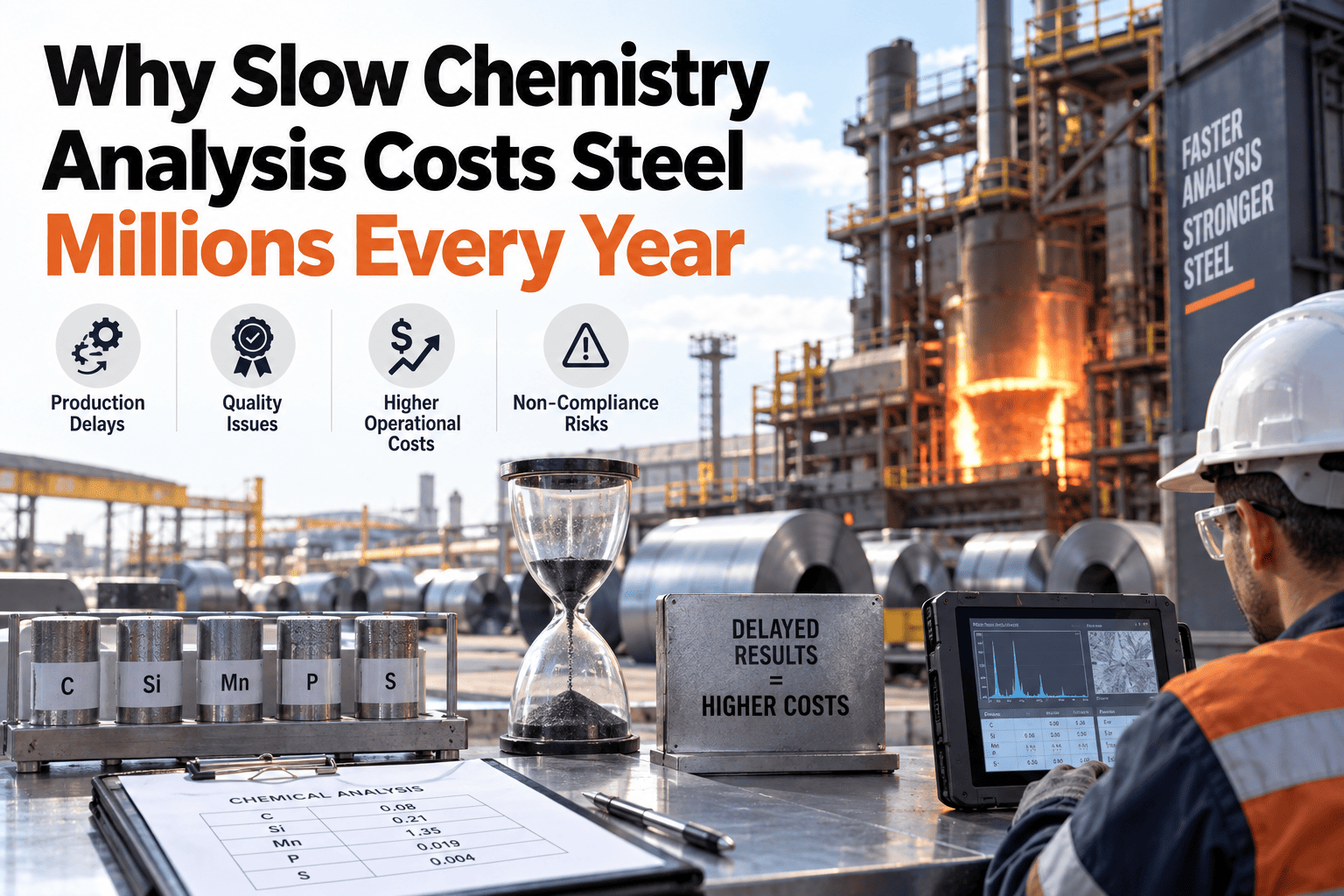
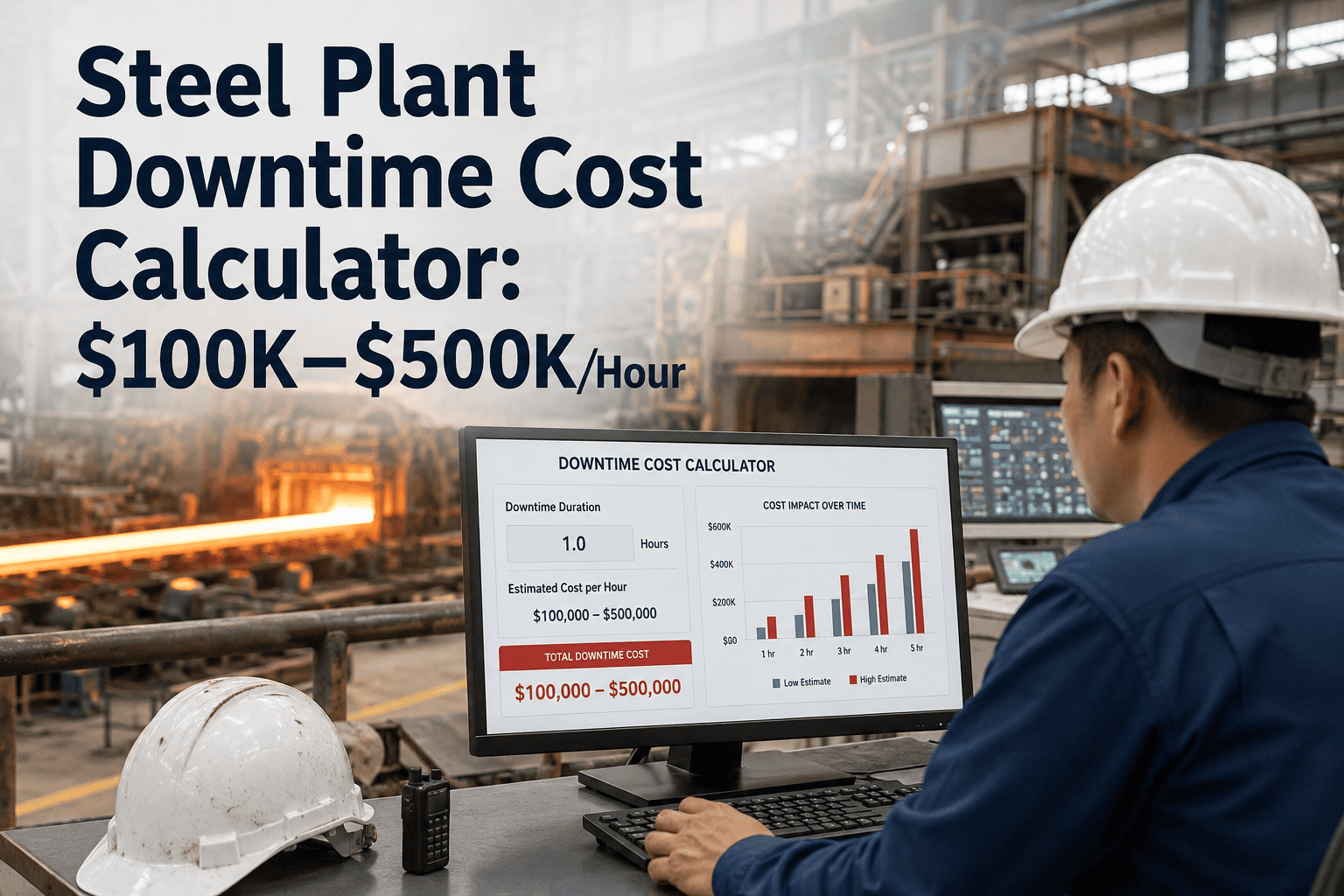
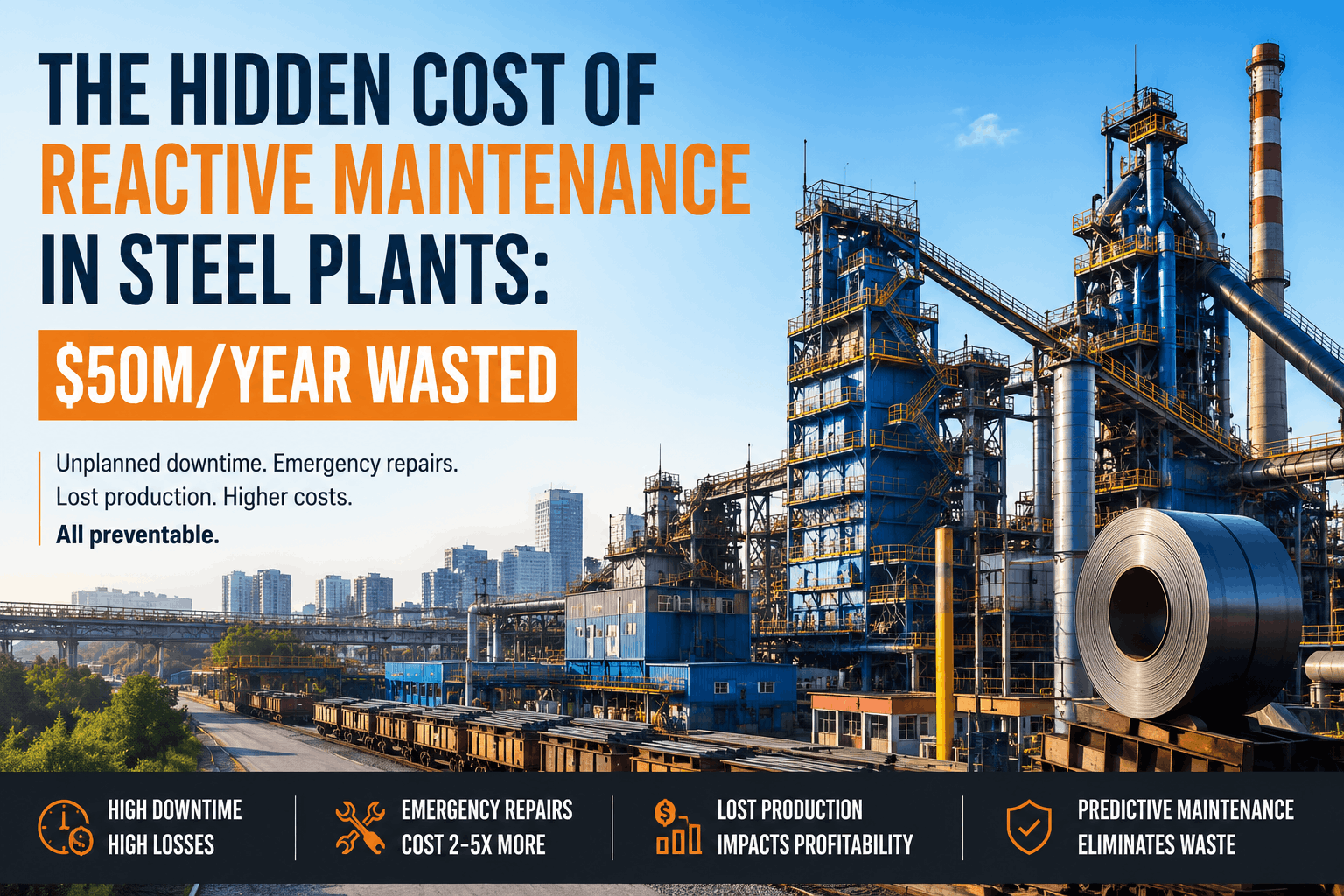
When a hot strip mill goes down unexpectedly, the meter starts immediately — and it counts a lot more than the repair bill. Direct production loss is obvious. What most steel plant managers undercount is everything that happens in parallel: the energy consumed by idle furnaces that cannot be safely shut down in minutes, the quality losses from off-spec material produced in the rundown and restart phase, the customer penalties for missed delivery windows, and the overtime labor to recover the lost tonnage over the following week. When you add all four categories together, unplanned downtime in steel manufacturing costs between $5,000 and $50,000 per hour depending on the production area — and most plants are only tracking the first number. Sign up for Oxmaint to start tracking your complete downtime cost across every production area in one dashboard. This breakdown matters because it changes the maintenance investment calculation. A plant manager who sees a $40,000 PM program and a $12,000 repair bill on the same spreadsheet will always feel pressure to defer the PM. A plant manager who sees that the deferred PM produced a $340,000 downtime event — $12,000 in repairs plus $190,000 in lost production, $68,000 in energy waste, $42,000 in quality rejects, and $28,000 in customer penalties — makes a different decision. Book a downtime cost analysis session to calculate the full cost picture for your facility.
The Four Cost Categories Most Plants Are Missing
Industry surveys consistently find that steel plant finance teams capture only 30–45% of the true cost of a downtime event. The gap is not intentional — it is structural. Maintenance cost systems capture repair labor and parts. ERP systems capture direct production loss. But the energy waste from stranded furnace loads, the quality penalty from restart-phase off-spec material, and the commercial cost of late deliveries typically sit in different systems, reported in different periods, and never get aggregated into a single downtime event cost. Start tracking all four cost categories in Oxmaint to close this visibility gap.
Downtime Cost by Production Area: Where the Numbers Are Highest
Not all downtime is equal. A 1-hour outage in the blast furnace carries a fundamentally different cost profile than a 1-hour outage on a slitting line. The difference comes from three factors: throughput rate, restart complexity, and upstream thermal commitment. Understanding this distribution across your production areas tells you where to concentrate predictive maintenance investment for the highest return. The following cost ranges reflect industry data from integrated flat-rolled and long products operations.
| Production Area | Cost Range / Hour | Primary Cost Driver | Restart Complexity | PM Priority |
|---|---|---|---|---|
| Hot Strip Mill | $28,000–$50,000 | Throughput loss + furnace energy waste | High — 2–4 hr thermal recovery | Critical |
| Basic Oxygen Furnace | $22,000–$42,000 | Heat loss + scrap charge write-off | Very High — heat abort costs $30K+ | Critical |
| Continuous Caster | $18,000–$38,000 | Breakout risk + tundish replacement | Very High — full restart sequence | Critical |
| Reheating Furnace | $12,000–$28,000 | Energy waste + downstream starvation | High — 3–6 hr heat soak required | High |
| Cold Rolling Mill | $8,000–$20,000 | Throughput loss + quality restart scrap | Medium — 30–90 min recovery | High |
| Pickling / Coating Line | $5,000–$14,000 | Chemical bath loss + throughput gap | Medium — bath temperature recovery | Medium |
| Finishing / Slitting | $3,000–$8,000 | Order schedule disruption | Low — quick restart | Medium |
| Ranges reflect integrated operations, 2–4 MTPA capacity. Costs increase proportionally for larger facilities and during peak order periods with customer penalty exposure. | ||||
Reactive vs. Predictive: The Real Financial Difference
The choice between reactive and predictive maintenance is not a technology preference — it is a financial position. Every steel plant running a reactive strategy is making an implicit bet that unplanned downtime events will cost less than the PM program required to prevent them. The data shows this bet loses badly in high-throughput, high-thermal-commitment production areas. Start your predictive maintenance program in Oxmaint to shift this calculation for your highest-cost production areas first.
What the Numbers Look Like Across a Full Year
The following projection models a 2 MTPA integrated flat-rolled steel plant running in reactive maintenance mode compared to the same facility operating with Oxmaint's downtime tracking and predictive maintenance program. Numbers use the midpoint of the production-area cost ranges above and assume industry-average unplanned event frequency. These figures are conservative — they exclude secondary supply chain costs and customer relationship damage from repeated delivery failures.
| Cost Category | Reactive Mode (Current) | With Oxmaint Predictive | Annual Saving |
|---|---|---|---|
| Production Loss | $4,200,000 | $1,260,000 | $2,940,000 |
| Energy Waste (idle furnaces) | $1,400,000 | $420,000 | $980,000 |
| Quality Rejects / Scrap | $860,000 | $258,000 | $602,000 |
| Customer Penalties | $520,000 | $104,000 | $416,000 |
| Emergency Repair Premium | $680,000 | $136,000 | $544,000 |
| Total Annual Impact | $7,660,000 | $2,178,000 | $5,482,000 |
| Based on industry-average unplanned event frequency for reactive operations. Oxmaint figures assume 70% downtime reduction, consistent with documented implementation outcomes. | |||
Real Results from Plants That Closed the Downtime Cost Gap
The following results are drawn from documented outcomes at steel and heavy manufacturing facilities that deployed Oxmaint's downtime tracking and predictive maintenance analytics platform. Each facility started with reactive-dominant maintenance strategies and incomplete downtime cost visibility.
How Oxmaint Tracks and Reduces Your Total Downtime Cost
Oxmaint's downtime tracking module is purpose-built for the multi-category cost structure that steel manufacturing downtime produces. Unlike simple work order systems that capture repair costs in isolation, Oxmaint connects every downtime event to the production data, energy meters, quality records, and commercial impact in a single consolidated cost record. Sign in to Oxmaint to configure downtime cost tracking for your production areas and start generating verified event cost reports.
Configure Production Area Cost Profiles
Map each production area to its throughput rate, energy load, quality restart window, and active customer contracts. Oxmaint uses these parameters to calculate a real-time cost accumulation rate the moment a downtime event is logged.
Connect Production, Energy, and Quality Data Feeds
Oxmaint integrates with your MES, historian, and energy metering systems to pull actual production counts, fuel consumption, and quality test results automatically during and after each downtime event — eliminating manual data collection from the cost calculation process.
Generate Full-Cost Event Reports for Leadership
Each closed downtime event produces a four-category cost summary — production loss, energy waste, quality impact, customer penalty — that finance and operations leadership can review without manual compilation. The report includes a root cause classification and the estimated cost of the PM that would have prevented the event.
Use Downtime Cost Data to Drive PM Prioritization
Oxmaint's analytics dashboard ranks each asset by its historical and projected downtime cost contribution. This ranking drives PM schedule prioritization automatically — highest-cost assets receive the most rigorous preventive maintenance intervals, and any proposed deferral shows the projected cost exposure in real time.
We were approving PM deferrals based on the repair cost comparison. A $35,000 PM versus a $15,000 repair — the repair looks cheaper on paper. After we deployed Oxmaint and started seeing the full downtime event cost, the calculation completely changed. The last time we deferred that PM, the subsequent failure cost $418,000 when you included the furnace energy waste, the two quality rejects, and the penalty on the Tier 1 automotive order. The PM was cheap. The failure was catastrophic.
Frequently Asked Questions
Start Tracking What Downtime Is Really Costing You
Most steel plants are managing downtime with less than half the financial picture. Oxmaint's analytics dashboard closes the gap — connecting every outage event to its full four-category cost so your maintenance investment decisions are based on verified numbers, not repair estimates.