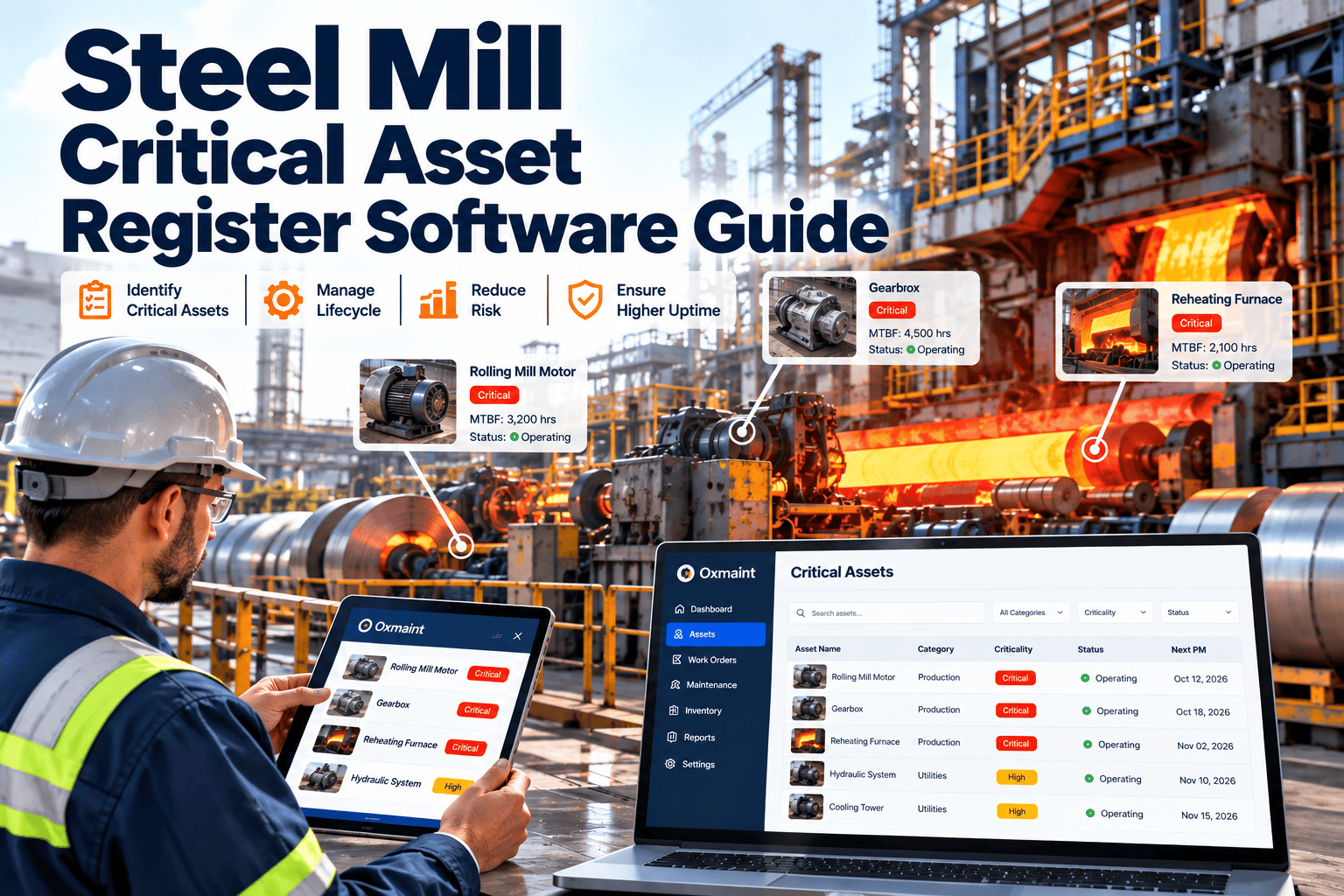
Every steel mill runs thousands of maintainable assets, but only a small share of them can stop a heat, break a cast sequence, or end a rolling campaign on their own. A critical asset register is the controlled list that identifies those assets, ranks them by production impact, safety exposure, and failure cost, and links each one to a defined maintenance strategy. Without it, planners spread effort evenly and a ladle crane hoist gets the same attention as a spare exhaust fan. This guide explains how to build, score, and maintain a steel mill critical asset register, and how to run it inside Oxmaint maintenance management software so criticality drives every work order.
Steel Mill Critical Asset Register Software Guide
Rank every asset from the stockyard to the finishing line by what its failure actually costs, then let that ranking set PM depth, spares holding, and response priority across the mill.
An asset list is not a critical asset register
Most mills already have an asset list in an ERP or spreadsheet. The difference is intent: a list records what exists, while a register records what matters, why it matters, and what the plant has committed to do about it.
Typical asset list
- Tag number, description, location, and manufacturer
- Every asset treated as equally important
- No link between the asset and its failure modes
- Spares held by habit rather than by risk
- Updated when someone remembers to update it
Critical asset register
- Functional location, parent system, and criticality class
- A documented score for production, safety, environment, and cost
- Dominant failure modes and the strategy that addresses them
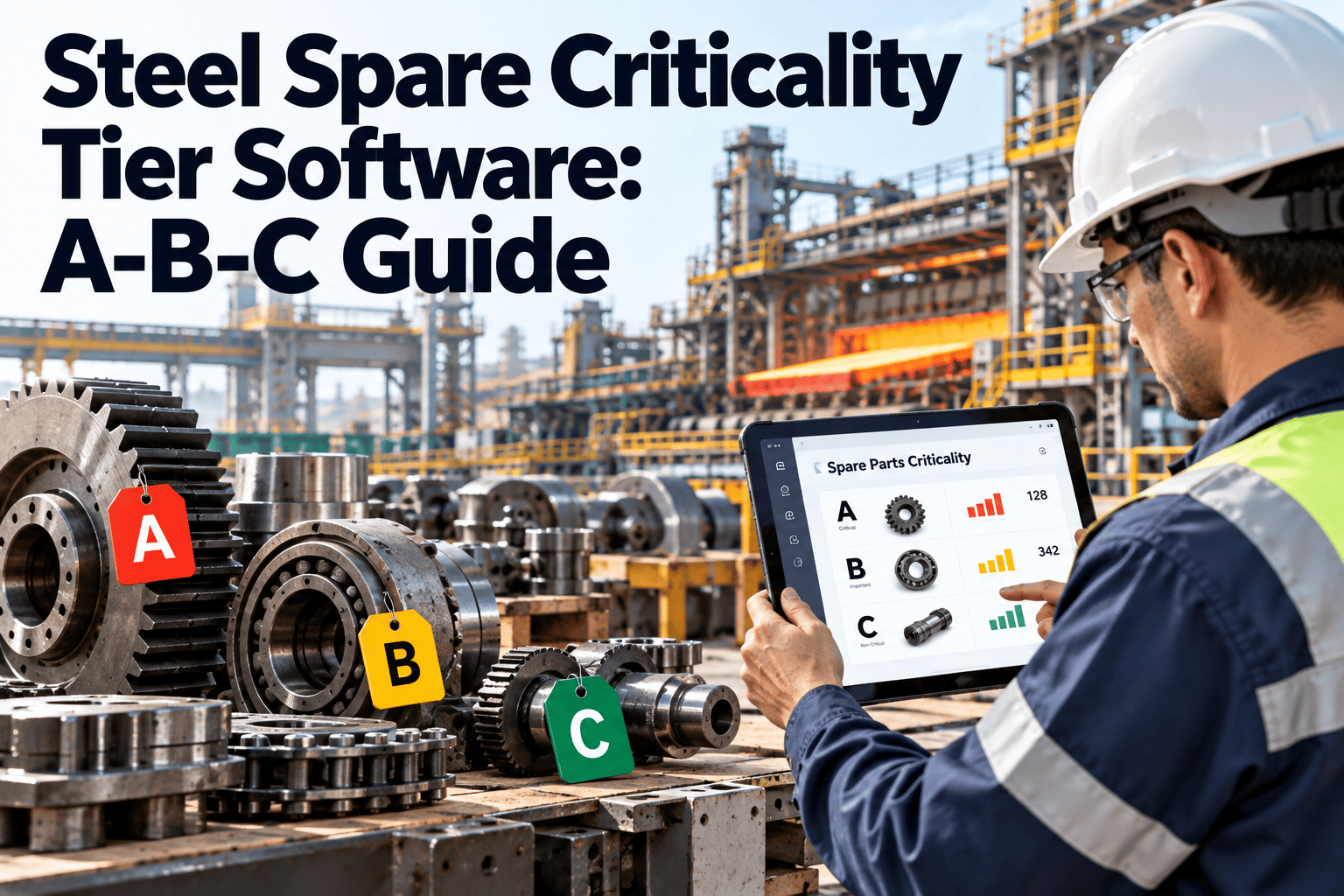
- Critical spares identified and tied to each class A asset
- Reviewed on a fixed cycle and after every major failure
Why steel plants need formal asset criticality now
Integrated and mini-mill operations share a common problem: highly coupled process units, molten metal hazards, and long-lead spares. When criticality is informal, the same failure chain repeats.
- Tight coupling: a blast furnace blower, caster ladle turret, or hot strip mill finishing stand affects every unit before and after it.
- Hazard severity: hot metal cranes, oxygen systems, gas holders, and furnace cooling circuits carry consequences far beyond lost tonnes.
- Spares exposure: custom rolls, mill motors, large gearboxes, and transformers can take months to source.
- Workforce change: as experienced technicians retire, the knowledge of which machines really matter needs to live in a system, not in memory.
- Asset management standards: frameworks such as ISO 55000 expect decisions to be risk-based and traceable, which starts with documented criticality.
Where critical assets sit across the steel route
Criticality depends on your configuration, redundancy, and product mix. The examples below show where class A candidates commonly appear; validate each against your own layout and failure history.
Raw materials and stockyard
Stacker-reclaimers, main feed conveyors, wagon tipplersSinter and pellet plant
Sinter strand and pallets, main exhaust fan, sinter cooler, ignition hoodCoke ovens
Pusher and guide machines, gas exhausters, battery heating systemsBlast furnace
Turbo blowers, hot blast stoves, top charging system, tap-hole drill and mudgun, stave cooling pumpsBOF or EAF steelmaking
Converter tilt drive, oxygen lance hoists, EAF transformer, electrode regulation, off-gas fansSecondary metallurgy and cranes
Ladle furnace, vacuum degasser, hot metal and ladle cranesContinuous casting
Ladle turret, tundish car, mold and oscillator, segments, secondary cooling pumpsHot rolling
Reheating furnace walking beams, descaler pumps, main stand drives, AGC hydraulics, downcoilersCold rolling and coating
Pickling line, tandem mill, annealing furnaces, galvanizing pot equipmentUtilities
Oxygen plant, air compressors, cooling water pumps, main substationsScoring criteria for steel plant asset criticality
A defensible score uses a small number of consequence criteria, each rated on the same scale. The bands below are an example starting point; calibrate them with production, safety, and finance before scoring.
| Criterion | Score 1 | Score 3 | Score 5 |
|---|---|---|---|
| Production impact | No loss; redundancy covers the function | Reduced rate or delayed sequence | Primary unit stops or downstream units are starved |
| Safety | Minor injury potential is unlikely | Recordable injury potential | Molten metal, gas, or fatality potential |
| Environmental and regulatory | No impact | Internal deviation that must be reported | Permit breach or uncontrolled emission |
| Product quality | No effect | Rework or grade downgrade | Scrapped heats or coils, or customer claims |
| Redundancy | Installed standby with automatic changeover | Standby with manual changeover | No standby available |
| Time to restore | Within one shift | One to three days | More than a week |
| Spare lead time | On the shelf or locally available | Several weeks | Months, or custom-engineered |
Example calculation
Consequence = highest score across production, safety, environment, and quality, adjusted for redundancy, restore time, and spare lead time Risk score = Consequence (1 to 5) × Likelihood of failure (1 to 5) Override rule: any asset scoring 5 on safety is class A regardless of its total.The criticality risk matrix
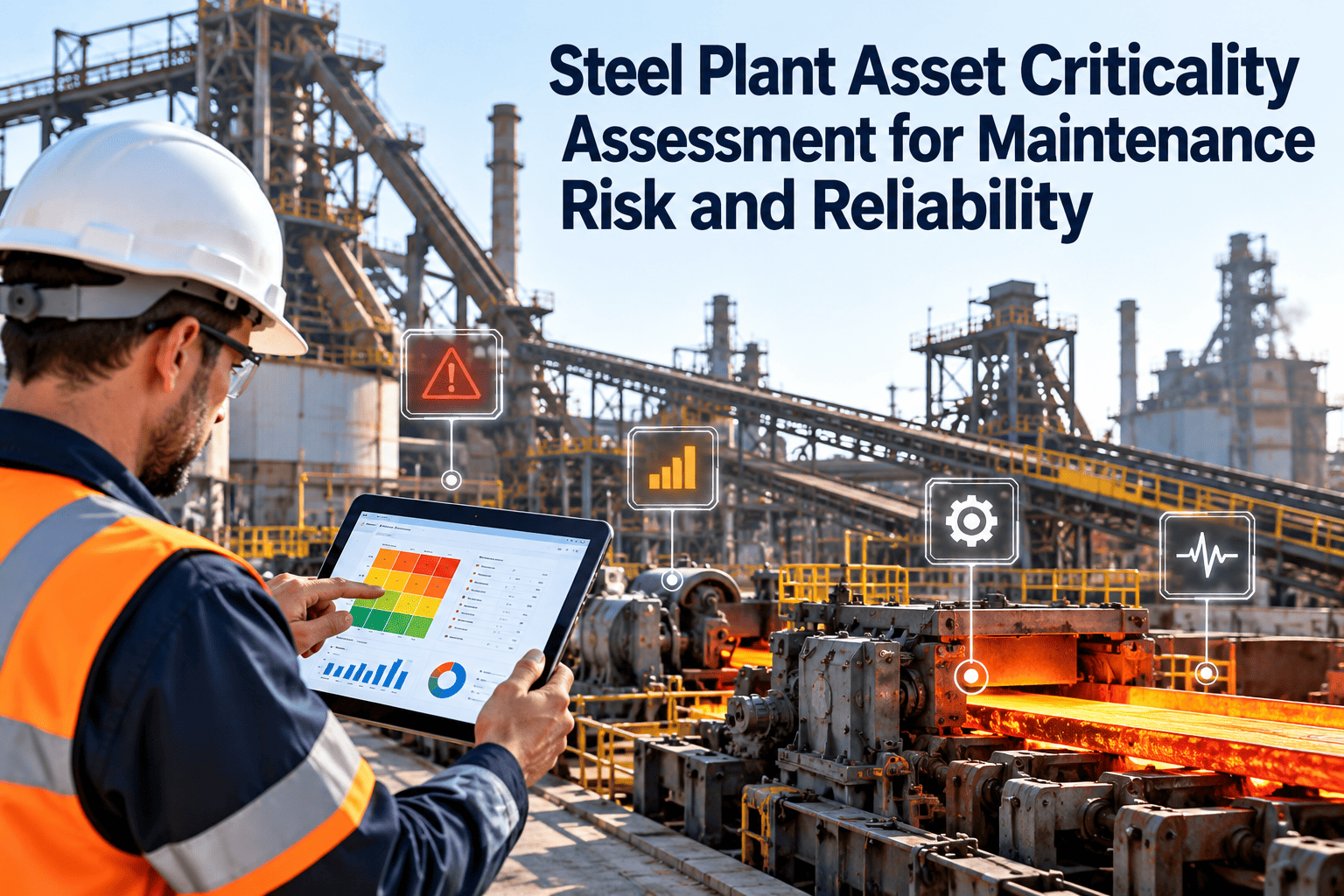
Plotting consequence against likelihood turns individual scores into a clear class boundary. In this example, a score of 15 or more is class A, 8 to 14 is class B, and 7 or less is class C.
Turn your criticality matrix into a working register
Structure your mill assets by area and system, tag their criticality, and schedule class A maintenance first. Start with one unit, then roll the method across the plant.
Build the register in seven steps
Treat the register as a project with an owner, a scope, and a sign-off, not as a spreadsheet exercise. Pilot on one area such as the caster or hot strip mill before scaling.
-
Define the functional location hierarchy
Break the plant into area, unit, system, and equipment levels. A taxonomy modelled on ISO 14224 keeps naming consistent across departments. -
Agree the scoring model and thresholds
Get production, safety, environment, and finance to sign off on the criteria, bands, and class boundaries before anyone scores an asset. -
Score at system level first
Score the hydraulic system of a finishing stand before its individual valves. Components inherit a starting class from their parent, then get adjusted. -
Run cross-functional scoring workshops
Bring operators, maintenance technicians, and reliability engineers together. Operators know the production impact; technicians know how failures actually happen. -
Identify failure modes for class A assets
Use FMEA methods, such as those in IEC 60812, to list the dominant failure modes and their effects. This is the bridge between criticality and strategy. -
Assign strategies and critical spares
Link each class to a maintenance approach, then flag the spares whose absence would extend a class A outage. -
Load, approve, and schedule reviews
Move the register into your CMMS, lock the approved version, and set a review trigger for every major failure, modification, or production change.
Data to gather before the first workshop
- Two to three years of work order and breakdown history, grouped by asset
- Production delay logs with cause codes from each unit
- Hazard studies, permit conditions, and incident reports
- P&IDs, single-line diagrams, and redundancy arrangements
- Spare parts lists with current stock and supplier lead times
- OEM manuals and any existing PM or condition monitoring routes
Match maintenance strategy to criticality class
A register only pays off when each class changes what the maintenance team does. This mapping is a common starting point for steel plants.
| Area | Class A | Class B | Class C |
|---|---|---|---|
| Maintenance approach | Reliability-centered analysis plus condition monitoring | Time or usage-based PM with inspections | Run to failure or minimal PM |
| Condition monitoring | Vibration, oil, thermography, or online sensors as failure modes require | Periodic route-based checks | Operator rounds only |
| Critical spares | Held on site and reviewed against lead time | Held where lead time exceeds tolerable downtime | Purchased on demand |
| Work order priority | Highest; immediate response | Scheduled within the planning window | Scheduled when capacity allows |
| Root cause analysis | Required after every functional failure | Required for repeat failures | Not required |
| Register review | Annually and after any major event | Every one to two years | When the asset changes |
What a usable register record contains
A register entry should answer three questions at a glance: how critical the asset is, why, and what the plan is. Here is an example record for a hot strip mill asset.
- Functional location
- Hot strip mill, finishing stand F4, hydraulic gap control
- Function
- Hold roll gap to setpoint under rolling load
- Score breakdown
- Production 5, safety 3, quality 5, redundancy 5, likelihood 3
- Dominant failure modes
- Servo valve sticking from contamination, cylinder seal leakage, position transducer drift
- Strategy
- Oil cleanliness sampling, filter differential pressure checks, seal inspection at planned stops
- Critical spares
- Servo valve, cylinder seal kit, position transducer
- Owner and review
- Area reliability engineer; reviewed annually and after any functional failure
Common register mistakes and better practice
Most failed criticality projects fail for the same few reasons. Avoiding them early saves a second round of scoring.
Who owns the register in a steel plant
Criticality is a shared decision, but the register needs one accountable owner. Clear roles stop the scoring from drifting as people and priorities change.
Reliability engineering
Owns the scoring model, facilitates workshops, maintains failure mode analysis, and approves class changes.Production and operations
Confirms production impact, redundancy, and operating context for each unit and shift pattern.Safety and environment
Validates hazard scores, especially for cranes, gas systems, oxygen service, and molten metal handling.Planning and stores
Applies class to scheduling priority, and keeps critical spares, reorder points, and lead times current.KPIs that show the register is working
Track these measures by criticality class, not just plant-wide. The goal is for class A performance to improve first and fastest.
Strategy coverage
Class A assets with an approved strategy ÷ total class A assetsClass A PM compliance
Class A PMs completed on time ÷ class A PMs scheduledClass A MTBF
Operating time ÷ number of functional failures on class A assetsCritical spares availability
Critical spares in stock at or above minimum ÷ critical spares listedEmergency work share
Emergency work order hours on class A assets ÷ total class A work hoursRegister currency
Assets reviewed within their cycle ÷ assets in the registerHow Oxmaint supports a criticality-driven steel plant
A register delivers value only when it shapes daily execution. Oxmaint helps steel plant maintenance teams carry criticality from the scoring workshop into planning, work execution, and reporting.
Asset management and hierarchy
Model area, unit, system, and equipment levels, and classify assets so criticality travels with the asset record.Preventive maintenance scheduling
Build calendar and usage-based PMs by class, so class A tasks are planned first and never quietly deferred.Work orders and mobile execution
Technicians see priority, checklists, and history on mobile, and close work with notes and photos from the shop floor.Condition-based workflows
Log inspection readings and raise corrective work when a class A asset shows a deviation, before it becomes a failure.Inventory and spares
Link critical spares to assets and track stock levels so the parts a class A outage needs are available.Dashboards and reporting
Report PM compliance, failures, and backlog by class to show management where risk is falling and where it is not.Steel mill critical asset register: FAQs
What is a steel mill critical asset register?
It is a controlled list of plant assets ranked by the consequence and likelihood of failure, with each asset linked to failure modes, a maintenance strategy, and critical spares.
How many assets should be class A?
There is no fixed share. If most assets land in class A, the bands are too loose and priorities lose meaning, so recalibrate with a cross-functional review.
Should criticality be scored at component or system level?
Start at system level, then adjust components. This keeps classes consistent and avoids scoring thousands of parts before the framework is proven.
How often should asset criticality be reviewed?
Review class A assets at least annually and after any major failure, modification, or production change. Lower classes can follow a longer cycle.
Can I run the register inside a CMMS?
Yes. Keeping criticality on the asset record means it drives PM planning and work priority. You can set up your asset hierarchy in Oxmaint and start with one mill area.
Put your most critical steel mill assets first
See how a criticality-driven register shapes PM schedules, work priority, and spares planning for your plant. Walk through your own mill areas with our team.