Energy Management in Steel Plants: AI-Driven Optimization for Carbon Reduction
By John Mark on March 12, 2026
Steel production accounts for roughly 8% of global carbon emissions—more than any other heavy industry—yet most plants still manage energy through outdated monitoring systems and manual reporting cycles. The difference between a steel plant that meets carbon targets and one that pays millions in penalties often comes down to how intelligently energy flows are tracked, predicted, and optimized across every furnace, compressor, and casting line. If your energy team is reacting to consumption spikes after they happen, the cost in both fuel and emissions is compounding every shift. Schedule a free energy audit with our team and find exactly where your plant is bleeding carbon and cost—and how to fix it this quarter.
Why AI-Driven Energy Management Is Now Critical for Steel Plants
Energy typically represents 20 to 40 percent of total steel production costs, with electricity, natural gas, and coke driving the bulk of that figure. At the same time, carbon pricing mechanisms, emissions trading schemes, and tightening regulatory thresholds are converting every tonne of CO₂ into a direct financial liability. Managing energy in steel manufacturing is no longer an operational concern—it is a strategic one, and AI is the only tool capable of operating at the speed and complexity the problem demands.
$180M
Estimated annual energy cost for a mid-sized integrated steel plant producing 2–3 million tonnes per year
8–12%
Typical energy savings achievable through AI-driven optimization without capital equipment changes
35%
Carbon reduction targets most steel producers face under current and pending regulatory frameworks by 2030
Key Insight
A 1% improvement in blast furnace energy efficiency at a plant consuming 500MW translates to roughly $3.5 million in annual savings. AI systems that continuously tune combustion, charge mix, and hot metal temperature achieve these gains every day—not just during improvement projects.
The Five Major Energy Loss Points in Steel Manufacturing
Before AI can optimize energy use, you must know where energy is actually lost. Steel plants lose energy through predictable, measurable pathways that most conventional monitoring systems fail to quantify in real time. Addressing these five zones delivers the largest and fastest return on any energy optimization investment.
Zone 1
Blast Furnace and Basic Oxygen Furnace Inefficiency
The blast furnace consumes more energy than any other unit in the integrated steelmaking route. Inefficient burden distribution, suboptimal hot blast temperature, and inconsistent coke quality create combustion inefficiencies that compound with every heat. BOF off-gas recovery systems frequently underperform due to poor timing of gas capture relative to the blowing cycle.
AI Opportunity: Continuous optimization of blast parameters, burden composition, and off-gas recovery timing. AI models trained on sensor data reduce specific energy consumption by 3–6% per tonne of hot metal.
Zone 2
Reheating Furnace and Rolling Mill Losses
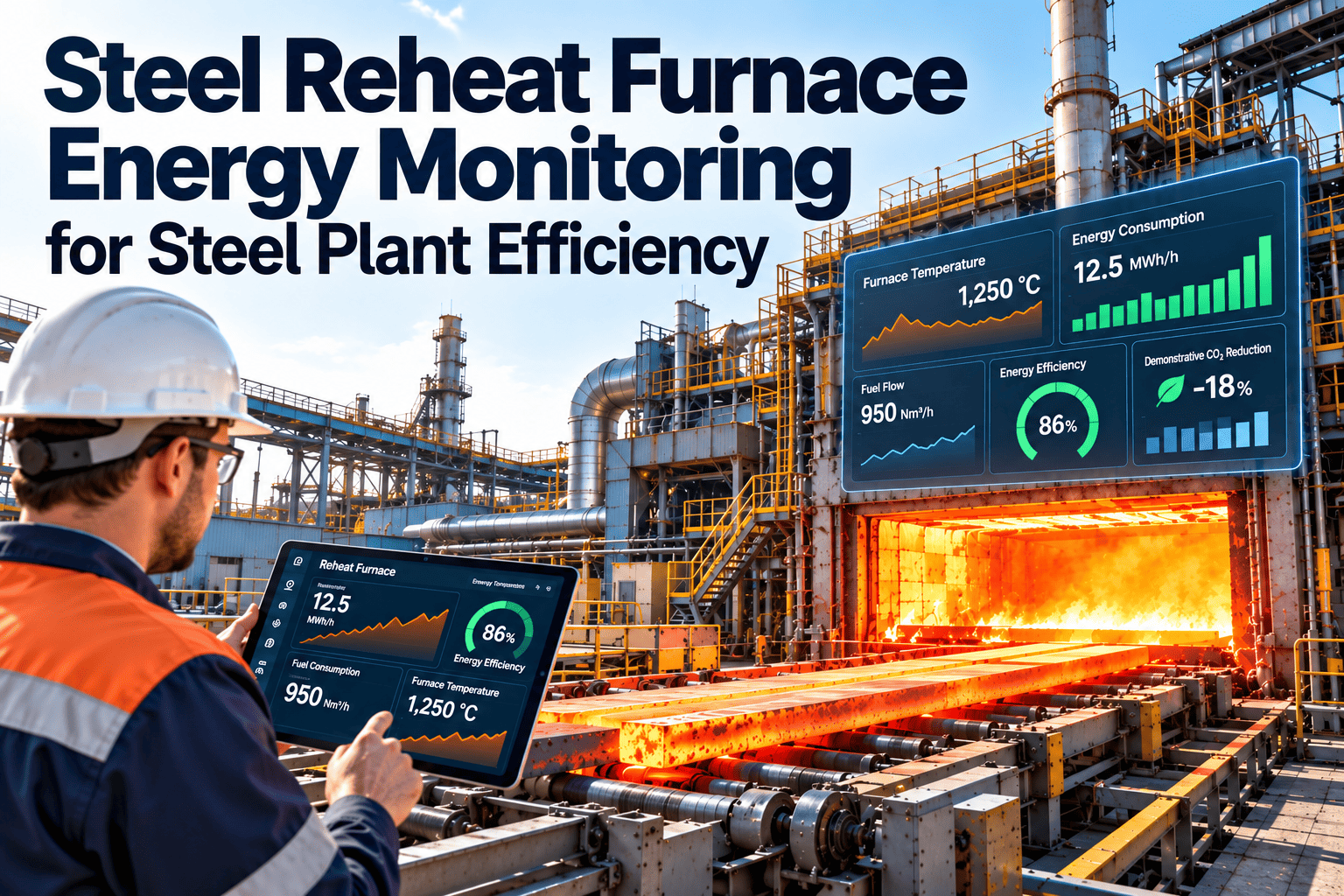
Reheating furnaces account for up to 15% of total plant energy consumption. Excessive slab soaking time, poor furnace scheduling relative to rolling mill demand, and combustion air-to-fuel ratio drift are the dominant loss mechanisms. Hot charging from continuous caster to reheating furnace can eliminate 30–40% of reheating energy entirely when coordinated correctly.
AI Opportunity: Predictive furnace scheduling synchronized with casting and rolling throughput. Real-time combustion control and hot charging coordination managed through integrated AI platforms.
Zone 3
Compressed Air and Steam System Losses
Compressed air is often called the fourth utility—and the most wasted. Leakage rates of 25–40% are common in aging steel plant air systems. Steam traps fail open without detection, venting energy to atmosphere for months. Turbine drives and blower systems operate away from their efficiency curves due to fixed-speed control and outdated load profiles.
AI Opportunity: Acoustic leak detection integrated with AI triage, steam trap condition monitoring, and variable speed drive optimization driven by real-time demand signals from process sensors.
Zone 4
By-Product Gas Imbalance and Flaring
Coke oven gas, blast furnace gas, and basic oxygen furnace gas are energy-rich by-products that should displace purchased fuel across the plant. Poor gas network balancing results in excess gas being flared—converting valuable fuel into CO₂ emissions and wasted energy simultaneously. Most plants flare 5–15% of by-product gas that could be recovered.
AI Opportunity: Gas network optimization models that predict generation volumes from process data and route gas to the highest-value consumers in real time, reducing flaring to near zero.
Zone 5
Electrical Peak Demand and Power Factor Losses
Electric arc furnace operations, large motors, and variable induction loads create demand spikes and power factor penalties that inflate electricity costs independent of actual energy consumption. Uncoordinated start sequences for major drives create avoidable demand peaks that trigger tariff surcharges for entire billing periods.
AI Opportunity: Load scheduling optimization that sequences large electrical loads to flatten demand peaks, combined with reactive power compensation management to maintain power factor above contractual thresholds.
5 AI Strategies That Deliver the Fastest Carbon Reduction in Steel Plants
Not every AI application in energy management delivers the same return. These five strategies are ranked by implementation speed and impact, giving steel plant energy managers a clear path from quick wins to sustained structural reduction in both cost and carbon intensity.
1
Real-Time Combustion Optimization Across All Fired Equipment
AI models trained on temperature, flow, and emissions sensor data continuously adjust fuel and air ratios across blast furnaces, reheating furnaces, and boilers. Unlike static set-point control, AI adapts to changes in fuel composition, ambient conditions, and production rate in real time. Plants implementing AI combustion optimization report 4–8% reductions in specific fuel consumption within the first operating quarter.
2
By-Product Gas Network Forecasting and Routing
AI systems predict blast furnace gas, coke oven gas, and BOF gas generation volumes 2–6 hours ahead using production schedule data and process sensor inputs. This forecast drives automated routing decisions that maximize displacement of purchased natural gas and minimize flaring. Reducing flaring by even 10 percentage points at a large integrated plant delivers both direct cost savings and significant CO₂ reduction at minimal capital cost.
Degraded equipment is energy-inefficient equipment. A compressor operating with worn seals, a heat exchanger fouled with scale, or a motor with bearing misalignment all consume more energy per unit of output than well-maintained equivalents. AI-powered predictive maintenance identifies these degradation signatures weeks before failure, enabling planned intervention that simultaneously reduces downtime and energy waste.
4
Energy Demand Forecasting Linked to Production Scheduling
Aligning energy procurement with production schedules using AI demand forecasts reduces both spot market exposure and internal peak demand penalties. AI models that integrate production plans, historical consumption patterns, and utility tariff structures allow energy managers to pre-position purchased energy and shift flexible loads away from peak tariff windows. This alone reduces electricity costs by 6–12% in plants with time-of-use tariff structures.
5
Carbon Intensity Monitoring and Automated Regulatory Reporting
AI platforms that continuously calculate CO₂-equivalent emissions at the process level give energy managers a real-time carbon dashboard rather than a monthly accounting exercise. This visibility enables proactive decisions that keep operations within permit thresholds and provides audit-ready data for carbon trading schemes and sustainability reporting frameworks, eliminating the administrative burden of manual data collection.
Your Energy Data Is Already There. AI Turns It Into Action.
Oxmaint connects to your existing sensors, historians, and maintenance systems to deliver real-time energy visibility, predictive alerts, and carbon tracking—without replacing your current infrastructure.
Reactive vs. Predictive Energy Management: The True Cost Comparison
Most steel plants manage energy reactively—investigating consumption spikes after the billing cycle closes or responding to regulatory notices after emissions thresholds are breached. Predictive AI-driven management inverts this model entirely, with measurable differences in both operating cost and carbon performance.
Reactive Approach
Monthly energy reports reveal problems already paid for
Combustion tuning done quarterly by external contractors
Flaring managed by operator judgment in real time
Carbon reporting assembled manually from disparate systems
Energy cost variance unexplained until audit
+18%
average excess energy cost versus best-in-class peers in same production segment
Predictive AI Approach
Real-time energy KPIs updated every 60 seconds per process unit
Combustion parameters adjusted automatically by AI every heat
Gas routing decisions made 4–6 hours ahead by forecast model
Carbon inventory calculated continuously at asset level
Anomalies flagged and assigned to work orders before shift end
30%
average reduction in energy-related carbon emissions within 18 months of AI platform deployment
What to Look for in an AI Energy Management Platform for Steel
Not every energy management software product is built to handle the complexity of integrated steelmaking. The right platform connects operational technology data with business intelligence to give every stakeholder—from furnace operators to CFOs—the information they need to act. These are the capabilities that separate genuinely effective AI energy platforms from sophisticated dashboards.
Real-Time Process Integration
Native connectivity to historians, DCS, SCADA, and sensor networks without manual data extraction. Energy calculations update in seconds, not hours.
Predictive Anomaly Detection
AI models that learn normal energy consumption signatures for each process unit and alert operators to deviations before they escalate into waste or equipment damage.
Carbon Accounting Engine
Automated calculation of Scope 1 and Scope 2 emissions at the asset and production unit level, aligned to GHG Protocol and ISO 14064 reporting standards.
Benchmarking and Target Setting
Compare specific energy consumption per tonne of output across shifts, units, and sites. Set AI-assisted improvement targets grounded in actual performance data.
Work Order Integration
Energy anomalies automatically generate maintenance work orders linked to the suspect asset, closing the loop between energy management and maintenance execution.
Multi-Plant and Enterprise View
Consolidate energy and carbon performance across all facilities in a single dashboard. Identify which plants offer the highest optimization potential and allocate improvement resources accordingly.
Industry Data
Steel plants that deploy integrated AI energy management platforms report an average 11% reduction in energy costs within the first year and a 28% improvement in carbon reporting accuracy—critical as regulatory scrutiny of emissions data intensifies globally.
Energy KPIs Every Steel Plant Energy Manager Should Track Daily
Effective energy management in steel requires a consistent set of metrics tracked at operational cadence—not month-end. These KPIs give plant energy managers and operations leaders the visibility they need to drive continuous improvement and demonstrate carbon progress to regulators and investors.
Essential Steel Plant Energy Performance Metrics
KPI
What It Measures
Target Benchmark
Why It Matters
Specific Energy Consumption
GJ of energy consumed per tonne of crude steel produced
17–19 GJ/t for integrated BF-BOF route
Primary efficiency metric; improvements here reduce both cost and carbon simultaneously
By-Product Gas Utilization Rate
Percentage of generated by-product gas used vs. flared
95% or higher utilization
Flaring wastes fuel value and creates direct CO₂ emissions with no production benefit
Carbon Intensity
Tonnes of CO₂-equivalent emitted per tonne of steel produced
1.8–2.1 tCO₂/t for integrated route
Directly linked to carbon pricing costs and regulatory compliance thresholds
Furnace Thermal Efficiency
Ratio of useful heat delivered to heat input in fired equipment
Above 75% for reheating furnaces
Low efficiency indicates combustion drift, fouling, or heat recovery system degradation
Energy Cost per Tonne
Total purchased energy expenditure divided by output tonnage
Varies by region; track trend not absolute
Normalizes energy cost for production mix changes; reveals true efficiency trajectory
Peak Demand Exceedance Rate
Frequency of breaching contractual electrical demand thresholds
Zero exceedances per billing period
Each exceedance triggers demand charges that persist for full billing cycles regardless of duration
Common Energy Management Mistakes in Steel Plants to Avoid
Even well-resourced energy programs fall into patterns that limit their impact. These recurring mistakes are found across plants of all sizes and technology levels—recognizing them is the first step toward building an energy management program that delivers lasting carbon and cost reduction.
01
Managing Energy at Plant Level Instead of Process Unit Level
Aggregate plant energy data hides where losses actually occur. Without sub-metering to the furnace, compressor, and mill level, efficiency improvements are guesswork rather than precision interventions.
02
Treating By-Product Gas as a Residual Rather Than a Primary Fuel
Plants that fail to fully integrate by-product gas networks into their energy balance pay for natural gas they do not need. Gas network optimization is one of the highest-return investments available to integrated steel producers.
03
Disconnecting Energy Management from Maintenance Planning
Degraded equipment drives energy inefficiency that never appears on maintenance work orders. Linking energy anomaly detection directly to the maintenance management system closes this gap and captures savings that would otherwise remain invisible.
04
Using Static Combustion Set-Points Across All Production Conditions
Fixed combustion parameters optimized for one set of conditions become inefficient as raw material quality, ambient temperature, and production rate vary. Dynamic AI-driven combustion control continuously recalibrates to current conditions.
05
Calculating Carbon Intensity Only for Annual Sustainability Reports
Annual carbon accounting arrives too late to influence operational decisions that generate emissions. Real-time carbon intensity tracking at the shift and heat level enables operators to adjust production parameters before emissions thresholds are breached.
06
Piloting AI Tools Without Integration Into Operational Workflows
AI energy optimization tools that exist in separate dashboards disconnected from operator screens, work order systems, and shift handover processes are ignored within weeks. Integration into daily operational workflows is not optional—it determines whether the investment delivers value.
Stop Reporting on Energy. Start Optimizing It in Real Time.
Oxmaint gives steel plant energy teams a single platform to monitor every process unit, predict anomalies before they become losses, track carbon intensity in real time, and connect every energy event to the maintenance actions that fix it. Whether you operate one furnace or a full integrated mill, the visibility starts from day one.
How does AI improve energy management in steel plants specifically?
AI improves steel plant energy management by processing sensor data from furnaces, compressors, gas networks, and electrical systems in real time—far beyond what human operators can monitor manually. It continuously adjusts combustion parameters, predicts by-product gas availability, detects energy anomalies before they escalate, and coordinates load scheduling to minimize demand charges. The result is lower specific energy consumption, reduced flaring, and measurable carbon intensity improvement achieved through operational optimization rather than capital investment.
What energy savings are realistic for a steel plant implementing AI optimization?
Most integrated steel plants achieve 8–12% reduction in total energy costs within the first 12 months of AI energy management deployment. The largest gains typically come from combustion optimization in blast and reheating furnaces, by-product gas utilization improvement, and electrical demand peak management. Plants with older, less-optimized baseline operations tend to see returns at the higher end of this range. The savings are recurring and compound as AI models improve with additional operating data.
How does AI energy management help steel plants meet carbon reduction targets?
AI delivers carbon reduction through three mechanisms: direct reduction in energy consumption per tonne of steel, near-elimination of by-product gas flaring, and optimization of fuel mix to prioritize lower-carbon sources. Real-time carbon intensity monitoring gives operators and managers the visibility to make production decisions that keep operations within regulatory thresholds. Automated carbon accounting also reduces the cost and risk of sustainability reporting and carbon trading scheme compliance.
Does AI energy management require replacing existing control systems?
No. Effective AI energy management platforms connect to existing historians, DCS, and SCADA systems through standard data interfaces, layering intelligence on top of current infrastructure. This integration approach avoids the cost and operational risk of replacing proven control systems while delivering optimization capability those systems cannot provide natively. The AI operates as a decision-support and optimization layer, with operators retaining control of all critical process adjustments.
How long does it take to see results from an AI energy management deployment?
Most steel plants see measurable energy anomaly detection and early efficiency improvements within the first 30 to 60 days of platform deployment, once sensor data ingestion and model initialization are complete. Combustion optimization and gas network routing benefits typically become quantifiable within the first operating quarter. Full optimization, where AI models have learned sufficient production pattern data to deliver consistent peak performance, matures over six to twelve months of continuous operation.