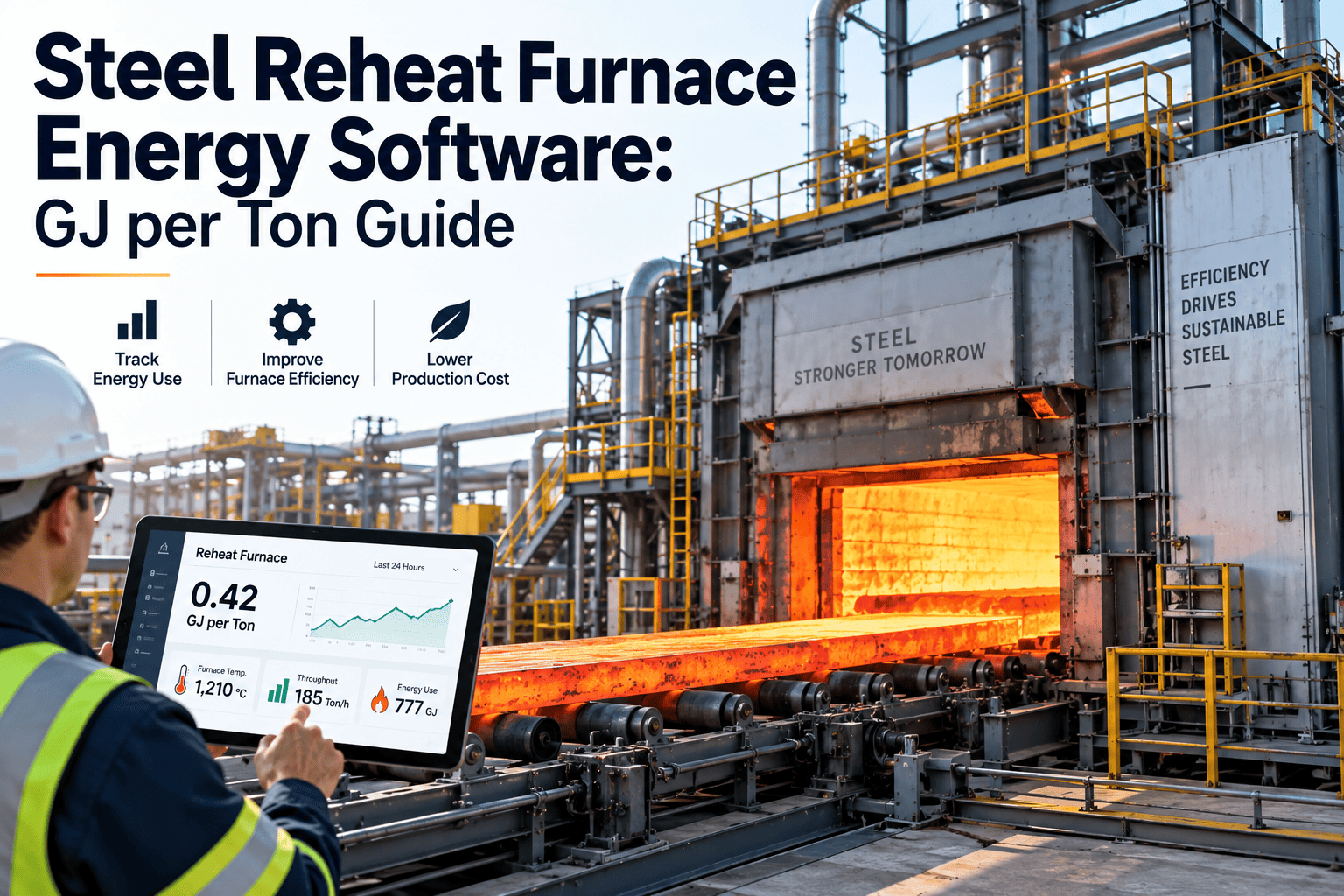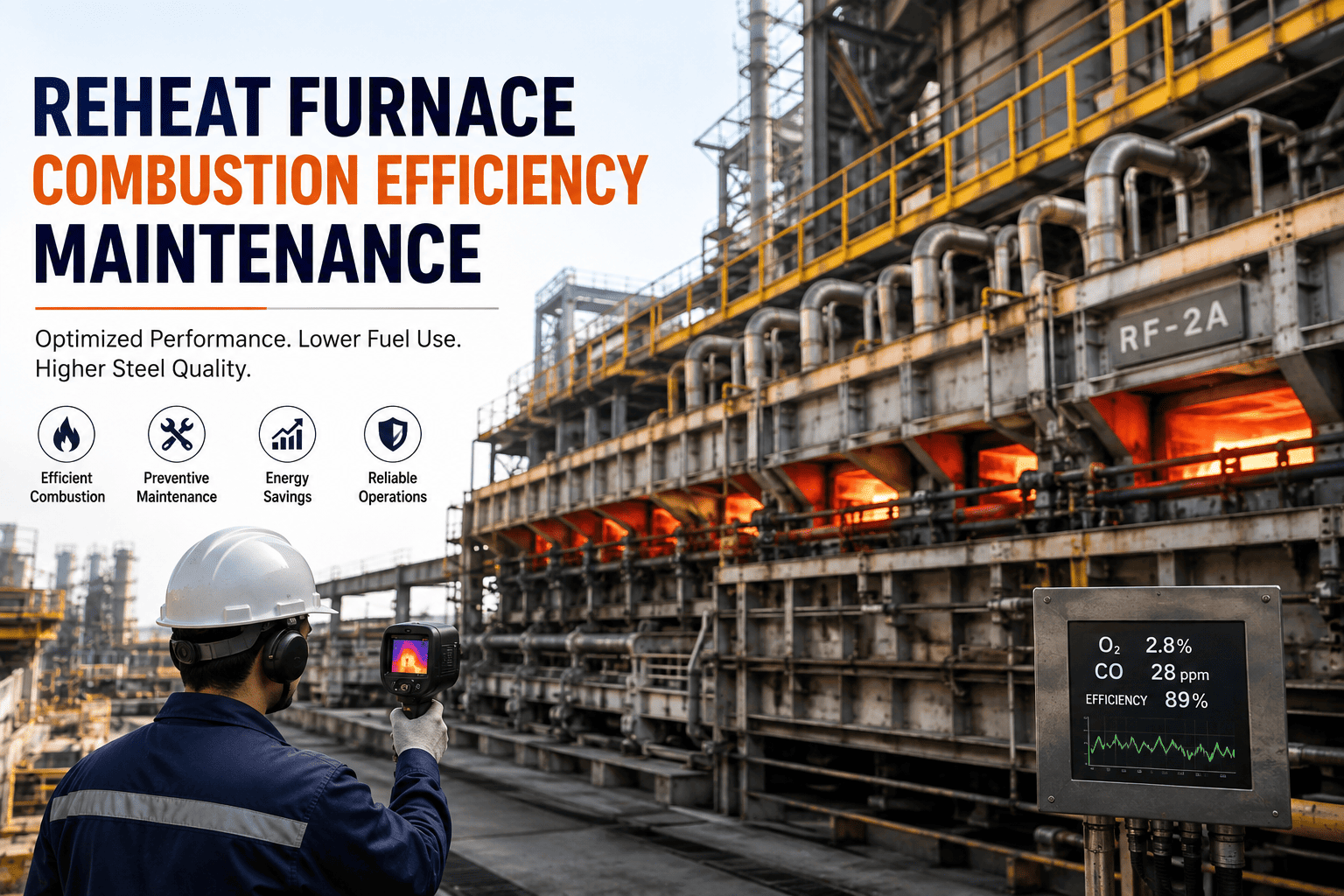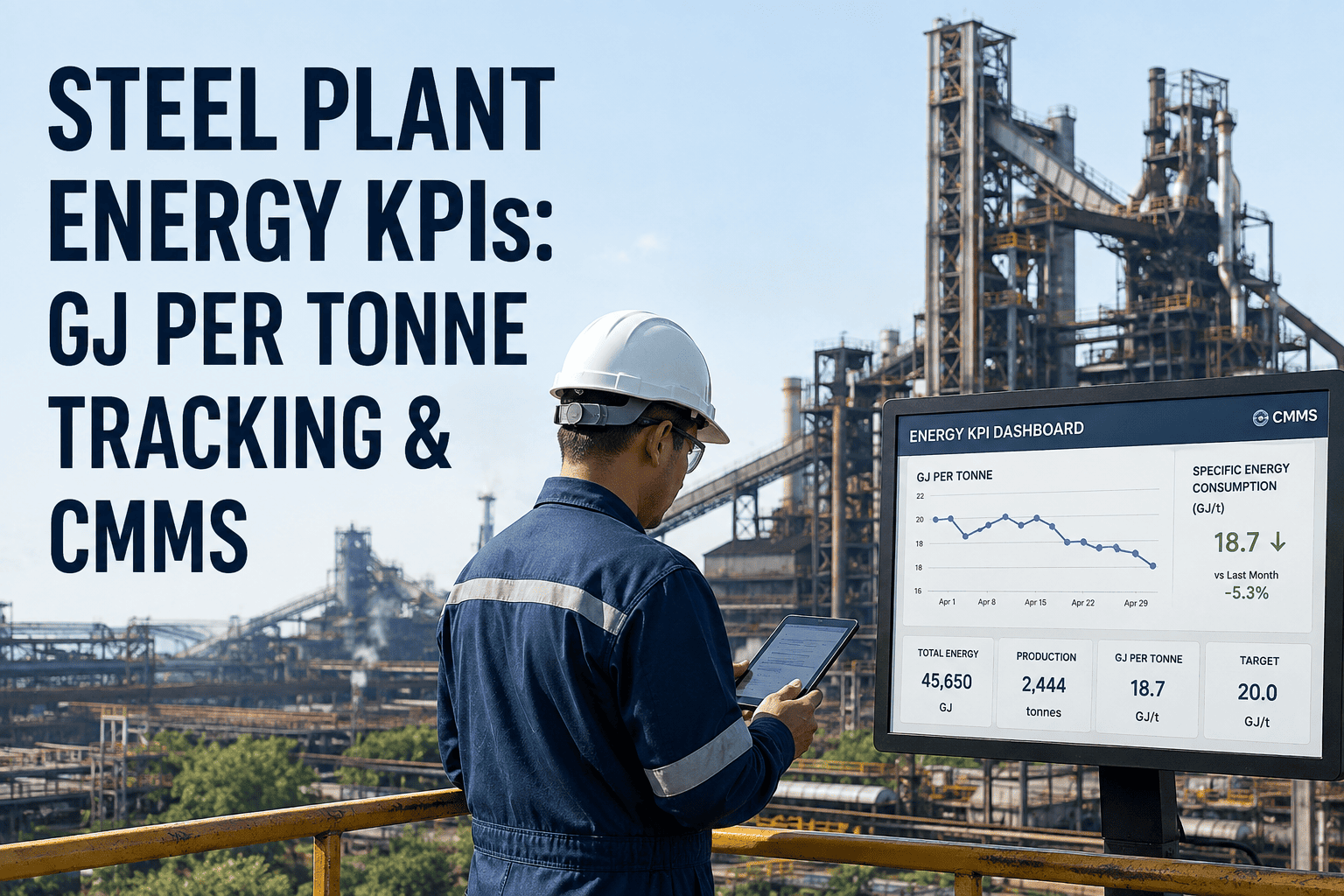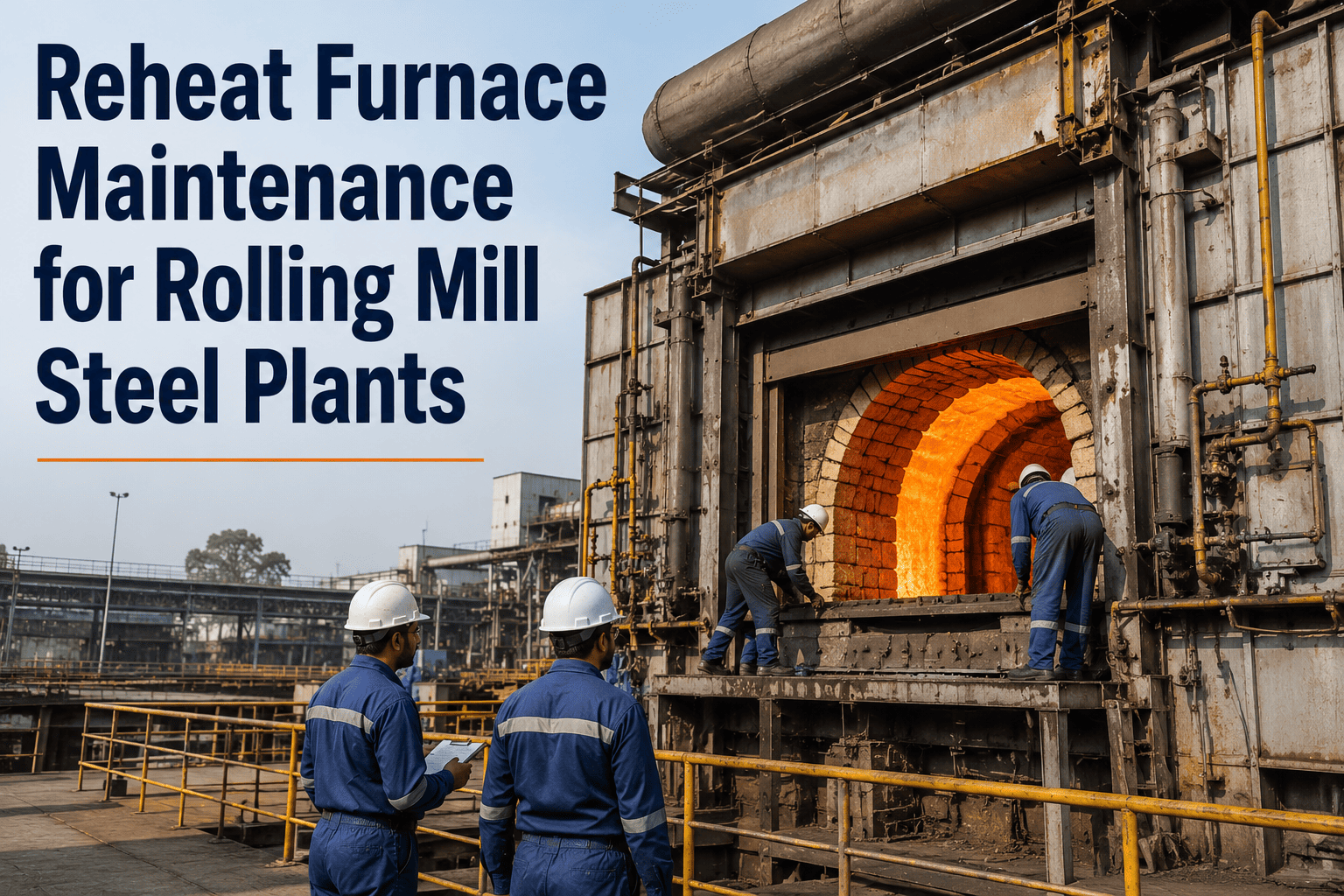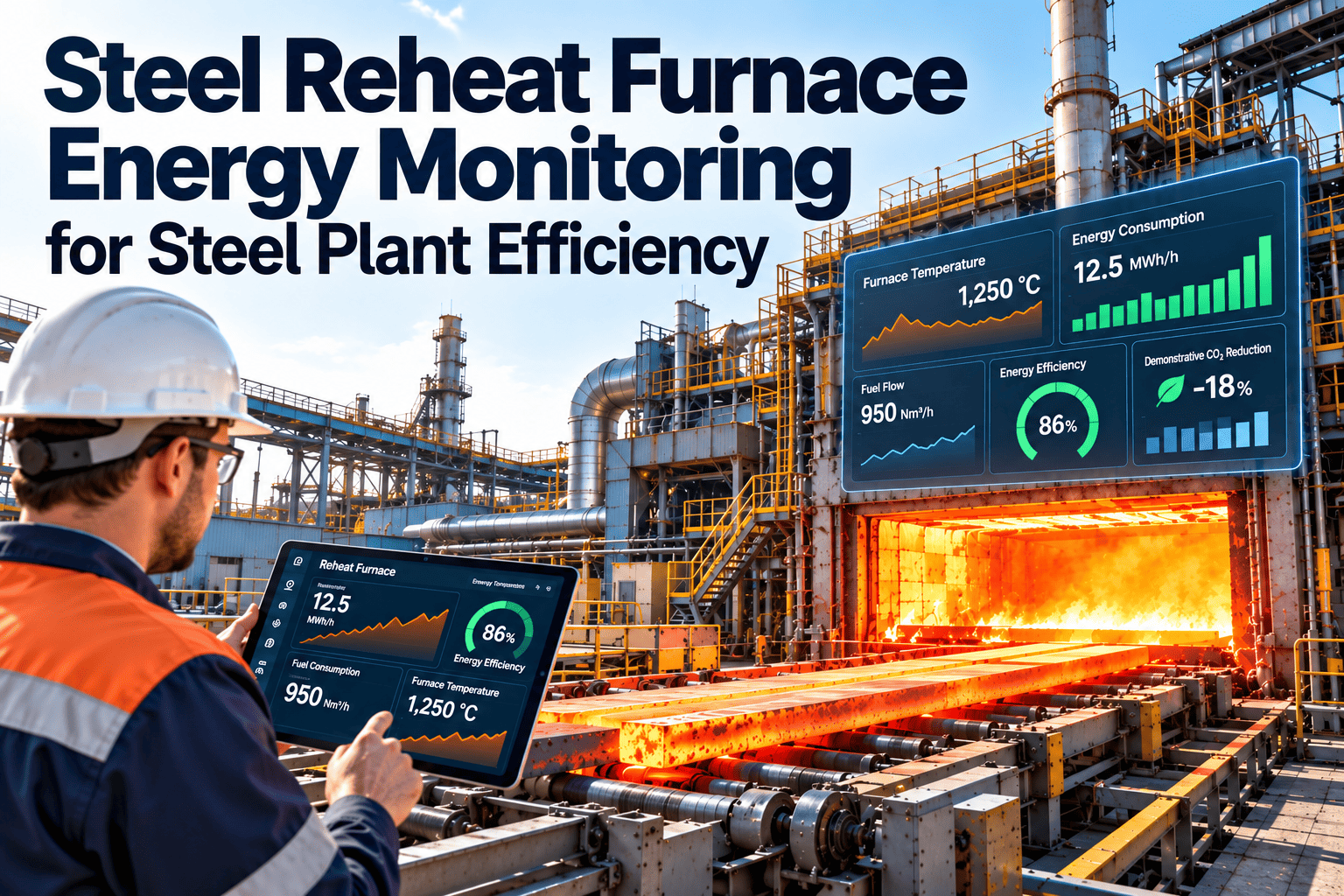
Reheat furnaces are among the largest fuel users in a rolling mill, and much of that fuel is spent on things that never make it into product: idle holds, excess air, door leakage and long dwell times. Energy per tonne is the number that summarises all of it, yet it is rarely tied to the maintenance work that moves it. This guide shows how steel teams can monitor reheat furnace energy, link losses to burners, refractory and downtime, and manage the work with a CMMS designed for steel plant maintenance.
Energy Management / Reheat Furnace
Steel Reheat Furnace Energy Monitoring: Lower Energy Per Tonne, Fewer Hidden Losses
Connect fuel use, furnace temperature, burner condition, downtime and throughput so every loss has an owner and every fix is measured.
Fuel Used
divided by
Tonnes Heated
equals
Energy Per Tonne
Maintenance moves both sides of the ratio: burners and seals change fuel, delays change tonnes
Where Reheat Furnace Energy Actually Goes
Only part of the fuel fired heats the steel. The rest leaves as flue gas, leaks through openings, heats water-cooled supports or is burned while the furnace waits for the mill.
The bars show relative order of magnitude in a typical furnace, not measured values. Your own balance depends on furnace type, fuel, product mix and operating pattern, which is why measuring it matters.
What to Monitor and Why It Moves Energy
| Measurement | What Drift Means | Maintenance Link |
|---|---|---|
| Fuel flow per zone | Rising fuel for the same throughput points to loss or poor combustion | Burner and control valve inspection |
| Combustion air flow and ratio | Excess air carries heat up the stack | Damper, actuator and airflow sensor checks |
| Flue gas oxygen | High oxygen means wasted heat, low oxygen risks incomplete combustion and scale | Analyser calibration and burner tuning |
| Zone and furnace temperature | Large gap from setpoint shows uneven heating | Thermocouple replacement and burner balance |
| Furnace pressure | Positive pressure pushes hot gas out, negative pulls cold air in | Damper control, seals and doors |
| Preheat air or recuperator outlet | Falling preheat temperature means less recovered heat | Recuperator inspection and cleaning |
| Throughput and dwell time | Long dwell burns fuel without adding value | Mill coordination and delay coding |
| Cooling water temperature rise | Higher heat pickup indicates insulation damage on supports | Skid and refractory repair |
Six Losses That Maintenance Can Reduce
01
Excess air from poor control
Worn dampers, sticking actuators and drifting oxygen analysers let air ratio wander. Regular calibration and inspection keep combustion where it was tuned.
02
Burner degradation
Fouled nozzles, damaged refractory quarls and failing ignition or flame detection give uneven flames and higher fuel for the same temperature.
03
Leaks at doors and seals
Damaged door seals, charge and discharge openings and worn skirt seals let heat out or cold air in, and both cost fuel.
04
Refractory and skid insulation damage
Lost insulation on water-cooled supports sends heat into cooling water. Regular inspection and repair reduce that continuous drain.
05
Recuperator or regenerator fouling
Scale, leaks and blocked passages reduce preheat and send more heat up the stack.
06
Unplanned stops and holds
Every delay downstream forces the furnace to hold, burning fuel without output. Reliability upstream and downstream matters as much as furnace condition.
Give Every Furnace Loss a Work Order and an Owner
Register burners, dampers, analysers, recuperators and seals in one asset structure, then schedule inspections and corrective work from what the energy data shows.
Why Energy Data Alone Does Not Reduce Fuel Use
Energy Dashboard Only
- Shows energy per tonne rising
- Does not say which burner or seal caused it
- Findings live in reports, not tasks
- No proof that a fix actually worked
Energy Data Linked to Maintenance
- Deviation raises an inspection task on the zone
- Fault, part and time recorded on the asset
- Energy per tonne compared before and after
- Recurring causes visible across shutdowns
The dashboard tells you that something changed. The maintenance record tells you what was found, what was done and whether the number moved back.
A Weekly Rhythm for Furnace Energy Reviews
Every shift
Operators record abnormal flame appearance, pressure swings, door issues and unusual holds. Findings become work requests.
Daily
Compare energy per tonne by zone against the same product family. Flag zones that drift and assign an inspection.
Weekly
Review delay codes, hold time and open energy-related work orders with operations and maintenance together.
Monthly
Check analyser calibration, damper response and recuperator performance trends. Update the shutdown scope.
Each outage
Inspect burners, refractory, skid insulation, seals and thermocouples. Confirm fixes with a before and after energy comparison.
Burner and Combustion Inspection Checklist
Burners and flame
- Check flame shape, stability and colour
- Inspect nozzles and quarl refractory
- Test ignition and flame detection
- Confirm burner balance across the zone
Air, fuel and control
- Verify fuel and air valve travel and response
- Calibrate oxygen analysers and flow meters
- Check damper linkages for play and sticking
- Compare thermocouple readings against reference
Envelope and heat recovery
- Inspect door and opening seals
- Survey furnace shell for hot spots
- Check skid and support insulation
- Review recuperator preheat trend and leaks
Trends in Reheat Furnace Efficiency
Steel producers face rising pressure to reduce fuel use and emissions, and reheat furnaces are a practical place to start because improvements are measurable at the furnace.
- Regenerative and recuperative burner systems recover more heat from exhaust gas, but only when they stay clean and sealed.
- Hot charging of slabs or billets reduces reheating demand, so coordination with the caster and the mill affects furnace fuel.
- Combustion optimisation and improved control models reduce excess air, provided sensors are calibrated and actuators respond.
- Energy management systems aligned with formal energy management standards such as ISO 50001 expect documented monitoring and corrective actions.
- Some plants assess alternative fuels or hydrogen blends, which demand careful burner and safety system maintenance.
Every one of these trends adds equipment that must be inspected, calibrated and recorded. Efficiency gains fade quickly when maintenance discipline does not keep pace.
KPIs That Connect Maintenance to Energy
Energy Per Tonne
By furnace, zone and product family, so comparisons are fair.
Hold and Idle Time
Hours the furnace waited, with delay reasons coded.
Furnace Downtime
Planned and unplanned, split by burner, control, refractory and mechanical.
PM Compliance
Share of combustion and envelope tasks completed on time.
Calibration Status
Analysers, flow meters and thermocouples within due date.
Repeat Faults
Same asset and same cause recurring within a defined period.
How Oxmaint Supports Reheat Furnace Maintenance
| Need | Oxmaint Capability | Result for the Furnace |
|---|---|---|
| Track burners, dampers, analysers and seals | Asset management with a furnace and zone hierarchy | Every loss source has a record and history |
| Keep combustion tuned | Preventive maintenance and calibration schedules | Fewer unnoticed drifts in air ratio |
| Act on deviations | Work orders raised from inspections or requests | Findings become tasks with owners |
| Capture rounds at the furnace | Mobile inspection checklists | Consistent readings and photos |
| Plan outages | Scheduling and parts inventory | Burners, seals and refractory materials ready |
| Show what changed | Reports and dashboards | Downtime, repeat faults and PM compliance in one view |
Oxmaint does not replace your furnace control or energy metering. It organises the maintenance response that those systems point to.
Fix the Data Before Trusting the Number
Energy per tonne is only as reliable as the meters behind it. A drifting fuel meter or an unreliable tonnage count can hide real problems or invent false ones.
A
Fuel metering
Verify flow meters on a calibration schedule, and correct for gas temperature and pressure where your setup requires it.
B
Tonnage counting
Confirm weight data from charging scales or the mill, and separate good product from rejected or returned material.
C
Temperature sensing
Thermocouples age and drift. A zone that reads correctly but heats poorly wastes fuel and risks quality problems.
D
Time alignment
Match fuel, temperature and throughput data to the same shift and product, so comparisons are like for like.
Calibration tasks belong in the preventive maintenance plan with due dates, results and the person who did the work. That gives auditors and energy managers confidence in the figure.
Reading the Pattern: What Different Drifts Usually Point To
| Pattern | Likely Direction to Check First | Follow-Up Task |
|---|---|---|
| Energy per tonne rises in one zone only | Burners, thermocouple or damper in that zone | Zone inspection and burner balance |
| Rises across all zones together | Recuperator, furnace pressure, door seals or fuel meter | Heat recovery check and pressure review |
| Rises only on certain products | Dwell time, heating curve or charging temperature | Review setpoints with process engineers |
| Rises after a long stop | Refractory damage or seal disturbance after cooling and reheating | Post-restart inspection of lining and doors |
| Stack oxygen high but stable | Air ratio set too generously or leakage | Tune combustion and inspect openings |
| Fuel high while output falls | Holds and delays | Delay analysis and upstream or downstream reliability review |
These are starting points for investigation, not diagnoses. The maintenance record confirms the cause and turns it into a recorded finding for next time.
Rollout Path for a Reheat Furnace Energy and Maintenance Programme
Step 1
Build the asset structure: furnace, zones, burners, valves, dampers, analysers, thermocouples, recuperator, doors and skid systems.
Step 2
Load existing preventive tasks, calibration intervals and spare parts for the highest-fuel zones first.
Step 3
Agree delay and downtime codes with operations, so holds and stops are recorded consistently.
Step 4
Set up mobile inspections for rounds, with photos of flames, seals and refractory condition.
Step 5
Review energy per tonne alongside open work orders weekly, and measure the change after each significant repair.
Common Reasons Furnace Energy Programmes Stall
What Goes Wrong
- Energy team and maintenance team work from separate reports
- Combustion tuning is done once and never revisited
- Small seal and insulation repairs are postponed
- Delay reasons are vague, so holds cannot be analysed
What Works Better
- One shared review of energy data and open work orders
- Recurring combustion checks with recorded results
- Small repairs scheduled by their fuel impact
- Consistent delay codes tied to the asset or process
Small losses matter because a furnace runs almost continuously. A minor seal leak or a slightly wrong air ratio repeats every hour of every shift.
Corrective and Condition-Based Work in the Furnace
- Use corrective work orders for burner failures, damaged refractory and seal damage, and record fault, cause and parts used.
- Use condition-based triggers when oxygen, pressure or preheat readings leave their normal band for a defined time.
- Use time-based tasks for calibration, actuator lubrication and safety checks that depend on age rather than condition.
- Use shutdown work packages for refractory repair, recuperator cleaning and skid insulation renewal.
Combining these gives a maintenance plan that follows the furnace rather than the calendar alone, and keeps combustion equipment near the condition it had when it was last tuned.
Refractory, Scale and Furnace Condition
Furnace condition changes slowly, which is why its energy cost is easy to miss. A lining that loses insulation value a little each month raises fuel use just as slowly.
Lining and shell
Schedule shell temperature surveys and lining inspections. Record hot spots by location so repairs can be compared over time.
Scale and hearth
Scale build-up in the hearth or on skids affects heat transfer and product movement. Log cleaning dates and the condition found.
Steel quality link
Poor combustion control can raise scale loss and cause uneven heating, so energy and yield problems often share the same cause.
Recording each inspection finding against the exact furnace zone lets engineers see whether a repair lowered fuel use or only moved the problem elsewhere. That evidence also helps justify shutdown budgets to management.
Questions to Ask Before Each Furnace Outage
- Which zones showed the largest rise in energy per tonne since the last outage, and which work orders explain it?
- Which burners, dampers and thermocouples had repeat faults, and are the right spares on site?
- Where did shell surveys show hot spots, and is refractory repair in the scope?
- Are analyser and flow meter calibrations due, so the post-outage baseline can be trusted?
- Who will compare energy per tonne before and after, and by which date?
Answering these from the maintenance record, rather than memory, keeps outage scope tied to measurable fuel savings and gives the next review a clear baseline.
Frequently Asked Questions
What is a good energy per tonne target for a reheat furnace?
It depends on furnace type, fuel, product and charging temperature, so benchmark against your own history first.
How does maintenance affect energy per tonne?
Burner condition, seals, insulation, analysers and delays all change fuel use. Track them in one system.
Should oxygen analysers be in the maintenance plan?
Yes. A drifting analyser leads to wrong air ratio, so calibration should be a scheduled and recorded task.
Can we compare zones fairly?
Compare by product family and throughput band, and record the asset work done in each zone.
Where should we begin?
Start with combustion and seal tasks on the highest-fuel zones, or book a demo to map your furnace.
Make Every Tonne Cheaper to Heat
Link furnace energy signals to inspections, calibration, repairs and downtime in one steel plant maintenance platform, and prove each improvement with data.