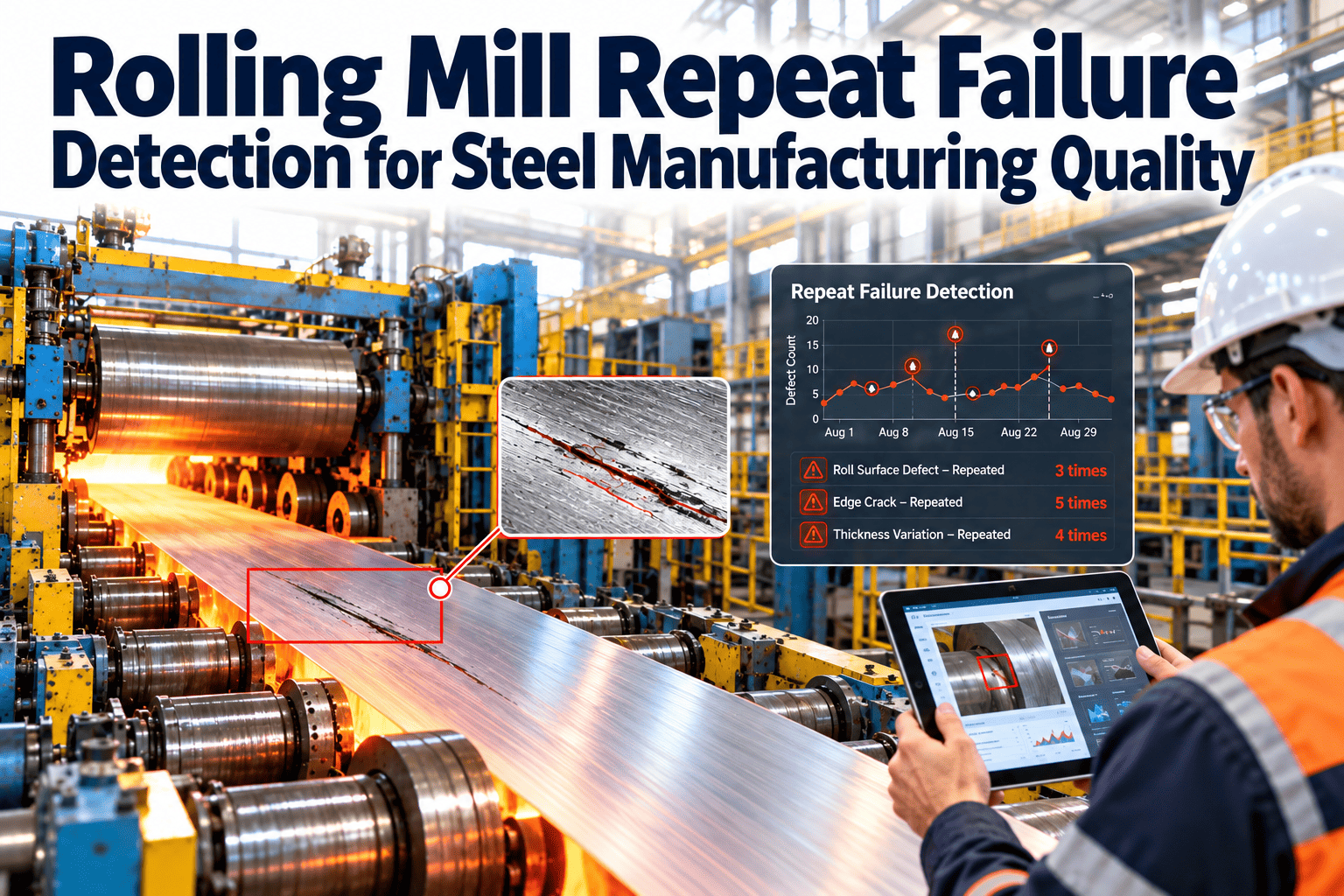
A 4 MTPA hot strip mill producing 1,400 coils per month cannot afford a quality event that propagates through 40 minutes of rolling before a manual inspector raises the alarm. At 1,200 metres per minute, that's 48 kilometres of affected strip — enough to trigger a full coil quarantine, customer notification, and an investigation process that pulls four engineers off production for three days. High-speed camera inspection eliminates this scenario entirely: OxMaint AI Vision classifies defects in under 2 seconds at full rolling speed, identifies the responsible stand, and creates a maintenance work order before the defective section reaches the coiler — converting a potential recall into a planned roll change.
Case Study · AI Vision Inspection · Hot Rolling Lines
High-Speed Camera Inspection for Hot Rolling Lines
How a 4 MTPA integrated steel plant reduced quality-related coil rejections by 78% and cut customer complaint costs by $2.4M annually by deploying OxMaint AI Vision Inspection across three finishing stands — with direct CMMS integration for automatic maintenance dispatch.
78%
Reduction in coil rejections due to surface defects — 12 months post-deployment
$2.4M
Annual saving in customer complaint costs, rework, and crop loss
<2s
Time from defect detection to maintenance work order creation
97%
Defect detection accuracy at 1,200 m/min rolling speed
The Problem
The Challenge: Manual Inspection at Rolling Speed
The plant's quality team ran a manual inspection process at the downcoiler — two operators visually examining the strip surface as coils were produced, sampling approximately 2% of the strip length at maximum rolling speed. The result: a defect detection rate of 58%, a 3–4 hour lag between defect occurrence and corrective action, and an average of 12 customer complaints per quarter related to surface quality issues.
01
Speed Incompatibility
Human visual inspection maxes out at roughly 12 m/min with acceptable accuracy. Hot strip mills run at 900–1,400 m/min. Manual inspection was physically incapable of covering more than 1% of the strip surface at production speed — a fundamental detection gap no staffing increase could close.
02
No Maintenance Linkage
When inspectors detected defects, they logged them on paper quality sheets. Those sheets reached the maintenance team during the next shift handover. By that time, the responsible roll had often produced another 3–4 coils with the same defect — compounding rejection quantities before any corrective action was taken.
03
Inconsistent Classification
Different inspectors classified the same defect differently — what one inspector called a sliver, another called a lap. Inconsistent classification made root cause analysis unreliable and prevented trend detection across shifts and production campaigns.
04
No Real-Time Data
Quality data existed only as end-of-shift summaries — no real-time view of defect rate trends, no correlation with process parameters, and no ability to halt production when defect frequency exceeded acceptable limits. Decisions were made on yesterday's data, not today's production state.
Event Flow — Before vs After
Detection to Action: The Before & After Timeline
Before OxMaint AI Vision
T+0: Roll mark defect begins on Stand F5
T+40 min: Inspector notices surface pattern at downcoiler
T+60 min: Paper quality sheet written, QA supervisor notified
T+180 min: Maintenance team receives defect report at next handover
T+240 min: Roll change scheduled for next campaign. 8 additional coils affected.
After OxMaint AI Vision
T+0: Roll mark defect begins on Stand F5
T+2s: AI camera detects pitch pattern, classifies as roll mark at F5
T+5s: Work order #WO-F5-Roll-Change auto-created in OxMaint
T+8s: Roll shop technician receives mobile notification with stand ID
T+90 min: Roll changed at next scheduled gap. Zero additional coils affected.
See how OxMaint AI Vision connects quality detection to maintenance dispatch in under 10 seconds — at full rolling speed, for every coil, every shift.
The Solution
OxMaint AI Vision Inspection — What Was Deployed
01
High-Speed Line-Scan Cameras
4K line-scan cameras installed at roughing mill exit, finishing stand F4 entry, and downcoiler entry — capturing full-width strip surface images at 1,200 m/min with no motion blur. Camera housings rated for mill environment: 70°C ambient, water ingress protection, vibration dampening mounts.
02
OxMaint AI Defect Classification
The AI model classifies 12 defect categories in real time — cracks, scale, laps, slivers, roll marks, pitting, edge defects, and coating irregularities. Each detection is tagged with GPS strip position, severity score, area coverage percentage, and process parameter correlation from the plant historian.
03
CMMS Work Order Integration
Every classified defect above threshold severity triggers an automatic work order in OxMaint. The work order is pre-populated with defect type, responsible stand, severity level, and relevant SOP — ready for technician acceptance without any dispatcher input. Roll marks specifically trigger work orders with roll change instructions and spare roll availability check.
04
Real-Time Quality Dashboard
Production managers see live defect rate, defect type distribution, affected strip position map, and open maintenance work orders in one dashboard. Configurable alerts trigger when defect rate exceeds 0.5% of strip area within any 10-minute window — enabling production intervention before entire coils are condemned.
Results — 12 Months Post-Deployment
Measured Outcomes Across the Hot Strip Mill
| Metric |
Before Deployment |
12 Months After |
Improvement |
| Defect detection rate |
58% |
97% |
+67% — full surface coverage |
| Time: defect to maintenance action |
3–4 hours |
<10 seconds |
99.9% faster response |
| Coil rejection rate (surface defects) |
4.2% |
0.9% |
78% reduction |
| Customer complaints (surface quality) |
12/quarter |
2/quarter |
83% reduction |
| Roll mark defect propagation (coils affected) |
8.3 coils avg per event |
0.8 coils avg per event |
90% less propagation |
| Crop loss from edge defects |
2.8% of strip length |
0.7% of strip length |
75% reduction in crop loss |
| Annual quality-related cost saving |
— |
$2.4M |
ROI achieved in month 4 |
Before vs After: Key Performance Bars
Coil Rejection Rate (%)
78% reduction
Customer Complaints per Quarter
83% fewer complaints
Defect Detection Rate (%)
+67% detection accuracy
Roll Mark Propagation (avg coils affected)
90% less propagation
"What made this deployment different from the camera systems we had evaluated before was the CMMS integration. Every AI inspection system we looked at could detect defects — but they all stopped at generating a quality report. OxMaint closed the loop: the camera detects a roll mark, the AI identifies which stand within 2 seconds, and a work order is already in the roll shop technician's queue before the defective coil reaches the recoiler. That speed of response is what dropped our roll mark propagation from 8.3 coils to 0.8 coils per event. The $2.4M saving is real, and it came almost entirely from closing that gap between detection and action — not from detecting more defects, but from acting on them before they became expensive."
General Manager — Quality Assurance, Integrated Steel Plant (4 MTPA)
OxMaint AI Vision customer · Hot strip mill, 3 finishing stands, 1,400 coils/month · Deployment completed Q2 2024 · Results measured at 12-month post-deployment review
Frequently Asked Questions
What rolling speeds can high-speed camera systems inspect at full accuracy?
OxMaint AI Vision uses 4K line-scan cameras capable of delivering 97%+ defect detection accuracy at rolling speeds up to 1,400 m/min — the maximum operating speed of most hot strip finishing stands. The system maintains accuracy across the full strip width at all speeds, with no sample-based inspection — 100% of the strip surface is examined for every coil. Camera housings are rated for hot mill environments with ambient temperatures up to 70°C, water spray protection, and vibration-isolated mounts.
How does the AI identify which rolling stand caused a roll mark defect?
The AI's pitch analysis algorithm measures the exact repetition interval of roll mark patterns in metres, then divides against the known circumference of rolls in each stand. Because each stand has rolls with different circumferences, the pitch period uniquely identifies the responsible stand — typically within 2 repetitions of the defect appearing on the strip. This identification is included in the auto-generated maintenance work order, so the roll shop technician receives the specific stand ID without any investigation required.
Book a demo to see pitch analysis in action.
How long does OxMaint AI Vision take to deploy in a hot rolling mill?
A standard hot strip mill deployment covering 3 inspection points (roughing exit, finishing entry, downcoiler) takes 6–10 weeks from equipment installation to full production accuracy. Week 1–2 covers mechanical installation and camera commissioning. Week 3–4 covers AI model calibration using plant-specific defect samples. Week 5–8 covers supervised production trials with accuracy validation. The CMMS work order integration goes live in parallel with model calibration, so maintenance teams start receiving automated work orders from day one of supervised production trials.
What ROI timeframe do most hot rolling mills achieve with AI vision inspection?
Most integrated steel plants with 2+ MTPA production capacity achieve ROI within 4–8 months of full deployment. The primary savings come from: coil rejection reduction (typically 60–80%), customer complaint cost elimination (typically 70–85% reduction), and crop loss reduction (typically 65–75%). Secondary savings from reduced manual inspection labour and faster maintenance response accumulate over 12+ months. A 4 MTPA plant in this case study achieved full ROI in month 4.
Start a free trial to model your facility's ROI.
Stop Finding Defects After the Coil Ships. Catch Them in 2 Seconds.
OxMaint AI Vision Inspection runs at full rolling speed, classifies every surface defect, and creates the maintenance work order that prevents the next occurrence — before your current coil reaches the recoiler.