AI Vision System for Steel Casting Lines

By Clerk Kent on January 21, 2026

ai-vision-system-for-steel-casting-lines

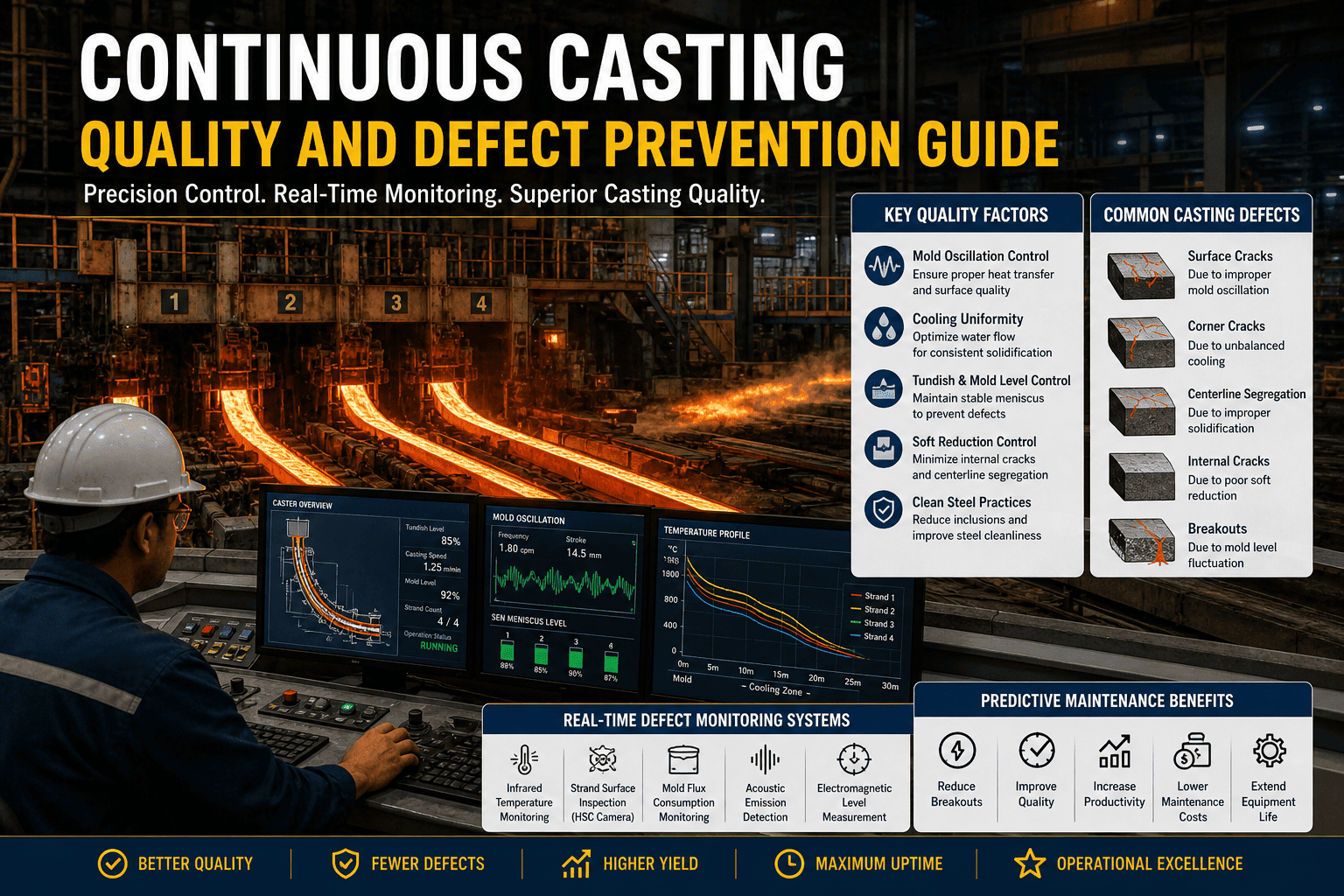
The continuous caster had been running for six hours when the breakout alarm triggered. Molten steel burst through the solidifying shell at 1,500°C—shutting down production for  18 hours while crews cleared solidified steel from the machine, replaced damaged equipment, and restarted the strand. Total cost: $2.3 million in lost production, repairs, and scrapped steel. That plant now runs AI vision monitoring every meter of the casting process—detecting shell thinning, mold level fluctuations, and surface cracks in real-time at casting speeds up to 6 meters per minute. When similar thermal patterns appeared last month, the system triggered automatic speed reduction before any damage occurred. That's the difference AI vision makes in steel casting.

1,500°C
Real-Time Monitoring at Casting Temperature
AI vision systems monitor continuous casting operations at extreme temperatures—analyzing thermal patterns, mold behavior, and strand surface quality in milliseconds while molten steel solidifies at speeds up to 6 meters per minute.

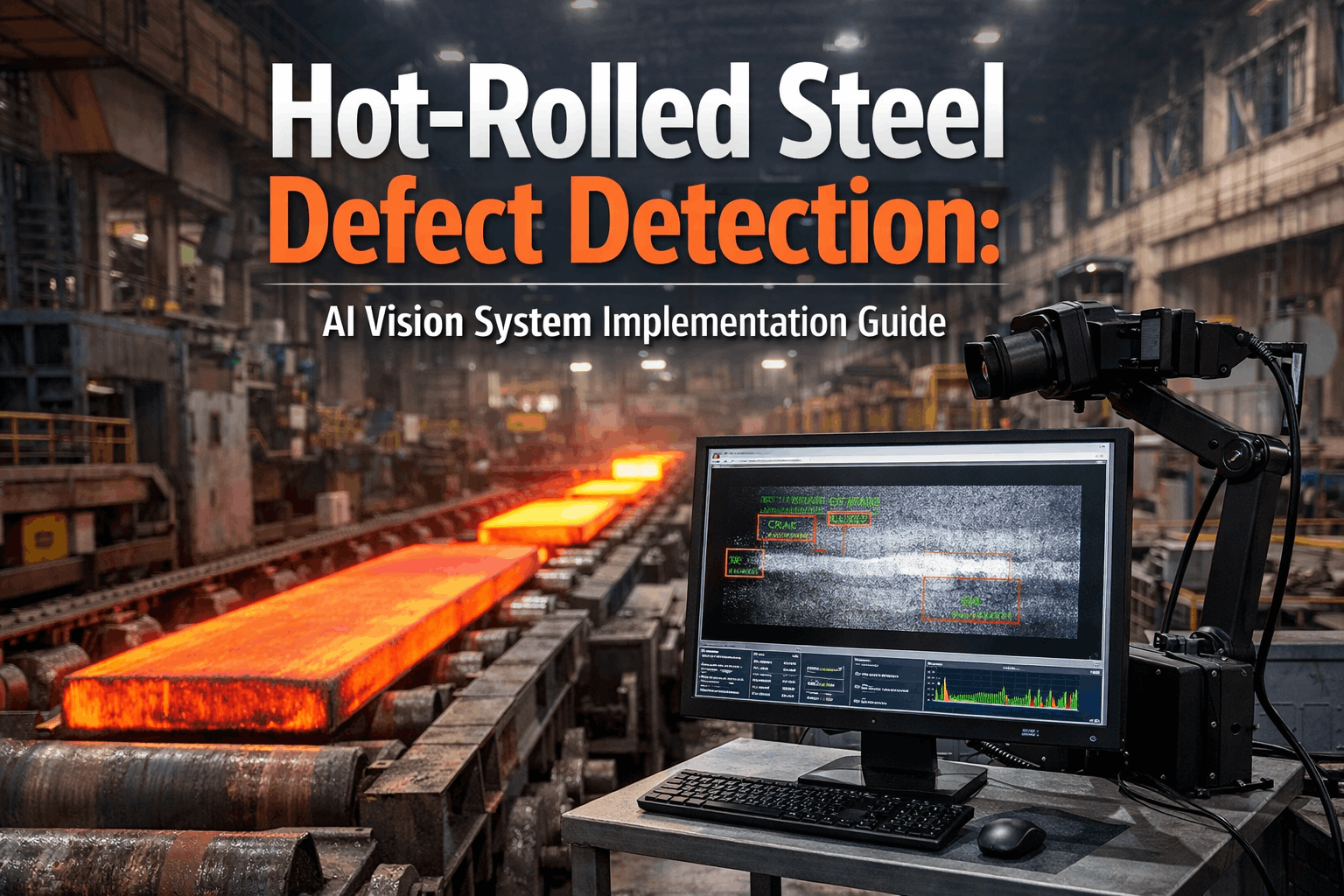
Steel casting lines present some of the most demanding environments for quality monitoring—molten metal, extreme heat radiation, rapid solidification, and the constant risk of catastrophic breakouts. Traditional monitoring methods rely on delayed sampling and operator experience, often detecting problems after significant damage has occurred. AI-powered vision systems change this equation entirely, detecting thermal anomalies, surface defects, and process deviations in real-time while there's still opportunity for intervention. Schedule a consultation to explore how AI vision can transform quality control at your casting facility.

Why AI Vision for Steel Casting

Steel casting operations face unique monitoring challenges that make AI vision not just beneficial but critical for safety and quality. The combination of extreme temperatures, rapid metallurgical changes, and catastrophic failure risks demands automated systems that can detect what humans cannot see.

The Case for AI Vision in Steel Casting
1,500°C
Molten steel temperatures where human observation is impossible—AI vision monitors continuously in extreme heat zones
24/7
Continuous strand monitoring—every cast analyzed from mold to cutoff, eliminating human fatigue and attention gaps
<100ms
Detection-to-alert latency—fast enough to trigger automatic speed reduction or casting parameter adjustments
95%
Reduction in breakout incidents—catching shell defects before they become catastrophic failures
Ready to eliminate breakout risks? Join leading steel mills using AI vision to achieve near-zero casting incidents.
Sign Up Free

Steel Casting Vision System Architecture

Modern AI vision systems for steel casting combine specialized thermal cameras, ruggedized processing hardware, and neural networks trained specifically on casting anomalies to deliver real-time process intelligence throughout the solidification process.

AI Vision System Components From thermal capture to actionable intelligence
01
Thermal Imaging Cameras
High-resolution infrared cameras with specialized filters capture thermal profiles at 60+ frames per second. Water-cooled housings and protective enclosures enable continuous operation near molten steel with temperature measurement accuracy of ±2°C.

02
Mold Level Monitoring
Laser-based and electromagnetic sensors track meniscus level with sub-millimeter precision. AI correlates level fluctuations with thermal patterns to predict shell formation issues before they manifest as defects.

03
Strand Surface Cameras
Line-scan cameras positioned after the mold exit capture surface features through scale and oxide layers. Visible and near-infrared imaging reveals cracks, oscillation marks, and surface inclusions at full casting speed.

04
Edge Processing Platform
GPU-accelerated industrial computers process AI models locally with sub-100ms latency. Ruggedized for caster environments—vibration-resistant, wide temperature range, redundant systems for 24/7 continuous operation.

05
Caster Integration
Direct connections to Level 2 automation enable real-time casting speed adjustments and cooling control. Integration with quality tracking correlates defects to specific slab positions. Sign up for Oxmaint to centralize quality data across multiple casting strands and facilities.

Defect Detection Capabilities

AI vision systems detect the full spectrum of casting defects—from thermal anomalies indicating breakout risk to surface cracks and internal quality indicators that determine downstream processing suitability.

Detectable Defect Types

Breakout Prediction
Thermal pattern anomalies in the mold region detected 30-60 seconds before potential shell rupture. AI recognizes sticker patterns, corner cracks, and localized hot spots with over 99% accuracy.

Oscillation Mark Defects
Deep oscillation marks, hook formation, and irregular mark patterns identified through surface imaging. AI correlates marks with mold parameters for process optimization.

Longitudinal Cracks
Surface and subsurface longitudinal cracks detected through thermal signatures. AI distinguishes true cracks from scale patterns and cooling marks with high precision.

Transverse Cracks
Corner and face transverse cracks identified through combined thermal and optical imaging. Early detection prevents crack propagation during downstream rolling.

Bulging & Rhomboidity
Strand shape deviations detected through laser profiling and thermal mapping. Real-time shape monitoring enables immediate roll gap adjustments.

Surface Inclusions
Non-metallic inclusions, mold flux entrapment, and slag spots detected at the strand surface. Thermal imaging reveals subsurface inclusions invisible to optical cameras.
See AI vision detecting defects at casting speed. Book a demo and we'll show you real-time detection on actual continuous casting footage.
Schedule Free Demo

Inspection Points in Continuous Casting

Strategic camera placement throughout the continuous casting machine enables comprehensive quality monitoring from tundish to torch cutoff. Each inspection point serves specific safety and quality control purposes.

Inspection Point Configuration
Location Temperature Primary Detection Process Value
Tundish Stream 1,530-1,560°C Stream stability, shroud alignment, reoxidation indicators Cleanliness control, nozzle clogging prediction
Mold Region 1,500-1,530°C Meniscus behavior, thermal patterns, sticker detection Breakout prevention, mold flux optimization
Mold Exit 1,100-1,200°C Shell thickness uniformity, corner temperatures, surface cracks Secondary cooling adjustment, speed optimization
Secondary Cooling 900-1,100°C Spray pattern effectiveness, reheating, thermal gradients Cooling zone control, crack prevention
Straightening Zone 850-950°C Surface cracks, strand shape, internal quality indicators Roll alignment, unbending stress management
Before Torch Cutoff 700-850°C Final surface quality, length measurement, temperature uniformity Product certification, slab grading, direct charging decisions
Temperatures are typical for carbon steel continuous casting. Specialty steels and different casting speeds may operate at different temperature profiles.
Not sure which inspection points you need? Our engineers will assess your caster layout and recommend optimal camera positioning.
Schedule Assessment

Traditional vs. AI-Powered Monitoring

Understanding the capabilities difference between traditional monitoring methods and AI vision systems reveals why casters worldwide are transitioning to automated quality and safety monitoring.

Monitoring Method Comparison
Traditional Monitoring
  • Thermocouple-based breakout detection
  • Delayed quality sampling on cooled slabs
  • Operator visual observation of mold
  • Post-mortem defect analysis
  • Reactive process adjustments
2-4/year typical breakout incidents
AI Vision Monitoring
✔️
  • Thermal pattern recognition
  • Real-time surface quality grading
  • Predictive anomaly detection
  • Continuous 24/7 monitoring
  • Proactive process optimization
<0.1/year breakout rate achievable
Transform Steel Casting Safety & Quality
Oxmaint connects AI vision systems across your casting operations—centralizing thermal data, quality trends, and safety alerts while each monitoring point delivers real-time process intelligence.

Product-Specific Applications

Different cast products have distinct quality requirements and defect profiles. AI vision systems adapt monitoring parameters and detection algorithms to each product type's specific metallurgical and dimensional needs.

AI Vision by Product Type
Product Critical Defects Monitoring Focus Customer Requirements
Automotive Slabs Surface inclusions, longitudinal cracks, subsurface defects High-resolution surface imaging, inclusion detection Zero surface defects, certified cleanliness levels
Plate Slabs Internal cracks, centerline segregation, porosity Thermal uniformity, solidification modeling Through-thickness integrity, ultrasonic certification
Beam Blanks Web/flange cracks, shape deviations, corner defects Complex geometry monitoring, corner temperatures Dimensional accuracy, structural integrity
Round Billets Rhomboidity, surface seams, centerline quality Circumferential temperature mapping, shape analysis Tube/pipe suitability, seamless quality
Stainless Steel Surface oxidation, grain boundary defects, flux entrapment Specialized thermal signatures, oxidation monitoring Surface finish, corrosion resistance preservation
High-Carbon Grades Centerline segregation, transverse cracks, shrinkage Slow cooling monitoring, segregation prediction Homogeneity, crack-free processing
AI models are trained on product-specific defect libraries to optimize detection accuracy for each cast product family.

ROI of AI Vision in Steel Casting

AI vision investments in continuous casting deliver returns through eliminated breakouts, reduced scrap, improved yield, and optimized maintenance scheduling. The financial impact accumulates across multiple value streams with dramatic safety improvements.

Documented Caster Benefits Based on steel industry deployment data
95%
Reduction in breakout incidents
70%
Decrease in surface defect claims
35%
Improvement in prime yield rate
50%
Increase in direct hot charging
Calculate your potential ROI. Create a free Oxmaint account and our team will help model the value for your specific operation.
Sign Up Free

Technical Specifications

AI vision systems for continuous casting must meet demanding specifications for thermal imaging technology, processing capability, and environmental resilience to deliver reliable performance in continuous operation near molten steel.

System Performance Requirements

Thermal Resolution
640x480 to 1280x1024 pixel thermal cameras with ±2°C accuracy capture temperature variations across the full strand width. Multiple cameras provide overlapping coverage for redundancy.

Operating Environment
Camera housings withstand 80°C ambient temperature with water cooling and air purge systems. Protective enclosures shield optics from radiant heat, steam, and scale debris.
Processing Speed
GPU clusters analyze 60+ thermal frames per second with pattern recognition completing in under 50ms. Edge deployment ensures latency independent of network conditions.

System Availability
99.9%+ uptime through redundant cameras, failover processing, and hot-swappable components. Automatic calibration maintains accuracy without production interruption.
In continuous casting, a breakout doesn't just stop production—it endangers people and costs millions. AI vision doesn't just monitor temperature; it recognizes the thermal fingerprints of failure before they happen. Every breakout prevented is a crisis avoided.
— Steel Industry Operations Director

Implementation Approach

Successful AI vision deployment in continuous casting requires careful planning across equipment installation, model training, and integration with existing Level 2 systems. A phased approach minimizes production disruption while building operational confidence.

Typical Deployment Roadmap
Month 1-2
Assessment & Design
Caster survey and camera positioning Thermal pattern library development Integration architecture planning
Month 3-4
Installation
Thermal camera installation Edge processing deployment Level 2 system integration
Month 5-6
Training & Validation
AI model training on live data Breakout detection validation Operator training program
Month 7+
Production & Optimization
Full production deployment Continuous model improvement Additional monitoring points
Start your implementation journey today. Get a detailed project plan customized for your caster's specific requirements.
Get Project Plan

Integration Capabilities

AI vision systems integrate with existing caster automation and quality management infrastructure to enable closed-loop process control and comprehensive data analytics.

System Integration Points
System Integration Type Data Exchange
Level 2 Automation Real-time bidirectional Speed reduction triggers, cooling setpoints, breakout alarms, automatic holds
Breakout Detection Parallel monitoring AI predictions complement thermocouple systems, shared alarm protocols
Quality Management (QMS) Database integration Thermal records, defect images, statistical reports, slab certification data
MES/ERP Systems Transaction-based Slab routing, grade assignment, direct charging decisions, inventory status
Historian/SCADA Time-series data Process correlation, trend analysis, root cause investigation support

Common Challenges & Solutions

Continuous casting environments present unique challenges for vision system deployment. Understanding these challenges and proven solutions accelerates successful implementation.

Challenge Resolution Guide
Challenge Impact Solution
Extreme radiant heat Damages cameras, degrades optics Water-cooled housings, heat-reflective shields, strategic positioning angles
Steam and spray interference Obscures thermal imaging, causes false readings Infrared wavelength selection, air purge systems, spray zone avoidance
Scale and debris Contaminates optical surfaces Protective windows, automated cleaning, sealed enclosures with positive pressure
Electromagnetic interference Disrupts sensors and communications Shielded cabling, isolated power supplies, fiber optic data transmission
Grade-specific patterns Different thermal signatures for different steels Grade-specific AI models, automatic model switching, recipe management
Deploy AI Vision for Casting Excellence
Your operators can't see thermal patterns in molten steel or predict breakouts before they happen. Oxmaint helps you deploy AI vision that monitors every thermal signature, predicts failures before they occur, and integrates seamlessly with your caster automation—transforming safety and quality from reactive response to predictive prevention.

Frequently Asked Questions

How long does AI vision implementation take?
Most continuous casters can have AI-powered thermal monitoring running within 4-8 weeks. The system integrates with your existing Level 2 automation and breakout detection infrastructure—no major equipment changes required. Schedule a consultation to get a customized timeline for your facility.
Does AI vision replace our existing breakout detection system?
No. Oxmaint's AI vision platform works alongside your existing thermocouple-based breakout detection as an additional safety layer. It provides earlier warning through thermal pattern recognition while your existing system remains fully operational as backup.
What data do we need to get started?
At minimum, you need access to thermal camera feeds from key monitoring points, strand tracking data, and basic casting parameters. The more data sources connected, the more powerful the AI predictions become. Sign up for a free account and our team will assess your data readiness.
How does AI handle different steel grades?
The system maintains grade-specific AI models that automatically activate based on the current heat. Different thermal patterns, solidification behaviors, and defect signatures are recognized for each grade family. New grades can be added to the training set as they're produced.
What ROI can we expect from AI vision implementation?
Casters typically see 95% reduction in breakout incidents, 70% decrease in surface defect claims, and significant improvements in direct hot charging rates within the first year. A single prevented breakout can justify the entire system investment. Book a demo to get a customized ROI projection based on your production volumes and incident history.

Share This Story, Choose Your Platform!