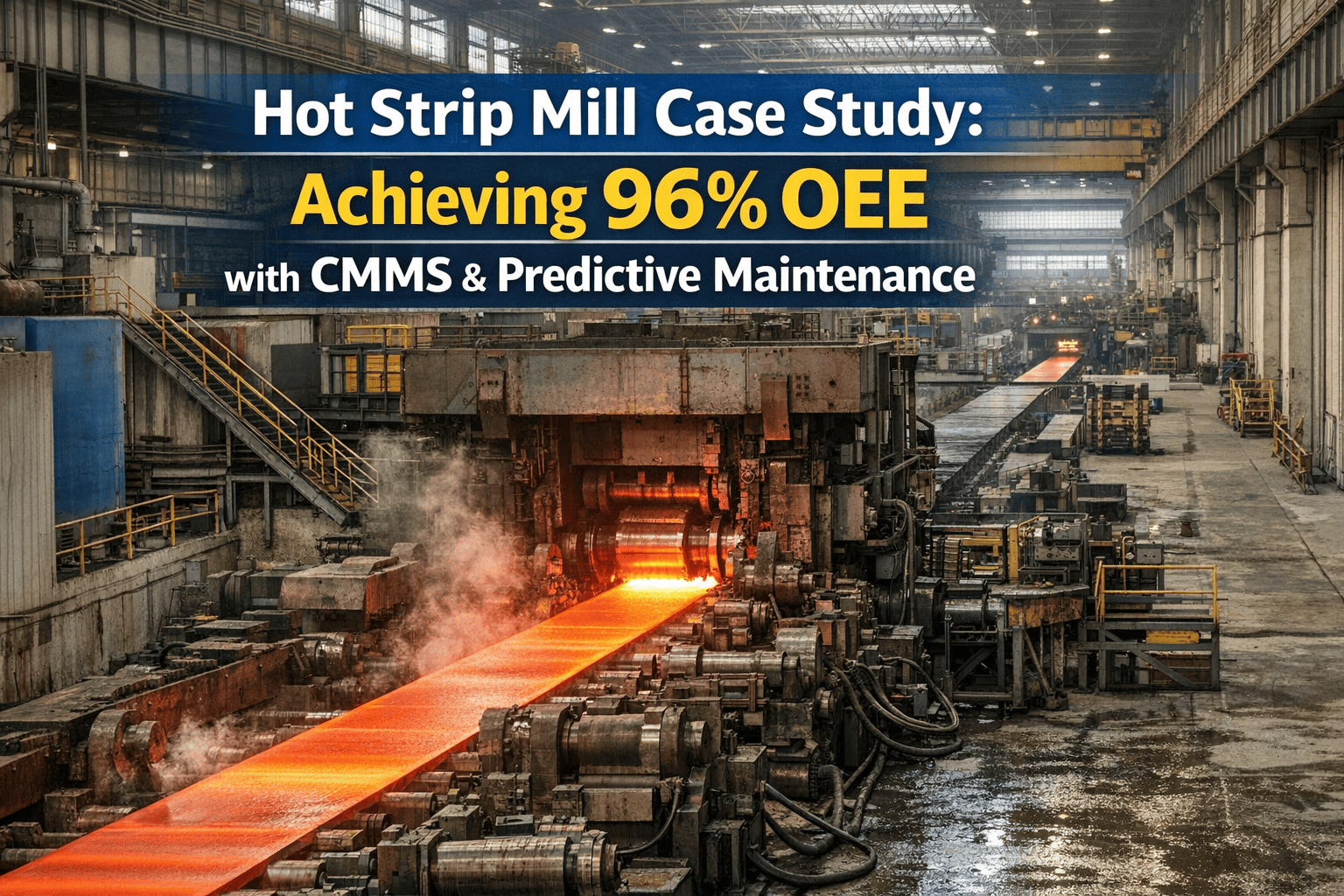
The hydraulic system PM that would have caught it was 11 days overdue — rescheduled twice because production wouldn't release the stand for the 35-minute inspection window. A hot rolling mill is a precisely synchronized chain of equipment spanning 300–600 meters — from reheat furnace through roughing stands, finishing stands, runout table, and coiler. Every component must function within tight tolerances simultaneously, at strip speeds exceeding 1,000 meters per minute, with material temperatures between 850°C and 1,250°C. When any single component degrades beyond its tolerance — a bearing, a hydraulic valve, a roll surface, a looper actuator, a cooling header — the entire line pays the price. Not in gradual performance loss, but in cobbles, off-gauge strip, surface defects, and unplanned shutdowns that cost $100,000–$500,000 per event. Hot rolling mill maintenance management software built on CMMS tracks every component across the entire mill line — from furnace walking beam mechanism through coiler mandrel — monitoring wear rates, vibration signatures, hydraulic performance, roll condition, and bearing health to ensure that maintenance happens at the precisely right moment: before the tolerance is exceeded, before the cobble occurs, before the quality defect reaches the customer.
Hot Rolling Mill Line — Critical Maintenance Zones
Reheat Furnace
Walking beams, burners, skid pipes, pusher/extractor, refractory, combustion control
→
Roughing Mill
Work/backup rolls, edger, descaler, roll bearings, mill housing, AGC hydraulics
target mill availability — every 1% lost = $3.2M–$5.8M annually in foregone production revenue
$191K
average cobble cost including damage, extraction, roll change, and lost production time
2,400+
maintenance-monitored components across a 7-stand finishing mill from reheating through coiling
$6.4M
annual value from cobble prevention, roll life extension, bearing failure avoidance, and reduced quality holds
Stand-by-Stand Health: Seeing the Whole Mill at a Glance
A finishing mill is only as reliable as its weakest stand. A single stand with degraded AGC response, a bearing with increasing vibration, or a work roll approaching surface roughness limits can cobble the entire line. Stand-by-stand health monitoring gives the maintenance team and the mill operator a single view of every stand's condition — highlighting the stand that needs attention before it becomes the stand that stops production.
Finishing Mill Stand Health Matrix — Real-Time Status
Roll Management: The Consumable That Defines Strip Quality
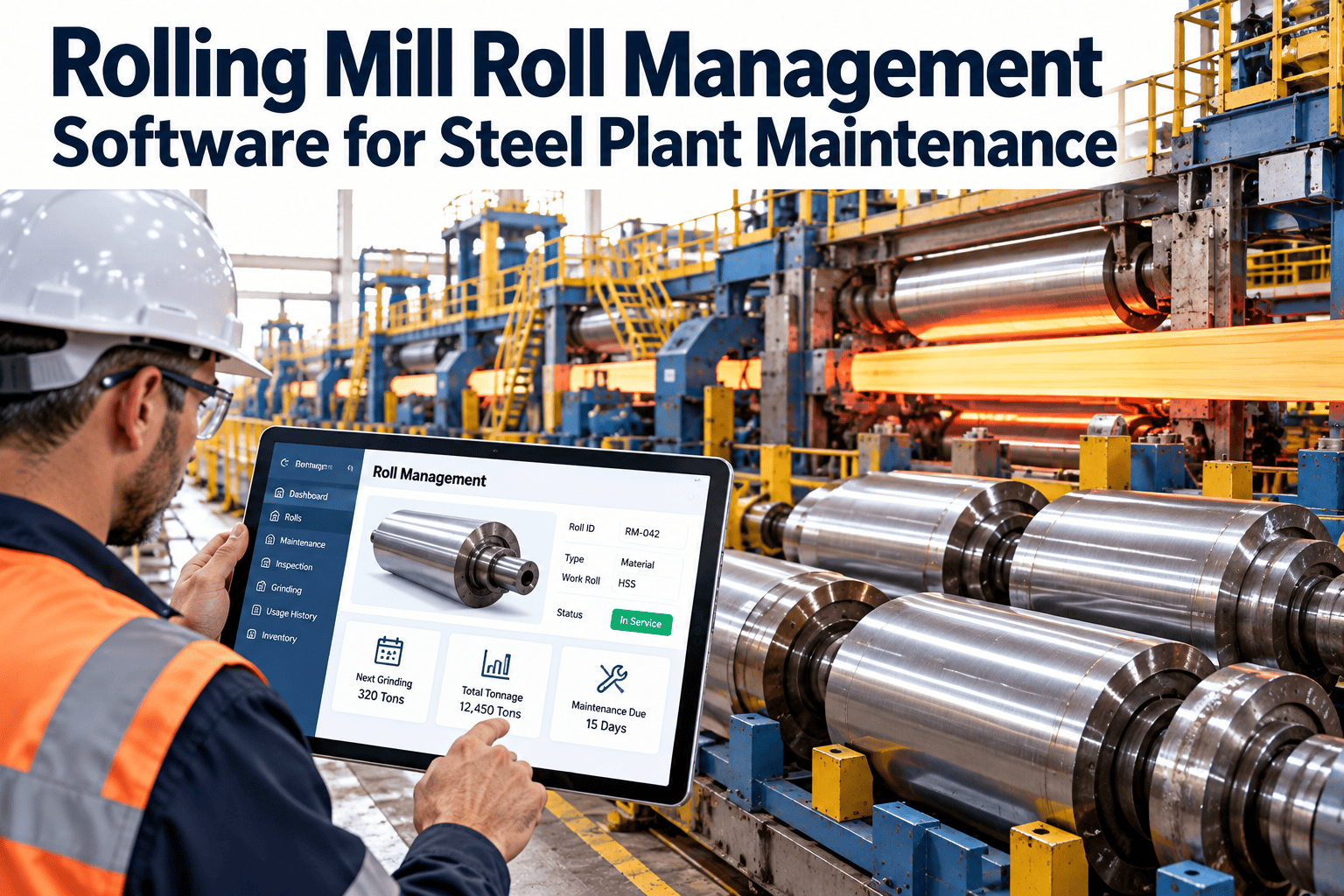
A hot rolling mill cycles through hundreds of work rolls and dozens of backup rolls per month — each roll ground to precise crown profiles, installed, run for a defined campaign length, removed, inspected, reground, and reinstalled. Roll management is a logistics and lifecycle challenge as much as a maintenance one. Poorly managed roll inventories lead to either wasted roll life (changed too early) or surface defects and cobbles (changed too late).
Roll Lifecycle Management — Grinding to Retirement
01
Grinding & Profile Verification
Roll ground to target crown profile. Surface roughness measured and verified (Ra 0.8–3.2 μm depending on stand position). Diameter recorded for gap calibration. Eddy current inspection for subsurface cracks before every reinstall.
02
Installation & Campaign Assignment
Roll installed in assigned stand. CMMS records: roll ID, diameter, grind number, target campaign (tonnes or strip-km), stand position, and bearing assembly ID. Campaign clock starts at first strip contact.
03
In-Service Monitoring
Roll force, torque, vibration, and strip surface quality monitored continuously. CMMS tracks accumulated tonnage against campaign target. Surface quality feedback from inspection lines flags rolls producing defects before campaign limit is reached.
04
Removal & Post-Campaign Inspection
Roll removed at campaign end or quality trigger. Post-service inspection: diameter loss, surface condition, bearing condition, fire crack depth. Data feeds roll life optimization model — adjusting future campaign targets per roll grade and stand position.
05
Regrind or Retirement
Roll reground if above minimum diameter. Average work roll: 80–120 grinds before retirement. CMMS tracks total grind history, remaining diameter stock, crack depth progression, and projects retirement date for procurement planning.
Every Roll Tracked. Every Stand Monitored. Every Cobble Prevented.
OxMaint manages the entire hot rolling mill maintenance ecosystem — stand-by-stand health monitoring, roll lifecycle management from grinding through retirement, bearing vibration analysis, AGC hydraulic performance tracking, and cobble root cause analysis. One platform keeping a 600-meter production line running at full speed.
Bearing Health: Listening to the Mill Before It Screams
A hot rolling mill contains 200–400 rolling element and hydrodynamic bearings across work rolls, backup rolls, table rollers, loopers, and coiler assemblies. Bearing failures are the leading cause of unplanned roll changes — and unplanned roll changes are the leading cause of lost production time after cobbles. Vibration monitoring converts bearing condition from guesswork into data-driven replacement scheduling. Teams building bearing programs should book a free demo to see how vibration data feeds predictive work orders in the CMMS.
CMMS: Replacement bearing confirmed in inventory. Roll change + bearing swap scheduled for next planned window. Monitoring frequency increased to daily until replacement.
Advanced inner race + cage defect. Remaining life estimated <200 hours. Risk of seizure if not addressed.
CMMS: S2 priority work order generated. Mandrel bearing replacement scheduled for next coiler maintenance window (3 days). Spare mandrel assembly on standby for emergency swap if conditions worsen.
Cobble Prevention: The Highest-Value Maintenance Outcome
A cobble doesn't just stop the mill — it damages equipment, wastes material, risks injury, and destroys scheduled production. Most cobbles trace back to one of five maintenance-related causes, each preventable with the right monitoring and PM discipline.
Roll gap drifts from setpoint because proportional valves, servo valves, or hydraulic cylinders have degraded beyond their response tolerance. The strip enters the next stand at off-gauge thickness.
CMMS: Hydraulic step-response test every 500 rolling hours. Servo valve replacement on condition (response time trending). Cylinder seal inspection at every roll change.
22%
Roll Surface Condition Failure
Work roll surface roughness degraded, fire cracks propagated, or spalled surface creates strip surface defect that disrupts threading or causes strip break between stands.
CMMS: Roll campaign tracked per stand. Surface roughness threshold triggers automatic change. Eddy current crack inspection mandatory before every reinstall. Roll history database optimizes campaign length per grade.
18%
Looper / Tension Control Malfunction
Interstand looper fails to maintain target strip tension — actuator slowdown, position sensor drift, or control system fault. Tension upset causes strip fold or lateral wander into side guide.
CMMS: Looper actuator PM on cycle count. Position sensor calibration monthly. Response time test at every roll change. Hydraulic accumulator pre-charge verification quarterly.
16%
Cooling System Asymmetry
Interstand or runout table cooling headers partially blocked — creating asymmetric temperature distribution that warps the strip shape. Strip walks laterally, contacts guide, and folds.
CMMS: Header flow verification every shutdown. Nozzle inspection quarterly. Cooling pattern symmetry monitored through strip temperature measurement — asymmetry alerts trigger header inspection WO.
10%
Descaler / Threading Equipment
High-pressure descaler header blocked or misaligned — scale patches on strip surface cause friction variation. Crop shear timing drift or pinch roll pressure malfunction disrupts head-end threading.
CMMS: Descaler nozzle replacement on tonnage. Shear blade condition at every roll change. Pinch roll pressure calibration weekly. Threading sequence functional test after every maintenance event.
Quality-Linked Maintenance: When Defects Tell You What's Failing
Strip surface defects, gauge deviations, and flatness problems aren't just quality issues — they're maintenance signals. Every quality defect has a mechanical cause, and the defect pattern identifies which component is degrading. Operations connecting quality data to maintenance should sign up to see how quality feedback loops generate CMMS work orders.
Quality Defect → Maintenance Root Cause Correlation
Quality Defect
Mechanical Root Cause
CMMS Response
Gauge deviation >±0.05mm
AGC hydraulic response degradation, roll eccentricity, mill stretch compensation drift
Hydraulic step-response test WO. Roll eccentricity measurement. Mill modulus recalibration.
Roll marks (periodic surface marks)
Work roll surface defect — spall, fire crack, bearing print transfer, foreign object embedded
Immediate roll change WO. Post-removal inspection. Bearing check on affected stand.
Edge wave / center buckle
Roll crown profile wear, work roll bending system malfunction, thermal crown asymmetry
Crown measurement at next roll change. Bending system hydraulic PM. Cooling spray pattern verification.
Asymmetric roll gap, side guide misalignment, work roll alignment drift, looper calibration
Roll alignment verification WO. Side guide position calibration. Looper balance test.
Expert Perspective: A Hot Mill Is a 600-Meter Symphony — One Instrument Out of Tune Ruins the Performance
I've managed hot rolling mill maintenance at six plants producing everything from structural beams to automotive exposed. The lesson that took 15 years to learn completely is this: a hot mill doesn't fail by equipment — it fails by interaction. Stand F3's hydraulic valve doesn't just degrade F3's performance. It upsets the thickness entering F4, which upsets the tension between F4 and F5, which upsets F5's looper, which causes a shape deviation at F6, which produces a flatness defect at F7 that the customer rejects. The valve degradation at F3 became a customer complaint about flatness at the coiler — and nobody connected the two until the root cause investigation traced the defect through five stands of cascading interaction. That's why stand-by-stand health monitoring matters more than individual equipment condition. You need to see the whole line as a system, not as a collection of independent machines. The CMMS that wins in a hot mill is the one that connects the quality defect at the inspection line to the hydraulic valve response time at F3 — automatically, traceably, with a work order generated at the source of the problem, not at the point where the symptom appeared. The other insight that transforms hot mill maintenance is scheduling discipline. A hot mill has natural maintenance windows built into its production cycle — roll changes every 8–24 hours depending on product mix. Every roll change is a 20–45 minute window where the stand is already offline. The maintenance team that uses every second of that window for PMs on that stand's hydraulics, loopers, guides, and cooling headers will run 93–95% availability. The team that treats roll changes as production events and schedules maintenance separately will run 86–89% and wonder why they have more cobbles.
Pack PMs Into Every Roll Change Window
A roll change gives you 20–45 minutes of planned stand downtime. Build a task checklist for every roll change: AGC step test, looper response check, bearing vibration reading, guide alignment verification, cooling header visual. Zero additional production loss.
Connect Quality Defects to Maintenance Actions
Every strip defect is a maintenance signal. Build the defect-to-root-cause lookup into the CMMS so the quality inspector's defect report automatically generates a maintenance investigation work order at the right stand — not a quality hold report that nobody acts on.
Track AGC Response as Your #1 Predictive Metric
Hydraulic AGC response degradation is the leading maintenance-related cobble cause. Test it systematically — not when you suspect a problem, but on schedule, every 500 rolling hours, on every stand. The cobble you prevent is the $191,000 you never spend.
Every Stand Healthy. Every Roll Optimized. Every Cobble Prevented. Every Coil On-Spec.
OxMaint delivers purpose-built hot rolling mill maintenance management — stand-by-stand health monitoring with automated work order generation, roll lifecycle tracking from grinding to retirement, bearing vibration analysis feeding predictive replacement schedules, AGC hydraulic performance trending, and quality-defect-to-maintenance-action correlation. One platform for a 600-meter production line.
What is hot rolling mill maintenance management software?
Hot rolling mill maintenance management software is a CMMS platform configured for the unique requirements of continuous hot strip mills, plate mills, and long-product rolling mills. It manages maintenance across the complete mill line — from reheat furnace (walking beam mechanisms, burners, skid pipes, combustion control) through roughing stands, finishing stands (work and backup rolls, AGC hydraulics, loopers, interstand cooling), runout table (laminar cooling, table rollers), and downcoiler (mandrel, wrapper rolls, pinch rolls). The software tracks 2,400+ maintenance-monitored components across a typical 7-stand finishing mill, integrating roll lifecycle management (grinding, campaign tracking, post-service inspection, regrind scheduling), bearing condition monitoring (vibration analysis feeding predictive replacement schedules), hydraulic AGC performance trending (response time, position accuracy, valve condition), and quality-defect-to-maintenance-action correlation (strip surface defects, gauge deviations, and flatness problems automatically generating investigation work orders at the source stand). The core value is cobble prevention — ensuring every component operates within its tolerance so the precisely synchronized 600-meter production chain never breaks due to a preventable maintenance failure.
How does CMMS prevent cobbles in hot rolling mills?
CMMS prevents cobbles by monitoring and maintaining the five equipment systems most commonly responsible for cobble events. AGC hydraulic response (34% of cobbles): the system schedules step-response testing every 500 rolling hours, tracks servo valve and proportional valve condition trending, and generates replacement work orders when response time degrades beyond specification — before the roll gap drift reaches the threshold that causes an interstand thickness upset. Roll surface condition (22%): campaign tracking based on accumulated tonnage per stand, with surface quality feedback from downstream inspection triggering early roll changes when defects are detected regardless of campaign progress. Looper and tension control (18%): actuator PM on cycle count, position sensor calibration, and response time testing at every roll change window. Cooling system symmetry (16%): header flow verification at every shutdown, nozzle inspection on schedule, and asymmetry detection through strip temperature measurement. Descaler and threading equipment (10%): nozzle replacement on tonnage, shear blade inspection at roll changes, and threading sequence functional testing after every maintenance event. Together, these five programs eliminate 85–90% of maintenance-related cobble causes.
How does roll management work in the CMMS?
Roll management in the CMMS tracks the complete lifecycle of every work roll and backup roll from initial commissioning through final retirement. Each roll has a digital record containing its unique ID, material grade, original diameter, current diameter (updated after every grind), grind history (number of grinds, material removed per grind, cumulative material removed), crown profile specification per stand position, surface roughness history, and crack inspection results. When a roll is ground and prepared for installation, the CMMS records the post-grind profile verification, surface roughness measurement, and eddy current crack inspection results. During service, the system tracks campaign progress (accumulated tonnage or strip-km against the target campaign for that roll grade and stand position), associating each campaign with quality data from the inspection line so the relationship between roll surface condition and strip quality is quantified. When a roll reaches its campaign target or quality feedback triggers an early change, the system generates the roll change work order, schedules the roll for post-service inspection, and queues it for regrinding. The system projects each roll's remaining usable life (grinds remaining before minimum diameter), enabling procurement planning for replacement rolls months before they're needed.
How does bearing monitoring integrate with hot mill CMMS?
Bearing monitoring integrates with the CMMS through vibration analysis data collection routes that cover the 200–400 bearings across work rolls, backup rolls, table rollers, loopers, and coiler assemblies. Route-based vibration measurements are collected on a 14–21 day cycle for non-critical bearings and a 7-day cycle for bearings in higher-stress positions (F1 backup rolls, downcoiler mandrel). Each measurement is analyzed for overall vibration level, bearing defect frequencies (BPFO, BPFI, BSF, FTF), envelope analysis for early defect detection, and temperature trending. When analysis detects a developing defect, the CMMS automatically generates a predictive work order with the bearing location, defect type, estimated remaining life, and recommended action. The work order is scheduled for the next planned maintenance window — typically the next roll change on that stand for mill stand bearings, or the next coiler maintenance window for coiler bearings. For advanced defects with shorter remaining life estimates, the system increases monitoring frequency to daily and escalates the work order priority. This approach replaces calendar-based bearing replacement (wasteful — most bearings are replaced with 60–80% of life remaining) with condition-based replacement that extracts maximum bearing life while preventing the unplanned failures that cause emergency roll changes.
What is the ROI of hot rolling mill CMMS?
ROI for hot rolling mill CMMS implementation at a typical 2–4 million tonne-per-year hot strip mill ranges from $4–8 million annually across five value streams. Cobble prevention (reducing cobble frequency from 15–25 per year to 3–8 through systematic maintenance of AGC hydraulics, roll condition, looper function, and cooling systems) generates $1.4–$3.8M in avoided damage, extraction time, and lost production. Roll life optimization (extending work roll campaign lengths by 8–15% through precise campaign tracking and quality-linked change timing, plus extending roll lifecycle by 5–10% through improved grinding practices guided by CMMS data) generates $400K–$900K in reduced roll consumption. Bearing failure prevention (replacing calendar-based bearing changes with condition-based replacement, eliminating unplanned bearing failures, and reducing bearing inventory through better life prediction) generates $300K–$700K. Availability improvement (increasing mill availability from 88–90% to 93–95% through systematic PM execution during roll change windows, reduced unplanned stops, and faster root cause resolution) generates $1.5–$3.2M in additional production throughput. Quality hold reduction (connecting strip defects to maintenance root causes, enabling faster corrective action and reducing the tonnage held for quality investigation) generates $200K–$500K in reduced downgrading and claim costs.