A hot strip mill is one of the most mechanically demanding assets in steelmaking — rolling slabs at 1,150°C through eight to twelve passes at speeds reaching 20 metres per second, with dimensional tolerances measured in tenths of a millimetre. When maintenance is deferred or unstructured, the consequences range from strip cobbles that destroy finishing stands to AGC system failures that send out-of-tolerance product to downstream customers. Every major HSM failure is expensive. Most are preventable. Start managing your hot strip mill maintenance program with Oxmaint.
Hot Strip Mill Maintenance Management: Roughing, Finishing and Coiler Systems
Complete maintenance guide for hot strip mill operations — covering roughing stand, finishing mill, run-out table cooling, coiler systems, AGC and work roll change management with CMMS-driven PM scheduling.
Why Hot Strip Mill Maintenance Requires a Structured CMMS Program
A hot strip mill processes 3–6 million tonnes of steel per year operating at near-continuous availability — scheduled maintenance windows are measured in hours, not days. The mill is a linear system where degradation in any upstream component affects every downstream process: a roughing stand bearing running at elevated vibration produces thickness variation that the finishing mill AGC cannot fully correct; a clogged laminar cooling nozzle on the run-out table creates cooling non-uniformity that shows up as mechanical property variation in the coil. The interdependency of components means individual asset condition data, aggregated into a CMMS with cross-system visibility, is the only way to manage this complexity.
Without a structured HSM maintenance program, mills default to a hybrid of calendar-based PM and reactive response — changing rolls on schedule regardless of actual wear state, responding to gearbox alarms rather than trending vibration, and planning work roll changes around production schedules rather than actual roll consumption. Oxmaint structures HSM maintenance around actual equipment condition, roll consumption tracking, and automated PM scheduling that coordinates with the production team's rolling programme.
Roughing Stand Maintenance: Rolls, Bearings and Drive Systems
The roughing stand processes reheated slab at temperatures above 1,100°C in 3 to 7 passes, reducing slab thickness from 200–300mm to 20–40mm. The high-torque, high-temperature environment places extreme demands on roll neck bearings, spindle couplings, and the balance and bending hydraulic system. Roughing stand maintenance is dominated by roll change frequency, bearing condition monitoring, and edger drive system inspection.
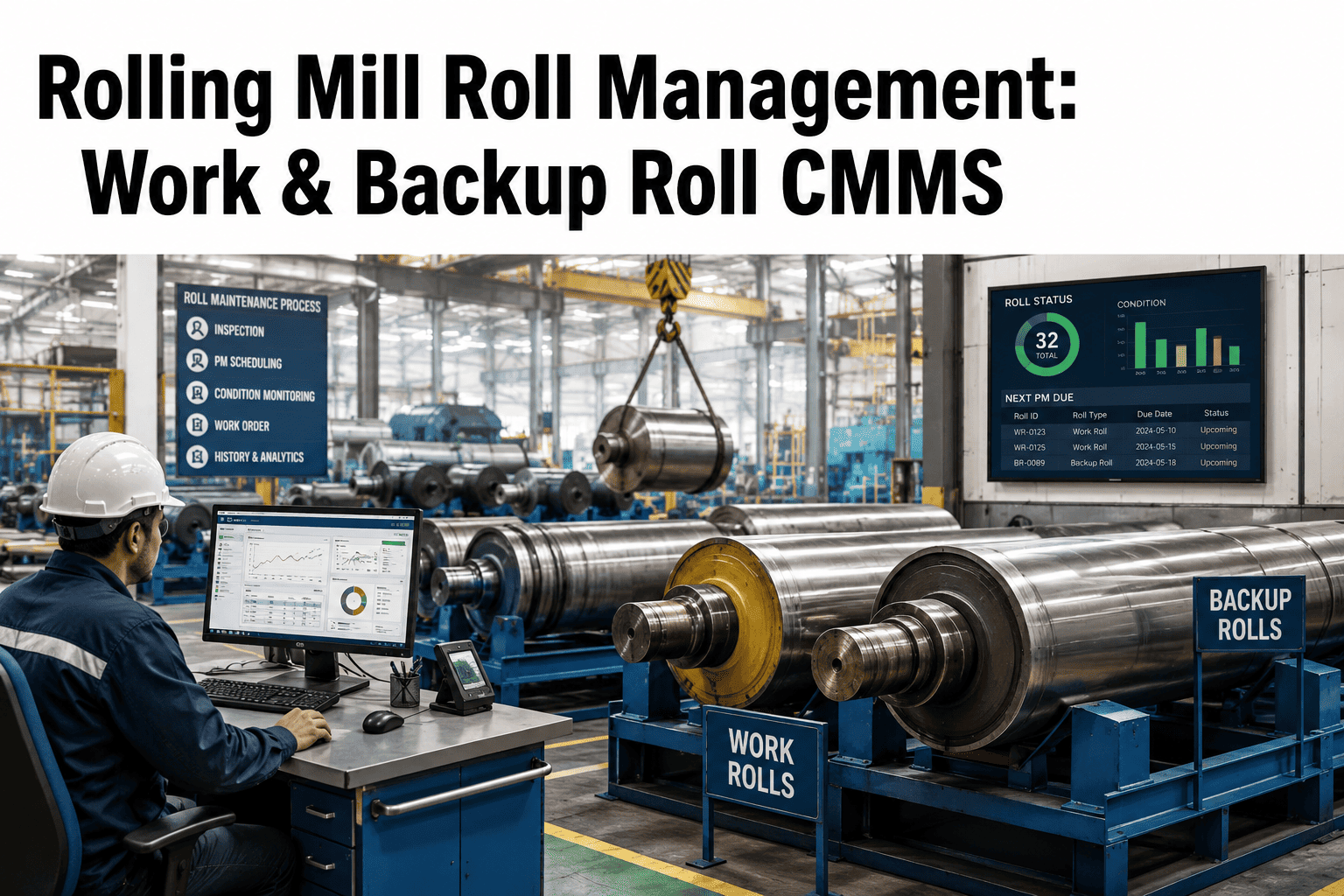
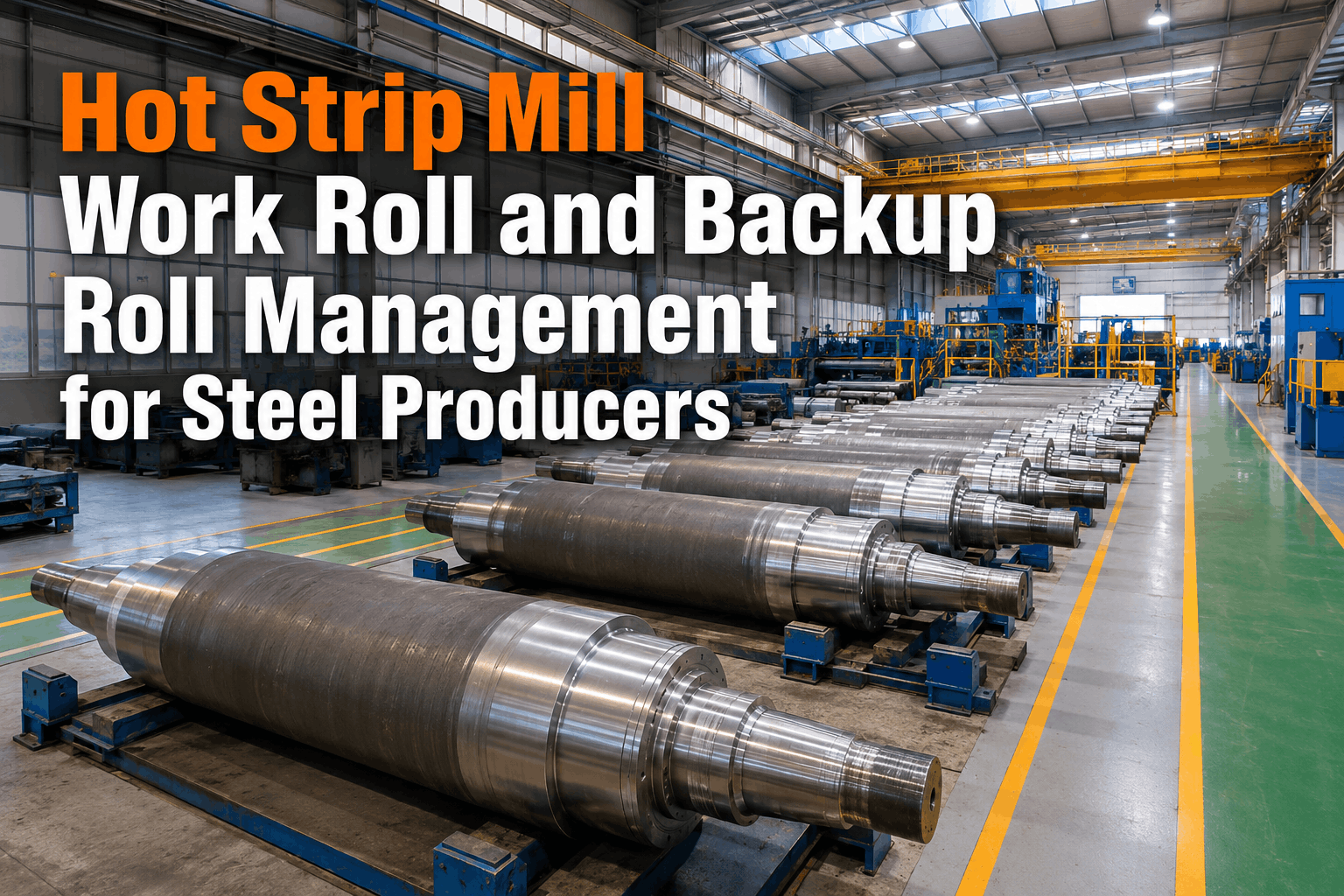
Work roll changes in the roughing stand are driven by surface wear — spalling or surface fatigue that develops after accumulating a defined tonnage on the roll surface. The change interval varies by roll grade and rolling programme but typically falls between 40,000 and 80,000 tonnes per roll pair. Oxmaint tracks roll tonnage accumulation per stand and triggers the work order for roll change when the interval is approaching — coordinating with the production team's rolling schedule to minimise downtime impact.
Finishing Mill Maintenance: Stands F1–F7 and Roll Change Management
The finishing mill reduces the transfer bar from 40mm to final strip thickness — typically 1.6 to 25mm — across seven tandem stands operating in continuous sequence at increasing strip speeds. Each stand has an independent roll change interval driven by the strip surface quality requirement for the product being rolled: harder product grades and thinner gauges consume work rolls faster, requiring shorter change intervals at F6 and F7 (the final finishing passes) than at F1 and F2.
Finishing mill maintenance complexity is amplified by the interdependency between stands — a strip threading problem in F3 creates a cobble that can damage F4, F5, and F6 in the same event. Roll surface condition monitoring, loopers and tensioners, interstand cooling headers, and the automatic thickness control (AGC) system must all be maintained as an integrated system. Oxmaint tracks maintenance for all seven finishing stands with per-stand roll consumption records, work order coordination, and threshold alerting on drive train condition.
| Stand | Typical Interval (tonnes) | Key Driver | Surface Grade Influence | Bearing Check Frequency | Priority |
|---|---|---|---|---|---|
| F1 | 15,000 – 25,000 | Roll spalling and thermal fatigue | Low — first contact with hot transfer bar | Daily | High |
| F2 | 12,000 – 20,000 | Surface fatigue and roughness | Medium — significant thickness reduction | Daily | High |
| F3 | 10,000 – 16,000 | Surface roughness and thermal marks | Medium-high — quality product starts here | Daily | High |
| F4 | 8,000 – 14,000 | Surface quality for end product | High — surface finish critical | Daily | Critical |
| F5 | 6,000 – 10,000 | Surface finish and strip flatness | Very high — dimensional accuracy | Daily | Critical |
| F6 | 4,000 – 8,000 | Surface grade and gauge tolerance | Critical — final surface quality stand | Per shift | Critical |
| F7 | 4,000 – 7,000 | Final gauge and surface finish | Critical — direct customer interface | Per shift | Critical |
Swipe right to view all columns on smaller screens
Run-Out Table and Laminar Cooling Maintenance
The run-out table (ROT) transports finished strip from the finishing mill exit to the coiler at speeds up to 20 m/s while applying laminar cooling water to bring strip temperature from approximately 900°C to the target coiling temperature — typically 550–700°C for structural grades, lower for API and high-strength grades. The precision of this cooling determines the mechanical properties of the finished coil: a 50°C variation in coiling temperature can move a structural steel product outside its specified yield strength range.
ROT maintenance is dominated by three systems: the conveyor rolls (high-wear items that must be replaced on rolling tonnage intervals), the laminar cooling headers and nozzles (subject to scale clogging and physical damage from cobbles), and the strip edge masking system that prevents over-cooling the strip edges. Track ROT conveyor roll service life and cooling header condition in Oxmaint with individual asset records per roll position and cooling zone.
ROT conveyor rolls are high-wear consumables operating at elevated temperature under the strip load and cooling water. Surface wear that creates steps or unevenness causes mark transfer to the hot strip surface, creating a surface quality defect that is visible in the finished coil.
- Weekly roll surface visual inspection — check for pitting, scoring, and thermal cracking on roll surface; rolls with surface damage above the specification limit are scheduled for replacement at the next rolling programme break
- Bearing temperature check per roll position — log bearing temperature on a rolling position basis; rising temperature at a specific position indicates bearing failure or loss of cooling water to the bearing housing
- Roll diameter measurement at outage — measure roll diameter and taper at three points; replace when diameter has reduced below minimum or when taper exceeds the strip tracking limit
Laminar cooling headers distribute cooling water in controlled curtains across the strip width. Header nozzle clogging reduces cooling density in specific positions, creating temperature non-uniformity across the strip width that translates directly into differential microstructure and mechanical property variation in the coil.
- Monthly nozzle flow verification by cooling zone — measure actual flow per header against design flow; zones with flow deviation above 5% are stripped and nozzles cleaned or replaced before the next rolling campaign
- Post-cobble header inspection — any cobble event that passes through the ROT section requires a header inspection before restart; cobble impact physically damages nozzles, header boxes, and edge masking equipment
- Header alignment check — verify that cooling headers are level and correctly positioned relative to the strip passline; misaligned headers create asymmetric cooling that causes strip camber and coiling problems
Coiler Maintenance: Mandrel, Wrapper Rolls and Pinch Roll
The coiler receives strip at speeds up to 20 m/s and winds it onto a collapsible mandrel at tensions that can exceed 200 kN. Coiler failures — mandrel collapse, wrapper roll seizure, or pinch roll jam — produce immediate production stops and physical damage that requires extended maintenance intervention. The coiler is one of the highest maintenance-intensity assets at the back end of the hot strip mill. Oxmaint tracks coiler component service life including mandrel segment wear, wrapper roll condition, and hydraulic system pressure trending.
Visually inspect mandrel segments for surface cracking and wear between coils. Monitor hydraulic expansion pressure — rising pressure to maintain mandrel diameter indicates internal leakage in the expansion cylinder. Log pressure reading per coiler per shift.
Inspect wrapper roll surfaces for grooving and scoring — surface damage transfers to the inside wrap of the coil, creating a defect at the coil eye that affects downstream cold mill threading. Check hydraulic wrapper roll actuator for correct clearance and seal condition.
Measure and record pinch roll gap at both drive and operator sides. Gap asymmetry causes strip steering into the coiler that produces telescoped coils. Inspect pinch roll bearing housings for temperature and contamination from cooling water ingress.
Sample coiler drive gearbox oil and analyse for metal particle count, water content, and viscosity. Elevated metal particles in the coiler gearbox are an early indicator of gear tooth wear that could progress to tooth failure during high-tension coiling of thick product.
Remove and measure mandrel segments for wear, crack propagation, and dimensional deviation from specification. Replace any segment with crack depth exceeding the acceptance criterion — mandrel segment cracks propagate rapidly under the cyclic loading of coiling operations.
Automatic Gauge Control System Maintenance
The AGC system in the finishing mill maintains strip thickness tolerance by continuously adjusting roll gap in response to strip thickness feedback — with response times measured in milliseconds. AGC system maintenance is a combination of mechanical (hydraulic screwdown cylinders, load cells, position transducers) and electrical/instrumentation (control system, sensor calibration, feedback loop integrity). Mechanical degradation in the AGC system appears as thickness variation in the finished strip — a product quality problem rather than an equipment alarm — making it essential to verify AGC component condition proactively rather than waiting for quality complaints.
AGC load cell drift is the most common undetected AGC maintenance problem in hot strip mills. Load cells that have experienced mechanical overload events — cobbles, strip jams, mill rundowns — often shift their zero point by 5–15% without triggering any alarm. The result is systematic thickness bias in all product rolled through that stand until the next calibration. Monthly zero-check verification after every work roll change is the only way to catch this drift before it generates customer quality complaints. Configure AGC calibration work orders in Oxmaint with mandatory completion before each rolling programme restart.
Hot Strip Mill — Inspection and PM Schedule Reference
All HSM maintenance tasks mapped by system, frequency, and responsible role. Deploy all tasks as automated PM work orders in Oxmaint — created and assigned on schedule without manual coordinator overhead.
| System | Task | Frequency | Responsible | Criticality |
|---|---|---|---|---|
| Roughing | Bearing temperature and vibration monitoring | Daily | Maintenance Tech | Critical |
| Roughing | Work roll change and tonnage logging | Per interval | Rolling Engineer | Critical |
| Roughing | Spindle coupling and balance cylinder | Weekly | Mechanical Tech | High |
| Finishing | Strip surface quality per stand (F1–F7) | Per shift | Rolling Operator | Critical |
| Finishing | Work roll inspection and grind record | Per change | Roll Shop | Critical |
| Finishing | Interstand cooling header flow | Daily | Maintenance Tech | High |
| Finishing | Looper and tensioner inspection | Weekly | Mechanical Tech | High |
| ROT | Conveyor roll surface inspection | Weekly | Maintenance Tech | High |
| ROT | Laminar cooling nozzle flow verification | Monthly | Maintenance Tech | High |
| ROT | Post-cobble header inspection | After event | Mechanical Tech | Critical |
| Coiler | Mandrel pressure and wrapper roll | Per shift | Rolling Operator | Critical |
| Coiler | Pinch roll gap and bearing check | Weekly | Mechanical Tech | High |
| AGC | Load cell zero and gauge calibration | Per roll change | Instrument Tech | Critical |
| AGC | HPU oil sample and filter check | Monthly | Hydraulic Tech | High |
Swipe right to view all columns on smaller screens
CMMS Capabilities That Match Hot Strip Mill Complexity
Hot strip mill maintenance management requires a CMMS capable of handling tonnage-based PM triggers alongside calendar intervals, tracking roll inventory across roughing and finishing stands, coordinating maintenance windows with the rolling programme, and surfacing multi-system degradation trends before they interact to produce a cobble or product quality event. Oxmaint is configured for this level of complexity without requiring a custom development project.
Tonnage-Based and Calendar PM Triggers
Configure work roll change work orders to trigger at the stand-specific tonnage interval — whichever threshold fires first between tonnage accumulation and calendar date. High-production periods generate more work orders at shorter intervals; low-production periods extend on the calendar trigger. Roll tonnage is updated automatically from the rolling schedule integration or manually from shift reports. F6 and F7 critical stands are tracked at per-shift resolution.
Roll Inventory Management
Track every work roll as an individual asset — serial number, material grade, current diameter, total service life in tonnes, and grind history. Roll shop grinding schedule is driven by actual consumption data, not fixed intervals.
Production Schedule Coordination
Maintenance windows are visible to the rolling team in real time — work orders flagged as requiring a rolling stop are coordinated with the production planner before they become overdue, preventing reactive maintenance interruptions to rolling campaigns.
Vibration and Temperature Trending
Daily bearing readings logged in Oxmaint build a trend dataset per stand position. Rising trends trigger inspection work orders before the threshold is breached — converting reactive bearing changes to planned replacements at the next roll change window.
AGC Calibration Compliance Records
AGC calibration work orders are mandatory-close tasks that cannot be marked complete without the calibration reading and responsible technician signature. Load cell zero checks are auto-triggered after every work roll change work order is closed. Gauge calibration records are stored against the instrument asset and retrievable for any quality investigation that traces a thickness complaint back to instrument condition. This creates the documented calibration trail that ISO quality systems and customer technical agreements require.
Manage Every Stand, Every Roll, Every Shift — From One Platform
Hot strip mill maintenance teams using Oxmaint reduce cobble risk, optimise work roll service life, maintain AGC calibration compliance, and give production teams real-time visibility into maintenance status across all mill systems. No IT project. No custom development. Running in 48 hours.
Hot Strip Mill Maintenance: Frequently Asked Questions
How should work roll change intervals be set for finishing mill stands?
Work roll change intervals should be set on a per-stand, per-product-grade basis using a combination of tonnage accumulation and surface quality monitoring. F6 and F7 — the final finishing passes that determine the surface quality of the finished product — typically require changes every 4,000–8,000 tonnes for surface-critical grades. F1 and F2 can tolerate longer intervals. The most common mistake is applying a single fleet-wide interval: it under-changes downstream stands and over-changes upstream stands. Configure per-stand tonnage triggers in Oxmaint to automate change scheduling based on actual rolling programme data.
What are the most reliable early warning indicators for finishing stand bearing failure?
For roll neck bearings in finishing stands, the most reliable early indicators are: rising bearing temperature trend above 10–15°C from the established baseline at operating speed, and increasing vibration velocity at the 1× and 2× running frequency components in the vibration spectrum. A single elevated reading is less significant than a consistent upward trend over 5–10 rolling sessions. Daily logging in a CMMS that surfaces the trend is the only way to catch this before the bearing fails during a rolling campaign. Book a demo to see how Oxmaint trends bearing data across all finishing stands.
How does AGC load cell drift affect finished strip quality and how is it detected?
Load cell zero drift causes systematic thickness bias — if the load cell reads 5% high, the AGC will maintain a roll gap that is slightly open relative to the theoretical setpoint, producing strip that is consistently above the nominal gauge. The bias is usually small enough to stay within the product tolerance band, so no alarm is generated. Detection requires a scheduled zero check: unload the stand, zero the load cell electronics, and compare to the last verified zero point. Any shift above the specification limit requires recalibration before the stand returns to production.
What maintenance is required on the laminar cooling system after a cobble event?
After any cobble event that passes through the run-out table section, a mandatory header inspection is required before restart. Check all headers in the affected zones for physical damage — bent header pipes, displaced nozzles, damaged edge masking equipment, and bent or broken temperature measurement pyrometers. Any nozzle that cannot be confirmed as undamaged should be replaced rather than risk cooling non-uniformity in the first coil after restart. Log the post-cobble inspection as a mandatory work order in Oxmaint with close-out sign-off from the rolling supervisor before strip is re-threaded.
Can Oxmaint integrate with the rolling programme scheduling system for tonnage tracking?
Oxmaint supports API integration with rolling programme management systems and Level 2 process automation, enabling automatic updating of roll tonnage accumulation per stand as rolling data is generated. For mills without available integration, manual tonnage entry via mobile at each shift handover is straightforward and provides sufficient resolution for all standard roll change interval management requirements. Most HSM maintenance teams are running digital roll tracking in Oxmaint within a week of account setup. Sign up free and configure your first HSM rolling stand asset today.