A work roll that goes to the mill with undetected surface defects — heat checks, grinding burns, or residual roll marks from the previous campaign — produces strip surface quality failures within the first coils. At typical cold rolling productivities, that means scrapped or downgraded material before the problem is identified, plus the unplanned roll change that resets the campaign schedule for every downstream stand. Work roll management is the highest-frequency, highest-consequence maintenance activity in a rolling mill. Start tracking your roll campaigns digitally with Oxmaint.
Rolling Mill Work Roll Management: Grinding, Change and Campaign Tracking with CMMS
Complete guide to work roll campaign management — covering roll grinding schedules, roll change procedures, surface quality inspection, backup roll maintenance, roll shop workflow, and roll inventory tracking using CMMS software.
Why Work Rolls Fail Before Their Campaign Target — and What It Costs
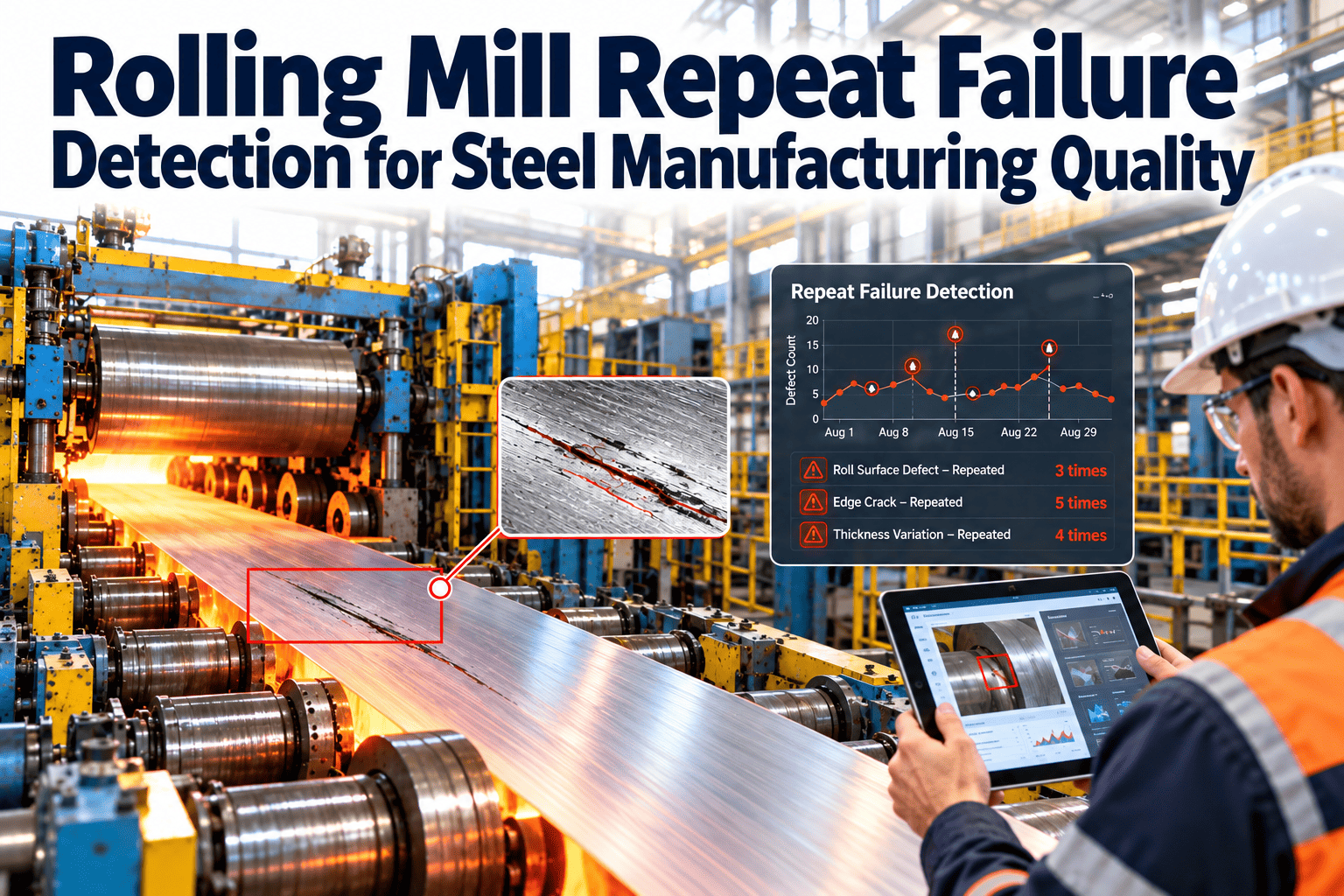
Work roll failures in a cold rolling or hot rolling mill cluster around four root causes — each preventable with systematic tracking. Thermal fatigue cracks (heat checks) develop in hot rolling from inadequate cooling water flow or strip threading issues. Grinding burns from the roll shop enter service as invisible stress risers that spall under mill loading. Roll mark transfers from a contaminated or damaged roll surface immediately reproduce on the strip. And early wear from mismatched roll crown or excessive rolling force shortens the campaign below its optimum length, consuming grinding allowance faster than planned.
Without per-roll campaign records — tonnes rolled, surface inspections completed, grinding depth and residual damage assessment per pass — the roll shop makes decisions based on the last visual inspection rather than the roll's full condition history. Oxmaint roll campaign tracking gives every roll an individual digital record that follows it from the grinding machine to the mill stand and back, so every decision is made on data rather than inspection recall.
70% of unplanned roll changes in rolling mills are traced to decisions made in the roll shop — not to unexpected mill events. The roll shop is where the campaign is won or lost, and it is the part of the operation with the least digital data infrastructure in most plants.
Work Roll Campaign Management: What to Track Per Roll Per Stand
A work roll campaign is the period between successive roll changes at a mill stand. Optimising campaign length — maximising tonnes rolled per roll change cycle while maintaining surface quality and staying within the roll's grinding allowance budget — is the core objective of roll management. Achieving this optimum requires per-stand, per-roll data on tonnes rolled, surface roughness evolution, crown deviation, and thermal profile. Oxmaint tracks all these parameters against each roll's identity throughout its service life.
Roll Shop Grinding: Schedule, Inspection and Quality Verification
The roll shop is the maintenance operation that determines whether a roll returns to the mill in serviceable condition or with hidden defects that will cause an in-campaign failure. Grinding quality cannot be verified visually — it requires measurement. Every roll leaving the grinding machine must have a traceable quality record before it is approved for mill service. Oxmaint roll shop work orders enforce this sign-off sequence digitally, preventing rolls from entering the ready-for-service inventory without a completed inspection record.
Pre-Grinding Inspection
Before mounting on the grinding machine, assess roll condition. Measure roll diameter and barrel profile. Conduct eddy current scan for heat checks (hot rolling rolls) or surface profilometry for cold rolling rolls. Record residual defect depth to determine minimum grinding allowance required to clear all surface damage. Log the pre-grind condition assessment against the roll serial number before any material is removed.
Grinding Program Execution
Machine the roll to the specified target profile — crown, taper, or cylindrical depending on stand specification. Grinding parameters (wheel speed, depth of cut, traverse rate, coolant flow) must be within specification to avoid thermal damage to the roll surface. Log the CNC grinding program used, actual depth removed, and any deviations from the planned program. Total grinding allowance consumed per pass must be logged to track remaining service life on each roll.
Post-Grinding Quality Verification
After grinding, the roll must be inspected before it is approved for mill service. No roll leaves the roll shop without a completed post-grinding inspection record. Surface roughness measurement (Ra, Rz) at minimum 5 axial positions must meet the stand specification. Barkhausen noise testing or nital etch inspection for grinding burns is mandatory for cold rolling work rolls. Crown profile measurement verifies the machined contour against the target.
Approval and Inventory Entry
Only a roll with a completed, signed-off inspection record is approved for entry into the ready-for-service roll inventory. The Oxmaint work order for the grinding job is closed with the inspection results attached — Ra values, crown profile, grinding burn result, and remaining grinding allowance. The roll's digital record is updated with the current specification and the stand it is approved for. The inventory record shows real-time count of approved rolls by stand and specification. See how Oxmaint manages roll shop sign-off workflows.
Planned Roll Change: Sequence, Checks and Documentation
Planned roll changes are executed at campaign end — a defined tonnage target, surface quality threshold, or scheduled production break. Emergency roll changes are executed when a roll failure occurs in service. The procedure for both is largely the same; what differs is the preparation time, spare roll availability, and the subsequent root cause investigation for emergency events. Digital work orders with pre-defined task sequences eliminate the risk of a missed step in either scenario.
| Step | Task | Planned Change | Emergency Change | CMMS Record |
|---|---|---|---|---|
| 01 | Mill strip exit and roll removal clearance | Pre-notified — strip threaded off cleanly | Immediate — strip may require cobble removal | Work order opened with change type classification |
| 02 | Replacement roll availability confirmation | Confirmed pre-change from inventory | Check inventory — may require expedited grinding | Roll serial number reserved from inventory |
| 03 | Roll extraction and chock removal | Standard procedure per stand type | Standard procedure — assess roll surface on extraction | Tonnes on roll at change logged — campaign closed |
| 04 | Roll surface assessment at extraction | Confirm roll reached campaign target | Classify failure mode — spall, heat check, mark | Failure mode logged, photos attached to roll record |
| 05 | Roll neck, chock and bearing inspection | Inspect bearing and seal condition | Full inspection — bearing may have failed with roll | Chock and bearing condition logged per side |
| 06 | New roll installation and nip setting | Standard installation from ready inventory | Same procedure — verify inventory sign-off status | New roll serial number installed — campaign opened |
| 07 | Thread and initial strip quality check | Standard thread and grade check coils | Grade check coils — verify no residual roll mark on strip | Thread and first coil quality confirmed in work order |
Swipe right to view all columns on smaller screens
Roll Inventory Tracking: Status, Location and Grinding Allowance
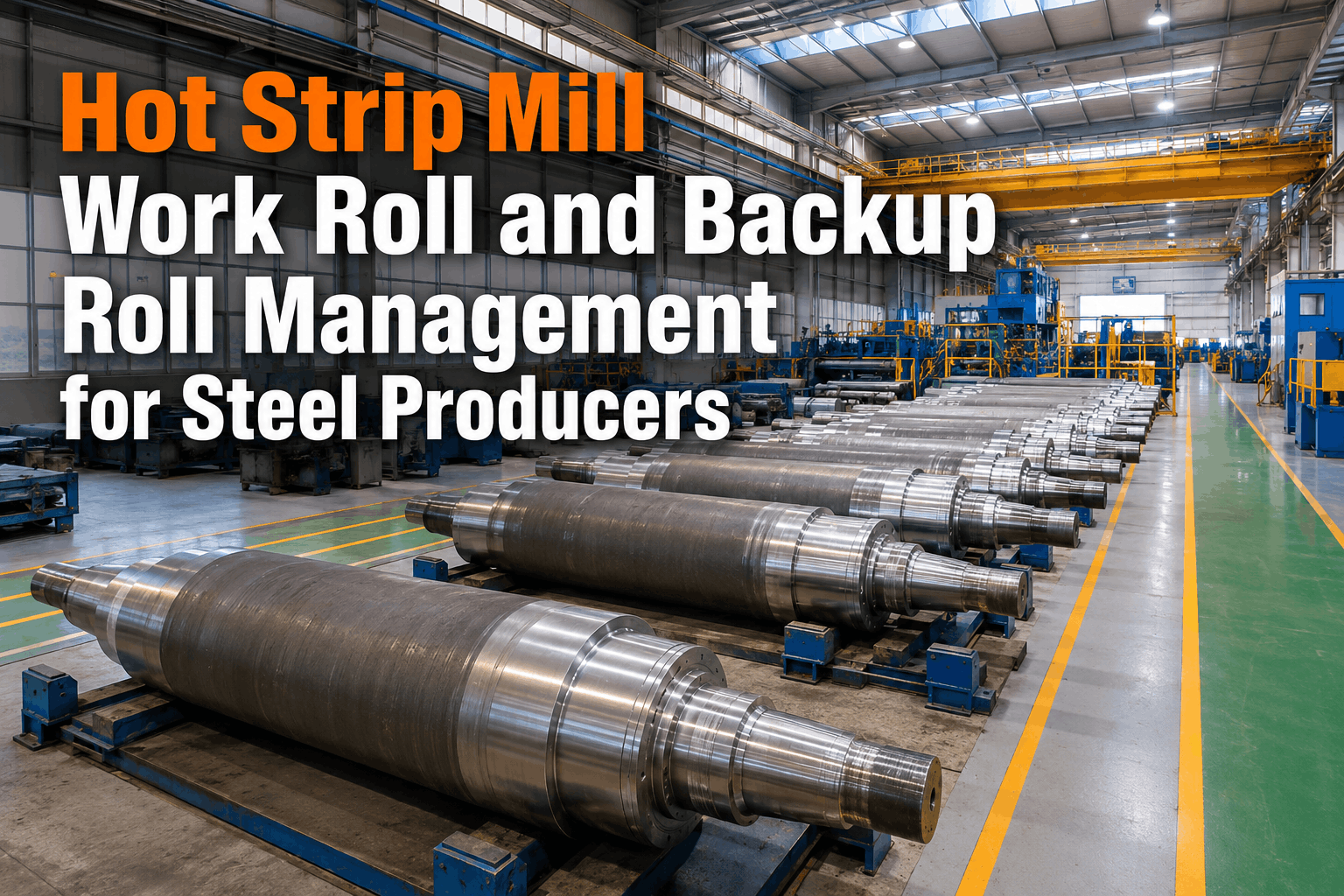
A rolling mill with 4–6 stands per line and multiple roll types per stand operates a working roll inventory of 30–80 rolls at any point — each at a different point in its service life cycle, each with a different remaining grinding allowance, and each approved for specific stand positions and product grades. Without a CMMS tracking each roll's current status, location, and remaining life, inventory management is a clipboard exercise with no visibility into which rolls are approaching condemn diameter and which need to be ordered. Oxmaint roll inventory tracking gives the roll shop supervisor real-time status on every roll in the fleet.
Roll currently installed in a mill stand on active campaign. Record shows stand assignment, tonnes rolled this campaign, surface specification, and campaign target remaining.
Inspected, ground, and approved roll held in roll storage waiting for the next scheduled change. Inspection record complete, remaining allowance logged, stand assignment confirmed.
Roll in the grinding machine or awaiting grinding. Work order open with pre-grind assessment complete. Expected completion time visible to mill planning team for change scheduling.
Grinding complete — awaiting post-grind inspection sign-off before release to ready inventory. Roll is not available for mill service until inspection is completed and approved.
Roll held pending engineer review — grinding burn detected, subsurface crack identified, or remaining allowance below condemn limit. Cannot enter service without engineering sign-off and documented disposition.
Roll has reached condemn diameter or has irreparable surface or subsurface damage. Removed from active inventory. CMMS record closed with total service life in tonnes and campaigns — data feeds into roll life analysis and procurement planning.
Managing roll inventory across 30–80 rolls on clipboards and spreadsheets means the mill always has rolls — it just does not know how many are actually ready for service vs in various stages of grinding, inspection, or hold. Oxmaint gives the roll shop supervisor real-time roll status across all six states above, accessible on any device in the roll shop or mill control room.
Roll Management — Inspection and Measurement Reference
All key roll management tasks mapped by roll type, inspection requirement, and frequency. Deploy all tasks as automated work orders in Oxmaint with roll-specific PM templates per stand assignment.
| Roll Type / Area | Inspection / Task | Frequency | Method | Criticality |
|---|---|---|---|---|
| Work Roll — Hot | Eddy current scan for heat checks | Every campaign end | Eddy current tester | Critical |
| Work Roll — Hot | Barrel diameter profile measurement | Every grind | CNC grinder gauge | Critical |
| Work Roll — Cold | Surface roughness Ra measurement | Post-grind, pre-service | Surface profilometer | Critical |
| Work Roll — Cold | Barkhausen noise / nital etch | Post-grind mandatory | Barkhausen instrument | Critical |
| Work Roll — Cold | Crown profile measurement | Post-grind, pre-service | Profilometer / gauge | Critical |
| Backup Roll | Barrel diameter at 7+ axial points | Every campaign | Measuring bridge | High |
| Backup Roll | Roll neck and journal inspection | On chock removal | Visual + dimensional | High |
| Chock and Bearings | Bearing clearance and condition check | Every roll change | Dimensional measurement | High |
| Roll Inventory | Remaining grinding allowance audit | Monthly | CMMS diameter record | Standard |
| Roll Inventory | Rolls approaching condemn diameter alert | Continuous — CMMS | Oxmaint threshold alert | High |
Swipe right to view all columns on smaller screens
How CMMS Transforms Roll Shop and Campaign Management
Roll management generates more individual asset records per day than almost any other maintenance operation in a steel plant — every roll that moves through the roll shop creates a grinding record, an inspection record, and an inventory status update. Oxmaint handles this volume digitally on mobile devices in the roll shop and at the mill stand, without requiring separate systems for roll shop and maintenance teams.
Per-Roll Campaign Tracking
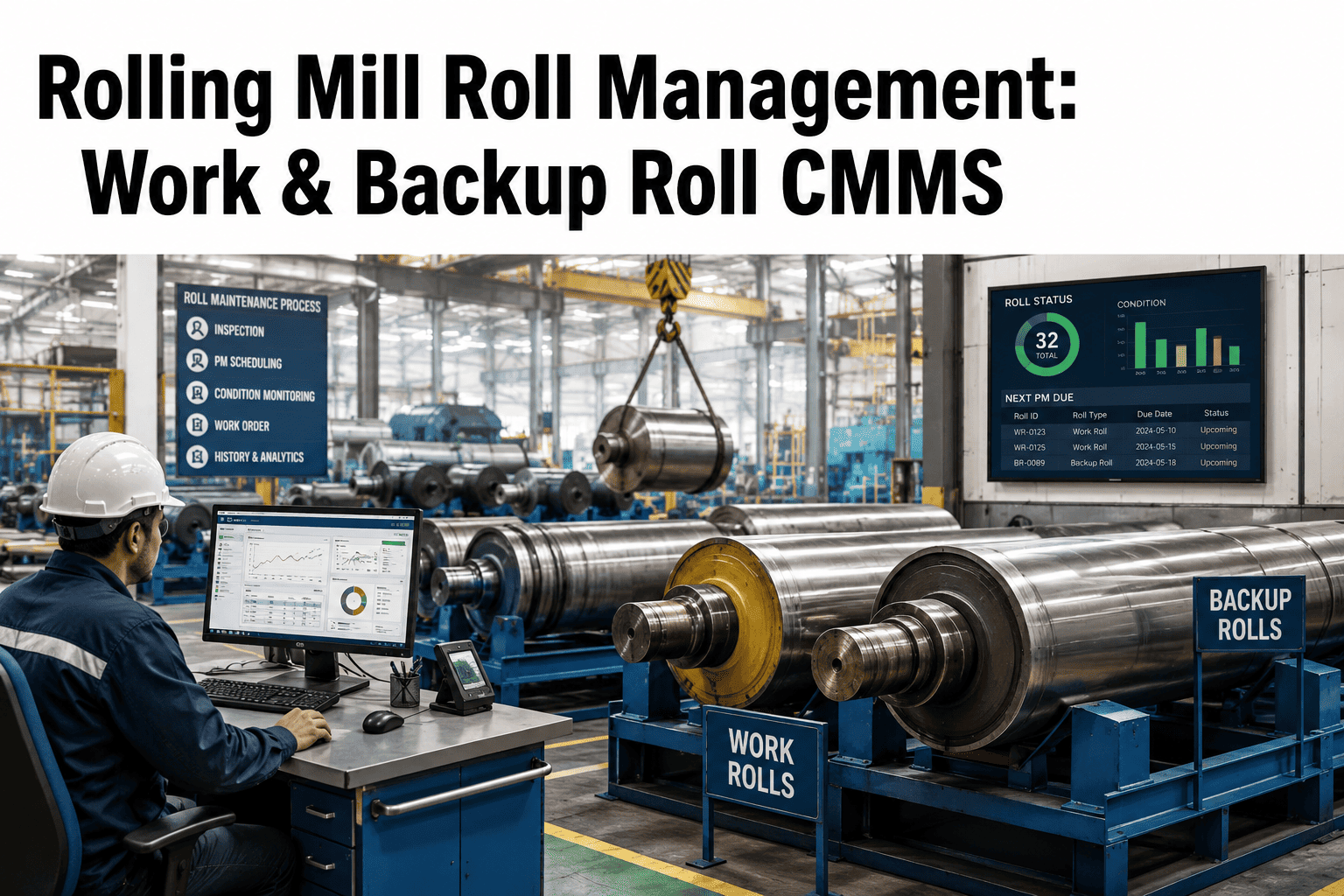
Each roll has an individual asset record showing current status, tonnes rolled per campaign, installation history across stands, grinding records per pass, and remaining allowance against condemn diameter. Campaign targets are configured per stand and product grade — the system alerts when a roll approaches its campaign limit.
Roll Shop Work Order Management
Every roll grinding job is a structured work order with defined task sequences — pre-grind inspection, grinding execution with parameter logging, post-grind quality checks, and supervisor sign-off before inventory release. Rolls cannot enter ready inventory without a completed, signed-off work order.
Real-Time Roll Inventory Status
Every roll in the fleet is tracked across six status states — in service, ready, in grinding, awaiting inspection, on hold, condemned. Mill planners see real-time count of ready-for-service rolls per stand assignment. Automatic alert when inventory falls below minimum safe level for any stand type.
Roll Life and Failure Analytics
Aggregate roll life data by roll type, supplier, stand position, and product grade to build the statistics that optimise procurement decisions. Failure mode classification on every emergency change identifies systematic roll shop or process problems — grinding burns concentrated in one machine, heat checks concentrated in one stand, short life from one supplier batch.
Mobile Data Entry in Roll Shop and Mill
Roll shop technicians log Ra measurements, crown profiles, grinding parameters, and inspection results on tablet or smartphone during the job — not retrospectively on a PC. Mill floor crews open and close roll change work orders at the stand in real time. Offline operation where network coverage is limited in the roll shop or on the mill floor.
Roll Traceability and Quality Audit Trail
Every roll that touches a product coil has a documented history — which roll was in which stand for which coil range, what inspection was completed before installation, and what condition was observed at removal. This traceability supports product quality investigations and customer quality audits where strip surface defects need to be traced back to specific rolls and grinding events.
Stop Managing Your Roll Fleet on Spreadsheets and Clipboards
Rolling mill teams using Oxmaint reduce unplanned roll changes, eliminate out-of-specification rolls entering service without an inspection record, and give mill planners real-time visibility into ready-roll inventory for every stand. Deploy your roll management program digitally — no IT project required, running in 48 hours.
Roll Management CMMS: Frequently Asked Questions
How should work roll campaign length be determined — by tonnage or by condition?
Best practice is condition-triggered campaign end with a tonnage ceiling as a safety limit. The primary change trigger should be surface roughness deviation from the rolling specification (Ra outside the target band), strip crown deviation exceeding the product tolerance, or visual observation of incipient roll marks on the strip surface. A maximum tonnage ceiling prevents over-running the roll beyond the point where grinding allowance consumption accelerates. Using tonnage alone as the trigger means every roll change happens at the same point regardless of actual condition — early changes waste grinding allowance, late changes produce quality failures. Oxmaint tracks both campaign tonnes and surface condition parameters, allowing each stand to use the appropriate trigger.
What does Barkhausen noise testing detect and why is it mandatory post-grinding?
Barkhausen noise measurement detects changes in the residual stress state of the roll surface — specifically the tensile stresses caused by grinding burns (thermal damage from excessive grinding parameters). A grinding-burned roll surface has invisible tensile residual stresses that reduce the roll's resistance to contact fatigue under mill loading, causing early spalling. Visual inspection of a ground roll surface cannot detect grinding burns. Nital etch acid-reveals the burned area by differential attack but requires careful execution and disposal of acid waste. Barkhausen noise is the industry-preferred non-destructive method because it is fast, non-contact, and produces a quantitative result. Making it mandatory means no cold rolling work roll enters service with an uninspected post-grind condition.
What is the condemn diameter for a work roll and how should it be tracked?
The condemn diameter for a work roll is determined by the minimum diameter at which the roll retains sufficient structural integrity for the applied rolling load, and by the minimum diameter at which the roll's crown profile can be maintained within the required tolerance range. These limits are specified by the roll manufacturer or by the mill engineering team for each roll type and stand position. In Oxmaint, the condemn diameter is configured on each roll's asset record as a threshold alert — the system flags rolls approaching condemn diameter automatically, giving the roll shop 1–2 grinding cycles of advance notice to initiate replacement procurement before the roll is physically condemned. Book a demo to see condemn tracking in Oxmaint.
How many ready-for-service rolls should be held in inventory per stand?
Minimum safe inventory depends on the planned change frequency and the roll shop cycle time. A stand changing rolls every 48 hours with a 24-hour roll shop cycle (grind to inspection sign-off) requires a minimum of 2 rolls in ready inventory plus 1 in the grinding cycle at all times — 3 rolls total per stand type as the minimum working fleet. Higher-utilisation stands or stands with complex grinding specifications requiring longer roll shop processing need proportionally larger inventories. The inventory minimum should be configured in Oxmaint as a minimum stock alert so the roll shop supervisor is notified before the inventory falls below the safe level, not after.
Can Oxmaint manage both work roll and backup roll records in the same system?
Oxmaint manages work rolls, backup rolls, and intermediate rolls as separate asset types within the same system, each with type-specific PM templates and inspection requirements. Work rolls have grinding-focused records with surface measurement data; backup rolls have dimensional and journal records with longer change intervals; intermediate rolls where applicable have their own campaign and grinding parameters. The same inventory status tracking, change work order workflow, and traceability records apply to all roll types. Mill planning teams see the combined roll fleet status across all types on a single dashboard.
How quickly can a rolling mill deploy Oxmaint for roll management?
Most rolling mill roll shop teams are completing digital grinding work orders and updating roll inventory status in Oxmaint within 2–3 days of account setup. The roll asset register — each roll entered with its current diameter, stand assignment, and remaining allowance — takes a day to build from the existing roll book. PM templates for grinding work orders and change procedures are built from existing paper forms. No IT integration is required to get started. Sign up free and register your first roll today.