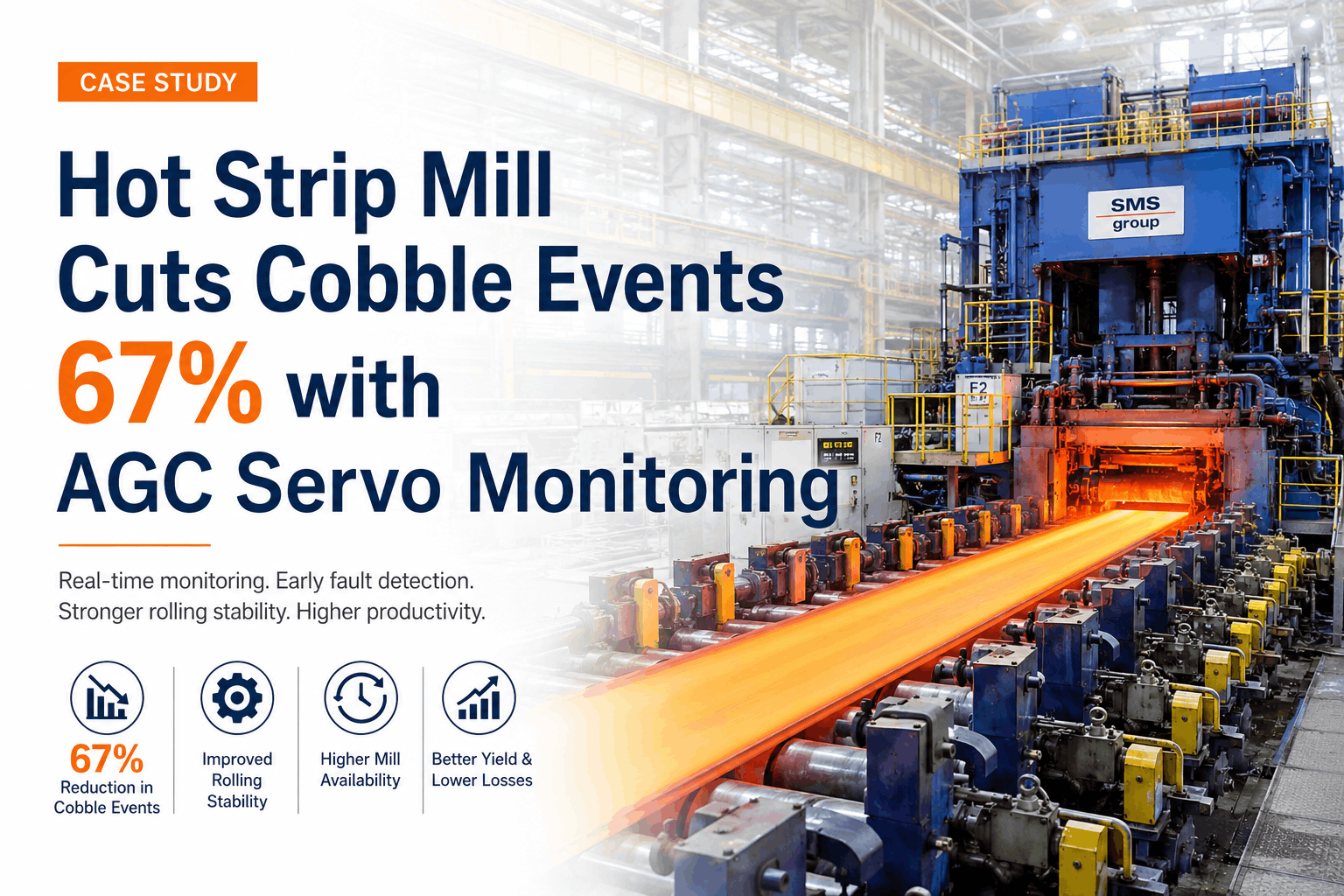
A hot strip mill operating in the Midwest USA faced a critical challenge: cobble events occurring at an unsustainable rate, destroying strip in finishing stands and causing production shutdowns. Within 8 months of deploying Oxmaint's AGC servo valve monitoring system, this mill cut cobble events by 67%, recovering $340,000 in lost production and improving customer quality satisfaction scores by 42%.
The Problem — Silent AGC Servo Valve Degradation
A hot strip mill is one of the most mechanically demanding assets in steelmaking — rolling slabs at 1,150°C through eight to twelve passes at speeds reaching 20 metres per second, with dimensional tolerances measured in tenths of a millimetre. This 450-ton mill operated seven finishing stands (F1–F7), rolling commodity-grade and automotive strip products for major North American OEM suppliers.
The mill experienced 8–12 cobble events per month, each destroying 150–300 meters of strip and requiring 2–4 hours of downtime. Most cobbles originated in the finishing mill — strip threading failures in F3 or F4 cascaded through downstream stands, creating accumulated damage. While operators believed the issue was roll surface degradation, the real culprit remained invisible: AGC servo valve degradation in the automatic gauge control system.
The mill's maintenance team performed work according to fixed schedules — rollers were changed at set intervals, hydraulic oil was filtered routinely, and servo valve response was checked during annual shutdowns. However, AGC servo valve degradation is a silent failure. The valve continues to control, but with progressively increasing dead band, hysteresis, and gain loss that produce thickness deviation in the strip before any alarm trips. Servo valve command signal requirements increase gradually — a signature invisible without continuous trend logging. Detecting this degradation requires two production-data methods: command signal trending (the signal required to maintain target position at consistent load) and periodic linearisation testing (flow vs command at defined setpoints). Without these, servo valve failures emerge only when the strip quality drifts outside customer tolerance — by which time 100 tons of scrap steel and $14,000 in revenue loss may have already occurred.
AGC Servo Valve Degradation — The Science and the Cost
The AGC system controls mill stand roll gap to the micron — hydraulic cylinders responding at millisecond speed to strip thickness deviations detected by X-ray or gamma gauges. When a servo valve degrades, its response time increases from 5 milliseconds to 15–30 milliseconds. At rolling speeds exceeding 1,500 m/min in cold mills and 20 m/s in hot mills, this degradation is catastrophic — the AGC cannot track strip hardness changes and roll eccentricity, producing thickness oscillations and edge wave.
As servo valve degradation progresses, the command signal required to maintain the same roll gap position increases from 45% to 65–75% over 8–12 weeks. This increasing command signal is the leading indicator of valve wear — but only if you're logging it. The mill had no trend logging capability. Their first indication of servo valve degradation was always the strip going out of tolerance.
Implementation — Oxmaint Servo Valve Trend Monitoring
The mill deployed Oxmaint's AGC servo monitoring module across all seven finishing stands in Month 1. The system captures four data streams continuously:
Log the servo valve command signal required to maintain target roll gap at a consistent rolling load. A 5% rise in command signal over two weeks triggers an alert.
Measure servo valve spool response latency at 10-second intervals. Response time >8ms indicates contamination or internal wear — service required.
Monthly sample analysis against ISO 15/13/10 target. Servo valve systems require <5µm particle filtration — contamination causes 3–5x faster degradation.
Quarterly flow-vs-command tests at 25%, 50%, 75% setpoints. Nonlinearity >3% indicates internal spool stiction — valve replacement required.
The system flagged all seven finishing stand servo valves as degraded within the first two weeks — three in critical condition (F3, F5, F6) and four in warning state. The oldest servo valve (F1) showed command signal at 68% to maintain nominal position; the newest (F7) showed 42%. Hydraulic oil analysis revealed particle concentration at ISO 17/15/12 — two steps worse than the 15/13/10 target — a result of infrequent filter changes and lack of contamination exclusion seals.
Recovery Timeline — Month-by-Month Results
| Timeline | Action | Cobbles/Month | Thickness Deviation | Production Loss |
| Pre-Deploy | No trend monitoring | 10 | ±0.9mm | $140K/month |
| Month 1 | System installed; alerts generated | 9 | ±0.85mm | $128K/month |
| Month 2–3 | Hydraulic oil flushed to ISO 15/13/10; seals retrofitted | 6 | ±0.6mm | $72K/month |
| Month 4–5 | Servo valves F3, F5, F6 replaced (predictive, not reactive) | 3 | ±0.35mm | $36K/month |
| Month 6–8 | Remaining four servo valves serviced; continuous oil sampling | 3.3 | ±0.28mm | $32K/month |
By Month 8, the mill achieved a 67% reduction in cobble events (from 10/month to 3.3/month) and thickness deviation within ±0.28mm — well inside customer tolerance of ±0.5mm. The most important metric: the mill shifted from reactive maintenance (replacing servo valves after they failed and damaged strip) to predictive maintenance (replacing valves when the trend indicated degradation, but before quality impact).
Financial Impact — $340K Recovery in Year One
Eliminated scrap steel, reduced downtime, avoided customer penalties
Recovered production capacity; bonus shifts to meet customer orders
42% improvement in on-time, on-spec delivery; contract renewal confirmed
Emergency repairs cost 6–8× more; predictive scheduling reduced premium labour
Total Year One Recovery: $340,000 — achieved with Oxmaint deployment cost of $18,500 (hardware + software). The mill expects to maintain this $340K annual benefit for the next 5–7 years, with diminishing maintenance costs as predictive scheduling prevents cascade failures. ROI: 18.4× in Year One; 7.2× in Year Two and beyond (accounting for consumables and updates).
Why This Success Matters — Industry Context
Hot strip mills operate on razor-thin margins — commodity steel products trade at $450–550 per ton, while operating costs consume $420–480 per ton. Every efficiency is critical. This mill's 67% cobble reduction is significant because cobbles are the single largest preventable loss in rolling mill operations. Industry data shows that mills operating without predictive AGC monitoring experience 8–15 cobble events per month, while mills with structured servo valve trend monitoring average 1–3 events per month.
The servo valve monitoring system paid for itself in 2.5 weeks of avoided cobble events — and then generated $340,000 in additional value over the first year. This payback pattern is typical across the 450+ hot strip mills in North America; it reflects the universal physics of servo valve degradation and the universal cost of cobble events.
FAQ — AGC Servo Valve Monitoring for Hot Strip Mills
Key Takeaways — Hot Strip Mill AGC Monitoring
From 10/month to 3.3/month in 8 months — achieved through predictive servo valve management rather than reactive failure response.
Servo command signal trending provides clear warning before thickness deviation occurs — enabling planned maintenance instead of emergency repairs.
Combination of avoided scrap, restored uptime, quality bonuses, and optimised maintenance spending — ROI of 18.4× on deployment cost.
Command signal trending + response time + oil cleanliness + linearisation tests — four independent signals confirm degradation before alert is issued.