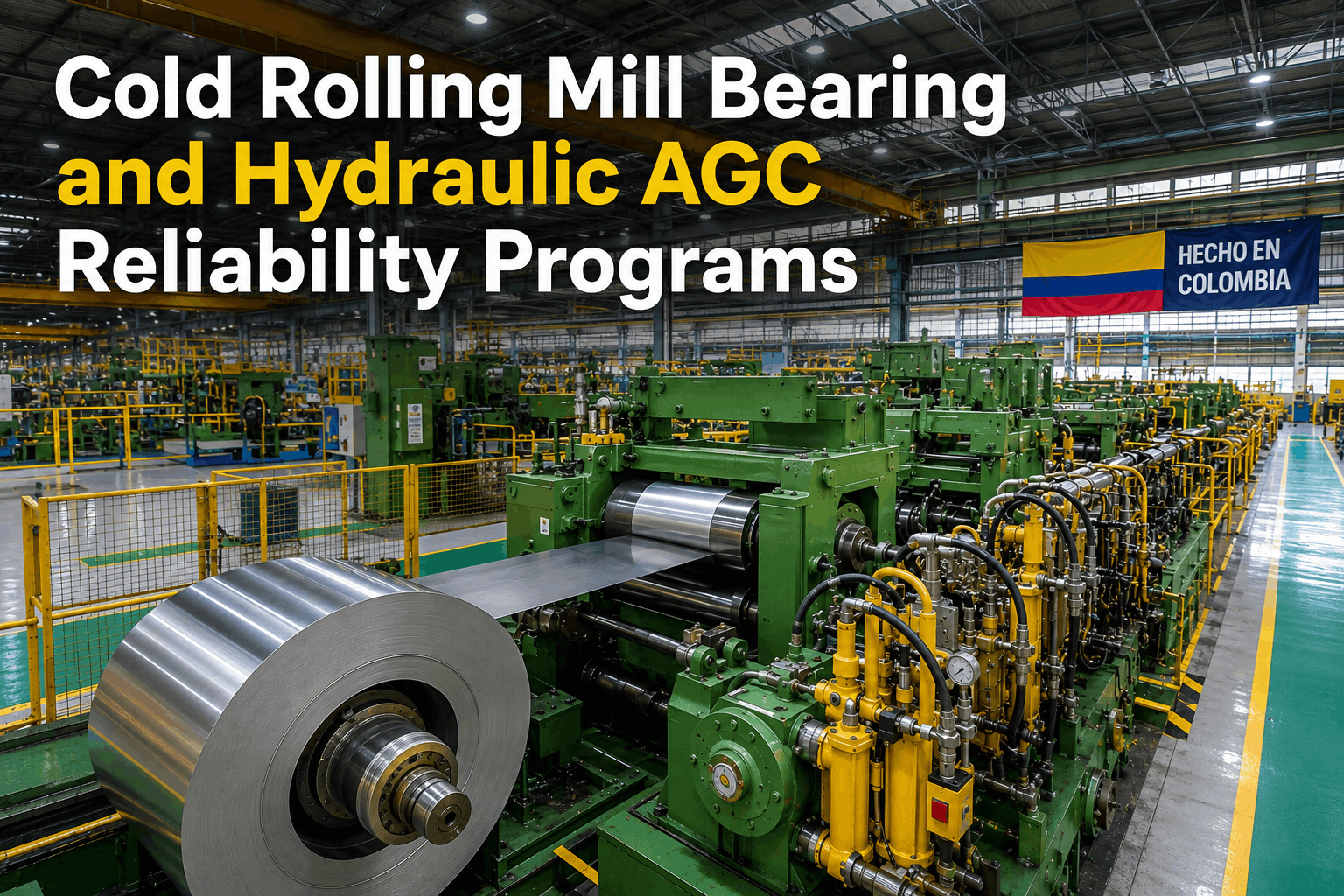
Cold Rolling Mill Lifts Strip Thickness Yield 4.2% in 10 Months
By Alex Jordan on May 28, 2026
When a North American cold rolling mill producing 850,000 tons annually faced persistent strip thickness deviation that eroded yield by 3.8%, conventional manual gauge checks and reactive bearing replacements could not isolate the root cause. Oxmaint's predictive maintenance platform integrated AGC servo data, hydraulic pressure telemetry, and bearing vibration signatures into a unified asset performance model — delivering a 4.2% strip thickness yield improvement in 10 months. This cold rolling mill case study documents the deployment, the failure patterns uncovered, and the ROI generated through condition-based intervention scheduling.
COLD ROLLING MILL CASE STUDY · 2026
Cold Rolling Mill Lifts Strip Thickness Yield 4.2% in 10 Months
Oxmaint predictive records for AGC servo, hydraulic, and bearing systems identified thickness deviation patterns invisible to manual inspection — enabling targeted maintenance that recovered $1.8M in annual yield loss.
The Challenge: Undetected Thickness Drift Across 4-Stand Tandem Mill
The cold rolling mill operated a 4-stand tandem configuration processing low-carbon steel strip at 1,200 meters per minute. Over 14 months, quality engineers observed a gradual increase in thickness out-of-tolerance coils — from 1.2% rejection to 5.0%. Traditional AGC feedback loops compensated for some deviation, but three underlying failure modes escaped detection until Oxmaint's predictive maintenance deployment correlated data across servo response time, hydraulic pressure stability, and work roll bearing clearance.
Deployment Timeline — 10 Months to 4.2% Yield Gain
Three Failure Modes Oxmaint Predictive Records Uncovered
The cold rolling mill's AGC system relied on hydraulic cylinders positioning work rolls with micron-level precision. Schedule a walkthrough to see how Oxmaint's PLC integration captures servo, hydraulic, and bearing data simultaneously — revealing interactions that single-sensor monitoring misses.
AGC Servo Response Lag
Critical Finding
Servo valves exhibited 18-millisecond response delay beyond specification — too subtle for operators to notice but sufficient to cause 12-micron thickness error at maximum rolling speed. Oxmaint's servo performance trend identified the degradation 7 weeks before a planned shutdown.
Hydraulic Pressure Micro-Fluctuations
Critical Finding
Pressure transients of 8-15 bar occurring at 3-5 Hz coincided with strip thickness ripples. The hydraulic power unit's accumulator pre-charge had degraded — a condition no manual gauge reading captured. Oxmaint pressure spectrum analysis flagged the pattern within 11 days of sensor onboarding.
Work Roll Bearing Clearance Growth
Contributing Factor
Vibration signatures from backup roll bearings showed progressive clearance increase of 0.03mm per 1,000 operating hours — directly correlating with strip crown variation. Oxmaint vibration trend analysis scheduled replacement at 0.12mm clearance, preventing unplanned roll change downtime.
Yield Recovery Results — Measured Quarter by Quarter
The cold rolling mill tracked thickness yield weekly through the 10-month Oxmaint deployment. The table below documents the quarterly progression from pre-deployment baseline through full optimization. Start your free trial to see how your rolling mill's AGC, hydraulic, and bearing data can generate similar predictive records.
Quarter
Thickness Yield
Rejection Rate
Key Intervention
Q1 (Pre-Deploy)
95.0%
5.0%
Reactive maintenance baseline
Q2 (Months 1–3)
96.1%
3.9%
AGC servo valve calibration
Q3 (Months 4–6)
97.8%
2.2%
Hydraulic accumulator service
Q4 (Months 7–10)
99.2%
0.8%
Bearing predictive replacement
$1.8M
Annual Yield Recovery
4.2%
Strip Thickness Yield Gain
62%
Deviation Reduction
5.2x
ROI in 10 Months
Oxmaint Technologies Deployed in This Cold Rolling Mill Rollout
The deployment integrated five Oxmaint modules configured specifically for tandem cold mill asset profiles. Each module contributed distinct data streams that the predictive engine correlated to isolate thickness deviation root causes. Explore the full cold rolling mill case study documentation for technical specifications.
Predictive Maintenance Engine
Vibration, temperature, and pressure trend analysis across work rolls, backup rolls, and mill housings. Detects bearing degradation 8–12 weeks before manual inspection identifies clearance issues.
PLC Sensor Integration
Direct data acquisition from AGC servo controllers, hydraulic pressure transducers, and load cells at 100Hz sampling. Real-time thickness deviation calculation against product specifications.
OEE Analytics Module
Availability, performance, and quality scoring per coil produced. Correlates thickness quality losses with specific stand conditions for targeted root cause analysis.
SAP Work Order Sync
Automated work order generation in SAP when predictive thresholds breach. Maintenance planners receive bearing replacement schedules 4 weeks before recommended intervention dates.
AI Vision Camera Inspection
Surface defect detection on rolled strip at exit conveyor. Classifies edge cracks, scale pits, and thickness marks — linking surface anomalies to specific stand conditions upstream.
Statistical Quality Control
SPC charts for strip thickness, profile, and flatness with automated out-of-control alerts. Integrates mill process data with laboratory coil test results for closed-loop quality management.
"Oxmaint's predictive records showed us that our AGC servo lag and hydraulic pressure fluctuation were interacting to produce thickness error we had accepted as 'normal variation' for years. Fixing those two issues alone recovered over $400,000 in downgraded coil value within the first quarter. The platform paid for itself before the pilot period ended."
— Maintenance Reliability Manager, Cold Rolling Division, Midwest USA · 2025
Deploy Predictive Records on Your Cold Rolling Mill
Oxmaint integrates with existing AGC controllers, hydraulic sensors, and bearing monitors — no rip-and-replace required. Schedule a demo to see thickness yield predictions specific to your mill configuration.
Frequently Asked Questions — Cold Rolling Mill Yield Improvement
How did Oxmaint identify AGC servo lag that operators missed during normal rolling operations?
Oxmaint's PLC integration sampled servo response time at 100Hz, detecting an 18-millisecond delay beyond specification — too fast for human perception but significant enough to create 12-micron thickness errors at maximum rolling speed. The trend was visible within 11 days of sensor onboarding.
What hydraulic parameters does Oxmaint monitor to prevent strip thickness ripple in cold rolling mills?
Oxmaint monitors hydraulic pressure stability, accumulator pre-charge integrity, and pressure transient frequency at 3–5 Hz. Degraded accumulator pre-charge was identified as the primary cause of thickness ripple, which manual gauge readings had missed for over 14 months before the Oxmaint rollout.
How does bearing clearance monitoring correlate with strip thickness yield improvement in tandem mills?
Vibration signature analysis tracks backup roll bearing clearance growth at 0.03mm per 1,000 operating hours. Oxmaint schedules replacement at the 0.12mm threshold, preventing the strip crown variation that directly reduces thickness yield and causes coil downgrades.
Can Oxmaint integrate with our existing AGC controllers and PLC systems already installed in the cold rolling mill?
Yes. Oxmaint's PLC sensor integration connects directly to existing Siemens, Allen-Bradley, and Mitsubishi AGC controllers via OPC-UA and Modbus protocols — no hardware replacement required. The platform reads servo, hydraulic, and load cell data at up to 100Hz without disrupting mill operations.
What is the typical deployment timeline for Oxmaint predictive maintenance in a North American cold rolling mill?
Sensor installation and baseline data collection complete within 8 weeks. First actionable predictive alerts typically appear by week 11, and measurable yield improvement is documented within 16–20 weeks. Full optimization with stabilized 4%+ yield gains is achieved within 10 months of deployment.
Does Oxmaint's OEE module calculate quality loss specifically from thickness out-of-tolerance coils?
Yes. The OEE Analytics module calculates quality performance per coil against customer thickness specifications, automatically linking thickness deviation events to the specific mill stand and time window where the deviation originated — enabling precise root cause identification.
How does Oxmaint's SAP integration automate work orders for bearing replacement based on predictive records?
When vibration trend analysis predicts bearing clearance reaching the 0.12mm threshold, Oxmaint automatically generates an SAP work order with the recommended replacement window, part numbers, and historical maintenance records — giving planners 4 weeks of lead time before intervention is required.
What ROI can a typical US cold rolling mill expect from Oxmaint predictive maintenance deployment?
This case study documented 5.2x ROI in 10 months, recovering $1.8 million in annual yield loss from thickness deviation reduction alone. Mills typically recover full platform investment within 3–5 months through reduced coil downgrades, fewer unplanned roll changes, and extended bearing service intervals.
Get Predictive Records for Your Cold Rolling Mill
Start monitoring AGC servo, hydraulic, and bearing health with Oxmaint — free trial, no card required.