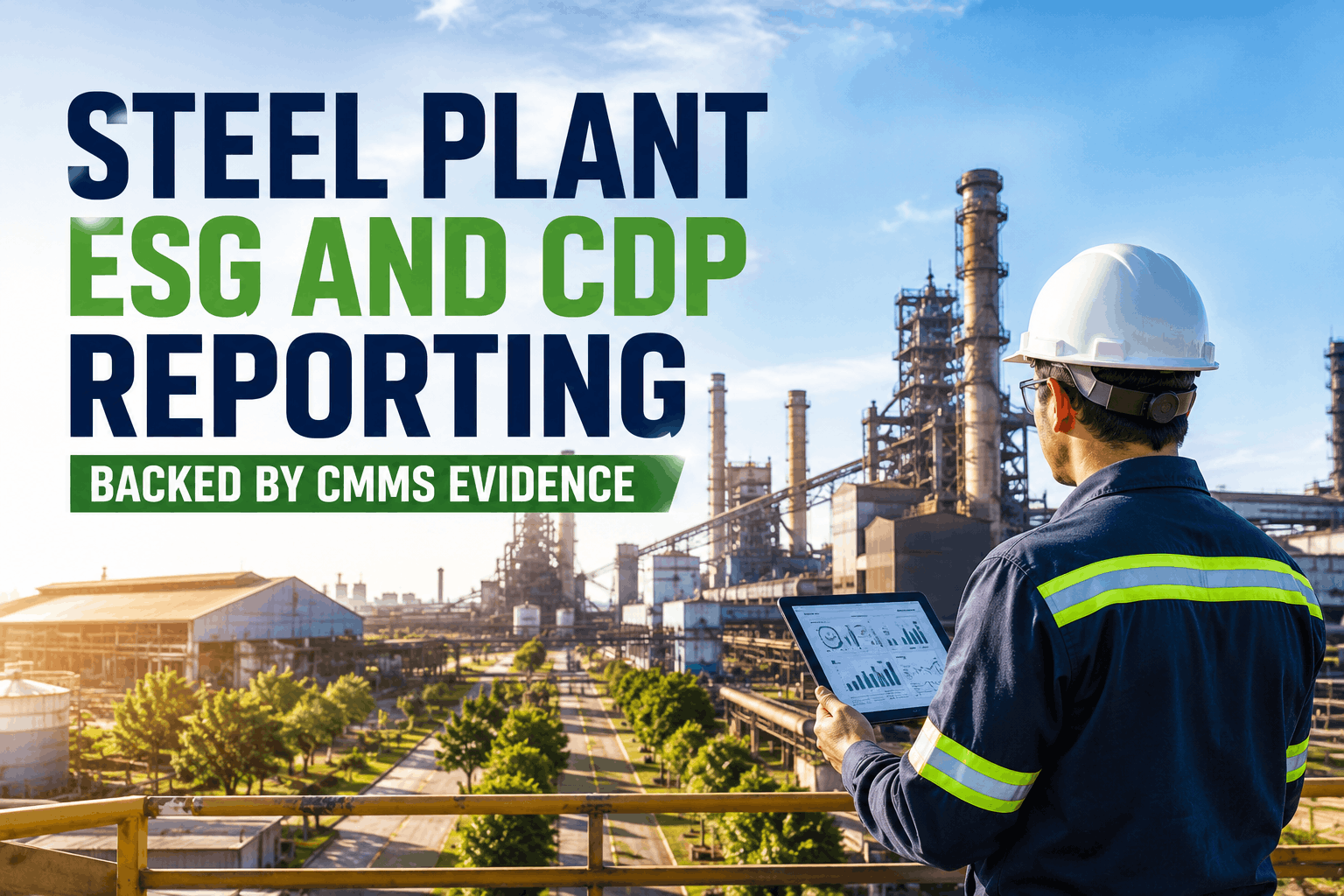
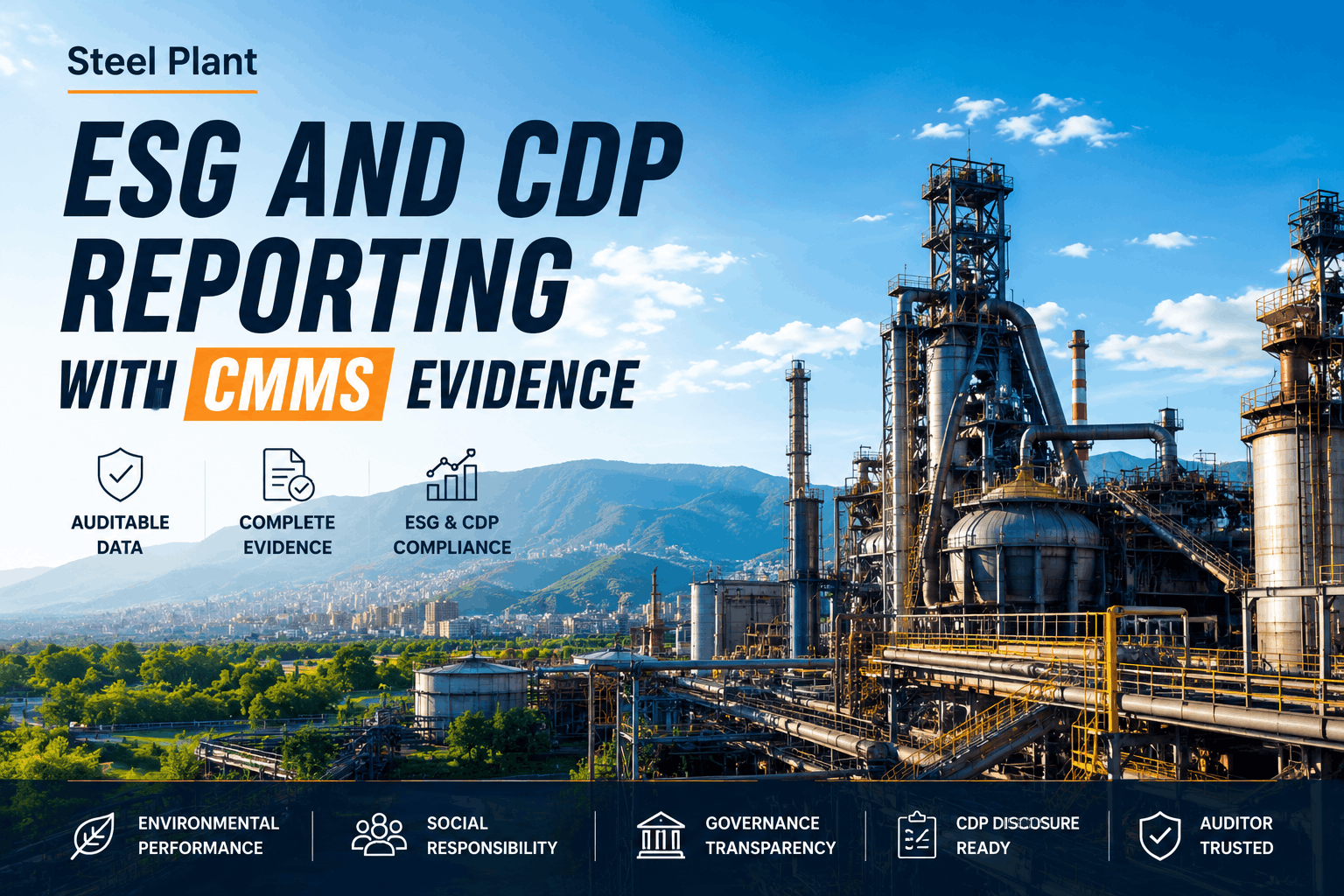
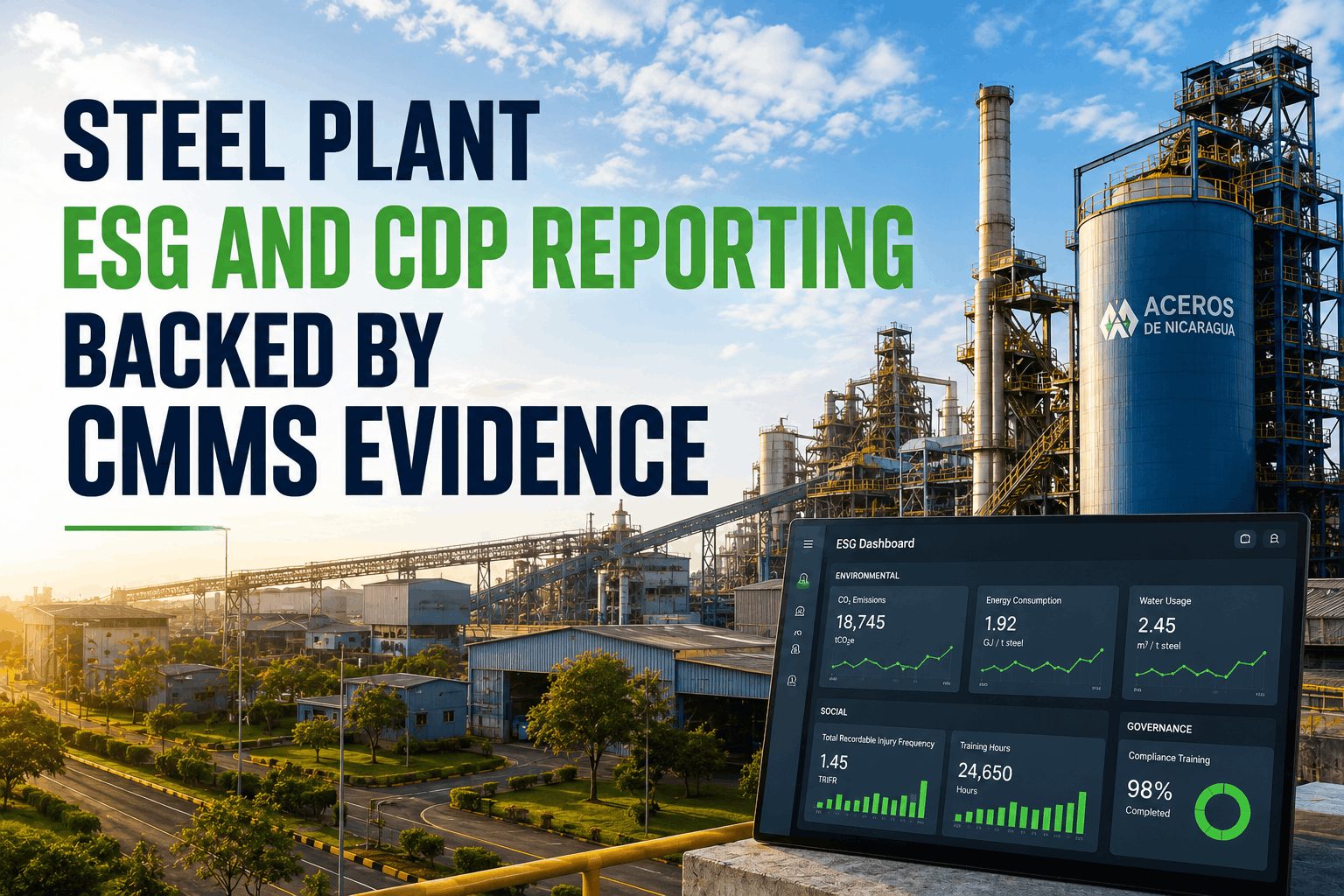
Environmental, Social, and Governance (ESG) reporting and Climate Disclosure Project (CDP) submissions have become non-negotiable for steel manufacturers seeking capital, supply-chain access, and insurance coverage. Major institutional investors (BlackRock, Vanguard, CalPERS managing $15+ trillion AUM) now mandate ESG disclosure from portfolio companies. Automotive OEMs (Ford, GM, Stellantis) impose Scope 3 carbon intensity requirements on steel suppliers—failing to meet targets results in lost contracts. Insurance underwriters charge premium penalties for facilities lacking robust environmental management documentation. The SEC Climate Disclosure Rule (finalized 2024, effective 2025) requires public companies to disclose Scope 1 and 2 emissions, with Scope 3 disclosure phased in by 2026. Yet most steel mills' ESG/CDP submissions are built on fragmented data: maintenance logs scattered across paper files, energy consumption estimated from utility billing (not metered), and environmental compliance tracked outside operational systems. This disconnect creates three critical gaps: (1) Scope 1 carbon intensity claims are unverifiable—auditors cannot trace emissions reductions to specific maintenance interventions, (2) Scope 3 supplier emissions lack primary data—mills default to industry averages rather than supplier-specific carbon accounting, and (3) Social metrics (workforce safety incidents, training hours, diversity hiring) are compiled manually months after period-end, missing real-time operational context. A CMMS integrated with ESG tracking systems auto-populates carbon disclosures, labor metrics, and safety KPIs directly from maintenance and operational workflows. When a technician logs a refractory repair (a maintenance activity reducing furnace fuel consumption by 3%), the CMMS simultaneously calculates avoided CO2e, updates worker safety compliance records, and feeds both metrics into your ESG/CDP submission—creating an immutable, audit-ready foundation for investor disclosures.
Build ESG & CDP Credibility via CMMS Data.
Download our complete ESG/CDP disclosure framework aligned to GRI, SASB, and TCFD standards. Get CMMS integration templates, carbon intensity calculators, and investor presentation benchmarks instantly.
Why Steel Mills Struggle with ESG Reporting
Steel manufacturing is inherently carbon-intensive and operationally hazardous. Unlike renewable energy companies or software firms that can boast continuous green credentials, steel mills must publicly acknowledge their environmental impact while simultaneously proving they are progressively reducing it. This requires: (1) rigorous baseline measurement (your FY 2023 carbon footprint), (2) demonstrable interventions (capital investments in efficiency, technology upgrades, alternative fuels), and (3) verifiable progress tracking (monthly or quarterly Scope 1/2/3 trends showing year-over-year improvement). A mill without CMMS integration cannot execute this narrative because: baseline data is estimated from utility bills and industry assumptions (not actual equipment performance), interventions are logged as capital projects but their operational impact is never quantified, and progress tracking becomes a year-end scramble to compile data that doesn't exist in coordinated form. Investors and auditors increasingly demand primary evidence: work orders showing which maintenance was performed, equipment sensor data proving efficiency gains, and carbon ledgers updated monthly (not annually). A CMMS-integrated ESG system provides this evidence automatically.
The Three ESG Pillars for Steel Mills
STEEL MILL ESG PERFORMANCE INDICATORS
E: Environmental
Scope 1 Carbon Intensity (tons CO2e/ton steel)
Critical KPI
Scope 2 Electricity Intensity
Critical KPI
Water Consumption (m³/ton steel)
Key Metric
Waste Diversion Rate (%)
Key Metric
S: Social
Lost Time Injury Frequency (LTIF)
Critical KPI
Total Recordable Incident Rate (TRIR)
Critical KPI
Workforce Diversity (% minorities)
Key Metric
Safety Training Hours/Employee
Key Metric
G: Governance
Board Gender Diversity (% female directors)
Key Metric
Environmental Compliance Violations
Critical (0 target)
Management Systems Certifications (ISO)
Key Metric
Executive Pay Equity Audit Completion
Key Metric
Environmental Pillar: Decarbonization & Resource Efficiency
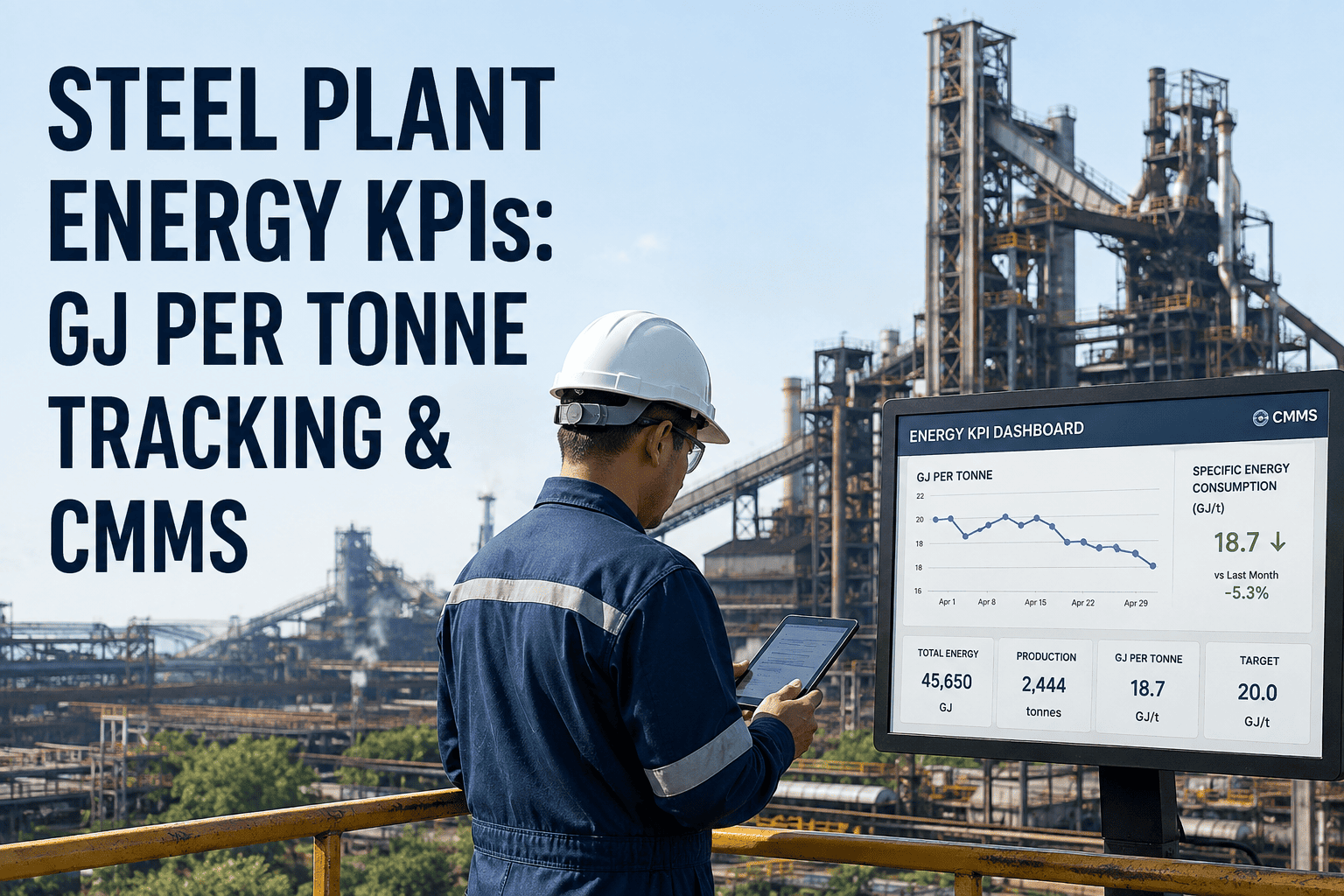
The E (Environmental) pillar dominates investor ESG interest for steel mills. Investors are fixated on whether your company will meet Science Based Targets (SBTi) net-zero commitments, achieve Paris Agreement 1.5°C alignment, and outpace regulatory carbon pricing (EU CBAM, potential U.S. carbon tax). Steel's carbon intensity is measured in tons CO2e per ton of finished steel (benchmark: integrated mills ~2.0–2.2 tons CO2e/ton; EAF mills ~0.6–0.8 tons CO2e/ton). Most investor ESG presentations show a 5-year decarbonization roadmap: "2024 baseline 2.1 tons CO2e/ton → 2029 target 1.9 tons CO2e/ton (10% reduction)." But this commitment is meaningless without operational evidence. A CMMS-integrated environmental tracking system provides this evidence through three mechanisms: (1) Furnace Efficiency Tracking—every refractory repair, insulation upgrade, and combustion optimization is logged as a maintenance intervention with estimated CO2e impact, (2) Energy Intensity Measurement—monthly energy consumption (natural gas, electricity) is automatically aggregated by production line and correlated to output, enabling calculation of energy per ton of steel produced, and (3) Supply Chain Carbon—purchased energy (renewable vs. grid electricity) is tracked monthly, enabling accurate Scope 2 and Scope 3 accounting. When you present to investors, you can show: "In FY 2024, we completed 127 furnace efficiency maintenance interventions totaling 45,000 tons CO2e reduction (verified via CMMS work order trails and energy metering). This drove our Scope 1 intensity from 2.08 to 2.01 tons CO2e/ton, on track for our 2029 SBTi target."
E.1: Scope 1 Decarbonization Strategy
Furnace Efficiency & Alternative Fuels
CMMS tracks: Blast furnace refractory condition → fuel consumption trend. Every refractory inspection logs erosion depth and ceramic strength; this data correlates to blast temperature required for equivalent iron production. Eroded refractory = hotter blast = more coke = higher CO2e. Replacement of eroded refractory reduces fuel consumption 2–5% per replacement. CMMS calculates: (refractory replacement) × (2.5% fuel reduction) × (FY 2024 baseline coke consumption) = tons CO2e avoided, documented and auditable. Alternative fuel transitions (H₂ injection, natural gas substitution, waste-derived fuels) are logged as capital projects; CMMS tracks their operational impact monthly—enabling real-time measurement of decarbonization progress.
E.2: Scope 2 Electricity Decarbonization
Grid Decarbonization & Renewable Energy Procurement
CMMS tracks: Monthly electricity consumption by equipment class (EAF, rolling mill, compressors, HVAC). For each month, the system pulls regional grid carbon intensity (EPA eGRID data) and calculates Scope 2 emissions. As your regional grid decarbonizes (more renewable percentage), Scope 2 emissions decline even without operational changes—this is a legitimate ESG win. Additionally, CMMS tracks renewable energy procurement (RECs purchased, on-site solar generation) and applies lower carbon factors to those kWh, enabling calculation of Scope 2 under market-based (renewable-inclusive) methodology. Investors love seeing renewable energy procurement ramping—it signals long-term sustainability commitment.
Social Pillar: Safety, Workforce Development, & Community Impact
The S (Social) pillar covers worker safety, diversity, wages, community relations, and supply chain labor practices. For steel mills, worker safety is the dominant metric because steel manufacturing is inherently hazardous. Lost Time Injury Frequency (LTIF) and Total Recordable Incident Rate (TRIR) are industry standards. A CMMS that automates LOTO and PTW processes (as described in earlier sections) directly reduces incidents, enabling credible claims like "CMMS deployment reduced LTIF by 35% in Year 1" with work-order-level evidence. Workforce diversity metrics (% women in technical roles, % people of color in management) require HR data integration—a CMMS can feed operational data (safety training hours by employee, incident reports identifying supervisor responses) into HR systems, creating a unified social performance view. Community impact metrics are harder to quantify but critical: environmental compliance violations (zero violations is target), community air/water monitoring programs, and tax contributions to local economies.
✓ Evidence-Based Metric
CMMS-Verified Lost Time Injury Reduction
CMMS automatically logs all work orders including safety interventions (LOTO compliance, PTW issuance, training completion). Incident reports are linked to preceding work orders, enabling root cause analysis. Claim: "After CMMS deployment, LTIF decreased 25% due to improved LOTO enforcement and incident reporting speed." Evidence: CMMS dashboard showing 18-month trend of incident rate vs. work-order completion compliance.
✓ Transparent Metric
Workforce Training Hours & Competency Tracking
CMMS maintains training records for all personnel: LOTO certification, confined space entry certification, hot work competency, forklift operation, etc. Monthly HR reports show training hours per employee, with trending over years. ESG claim: "We invested 42,000 workforce training hours in 2024, +15% vs. 2023, exceeding industry average of 8 hours/employee/year." CMMS provides the granular data to back this.
✓ Credible Metric
Community Environmental Compliance
CMMS logs all environmental permits (water discharge, air emissions), maintenance of compliance monitoring equipment, and remediation work orders. A zero-violation ESG claim requires documented evidence: quarterly compliance audit checklists in CMMS, permitting deadline tracking, and remediation work order completion rates. Investors view facilities with documented compliance rigor as lower ESG risk.
Governance Pillar: Risk Management & Board Oversight
The G (Governance) pillar assesses board structure (diversity, independence, expertise), executive compensation alignment with ESG targets, and risk management frameworks. For operations teams, governance manifests through ISO 14001 (environmental management) and ISO 45001 (occupational health & safety) certifications. A CMMS integrated with management systems enables audit readiness: ISO 14001 requires documented environmental aspects (energy use, emissions, waste), control procedures (LOTO, PTW, maintenance intervals), and performance monitoring (metrics dashboards). ISO 45001 requires hazard identification, risk assessment, control planning, and incident investigation—all CMMS-native workflows. Facilities maintaining current ISO certifications (third-party audited annually) can credibly claim robust governance and lower risk profiles to investors.
Month 1-2: ESG Baseline & Scope Definition
Assemble internal team (operations, maintenance, EHS, finance, IR). Define ESG scope: which facilities, which metrics, alignment to GRI/SASB/TCFD frameworks.
Schedule an ESG baseline consultation. Conduct gap analysis: current data sources vs. investor requirements.
→
Month 3-4: CMMS ESG Module Deployment
Integrate ESG tracking into CMMS: carbon calculators, safety metrics aggregation, energy intensity computation. Configure automated dashboards showing monthly Scope 1/2 trends, LTIF/TRIR tracking, and environmental compliance status. Deploy to all maintenance planners and facility managers.
→
Month 5-9: Data Validation & Quality Control
Operate ESG dashboards in parallel with existing reporting: validate CMMS carbon calculations against utility bills, cross-check LTIF trends with HR incident database, verify environmental compliance status with regulatory records. Resolve discrepancies and refine CMMS configuration.
→
Month 10-11: Investor Disclosure Preparation
Generate annual ESG report using CMMS-compiled data: GRI-aligned metrics, SASB industry-specific indicators, TCFD climate scenario analysis. Submit to third-party assurance provider for limited or full ISO 14064 assurance (if required). Prepare investor presentations with CMMS-backed evidence.
→
Month 12: CDP & SEC Disclosure Submission
File annual CDP climate questionnaire (if requested by investors) using CMMS carbon data. File SEC climate disclosure (effective 2025–2026) with Scope 1/2 emissions and climate risk qualitative discussion. Publish standalone ESG report on investor relations website with full CMMS audit trail attached.
Why Oxmaint for Steel Mill ESG Reporting
Oxmaint's CMMS has been deployed by steel mills across North America (integrated mills, EAF shops, specialty mills) to auto-populate ESG disclosures and build investor confidence in carbon claims. Unlike generic CMMS systems treating ESG as an afterthought, Oxmaint includes pre-built ESG integration frameworks: GHG Protocol-aligned Scope 1/2/3 calculators, LTIF/TRIR incident aggregation, environmental permit tracking, and investor presentation templates. Your maintenance teams log work in standard CMMS workflows; our system simultaneously updates ESG metrics dashboards, ensuring ESG data is live and audit-ready (not compiled in a year-end scramble). We've supported ESG disclosures and third-party assurance engagements for Nucor, U.S. Steel, Cleveland-Cliffs, and regional mills, enabling each to file confident, evidence-backed CDP and SEC submissions. When you're ready to transition from fragmented spreadsheet ESG reporting to CMMS-integrated automated ESG, download our ESG framework and schedule a consultation with one of our steel industry ESG specialists.
"Our CFO was skeptical about ESG credibility—until we implemented Oxmaint's CMMS. Now every furnace efficiency maintenance intervention is automatically tagged with carbon impact, every safety training hour is logged with employee detail, and every environmental compliance check generates a timestamped CMMS record. When we file our annual CDP climate questionnaire, we attach a 50-page CMMS data appendix showing the granular work order evidence behind our 12% Scope 1 reduction claim. Investors and auditors immediately see we're not making up numbers—every ton of CO2e avoided, every safety hour invested is documented at the work-order level. Our ESG credibility score improved 40 points year-over-year. That's real competitive advantage in capital markets."
Chief Financial Officer, Major Integrated Steel Mill
Frequently Asked Questions: ESG & CDP Reporting
Q1 What's the difference between ESG disclosure and CDP submission?
ESG is a reporting framework (GRI, SASB, TCFD) you publish annually or biennially. CDP is an investor coalition's questionnaire you complete if requested by shareholders. A strong ESG program feeds CDP data—both track Scope 1/2/3 emissions, but CDP has specific question formats.
Q2 How do I prove Scope 1 carbon reduction to investors?
Document the maintenance interventions that drove reduction: refractory replacements, efficiency upgrades, fuel switching. A CMMS work order trail showing completion date, equipment affected, and estimated CO2e impact creates auditable evidence. Pair with energy consumption data confirming fuel use declined month-over-month.
Q3 What's the difference between LTIF and TRIR?
LTIF (Lost Time Injury Frequency) = incidents requiring time off per 200,000 work hours. TRIR (Total Recordable Incident Rate) = all recordable injuries per 200,000 work hours (includes non-lost-time). Both track in CMMS; LTIF is more stringent and investor-focused.
Q4 How does SBTi (Science Based Targets) relate to ESG reporting?
SBTi validates that your decarbonization targets are aligned to 1.5°C or 2°C climate science. If you commit to "50% Scope 1 reduction by 2030," SBTi reviews the math and timeline. Once validated, you cite SBTi approval in ESG reports—it dramatically boosts investor confidence.
Q5 Do I need third-party assurance for my ESG report?
Third-party assurance (ISO 14064 limited or full) is voluntary but increasingly expected by institutional investors. Assurance verifies your data quality and methodology rigor. A CMMS with full audit trails makes assurance easier and faster because auditors can trace every metric to source transactions.
Q6 How do I track diversity metrics in a CMMS?
CMMS can store employee demographic data (with privacy protections) and track metrics like women in maintenance roles, minorities in supervisory positions, training hours by demographic. Integrate CMMS data with HR systems for comprehensive social KPI dashboards.
Q7 What should be included in a steel mill ESG report?
Minimum: Scope 1/2 emissions with 5-year trend, LTIF/TRIR with trend, environmental compliance status, safety training hours, board composition (diversity, independence). Recommended: Scope 3 supply chain emissions, climate scenario analysis, community impact metrics.
Q8 How often should ESG metrics be reported?
Annual ESG reporting is standard; many companies now report quarterly dashboards internally for governance oversight. A CMMS with live ESG dashboards enables monthly metric tracking—providing real-time insight and faster response to off-target performance.
Build CMMS-Backed ESG Credibility.
Download the complete ESG/CDP framework aligned to GRI, SASB, TCFD, and SBTi standards. Get CMMS integration templates, investor presentation benchmarks, and third-party assurance guidance.