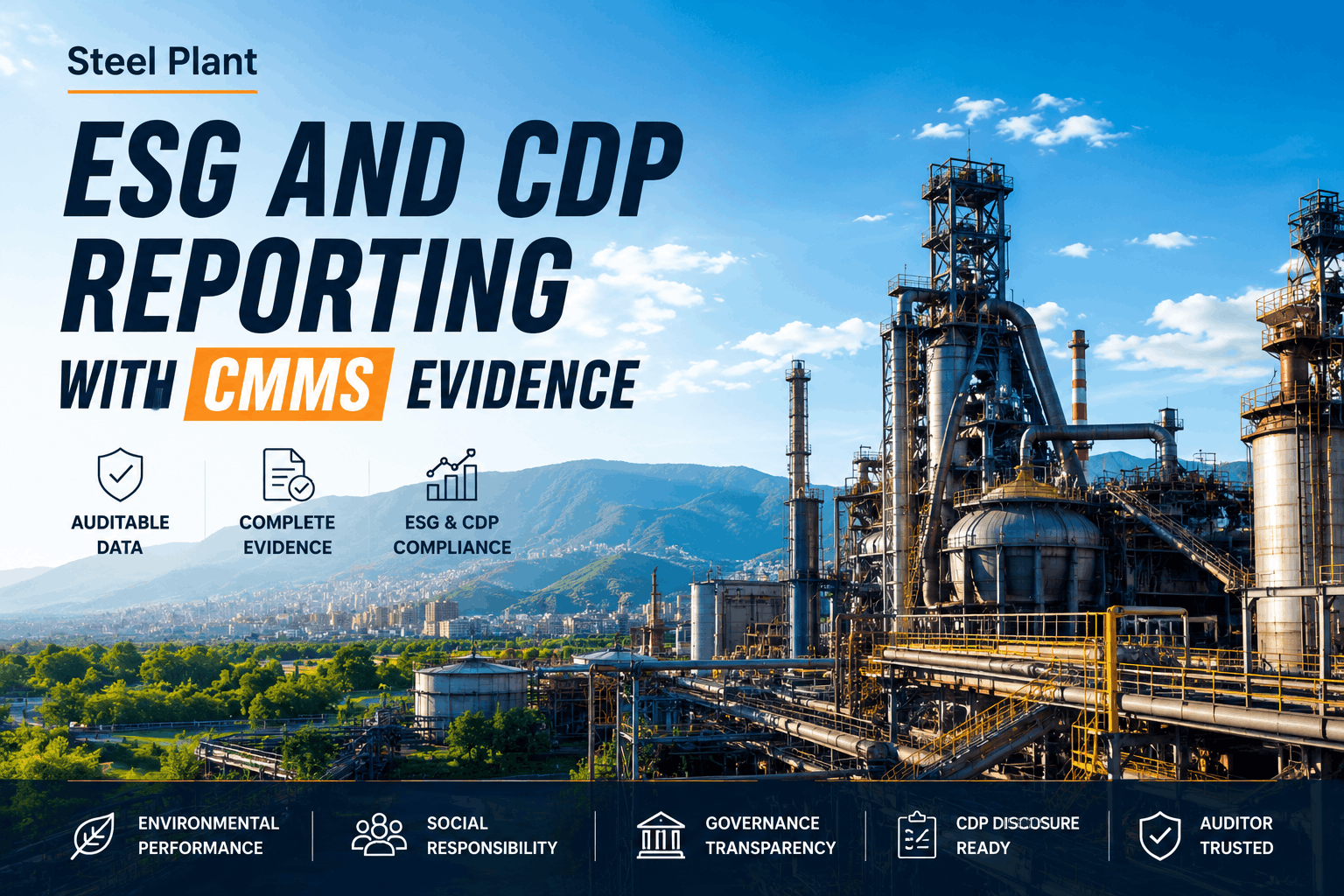
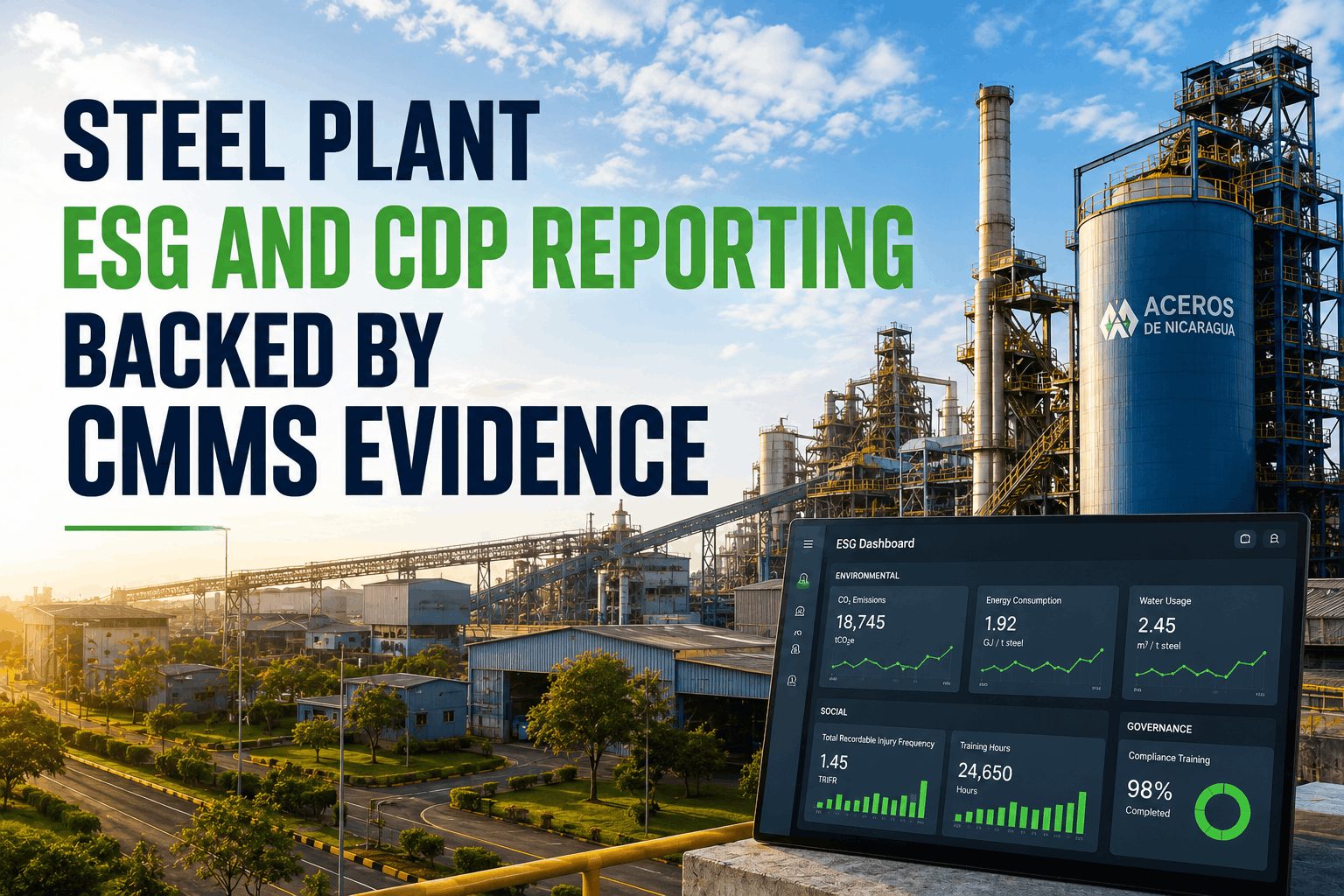
Steel mills face existential pressure to demonstrate environmental, social, and governance (ESG) progress — yet 76% of North American steelmakers struggle to compile auditable evidence for ESG disclosures because maintenance records, energy consumption data, and operational compliance documentation remain scattered across disconnected systems. CDP (formerly Carbon Disclosure Project), Science-Based Targets initiative (SBTi), TCFD (Task Force on Climate-related Financial Disclosures), and emerging SEC climate disclosure rules now require quantified Scope 1 (direct emissions), Scope 2 (purchased electricity), and Scope 3 (supply chain) carbon accounting — backed by auditable operational records. When your CMMS lacks integration with energy monitoring systems, water tracking programs, and equipment maintenance records, ESG reporting becomes expensive annual scramble rather than continuous operational discipline. OxMaint's ESG and CDP reporting solution integrates energy consumption data, equipment maintenance records, equipment efficiency improvements, water usage tracking, and regulatory compliance documentation into unified evidence archive — enabling your sustainability team to generate audit-ready ESG disclosures continuously rather than commissioning expensive third-party audits annually. Explore this comprehensive guide to steel plant ESG reporting, covering Scope 1/2/3 emissions quantification, EnPI (Energy Performance Indicator) tracking, water disclosure requirements, TCFD climate risk assessment, and CMMS-backed evidence collection that transforms ESG from compliance burden into operational transparency and competitive advantage.
ESG and CDP Reporting Built on Operational Evidence, Not Estimates
OxMaint integrates energy consumption, equipment maintenance, water tracking, and compliance records into unified ESG evidence archive — enabling continuous CDP reporting, SBTi validation, and TCFD climate risk disclosure with auditable operational data.
Steel Plant ESG and Sustainability Reporting: Where Evidence Meets Accountability
ESG reporting and CDP climate disclosure have evolved from optional corporate responsibility initiatives into investor requirements, financing conditions, and customer contract mandates. Major institutional investors (BlackRock, Vanguard, State Street) now demand rigorous ESG disclosure before allocating capital. Banks increasingly require net-zero transition plans and ESG performance metrics as lending conditions. Automotive customers increasingly specify low-carbon steel sourcing in procurement contracts, with penalties for non-compliance. SEC climate disclosure rules (final rules effective 2024–2025) mandate Scope 1 and 2 emissions reporting; Scope 3 guidance likely follows within 2–3 years. Yet many mills approach ESG reporting through estimation and extrapolation: calculate baseline emissions, assume efficiency improvements, project future performance without ground-truth operational data. When auditors ask "how do you know your energy intensity improved 3% year-over-year?" responses lacking continuous measurement and equipment-level documentation fail scrutiny. Leading mills embed ESG reporting into operational CMMS discipline: equipment efficiency improvements (VFD retrofits, boiler maintenance, motor upgrades) trigger automatic energy impact calculations; maintenance records prove preventive discipline that extends equipment life and reduces embodied carbon in replacement; water conservation programs track cooling tower blowdown reduction and closed-loop system optimization; waste minimization initiatives document material reuse and byproduct recovery. This operational approach transforms ESG from annual compliance scramble into continuous evidence collection. When investor calls request detailed emissions justification or customer audits demand low-carbon sourcing proof, your CMMS provides instant auditable documentation rather than scrambled spreadsheets and consultant estimates. ESG reporting backed by operational CMMS evidence becomes competitive advantage: demonstrates discipline to capital markets, justifies premium pricing for low-carbon steel, and supports financing access for decarbonization capex.
Direct combustion emissions (blast furnace coke, natural gas, coal consumption) represent 60–75% of typical steelmaker's carbon footprint. OxMaint integrates fuel delivery records, energy consumption data, and equipment operating hours to calculate Scope 1 emissions continuously — eliminating annual estimation guesswork.
Purchased electricity emissions depend on grid carbon intensity (varies by region and time). OxMaint tracks electrical consumption by facility/circuit, integrates utility emission factors, and documents renewable electricity purchasing (PPAs, RECs) to calculate true Scope 2 emissions and claim emissions reductions from decarbonized power sources.
Scope 3 includes upstream supplier emissions (iron ore mining, coal production, transportation) and downstream product use. OxMaint documents scrap sourcing, supplier partnerships, and product quality metrics enabling Scope 3 emissions calculations per GHG Protocol methodology.
Science-Based Targets initiative (SBTi) requires Energy Performance Indicator baseline and year-over-year tracking. OxMaint calculates EnPI (adjusted for production volume and external variables), trending performance against baseline and industry benchmarks — validating claimed energy efficiency improvements.
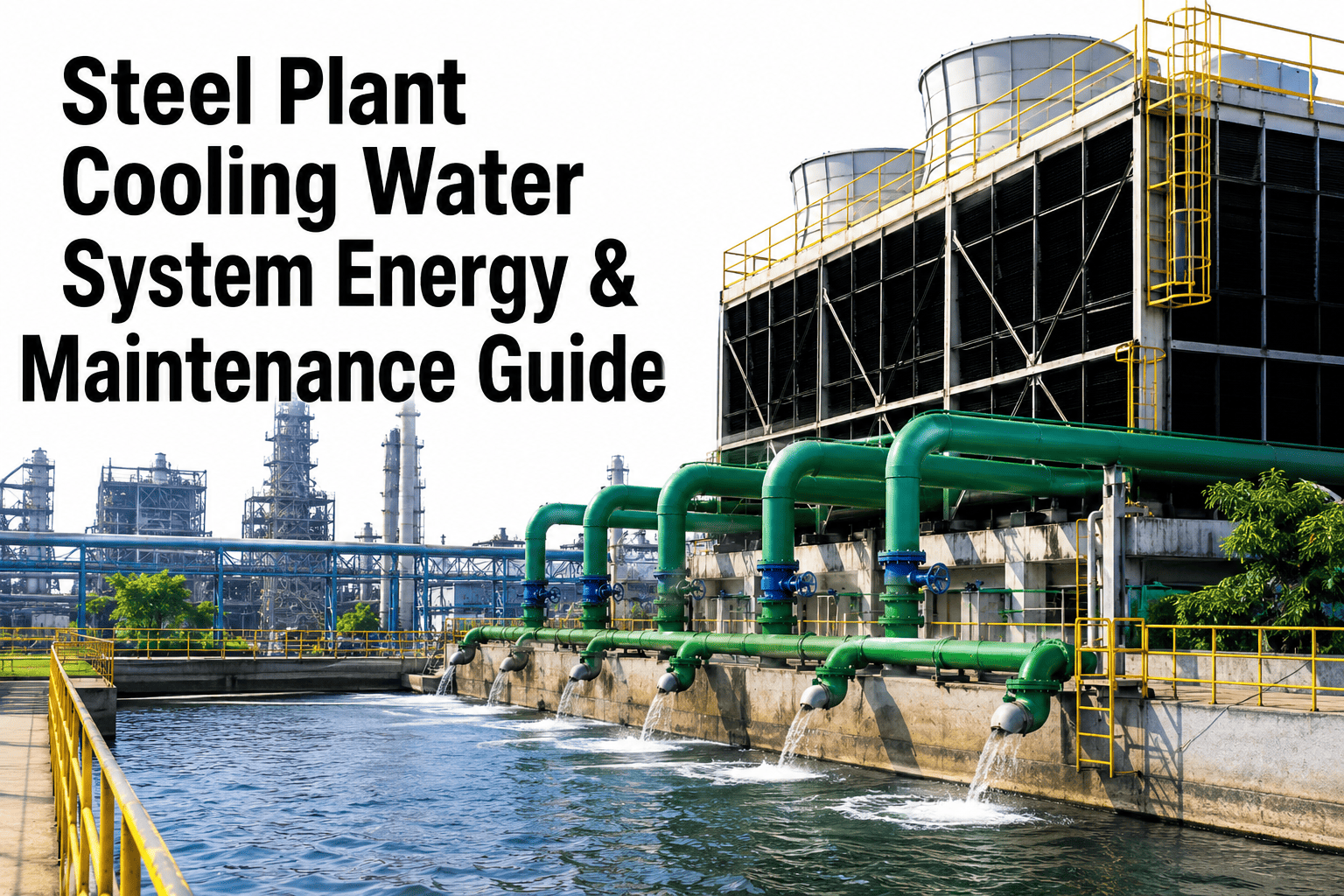
ESG reporting increasingly requires water intensity metrics (gallons per ton produced) and discharge quality data. OxMaint tracks cooling tower water consumption, cooling tower blowdown, water treatment chemical usage, and discharge water quality — documenting water stewardship and enabling water stress disclosure per TCFD guidance.
TCFD (Task Force on Climate-related Financial Disclosures) requires assessment of climate change physical risks (flooding, water stress, extreme heat) and transition risks (carbon pricing, decarbonization capex, customer decarbonization mandates). OxMaint documents equipment resilience, decarbonization roadmap progress, and scenario analysis supporting TCFD disclosure.
ESG Reporting Framework: Scope 1/2/3 Emissions, EnPI, and Regulatory Compliance Landscape
ESG reporting standards continue evolving rapidly: SEC climate rules (2024–2025), GHG Protocol methodology (Scope 1/2/3 definitions), SASB (Sustainability Accounting Standards Board) steel-specific metrics, TCFD climate risk guidance, and emerging carbon accounting standards. Your ESG reporting strategy must address three interdependent dimensions: quantification methodology (Scope 1/2/3 boundaries, EnPI calculation), evidence collection and validation (operational records, third-party audits, verification), and continuous improvement disclosure (decarbonization roadmap, capex, targets). Most mills operate at 30–50% maturity: calculate baseline emissions, report annual changes, but lack granular equipment-level evidence or decarbonization commitment. Leading mills operate at 80%+ maturity: continuous equipment-level monitoring, documented energy efficiency improvements, auditable decarbonization roadmap, and Scope 3 supply chain engagement.
| ESG Reporting Component | Scope Definition / Data Source | Typical Steel Mill Proportion | Key Metrics / Units | Regulatory / Investor Requirement |
|---|---|---|---|---|
| Scope 1: Direct Combustion Emissions | Fuel purchased and consumed: coke, natural gas, coal, fuel oil, waste fuels | 60–75% of total emissions (BF-heavy mills 75%+; EAF mills 20–30%) | Tons CO₂e, emissions intensity (kg CO₂e/ton steel) | SEC climate rules, GHG Protocol, CDP, SBTi, customer procurement audits |
| Scope 2: Purchased Electricity | Grid electricity consumption; location-based vs. market-based methodology | 20–35% of emissions (varies by electrification, grid mix) | MWh consumed, kg CO₂e/MWh (grid factor), RECs/PPAs claimed | SEC rules, TCFD, customer sourcing requirements, financing conditions |
| Scope 3: Supply Chain Emissions | Upstream (iron ore, coal, scrap sourcing) + Downstream (logistics, customer use) | 30–50% of total emissions (increasing focus from investors) | Tons CO₂e upstream and downstream, supplier engagement metrics | GHG Protocol guidance, SBTi (likely mandatory in 2–3 years), customer audits |
| EnPI (Energy Performance Indicator) | Total energy input (Scope 1 + Scope 2 + thermal) / production output, adjusted for external variables | Primary metric for decarbonization progress; baseline + annual tracking required | MJ/ton, GJ/ton, kWh/ton (varies by metric definition) | SBTi validation, ISO 50001, company net-zero commitments, customer ESG scorecards |
| Water Consumption and Discharge | Cooling water intake, blowdown, treated wastewater discharge, quality metrics | 2–4% of overall ESG disclosure value but increasingly critical in water-stressed regions | Gallons/ton, water stress risk rating, discharge water quality (pH, TSS, temperature) | TCFD physical risk disclosure, SASB water metrics, CDP Water Security program |
| Waste Minimization and Byproduct Recovery | Slag granulation, GBFS production, scrap reuse, waste sent to landfill vs. recovery | Supporting metric for circular economy narrative, increasingly valued by ESG scorecards | Tons byproduct recovered, % waste diverted from landfill, circular economy %, revenue from byproducts | SASB metrics, customer ESG audits, circular economy initiatives, carbon intensity reduction (indirect) |
Building Your ESG Reporting Program: Data Collection, Validation, and Continuous Improvement
Establish Scope 1/2/3 Boundaries and Baseline Emissions Calculation
Define organizational boundaries (all facilities included or subset?), operational boundaries (Scope 1/2/3 separation), and methodology (location-based vs. market-based Scope 2). Calculate multi-year baseline (typically 3–5 years average) from utility bills, fuel delivery records, and production data. OxMaint centralizes emissions data collection, eliminating spreadsheet sprawl.
Integrate Energy Monitoring Systems and Real-Time Consumption Tracking
Connect CMMS to metering systems, SCADA platforms, and utility data feeds to track energy consumption in real-time. OxMaint normalizes consumption data for production volume and external factors (ambient temperature, raw material composition) — enabling accurate EnPI calculation and anomaly detection when energy intensity deteriorates.
Document Equipment Efficiency Improvements and Energy Impact Quantification
When implementing efficiency projects (VFD retrofits, boiler upgrades, heat recovery systems), measure baseline energy consumption and post-implementation performance. OxMaint tracks energy savings, calculates carbon reduction equivalent, and links improvements to ESG reporting narratives. Quantified improvements provide auditable evidence replacing estimation.
Scope 3 Supply Chain Engagement and Supplier Emissions Tracking
For Scope 3, engage key suppliers (iron ore producers, coal suppliers, scrap dealers) to provide emissions data. OxMaint maintains supplier emissions profiles, tracks sourcing volumes, and calculates Scope 3 intensity. Document supplier engagement efforts and emissions reductions achieved through supplier development initiatives.
Water Consumption Monitoring and Quality Documentation
Track cooling tower water intake, blowdown volumes, and wastewater discharge. OxMaint monitors water intensity (gallons/ton), water quality parameters (pH, TSS, temperature), and regulatory compliance. Link water conservation projects (closed-loop optimization, blowdown reduction) to water intensity improvements demonstrating environmental stewardship.
Third-Party Verification and Auditor Readiness
Prepare ESG reporting for third-party auditor review (typically required for major disclosures or certification pathways). OxMaint maintains audit trail documentation: energy data sources (utility bills, meter readings), emissions calculation methodology, equipment improvement records, and supply chain evidence. Auditor-ready documentation accelerates verification and reduces compliance risk.
ESG Reporting Excellence: Best Practices from Leading North American Steelmakers
ESG Reporting Impact on Steel Mill Financing, Market Access, and Investor Relations
OxMaint ESG Reporting: Transforming Compliance into Operational Transparency
OxMaint centralizes energy consumption, equipment maintenance, water usage, and emissions data into unified platform. Eliminates spreadsheet fragmentation — all data accessible to ESG team, auditors, and investor stakeholders through single system of record.
OxMaint calculates Scope 1/2/3 emissions per GHG Protocol methodology, documents data sources, and maintains calculation methodology versioning. Enables easy transition between calculation approaches (location-based vs. market-based Scope 2, upstream vs. comprehensive Scope 3) as standards evolve.
OxMaint calculates EnPI (adjusted for production volume, raw material composition, ambient conditions), stores historical baselines, and trends performance against SBTi requirements. Auditors see normalized energy performance data supporting claimed decarbonization progress.
OxMaint documents all efficiency projects: VFD retrofits, boiler upgrades, heat recovery systems. Captures baseline energy consumption, post-improvement performance, and carbon reduction equivalent. Provides auditors with project-level evidence replacing high-level estimates.
OxMaint auto-generates ESG reporting templates aligned with CDP, TCFD, and SEC climate disclosure requirements. All data sourced from CMMS operational records — credible evidence base for investor communications, customer audits, and regulatory filings.
Customer Success: How Steel Mills Achieved ESG Credibility and Financing Advantage Through CMMS-Backed Reporting
"CMMS-Backed ESG Reporting Secured $180M Sustainable Financing at Lower Cost"
"We implemented OxMaint ESG reporting integration capturing equipment efficiency improvements, energy consumption tracking, and water conservation results. When approaching banks for sustainability-linked financing, we could provide auditable CMMS evidence for every claimed improvement — not third-party estimates. Our ESG credibility improved dramatically; banks offered financing at 40–60 basis points lower than conventional debt. We accessed $180M in capital at 2.8% vs. 3.5% conventional rates — a $27M interest savings over loan lifetime. Automotive customers audited our low-carbon steel sourcing claims using CMMS records; we passed audits immediately rather than scrambling for consultants. Our ESG rating improved from B to A-, directly attributed to CMMS-driven reporting credibility. Operational discipline translated into financing advantage." — CFO, Tier-1 North American Integrated Steel Mill
Steel Plant ESG and CDP Reporting: FAQ for Sustainability Directors and Finance Teams
What is the difference between Scope 1, Scope 2, and Scope 3 emissions for steel mills?
Scope 1: direct combustion (coke, natural gas, coal) at facility — 60–75% of typical steelmaker emissions. Scope 2: purchased electricity; typically 20–35% of emissions depending on grid carbon intensity. Scope 3: upstream (iron ore, coal sourcing) and downstream (customer use); increasingly 30–50% of total emissions and subject to new investor/regulatory focus.
How do we calculate and improve EnPI (Energy Performance Indicator) for SBTi validation?
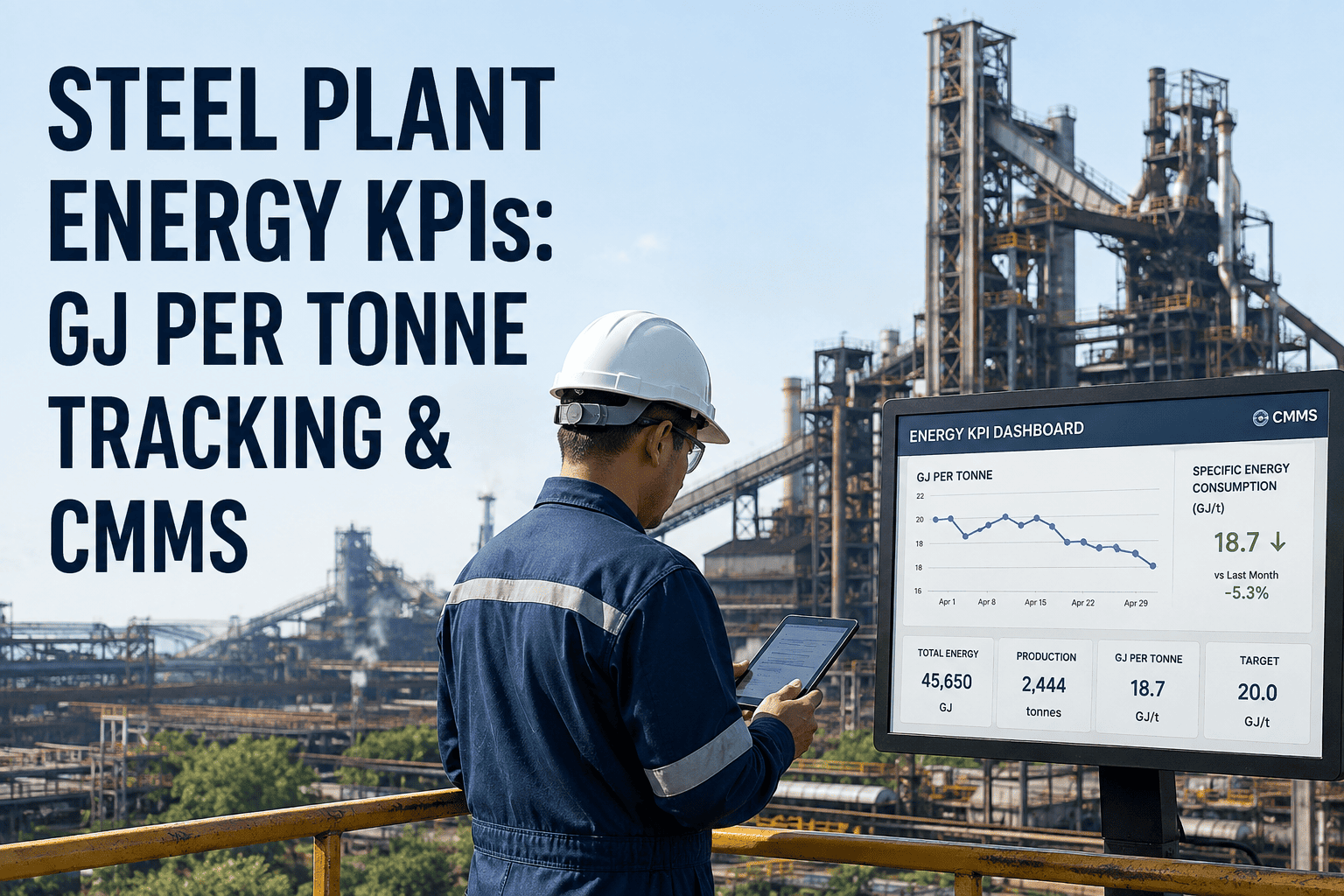
EnPI = total energy consumed (Scope 1 + 2 + thermal) / production output, normalized for production volume and external variables (ambient temperature, raw material). SBTi requires baseline establishment, year-over-year tracking, and demonstrated improvement trajectory. OxMaint calculates EnPI continuously, adjusting for variables automatically.
What equipment efficiency improvements have largest impact on ESG emissions reduction claims?
Highest-impact improvements: (1) EAF conversion/scrap maximization — 80–95% emissions reduction; (2) hydrogen DRI infrastructure — 50–95% reduction; (3) waste heat recovery — 2–4% total facility reduction; (4) boiler optimization + steam trap replacement — 2–3% reduction. OxMaint documents each improvement's baseline/post-implementation performance, quantifying carbon reduction in verifiable terms.
How does TCFD climate risk assessment differ from GHG Protocol emissions reporting?
GHG Protocol quantifies historical emissions; TCFD assesses future climate risks to business (physical risks like drought/flooding, transition risks like carbon pricing). TCFD requires scenario analysis (1.5°C, 2°C, 3°C warming pathways) showing how mill operations/finances would be impacted. OxMaint supports both through operational resilience documentation and decarbonization roadmap visibility.
What Scope 3 emissions data must we collect from suppliers and how do we validate accuracy?
Scope 3 upstream includes iron ore mining emissions, coal production emissions, transportation. Request suppliers provide emissions per unit delivered (kg CO₂e/ton ore or coal). Validate through third-party auditors or supplier certifications (ISO 14064). OxMaint maintains supplier emissions profiles, tracks purchasing volumes, and calculates scope 3 intensity trends over time.
How do we prove equipment efficiency improvements to investors and auditors without third-party consultants?
Capture baseline energy consumption before improvement, post-implementation consumption after, and calculate energy savings. Document via CMMS: equipment specifications, installation dates, energy meter readings pre/post. OxMaint provides audit trail (timestamps, personnel records, measurement method) proving improvements were actual, not estimated.
What is the difference between location-based and market-based Scope 2 emissions calculation?
Location-based: uses average grid carbon intensity for your region (conservative, doesn't reflect actual power sources). Market-based: uses emission factors from actual electricity sources (PPAs, RECs, grid mix); allows claiming emissions reductions from renewable purchases. Leading mills use market-based reporting showing renewable electricity impact. OxMaint calculates both approaches, enabling methodology choice.
How does ESG reporting credibility impact financing access and customer relationships?
Banks offering sustainability-linked financing require rigorous ESG disclosure; mills with strong CMMS-backed evidence access 40–60 basis points lower rates ($27M+ savings on $180M loans). Automotive customers conducting ESG audits require auditable low-carbon steel sourcing evidence; CMMS records pass audits instantly vs. scrambled consultant reports. ESG credibility translates directly to financing advantage and customer market access.
ESG and CDP Reporting: Building Sustainability Credibility Through Operational Discipline
ESG and CDP reporting are no longer optional disclosures — they determine access to capital, customer contracts, and market positioning. Yet many mills approach ESG as annual compliance exercise rather than continuous operational discipline. Leading mills embed sustainability into CMMS: equipment efficiency improvements trigger automatic energy impact calculations, maintenance records prove preventive discipline extending equipment life, water conservation projects document consumption reduction. This operational approach transforms ESG from compliance burden into competitive advantage. When investor calls request detailed emissions justification or customer audits demand low-carbon sourcing proof, your CMMS provides instant auditable documentation. OxMaint makes ESG reporting auditable, continuous, and integrated with operations — elevating sustainability from marketing narrative into operational reality.
Transform ESG Reporting From Compliance Burden Into Financing Advantage
OxMaint integrates energy consumption, equipment maintenance, water tracking, and compliance records into unified ESG evidence archive — enabling continuous CDP reporting and investor communication backed by auditable operational data.