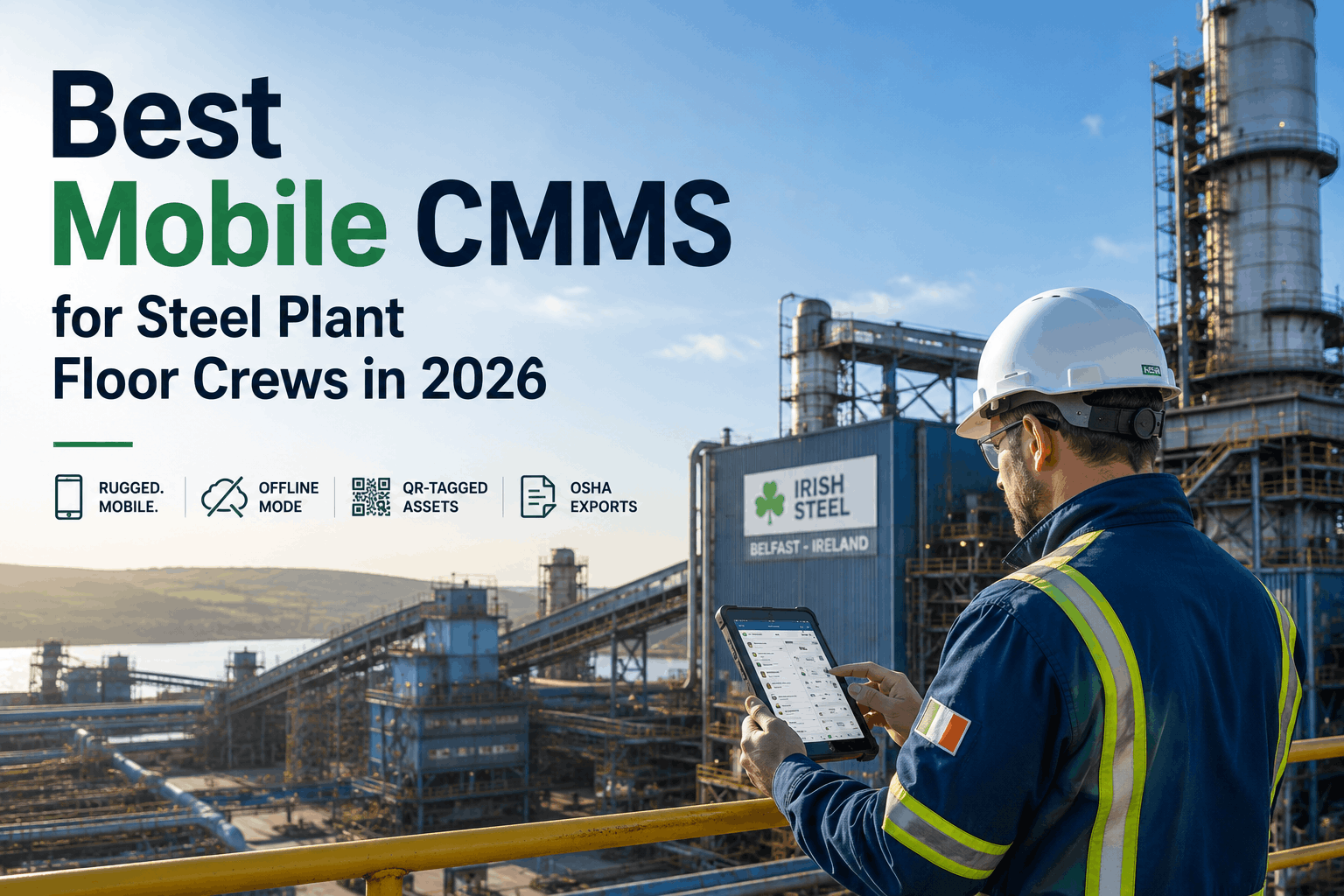
Selecting a Computerized Maintenance Management System (CMMS) is one of the highest-impact infrastructure decisions steel plants make — yet 58% of mills select systems through incomplete evaluation criteria, missing critical functionality later at deployment cost of $500,000–$2 million in lost productivity during implementation. A CMMS that doesn't understand steel mill operations (blast furnace maintenance windows, refractory tracking, EAF downtime impact, continuous casting criticality, OEE integration) becomes an administrative burden rather than operational enabler. Leading mills evaluate CMMS platforms across 16 critical dimensions: mobile-first technician experience, integration with SCADA/MES/ERP systems, refractory and specialized material tracking for BF/BOF/EAF operations, mobile parity (offline-capable field apps), multilocation portfolio management, predictive analytics capability, regulatory compliance documentation, and total cost of ownership transparency. OxMaint was purpose-built for steel mills by engineers who understand blast furnace cooling interdependencies, rolling mill PM scheduling complexity, continuous casting reliability requirements, and the operational pressure to maintain 24/7 production schedules. This comprehensive guide walks you through 16 CMMS evaluation criteria, RFP construction, vendor shortlist scoring, and implementation readiness assessment — enabling your team to select a platform that multiplies maintenance effectiveness rather than complicating operations.
CMMS Selection Made Strategic for Steel Plant Operations
Use this 16-criteria evaluation framework to shortlist CMMS vendors that understand steel mill complexity — then implement the system that becomes competitive advantage, not compliance burden.
Why CMMS Selection Failures Cost Steel Mills Millions in Lost Productivity
Steel plant maintenance is uniquely complex compared to other industries. Blast furnaces operate continuous 5–10 year campaigns; maintenance windows measure hours, not days. Equipment failures cascade instantly: blast furnace cooling failure → immediate furnace shutdown → 2–4 week restart sequence → $100+ million production loss. Rolling mills coordinate 10+ stands through synchronized automation; single motor failure triggers entire campaign halt. Continuous casting operates at millisecond precision; mold oscillation interruption causes surface defects and product loss. Yet many plants implement generic CMMS platforms designed for conventional industries (petrochemical, pharmaceutical, mining), forcing square-peg steel operations into round-hole software architecture. When technicians can't access equipment inventory offline in the field (because CMMS requires constant internet connectivity), work orders get completed manually on paper, then transferred to CMMS later — creating data integrity gaps and defeating system value. When CMMS doesn't understand BF refractory consumption patterns, maintenance planners can't predict refractory replacement needs systematically. When system lacks real-time integration with SCADA (showing actual equipment status), it becomes historical record-keeping tool rather than operational enabler. Wrong CMMS selection cascades into failed implementation: vendors can't customize platform adequately for steel operations, training becomes frustrating when system logic doesn't match facility workflows, adoption rates decline as technicians bypass system in favor of paper records. Two years post-implementation, many mills discover they've invested $2–$5 million capex/licensing/implementation in a system that adds administrative burden without operational benefit. Leading plants approach CMMS selection strategically: define 16 critical evaluation criteria specific to steel operations, create detailed RFP with steel-specific scenarios, score vendors against objective criteria, and commit to deep implementation partnership with vendor that understands steel industry physics and economics.
Technicians must access work orders, equipment history, and parts catalogs in facilities with inconsistent connectivity. System must function offline (no wi-fi, cellular dead zones), syncing data when connectivity returns. Web-only platforms fail in steel mill field operations where technicians spend 80% of time away from office connectivity.
CMMS must integrate with existing SCADA systems (showing real-time equipment status), MES platforms (production scheduling), and ERP systems (parts inventory, financial tracking). Real-time integration enables condition-based maintenance triggering and avoids duplicate data entry across systems.
Blast furnaces consume refractory at predictable rates; maintenance planners must track refractory consumption trends and predict replacement needs. CMMS must support specialized inventory tracking for refractory, alloys, and BF-specific consumables — not generic parts management.
Many mills operate multiple facilities across regions. CMMS must enable portfolio-level visibility: work order rollup across locations, spare parts inventory management across sites, maintenance compliance trending by facility. Single-location systems require duplicate implementations.
System must analyze historical work order patterns to identify equipment approaching end-of-life: rising failure frequency, increasing MTTR, declining MTBF. Predictive capability enables proactive replacement decisions before catastrophic failure interrupts production.
Steel mills prioritize uptime and OEE (Overall Equipment Effectiveness) above all else. CMMS must calculate MTBF, MTTR, OEE, planned/reactive ratio, and PM compliance — showing in real-time dashboards that guide operational decisions.
16 Essential CMMS Evaluation Criteria for Steel Mill Selection and RFP Scoring
Your CMMS selection must address steel mill operational complexity through comprehensive evaluation criteria. Rather than generic software feature checklists, evaluate platforms against these 16 steel-specific dimensions covering field operations, integration architecture, industry-specific functionality, deployment flexibility, and total cost of ownership transparency. Score each vendor systematically to avoid subjective vendor sales pitches and decision bias.
| Evaluation Criterion | Why This Matters for Steel Mills | Evaluation Question for Vendors | Scoring Guidance (1–5) | Red Flag Indicators |
|---|---|---|---|---|
| 1. Mobile-First Field App & Offline Capability | 80% of maintenance work happens in field with intermittent connectivity; must function without internet | Can technician complete work orders offline and sync when connectivity returns? | 5=Full offline + sync; 3=Online required; 1=Web-only | Vendor emphasizes web platform; "requires connectivity"; no offline mode |
| 2. SCADA/MES/ERP Integration (APIs) | Synchronize equipment status, production schedules, parts inventory across systems automatically | What APIs exist for SCADA, MES (SAP/Oracle), ERP integration? Custom development required? | 5=Pre-built APIs; 3=Some integrations; 1=Manual only | No API documentation; integration requires expensive consulting; limited connector library |
| 3. Refractory & Specialized Material Tracking | BF operates specific refractory consumption rates; must predict replacement needs systematically | Does system support specialized BF/BOF/EAF material tracking beyond generic parts inventory? | 5=Purpose-built steel tracking; 3=Customizable; 1=Generic parts only | Generic parts catalog; no industry-specific material tracking templates |
| 4. Multilocation Portfolio Management | Operate multiple mills across regions; need rollup visibility, shared spare parts management | Can one system manage multiple sites with consolidated dashboards and shared inventory? | 5=Portfolio view built-in; 3=Custom development required; 1=Single location only | "Each location needs separate license"; no cross-site inventory management; no rollup reporting |
| 5. Predictive Analytics & Failure Pattern Recognition | Identify equipment approaching end-of-life before catastrophic failure; proactive replacement | Does system identify MTBF decline, MTTR increase, approaching failures through algorithms? | 5=Automated analytics; 3=Manual trending tools; 1=Historical only | No predictive capability; relies on manual analysis; no AI/ML integration plans |
| 6. OEE, Reliability KPI, MTBF/MTTR Dashboards | Steel mill success metric is uptime/OEE; CMMS must provide real-time KPI visibility | Does system auto-calculate MTBF, MTTR, OEE, planned/reactive ratio with trending? | 5=All metrics auto-calculated; 3=Some dashboards; 1=Manual reporting only | Cannot auto-calculate MTBF/MTTR; requires manual spreadsheet work; no KPI dashboards |
| 7. Condition-Based Maintenance (CBM) Integration | Trigger PM based on actual equipment condition (vibration, temperature, oil analysis) not calendar | Can vibration, temperature, oil analysis data auto-trigger maintenance work orders? | 5=Native CBM engine; 3=Custom integration; 1=Calendar-only PM | PM scheduling is calendar-based only; no sensor integration capability; no threshold alerting |
| 8. Regulatory Compliance Documentation (ISO, OSHA, API) | Auditors require documented compliance: PM completion, inspection records, calibration certificates | Does system auto-generate audit-ready compliance reports? API 670, OSHA, ISO templates? | 5=Pre-built compliance templates; 3=Customizable; 1=Manual reporting | No compliance templates; manual report assembly; cannot prove PM compliance to auditors |
| 9. Spare Parts Management & Inventory Optimization | Optimize parts stocking to avoid stockouts during emergencies; track critical spare locations | Does system manage inventory levels, reorder points, supplier lead times, and multi-location availability? | 5=Full inventory module; 3=Basic tracking; 1=Manual only | Generic parts tracking; no reorder automation; no multi-location visibility; manual procurement |
| 10. Work Order Customization for Steel Operations | BF maintenance differs from rolling mill maintenance; workflows must adapt to specific operations | Can system create custom work order templates for BF, rolling mill, continuous casting, sintering? | 5=Unlimited customization; 3=Limited; 1=Fixed template only | "One-size-fits-all" work order structure; cannot adapt to BF-specific maintenance; rigid workflows |
| 11. Mobile Parity (Field App = Desktop Experience) | Technicians spend 80% of time in field; app must offer full functionality, not crippled subset | Are mobile app features identical to desktop? Can technicians perform all operations on phone? | 5=100% feature parity; 3=90% parity; 1=Mobile is read-only | Mobile app is "lite" version; full features require desktop; mobile cannot create/edit; read-only access |
| 12. Real-Time Asset Status Integration (SCADA Sync) | Know if equipment is running, idle, or failed; don't schedule maintenance during active campaign | Does system show real-time equipment status from SCADA? Auto-reschedule PM if equipment unavailable? | 5=Real-time SCADA sync; 3=Manual status update; 1=Blind to asset status | No SCADA integration; manual status tracking; schedule PM during active blast furnace operation |
| 13. Vendor Support and Steel Industry Expertise | Implementation requires vendor understanding of BF/BOF/EAF physics, not generic CMMS knowledge | How many steel mills use your platform? Can you reference customers in blast furnace operations? | 5=20+ steel mills, reference mills available; 3=5–10 steel customers; 1=No steel references | Generic support staff; no steel industry expertise; cannot answer BF-specific questions; no reference mills |
| 14. Total Cost of Ownership (TCO) Transparency | Avoid surprise costs: licensing, customization, integration, training, annual support escalation | What are all-in costs including licensing, implementation, integration, training, Year 1 and Year 5 support? | 5=Full TCO transparent; 3=Partial disclosure; 1=Vague pricing | Licensing opaque; "separate consulting quotes required"; support costs unclear; escalation clauses hidden |
| 15. Implementation Timeline and Deployment Risk | Extended implementations delay value realization; aggressive timelines create training/adoption risk | What is typical implementation timeline for steel mills? Phased or big-bang? Change management plan? | 5=Proven phased approach, 6–9 months; 3=12–18 months feasible; 1=Indefinite timeline | Overly aggressive timeline (3–4 months); no phased option; minimal change management; no pilot approach |
| 16. Vendor Stability & Roadmap Alignment | CMMS is 10–15 year investment; vendor must survive, innovate, and align with AI/IoT evolution | Is vendor profitable? What is product roadmap for AI analytics, IoT, predictive maintenance? | 5=Profitable, clear roadmap, AI/IoT planned; 3=Stable, some innovation; 1=Startup risk, vague future | Frequent vendor ownership changes; product stagnation; no AI/IoT strategy; uncertain financial stability |
CMMS RFP Construction and Vendor Evaluation Scoring Methodology
Define Evaluation Weightings Based on Mill Priorities
Not all criteria carry equal weight: mobile-first capability matters more to mills with distributed equipment; SCADA integration critical if you have advanced control systems; refractory tracking essential for BF-heavy operations. Define weighting (1–5 points each), total 100 points. Align weights with your facility's actual operational pain points and strategic priorities.
Create Steel-Specific RFP Scenarios for Vendor Response
Include detailed scenarios requiring vendor responses: "Describe your mobile work order process during blast furnace cooling system emergency (no office connectivity for 4 hours)"; "Walk through how you integrate SCADA real-time equipment status with predictive maintenance alerting"; "Show us your refractory consumption tracking for a 2,000-ton/day blast furnace." Vendor responses reveal practical system knowledge.
Request Working Demos and Proof-of-Concept Pilots
Do not evaluate based on sales presentations alone. Require vendors to deploy limited POC at your facility (3–6 month pilots) with real technicians, real equipment, actual workflows. POC reveals system strengths/weaknesses that sales demos hide. Budget $50K–$150K per POC; investment pays off through risk reduction.
Reference Site Visits for Steel Industry Validation
Visit 2–3 reference mills where vendor CMMS is deployed. Interview maintenance directors, operations managers, and technicians directly. Ask: "Is system meeting expectations 3 years post-implementation?"; "What functionality disappointed you?"; "Would you choose this vendor again?" Candid feedback from similar operations outweighs vendor claims.
Score Each Vendor Systematically Against 16 Criteria
Create scoring matrix: 16 criteria × vendor columns. Score each vendor 1–5 per criterion based on RFP responses, POC results, reference feedback, and vendor demos. Weight scores per importance (criterion 1 mobile = 5 points; criterion 16 stability = 3 points). Objective scoring eliminates subjective vendor sales pitch bias.
TCO Modeling and Economic Comparison Across Finalists
Model 10-year total cost of ownership for top 2–3 vendors: Year 1 capex (software, hardware, implementation), ongoing licensing, annual support escalation, customization costs, training/change management. Include productivity assumptions (how much technician time CMMS saves annually). Compare economic value vs. upfront cost across vendors.
Post-Selection Implementation Strategy and Deployment Risk Mitigation
CMMS Selection Success: Steel Mills That Transformed Through Disciplined Vendor Evaluation
Customer Success: How Strategic CMMS Selection Transformed Mill Maintenance from Reactive to Predictive
"Rigorous CMMS Evaluation and Phased Implementation Delivered 40% Maintenance Cost Reduction"
"We evaluated 5 CMMS vendors using a 16-criteria framework specific to our blast furnace operations. Most vendors failed on mobile offline capability or refractory tracking — clearly designed for generic industries. OxMaint demonstrated deep understanding of BF physics, refractory management, and mill-specific workflows. We ran a 6-month POC at one facility, trained technicians, and proved value before full rollout. Phased implementation across 3 mills over 12 months gave us time to refine workflows. Within 3 years, we improved PM compliance from 65% to 94%, identified equipment failures 3–6 months in advance through predictive analytics, and reduced unplanned downtime 35%. Our annual maintenance costs dropped $8.2 million while reliability improved dramatically. Best IT investment we've made." — Maintenance Director, Multi-Mill Integrated Steel Group
CMMS Selection and Implementation: FAQ for Plant Engineers and Operations Leaders
What is the difference between generic CMMS platforms and steel-specific systems like OxMaint?
Generic CMMS treats equipment maintenance as standardized calendar-based PM; OxMaint understands steel mill physics — refractory consumption rates, blast furnace cooling interdependencies, continuous casting criticality, energy recovery optimization. Steel-specific systems provide out-of-the-box workflows vs. months of customization required for generic platforms.
How should we weight the 16 evaluation criteria based on our specific mill configuration?
Weight criteria by your operational pain points: mills with distributed equipment prioritize mobile offline capability (8–10 points); BF-heavy mills prioritize refractory tracking (8–10 points); multi-location mills prioritize portfolio management (7–9 points). Total weighting should sum to 100 points. Adjust weights to reflect your facility's actual priorities.
What should we require in RFP scenarios to evaluate vendor understanding of steel operations?
Include detailed scenarios: "Walk through mobile work order process during BF cooling emergency with no connectivity"; "Show how you track refractory consumption and predict replacement needs"; "Demonstrate SCADA integration and predictive failure alerting"; "Explain how you handle multilocation spare parts inventory." Vendor responses reveal practical system knowledge vs. generic training.
How long should we budget for CMMS implementation and what is realistic ROI timeline?
Phased implementation: months 0–3 pilot site, months 3–6 rollout to facility 2, months 6–12 complete facility 3. Full value realization: 18–36 months as workflows optimize and predictive analytics mature. Payback timeline: 2–4 years typical for mid-sized mills; leading mills see operational benefits within 12 months through improved reliability.
What are red flags that indicate a vendor CMMS will struggle with steel mill complexity?
Red flags: web-only platform with no offline mobile; no SCADA integration capability; generic parts catalog without refractory tracking; no reference mills in steel industry; support staff lacking steel expertise; vague total cost of ownership; big-bang implementation approach only; no predictive analytics roadmap. Any of these indicate poor steel mill fit.
Should we consider proof-of-concept pilots and how much should that investment cost?
POCs are essential — they reveal system strengths/weaknesses that sales demos hide. Budget $50K–$150K per POC (3–6 months, one facility or process area). POC costs recover quickly through risk reduction: identifies integration issues, workflow misfits, and adoption barriers before full rollout. Well-run POCs have prevented millions in bad vendor selections.
How do we ensure technician adoption when rolling out new CMMS across our mills?
Success requires: (1) dedicated change management leader; (2) technician involvement in system design/testing before rollout; (3) comprehensive training tailored to job roles; (4) supervisor coaching and feedback loops; (5) feedback collection and workflow refinement post-launch. Without active change management, technicians revert to paper and system fails despite good software.
What financial metrics should we track post-implementation to prove CMMS ROI to executives?
Track: (1) PM compliance rate (should increase from ~70% to 90%+); (2) unplanned downtime reduction (typically 20–35% reduction within 3 years); (3) equipment MTBF improvement (signals predictive maintenance value); (4) maintenance cost per ton produced (should decrease 10–20%); (5) technician time on reactive vs. planned work (ratio should improve toward 80% planned). Quantified metrics justify continued investment.
Making the CMMS Selection Decision: Framework for Strategic Alignment and Implementation Success
CMMS selection represents high-stakes decision affecting daily operations, technician effectiveness, and maintenance economics for 10–15 year horizon. Yet many mills approach selection through incomplete evaluation, relying on vendor marketing pitches rather than systematic assessment. This 16-criteria evaluation framework forces disciplined vendor comparison, eliminating subjective bias. Reference site visits and proof-of-concept pilots validate vendor claims through real operational evidence. Total cost of ownership modeling ensures pricing transparency. Implementation planning mitigates deployment risk through phased rollout, change management focus, and continuous optimization mindset. Steel mills that follow this disciplined selection process typically achieve 3–5 year payback on CMMS investment with ongoing efficiency gains and reliability improvement extending through system lifetime.
Start Your CMMS Selection Journey With Strategic Evaluation Framework
Use the 16-criteria framework, RFP template, and vendor scoring methodology to select a CMMS platform built for steel mill operations — transforming maintenance from reactive burden into competitive advantage.



.png)