Industrial IoT (IIoT) Sensor Deployment for Steel Plants
By Alex Jordan on June 4, 2026
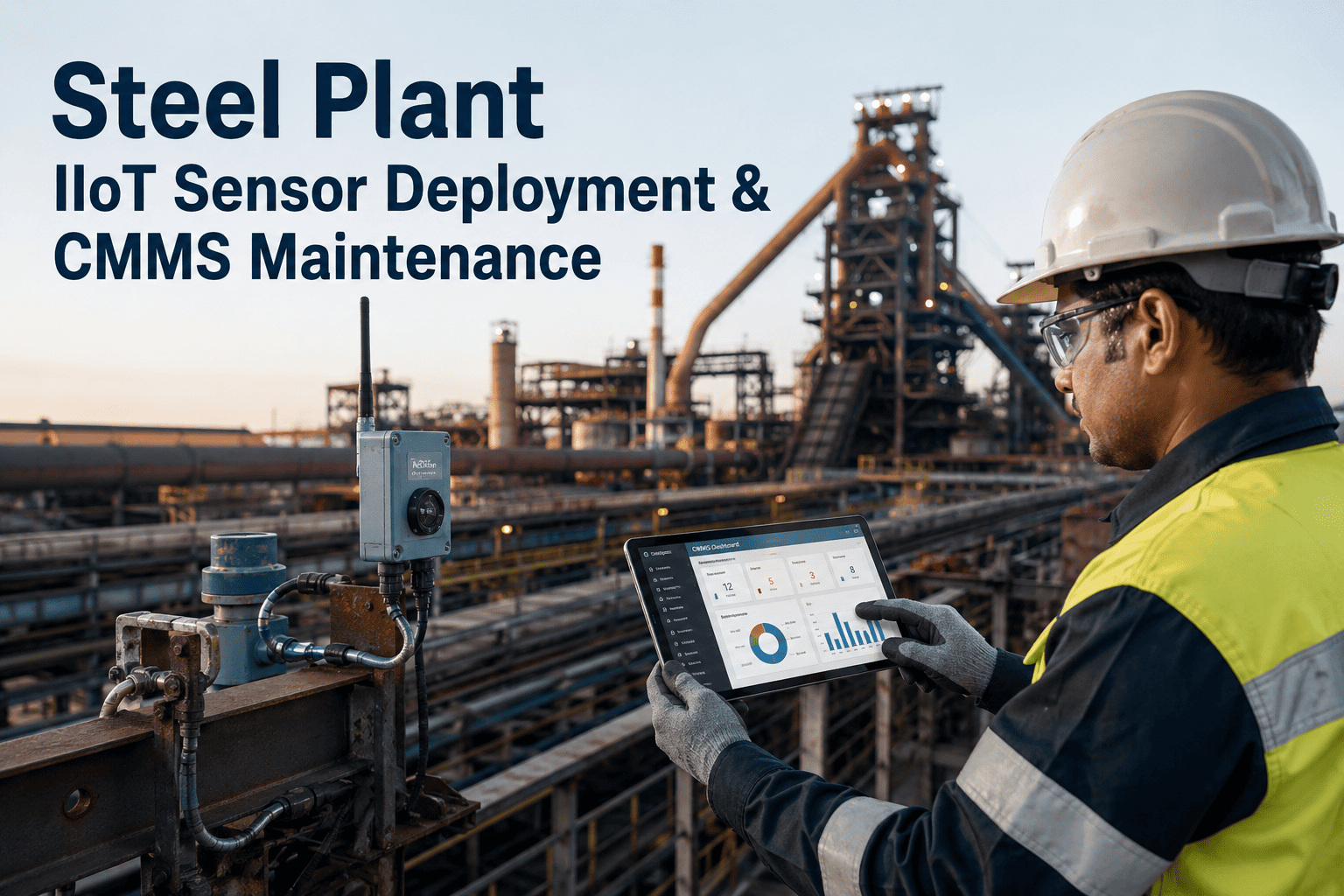
A maintenance engineer at a rolling mill in Pennsylvania installed twenty wireless vibration sensors across the main motor drive train, cooling system, and bearing housings in June 2025 — expecting to capture granular machine health data in real time. What she discovered in her first week shocked her: the mill had been replacing bearings on a six-month calendar schedule despite the fact that most bearings were operating perfectly healthy. Three bearings showed early wear signatures consistent with 3-4 months remaining useful life; one bearing showed catastrophic wear progression that would cause failure within 14 days if unaddressed. The cost to capture this visibility was $6,200 in wireless sensors and $8,400 in OxMaint platform deployment. The value captured in the first two months: $94,000 from deferring unnecessary bearing replacements, $48,000 from preventing an emergency failure that would have stopped the entire rolling mill mid-shift, and $34,000 from optimizing maintenance crew scheduling around actual equipment need rather than calendar dates. Every other mill on the same facility planning to deploy IIoT sensors based on her success. OxMaint integrates wireless IIoT sensors across harsh mill environments — from vibration accelerometers that survive 150°C heat near blast furnaces to pressure transducers that operate in explosive atmospheres — and translates raw sensor data into maintenance-ready condition trends that drive predictive work orders.
IIoT Sensors Transform Calendar PM Into Condition-Driven Maintenance
Wireless vibration, thermal, pressure, and acoustic sensors retrofit onto legacy equipment without downtime — delivering 90%+ prediction accuracy at <$200 per measurement point including installation and five-year operation
Realized value in first two months: avoided unnecessary bearing replacements + prevented mid-shift emergency breakdown at one rolling mill
20 sensors
Deployed in seven days across rolling mill drive train — zero production downtime, wireless retrofit, data flowing immediately
3 years
Average sensor battery life — wireless eliminates cable routing complexity and installation labor in 24/7 mill environments
IIoT Sensor Types for Steel Mill Operations — What Each Detects and Why It Matters
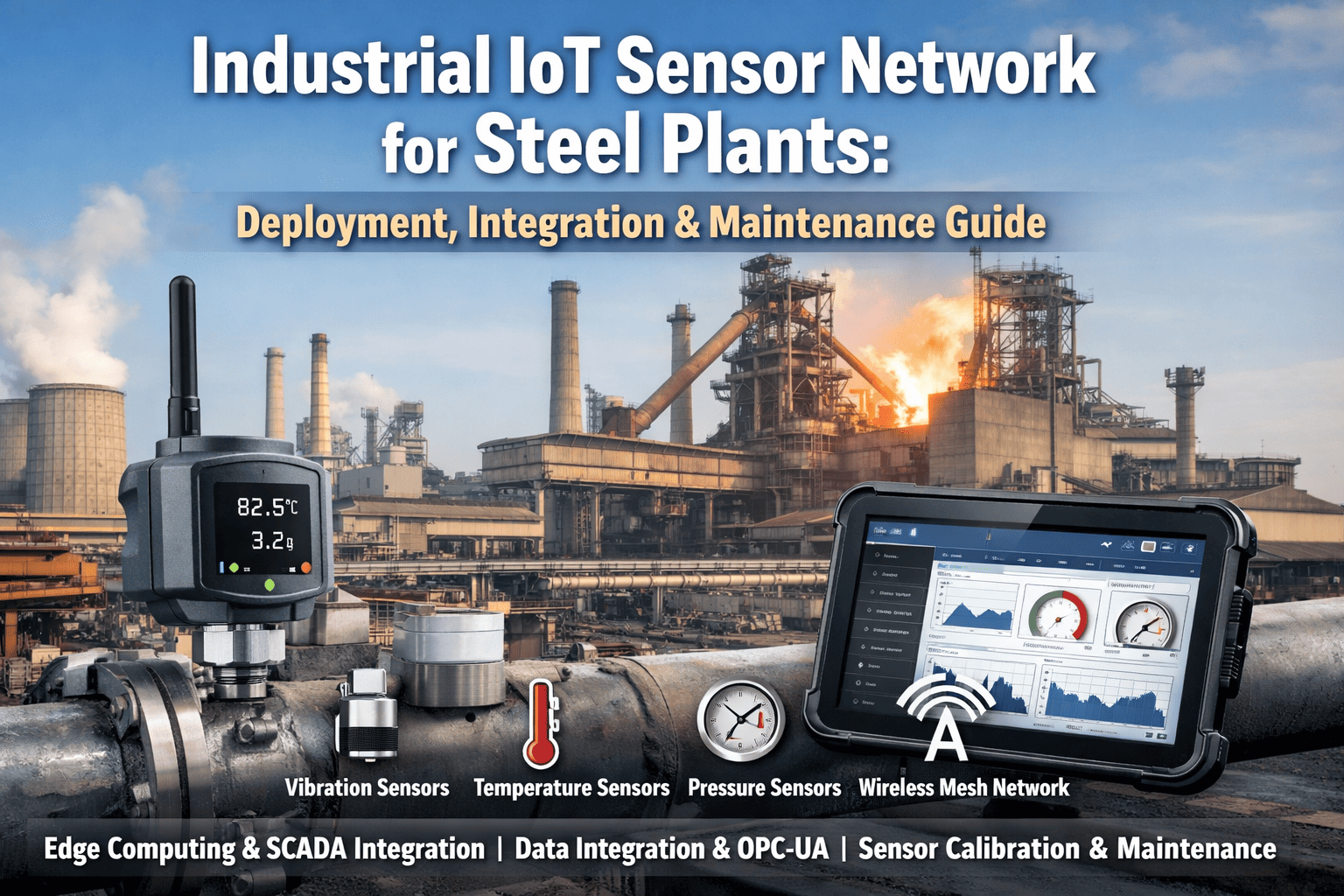
The steel mill environment demands industrial-grade sensors rated for temperature extremes, moisture, dust, and electromagnetic interference. Five sensor categories dominate predictive maintenance deployment: Vibration sensors (triaxial accelerometers) detect bearing wear, misalignment, imbalance, looseness, and friction degradation through high-frequency acceleration measurements. A bearing that is degrading will show rising vibration amplitude in specific frequency bands — patterns that machine learning algorithms can recognize 4-6 weeks before mechanical failure. Temperature sensors (thermocouples and RTDs) track critical asset temperatures: blast furnace stave cooler temperatures, rolling mill bearing housings, transformer windings, and hydraulic reservoir fluid. Rising temperature trends often precede failure by 2-3 weeks. Pressure transducers monitor hydraulic systems, cooling loops, and gas flows — detecting leaks, pump degradation, and filter blockages through pressure ripple analysis and trend detection. Acoustic and ultrasonic sensors detect compressed air leaks, electrical arcing, and friction noise that indicate developing problems invisible to traditional vibration sensors.
Triaxial Vibration Accelerometers
Wireless sensors measure vibration in X, Y, Z axes simultaneously — detecting bearing spalling, shaft misalignment, rotor imbalance, and looseness through envelope analysis and kurtosis trending. Rated to 150°C, IP67 waterproof, 3-year battery life. Deployment: motors, gearboxes, bearing housings, compressors. Alert threshold: 3-4 weeks before failure threshold.
Wireless Temperature Transmitters
Thermocouples and RTD transmitters with ±0.5°C accuracy measure critical asset temperatures. Applications: blast furnace stave cooler outlet temperature, rolling mill bearing housing, transformer winding average, hydraulic reservoir, motor frame temperature. Wireless range: up to 1,000 feet in mill environment. Detect degradation 2-3 weeks before failure.
Pressure Transducers and Differential Pressure Sensors
4-20mA or 0-10V wireless transmitters measure absolute and differential pressure across hydraulic systems, cooling loops, compressed air lines, and gas flows. Detect pump cavitation, filter blockage, seal leaks, and line ruptures through rate-of-change and static pressure trending. Response time: <100ms. Critical for safety-relevant hydraulic systems.
Acoustic / Ultrasonic Sensors
High-frequency sound sensors (20kHz-100kHz) detect compressed air leaks, electrical arcing, mechanical friction, and fluid cavitation — revealing problems invisible to standard vibration monitoring. Key applications: electrode system arcing detection, cooling water leaks, bearing raceway spalling initiation. Early warning: 8-12 weeks before mechanical failure.
Motor Current Signature Analysis (MCSA) Devices
Non-invasive clip-on current sensors measure motor supply current and harmonics — revealing mechanical load imbalance, bearing friction increase, winding insulation degradation, and rotor bar stress. Detects problems in large motors (>50HP) that vibration sensors miss. Deploy on primary mill motor drives, blast furnace fans, hydraulic pump motors.
Fluid Condition Sensors
Particle counters, viscosity monitors, and water-in-oil sensors deployed in hydraulic tanks and sumps. Detect wear particle generation (bearing degradation, gear wear), viscosity breakdown (heat exposure), and water contamination (seal leakage). Predictive alert: fluid condition deterioration signals are some of the earliest warning signs of internal component wear.
IIoT Sensor Deployment
Real Condition Data Changes Everything. Deploy Wireless Sensors in Days. Start Predicting Failures in Weeks.
OxMaint integrates wireless IIoT sensors with machine learning to transform static calendar PM into dynamic condition-driven maintenance. Sensors retrofit onto existing equipment without downtime, integrate with your SCADA and CMMS, and automatically generate maintenance work orders when condition data predicts approaching failure.
IIoT Sensor Network Architecture — Planning Your Deployment
The decision of which sensors to deploy depends on criticality analysis and failure mode assessment. The highest-value deployments focus on critical assets where failure consequences are severe (safety hazard, production line stop, $500K+ repair cost). At a typical integrated mill, the first sensor deployment targets: 1) Blast furnace main blower motor and drive system, 2) Primary blast furnace water-cooling system, 3) Main rolling mill motor and gear drive, 4) Continuous caster mold and guide roll assembly, 5) EAF transformer top cooling, and 6) Hydraulic power pack serving multiple production lines. These six asset classes account for 60-70% of unplanned failure costs despite representing only 15-20% of equipment count. Once baseline sensors are deployed and data starts flowing, patterns emerge that suggest secondary assets worth monitoring.
Phase 1: Criticality Assessment
Identify the 5-10 asset classes where unplanned failure costs most: production downtime, safety consequence, repair budget, supply chain impact, spare part availability. Build a criticality matrix ranking by cost of failure divided by frequency of failure. Target sensors at the top 3-5 assets. Typical result: 20% of equipment, 70% of failure cost.
Phase 2: Failure Mode Mapping
For each critical asset, identify failure modes and corresponding sensor types. A blast furnace stave cooler leak requires pressure differential and water temperature trending. A rolling mill bearing failure requires vibration envelope and temperature. A motor winding failure requires current signature and insulation degradation trends. Sensor selection determines early warning capability.
Phase 3: Site Assessment and Placement
Evaluate sensor installation locations for temperature rating, vibration mounting surface, wireless communication range, and safety compliance. Blast furnace areas may exceed 150°C near tuyere — require high-temperature sensors at cooler distances. Compressed air lines require moisture-protected enclosures. Hazardous atmospheres require explosive atmosphere certification. Professional site assessment prevents deployment failures.
Phase 4: Installation and Commissioning
Deploy sensors during planned maintenance windows to minimize production impact. Wireless retrofit installations typically take 3-7 days for 15-20 critical assets. Sensors begin transmitting data immediately; OxMaint ingests raw streams and initiates algorithm training on historical patterns. First meaningful condition alerts typically emerge 2-3 weeks post-deployment as AI models mature with plant-specific data.
Phase 5: Continuous Network Optimization
As baseline data accumulates, pattern recognition reveals secondary assets worth monitoring. Cascade failures that weren't obvious during initial planning become visible. Sensor network grows organically to 40-60 measurement points over 12-18 months, guided by cost-benefit analysis of each additional sensor deployment.
"We deployed 20 wireless sensors across our rolling mill in one week. Within 14 days, OxMaint flagged three bearings with early wear signatures — all on the existing six-month calendar replacement cycle. One bearing was actually failing rapidly and would have broken mid-shift; the other two were actually healthy and we were just replacing them unnecessarily. The cost of the sensors and platform paid for itself in that first maintenance cycle alone."
— Maintenance Engineer, Rolling Mill Operations · 450K tonnes annual capacity · Pennsylvania, USA
Wireless IIoT Communication Protocols for Steel Mills
Industrial wireless sensor networks must overcome harsh environments: electromagnetic interference from high-power electrical equipment, distance attenuation through steel structures, temporary communication outages during equipment operation, and the need for real-time data delivery to enable fast maintenance response. Different communication protocols serve different needs. WirelessHART and ISA100.11a are industry standards for process automation environments — they provide redundant mesh networking, security certification, and deterministic message delivery. However, they require gateway infrastructure and certified installers, making them expensive ($50K-$150K per plant). LoRaWAN provides long-range (5-10km) low-power transmission — excellent for distributed mill sites but requires cloud connectivity and monthly service fees. Zigbee operates in unlicensed 2.4GHz spectrum with typical 30-100m range, sufficient for most mill floor but vulnerable to interference from WiFi networks and microwave ovens common in break rooms. Cellular 5G and LTE-M provide excellent coverage and determinism but incur per-device connectivity costs. Proprietary mesh networks like those built into OxMaint's sensor suite provide optimized range, interference resistance, and edge computing — they trade vendor lock-in for superior performance in the specific steel mill environment. OxMaint supports hybrid wireless deployment — mixing communication protocols based on location-specific constraints and cost-benefit analysis.
Common Questions About IIoT Sensor Deployment in Steel Mills
Q1Do we need to shut down equipment to install wireless sensors?▼
No — wireless sensors mount externally on equipment surfaces with adhesive or magnetic mounting. Installation takes 15-30 minutes per sensor during normal operation. Only moving sensor locations or modifying sensor mounting structures requires production downtime.
Q2Can wireless sensors operate near blast furnaces and EAF melting zones?▼
Yes — high-temperature wireless transmitters rated to 150-180°C mount at appropriate distances from direct heat exposure. Optical temperature sensors measure surface temperatures without electronic sensors in the hot zone. Placement strategy is critical and should be professionally assessed.
Q3How long do wireless sensor batteries last?▼
Most industrial wireless sensors operate 3-5 years on standard batteries. Sampling frequency, radio transmission power, and environment temperature affect battery life. OxMaint sends low-battery alerts 2-3 months before depletion — allowing planned battery replacement during routine maintenance windows.
Q4What wireless communication protocol should we choose?▼
Choice depends on mill layout, distance from gateway, interference environment, and budget. WirelessHART suits process automation; LoRaWAN suits distributed facilities; OxMaint proprietary mesh suits rolling mills with dense equipment concentration. Professional assessment recommends optimal protocol for your specific topology.
Q5How much bandwidth do IIoT sensors consume?▼
Modern industrial sensors consume minimal bandwidth — 50-100 sensors typically require <1Mbps network capacity. OxMaint compresses sensor data locally, aggregates readings, and transmits summaries rather than raw sample streams. Bandwidth cost is rarely a deployment barrier.
Q6Can existing plant SCADA and PLC systems integrate with IIoT sensors?▼
Yes — OxMaint connects via OPC-UA, Modbus, MQTT, and REST APIs. Legacy PLC systems can be bridged through edge gateway devices that translate old protocols to modern standards. Integration typically takes 2-4 weeks for medium-complexity mill environments.
Q7What is the typical cost per sensor measurement point including installation and 5-year operation?▼
Total cost of ownership ranges $180-$320 per measurement point depending on sensor type and installation complexity. This includes hardware, installation labor, battery replacement, maintenance, and platform connectivity. Most mills achieve ROI within 6-12 months through prevented failures.
Q8How do we handle sensor data during network outages or communication failures?▼
Modern industrial sensors include onboard memory that records data continuously. When communication is restored, buffered data uploads to the platform. OxMaint edge computing enables local analysis and alerting during outages — critical failures are detected and reported even without cloud connectivity.
IIoT + Predictive Intelligence
Transform Your Mill Into a Real-Time Condition Sensing Facility. Deploy Sensors in Days. ROI in Months.
-sensor-deployment-for-steel-plants.png)