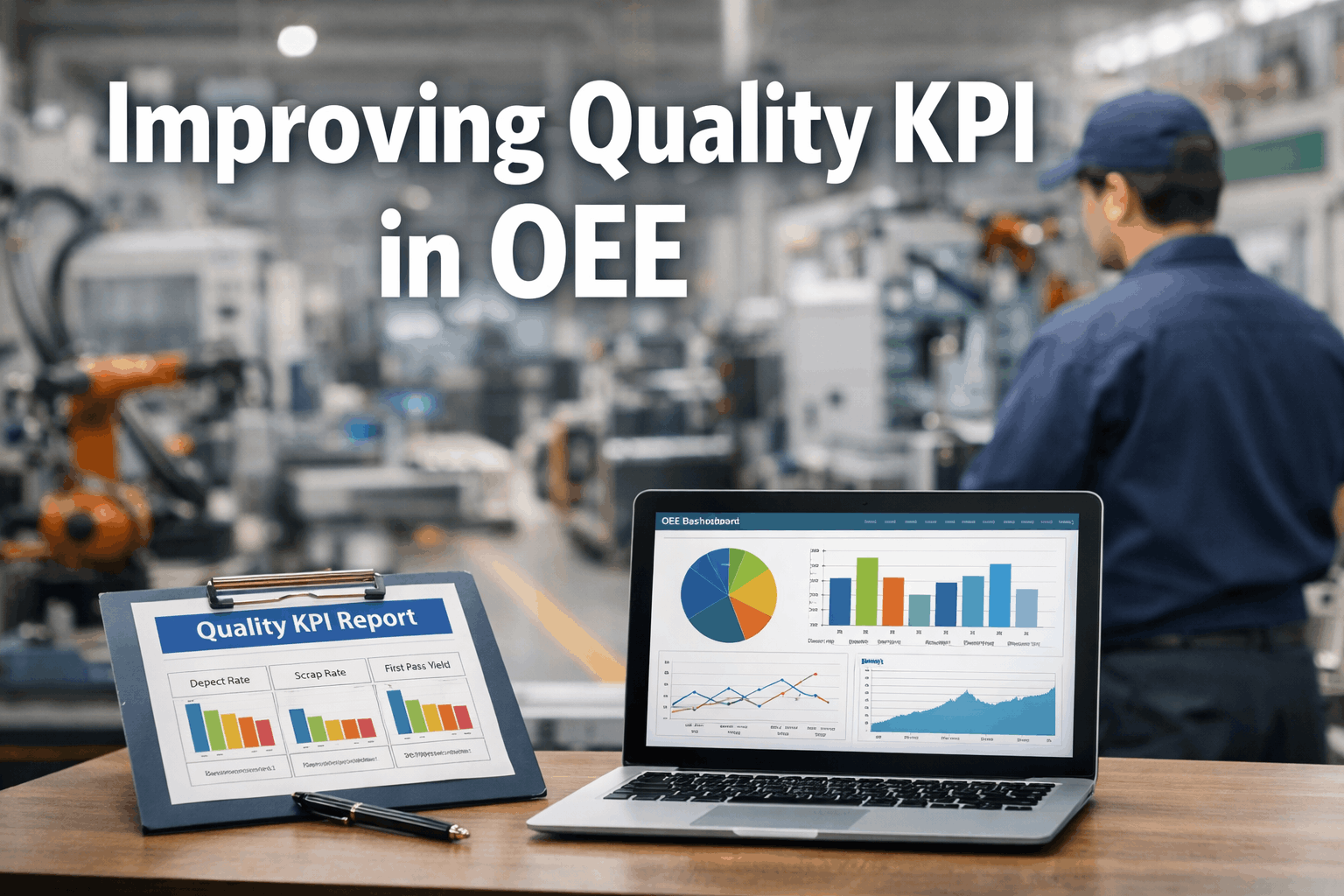
Every defective part represents wasted materials, wasted machine time, and wasted labor. While most manufacturers achieve Quality rates above 95%, that remaining 3-5% of scrap and rework silently erodes profitability—often more than people realize. Quality, the third pillar of OEE, measures the percentage of units that meet specifications on the first pass without rework. Improving Quality doesn't just reduce waste; it improves Availability (less time fixing problems) and Performance (more good parts per hour). Modern OEE tracking systems capture quality data in real-time, enabling immediate response to defect trends before they become costly problems.
This guide explains exactly what Quality measures in the OEE context, what causes Quality losses, and provides proven strategies to reduce defects and increase your first-pass yield.
Quality Defined
The percentage of units produced that meet quality standards on the first pass
Example Calculation
The Two Types of Quality Loss
Quality losses fall into two categories from the Six Big Losses framework. Understanding the distinction helps you target improvement efforts correctly. Talk to our quality experts about analyzing your quality losses.
Production Rejects
Typically 70-80% of quality lossDefective parts produced during stable, steady-state production. These occur after the process has stabilized and should be running correctly.
Common Causes
Startup Rejects
Typically 20-30% of quality lossDefective parts produced from startup until stable production is reached. Most common after changeovers, equipment restarts, or shift beginnings.
Common Causes
The Hidden Cost of Quality Loss
Material Waste
Scrapped parts mean scrapped materials. At 95% Quality, 5% of all raw materials become waste.
Lost Machine Time
Time spent producing defects is time not producing good parts. Defects consume Availability.
Rework Labor
Parts requiring rework need additional labor hours—often at premium cost for skilled technicians.
Customer Impact
Escaping defects damage reputation, trigger returns, and risk losing customers permanently.
Track Quality in Real-Time
Oxmaint captures quality data at the point of production—scrap, rework, and defect reasons—so you can respond immediately to quality trends before they become costly problems.
Quality Benchmarks
Quality is typically the highest-scoring OEE factor because mature quality systems are near-universal. But "high" doesn't mean "no opportunity."
The Math of Small Quality Gains
Improving Quality from 95% to 98% sounds small, but:
A 3-point Quality improvement = 60% reduction in defects, scrap, and rework.
Strategies to Reduce Production Rejects
Production rejects—defects during steady-state operation—are often caused by process variation, equipment issues, or operator factors. These strategies address root causes systematically. Oxmaint integrates quality tracking with maintenance and production data to identify correlations.
Implement Statistical Process Control (SPC)
Monitor key process parameters in real-time. When variables trend toward control limits, intervene before defects occur—not after.
Error-Proof the Process (Poka-Yoke)
Design processes and fixtures so errors are impossible or immediately obvious. Prevention beats detection every time.
Standardize Work Instructions
Ensure every operator follows the same proven methods. Variation between operators creates variation in quality.
Maintain Equipment for Quality
Equipment wear causes gradual quality degradation. Maintain to quality standards, not just to prevent breakdowns.
Conduct Root Cause Analysis on Every Defect
Don't just count defects—understand them. Systematic RCA eliminates recurring issues at their source.
Strategies to Reduce Startup Rejects
Startup rejects occur during changeover and process stabilization. Reducing them improves both Quality and Availability. Schedule a consultation to develop a startup quality improvement plan.
Standardize Changeover Procedures
Create detailed, visual changeover checklists. When every changeover follows the same steps, results become consistent and predictable.
Automate Recipe/Settings Download
Use automated recipe management to download proven settings for each product. Eliminates manual entry errors and ensures optimal parameters.
First-Piece Inspection Protocol
Verify the first piece meets specifications before running full production. Catch problems when you've made one defect, not 100.
Optimize Warmup Procedures
Understand equipment warmup requirements. Pre-heat during changeover, run warmup cycles before production, establish minimum stabilization time.
Cross-Train Changeover Teams
Ensure multiple operators can execute changeovers correctly. Reduces dependency on specific people and maintains consistency across shifts.
Track Startup Metrics Separately
Measure time-to-first-good-part and startup reject count for every changeover. What gets measured gets improved.
In-Process vs. End-of-Line Inspection
Where you inspect affects how quickly you catch problems—and how much waste you generate before catching them.
In-Process Inspection
Inspection at critical steps during production—catch defects when they occur.
Advantages
- Catch problems immediately
- Minimize downstream waste
- Enable real-time correction
- Identify root cause faster
Challenges
- May slow production
- Requires more inspection points
- Higher implementation cost
End-of-Line Inspection
Inspection only at the end—verify finished products before shipping.
Advantages
- Simpler to implement
- Doesn't interrupt flow
- Single inspection point
- Lower equipment cost
Challenges
- Defects accumulate before detection
- Root cause harder to identify
- More waste before correction
Drive Quality Improvement with Data
Oxmaint provides real-time quality tracking, defect Pareto analysis, and integration with maintenance data to identify and eliminate root causes of quality loss.
Frequently Asked Questions
Should rework count as a Quality loss even if the product eventually ships?
Yes—absolutely. OEE Quality measures first-pass yield. A unit requiring rework consumed machine time and labor to make incorrectly, then additional resources to fix. If you exclude rework from Quality calculations, you hide significant cost and improvement opportunity. Count any unit that doesn't pass inspection the first time as a Quality loss.
How do I separate startup rejects from production rejects?
Define a clear boundary—either time-based (first 15 minutes after startup) or count-based (first 10 units after changeover). Some systems use "first good part" as the boundary: everything before the first verified good part is startup, everything after is production. Be consistent in your definition and track both categories separately to drive different improvement actions.
Our Quality is already 98%—is further improvement worth the effort?
At 98% Quality, you're still producing 20 defects per 1,000 units. Each defect costs materials, machine time, and potentially rework labor. Calculate the actual cost: (defects × cost per defect) often reveals significant savings opportunity. Also consider that escaping defects damage customer relationships—the true cost of quality issues exceeds what's visible in production data.
How does Quality relate to the other OEE factors?
Quality losses also consume Availability and Performance. Time spent making defective parts is time not spent making good parts—so defects effectively reduce your available capacity. This is why the OEE formula multiplies the three factors: a 5% Quality loss at 90% Availability and 90% Performance costs more than 5% of output (it costs about 4% of total potential output after the multiplication effect).
Should we track defect reasons or just defect counts?
Track both. Defect counts tell you how big the problem is; defect reasons tell you what to fix. Use simple reason codes (5-10 categories) that operators can quickly assign. Pareto analyze reasons to identify the vital few causing most defects. Without reason data, you're guessing at root causes instead of targeting improvement systematically.