Ladle cranes carrying 150-350 tonnes of molten steel at 1,600°C represent the highest-consequence lifting equipment in any integrated steel plant. A single wire rope failure, hoist brake malfunction, or hook defect doesn't just halt production — it releases catastrophic loads over uncontained areas where personnel may be present. OSHA 1910.179 mandates daily visual inspections and monthly certified inspections with written sign-off, yet fewer than 40% of North American steel plants maintain systematic daily inspection records. This ladle crane daily OSHA 1910.179 operator inspection checklist provides a structured, CMMS-integrated framework that captures all critical safety points before each shift begins. Oxmaint CMMS automates sign-off tracking, deficiency escalation, and compliance audit trails — transforming operator rounds from manual paper checklists into digitally verified safety events that prove regulatory compliance during OSHA inspections.
of ladle crane failures traced to missed daily wire rope inspections under OSHA 1910.179 requirements
$340K
average emergency repair and production loss from single unplanned ladle crane failure in steel mills
91%
inspection compliance rate achieved by steel plants using CMMS-tracked daily checklist sign-off
5M
tonnes of daily molten steel handled by ladle cranes in USA integrated steel mills requiring mandatory daily inspections
Why Ladle Crane Inspections Get Missed
Ladle cranes operate under the most severe service conditions in any industrial facility — temperatures reaching 60-80°C at crane level from radiant heat, 1,600°C liquid loads, corrosive atmospheres, and continuous cyclic duty. Yet inspection gaps persist across steel plants because daily visual rounds are not connected to maintenance scheduling systems, defect escalation procedures are manual and slow, and operators lack digital tools to document findings in real-time. The result: wire rope condition deteriorates undetected, hook wear exceeds removal limits before monthly certified inspections catch it, and brake drift accumulates until a loaded lift reveals the problem.
01
Paper Checklists Without Follow-Up Tracking
Daily visual inspection forms are completed but not reviewed systematically — defect findings are not cross-referenced to work orders or escalated to maintenance planning, creating a compliance record without actual safety improvement.
02
Operator Training Gaps on Wire Rope Removal Criteria
ASME B30.2 wire rope removal criteria (six broken wires in 30 days, eight in any strand) are not clearly communicated — operators cannot distinguish between cosmetic wear and safety-critical defects, leading to deferred replacements that exceed design limits.
03
Brake Performance Degradation Undetected Until Load Test
Hoist brake drift develops gradually — visual inspection alone cannot detect load-holding performance loss; monthly load tests are the only reliable detection method, but they are often deferred or scheduled at long intervals without interim daily observation protocols.
04
Disconnected Safety Data From Preventive Maintenance Scheduling
Daily inspection findings are not automatically linked to PM work order generation — a critical defect recorded on a paper form may not trigger maintenance scheduling until weeks later, leaving the hazard in operation during the interval.
Daily Ladle Crane Inspection Checklist Components
01
Wire Rope Condition — Visual & Tactile Assessment
Impact: Detects wire break accumulation and heat damage before failure
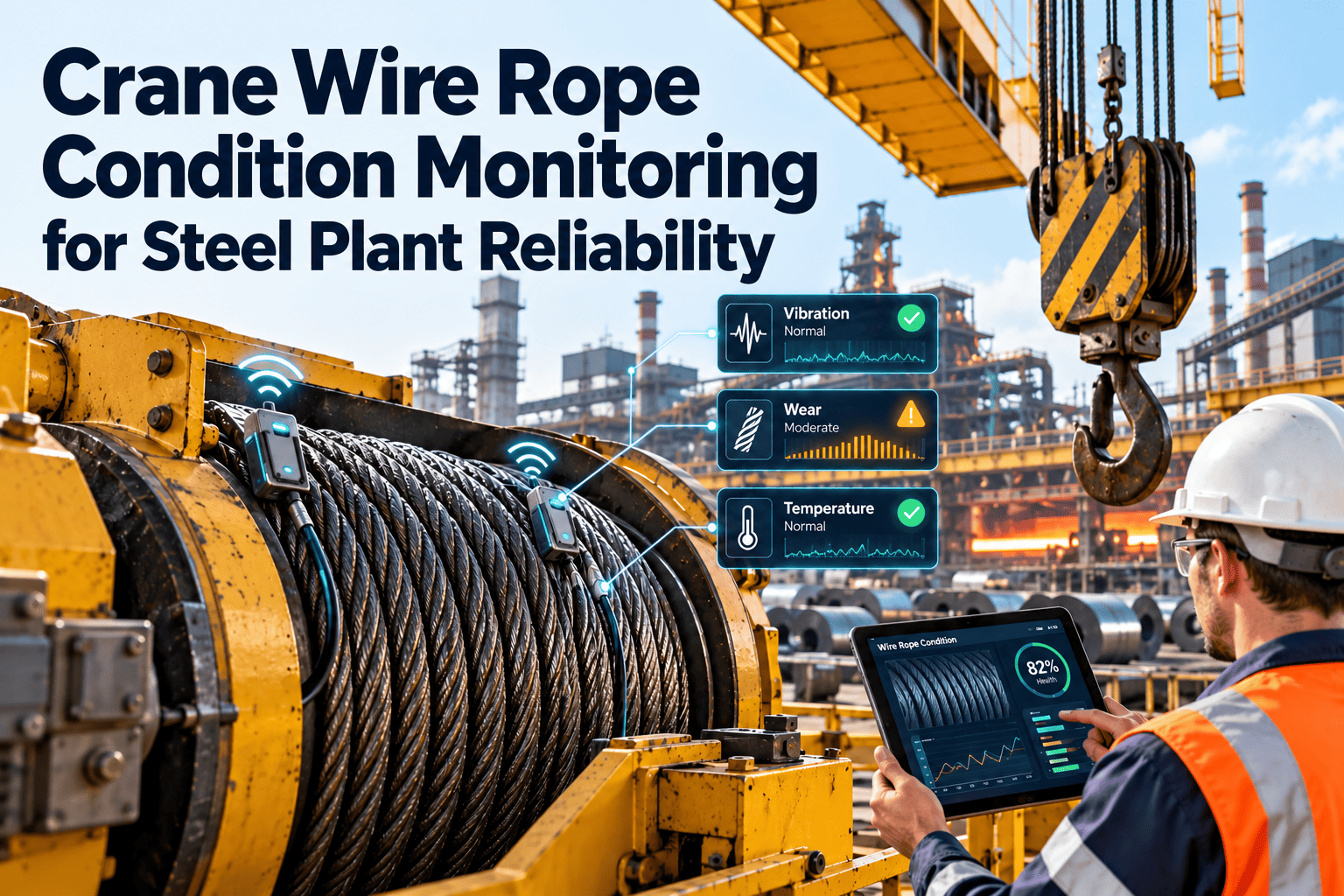
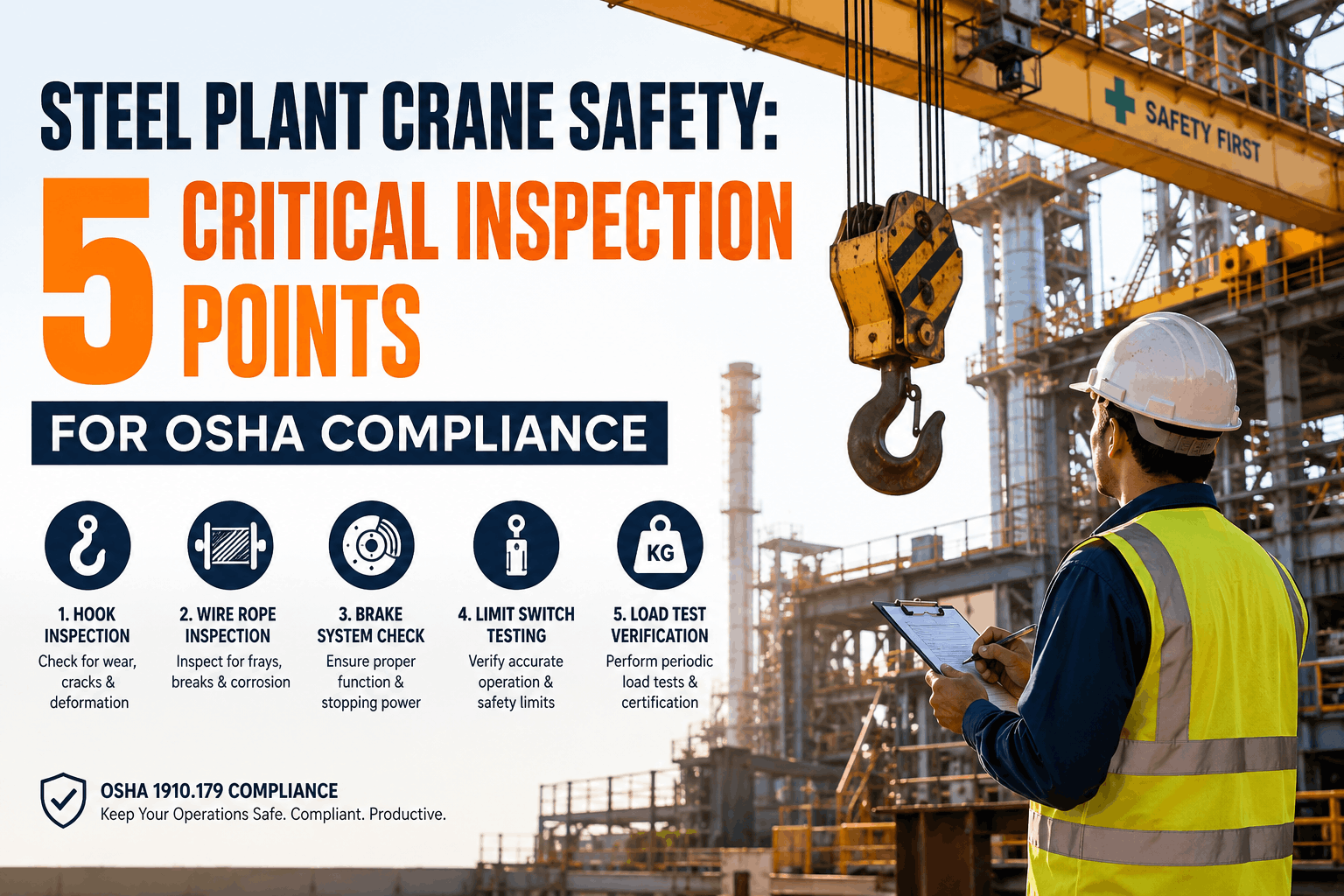
Ladle crane wire rope is subject to heat discolouration when surface temperatures exceed 300°C — a blue-grey oxidation pattern indicates the rope has reached heat-treatment limits regardless of wire break count. Operators should inspect all four rope drum positions daily: (1) Count visible broken wires in each strand; (2) Run gloved hand along rope to detect kinks, birdcaging, or distorted links; (3) Look for blue-grey discolouration indicating heat damage; (4) Verify rope is not pinched or damaged at reeve points. Removal criteria: Remove rope immediately if six or more broken wires appear in 30 days, eight in any single strand, visible heat discolouration, or any birdcaging observed. Document findings in CMMS with date, rope position, wire count, and operator name for monthly certified inspection cross-reference.
Removal Trigger Thresholds
6 wires in 30 days OR 8 in any strand OR heat discolouration OR birdcaging = Immediate Service Stop
02
Hook Assembly Dimensional Verification
Impact: Prevents load drop from hook throat erosion or opening exceeding limits
Ladle hook throats erode under cyclic loading and heat cycling — throat opening increases by 2-4mm per year in heavy-duty service. Daily inspection requires: (1) Visual check for cracks in hook body, throat, or lug areas; (2) Measure throat opening with hook caliper or feeler gauge (documented limit varies by manufacturer, typically 0.5-0.75mm increase beyond original); (3) Check for twisting or lateral bending; (4) Verify hook eye is not damaged or enlarged. Any crack, throat erosion exceeding limit, or twisting requires immediate hook removal. OSHA requires monthly certified hooks inspections with documented serial number and inspection date on record. Oxmaint automatically schedules certified monthly inspections and flags hooks exceeding removal criteria for immediate scheduling before next lift.
03
Hoist Brake Load-Holding Performance Assessment
Impact: Detects brake drift that could drop loaded ladle if hoist loses power
Hoist brake failure is the highest-severity single-point failure mode on any ladle crane — a brake that cannot hold load under gravity-only conditions will drop the ladle if main power is lost. Daily operator assessment includes: (1) Lower ladle hook slowly with no load and observe: does the hook drift downward when brake is engaged? Any drift is a critical deficiency. (2) Raise loaded ladle approximately 2-3 feet, stop hoist, and observe for five seconds: does the load remain stationary or drift downward? Drift exceeding 1 inch per 10 seconds requires immediate brake service. (3) Check brake indicator lights on pendant — warn lights indicate low brake charge or hydraulic pressure. (4) Listen for unusual brake engagement sounds (grinding, squealing). Monthly load tests under controlled conditions (50% rated load hold for 10 minutes) must be documented by qualified technician. If daily observation detects drift, remove ladle crane from service immediately pending brake inspection.
Critical — Stop Use
Brake drift observed · Any downward load movement
Remove from service · Schedule emergency brake service · Document in CMMS
Alert — Monitor Closely
Unusual brake sounds · Indicator light warning
Schedule brake inspection within 7 days · Continue use with caution · Log in CMMS
Normal — Continue Operation
No drift detected · Normal sounds · Clear indicator lights
Document daily finding · Next inspection tomorrow · Mark compliant in CMMS
04
Hoist Drive Mechanism and Limit Switch Operation
Impact: Ensures electrical safeguards and mechanical lift speed consistency
Hoist electrical systems and limit switches are the safety backbone of ladle cranes — they prevent over-travel to the drum, detect load engagement, and signal unsafe conditions. Daily checks: (1) Test hook raise for consistent speed — slowing or stalling indicates motor strain; (2) Test hook lower for smooth descent with no jerking; (3) Verify upper limit switch activates when hook reaches its upper travel limit (hoist motor should stop automatically); (4) Verify lower limit switch activates when hook reaches lowest safe position; (5) Check emergency stop button on pendant is accessible and responsive; (6) Listen for unusual electrical sounds (humming, buzzing) that may indicate motor bearing wear. All limit switches must function within OSHA tolerance — if either fails, crane cannot be used until repaired. Document daily findings by component in CMMS with timestamped sign-off.
05
Bridge Drive and Trolley Operation Smoothness
Impact: Prevents load swing and positioning errors during hot metal handling
Ladle cranes must position molten steel loads with precision — bridge drive and trolley mechanisms must move smoothly without jerking or binding that could cause load swing or spill. Daily operational assessment: (1) Raise an empty ladle to mid-height and move the bridge slowly in both directions — motion should be smooth with no hesitation or grinding sounds; (2) Check trolley movement perpendicular to bridge — smooth operation confirms wheels and rails are not damaged; (3) Listen for unusual noises in bridge drive motor or trolley wheels; (4) Verify all movement stops cleanly (no drift after control release); (5) Check for visible damage to bridge wheels, rails, or trolley mechanism. Jerking motion, binding, or grinding sounds indicate bearing wear or rail damage requiring immediate inspection. Before hot metal handling, crane movement must be verified smooth — any hesitation risks load swing into furnace structure or personnel.
06
Structural Frame Inspection for Visible Cracks or Deformation
Impact: Detects fatigue cracks before load path failure occurs
Ladle crane bridges and trolley frames experience continuous cyclic loading — fatigue cracks can develop in structural welds and sections without warning. Daily visual walkdown: (1) Inspect all visible weld lines (bridge main beam, trolley frame, hoist bracket welds) for new cracks; (2) Look for permanent deformation or bowing of structural members; (3) Check for bolt looseness at all major connections — retorque if movement observed; (4) Inspect gussets, lugs, and reinforcement plates for cracks; (5) Verify no visible corrosion or rust breakthrough that may indicate loss of structural section. Any crack in structural welds or main load path members requires immediate engineering assessment before further use. For steel plants in salt-air or chemically corrosive environments, anti-corrosion coating inspection and touch-up should be part of quarterly maintenance rounds.
Implementation Impact: Paper Checklists vs. CMMS-Tracked Inspection
Without Structured CMMS Integration
Daily inspections completed on paper — no digital trail or follow-up escalation
Wire rope condition defects noted but not automatically linked to monthly certified inspections
Hook removal criteria not enforced — high-wear hooks stay in service between quarterly checks
Brake drift noted verbally but not tracked — brake service scheduled on intuition, not data
Limit switch failures discovered during loads instead of detected during daily rounds
Compliance records scattered across multiple binders — OSHA audit requires manual compilation
Inspection compliance: 40-55% of daily checks actually completed and documented
Average emergency brake replacement cost: $45K + 12-24 hours downtime per incident
With Oxmaint CMMS Daily Checklist Integration
Digital daily inspection checklist auto-populated, completed on mobile in <3 minutes per crane
How Oxmaint CMMS Automates Ladle Crane Safety Compliance
Oxmaint's ladle crane inspection module transforms OSHA 1910.179 daily rounds from manual paper checklists into connected safety workflows. Daily findings automatically trigger monthly certified inspection scheduling, defect alerts escalate directly to maintenance planners with severity levels, and compliance records are maintained in a single searchable database that satisfies regulatory audit requirements. Steel plants using Oxmaint for ladle crane inspection consistently report 60-70% reduction in emergency crane failures and 91%+ inspection compliance rates.
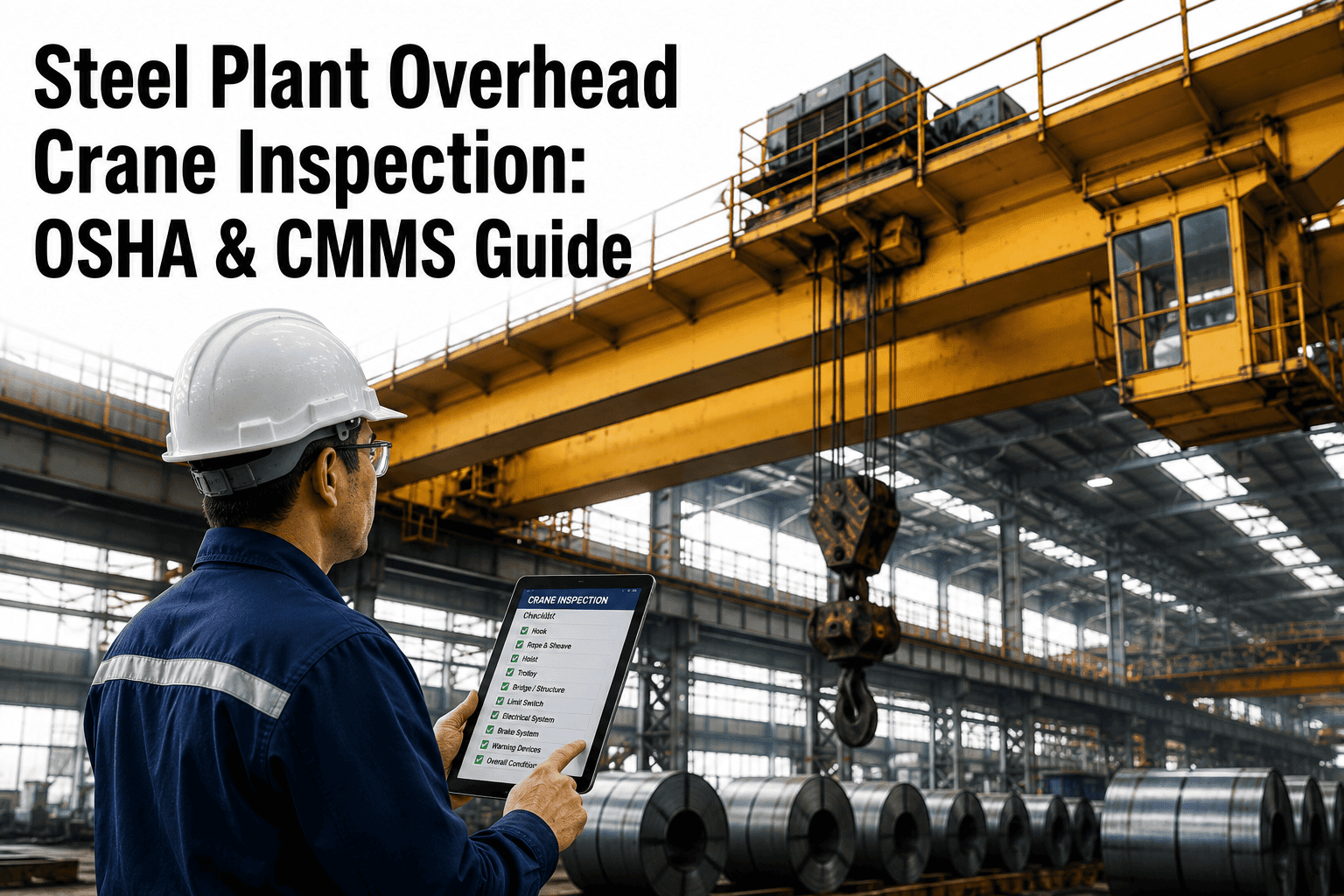
Daily Digital Inspection Checklists
Mobile-ready daily rounds completed in <3 minutes per crane. Auto-populates from asset configuration. Single tap pass/fail recording. Timestamped sign-off with operator identification.
Automatic Monthly Certified Inspection Scheduling
CMMS auto-calculates monthly certified inspection due dates per OSHA 1910.179(j)(1)(ii). Work orders generated 7 days before due date. Hook serial number and wire rope identifier auto-populated for technician documentation.
Defect Alert Escalation with Severity Levels
Critical findings (brake drift, hook cracks, wire rope removal criteria) auto-escalate to maintenance supervisor and crane operations lead. Severity 1 alerts trigger immediate crane service stop recommendation with escalation path.
Inspection Compliance Tracking and Trending
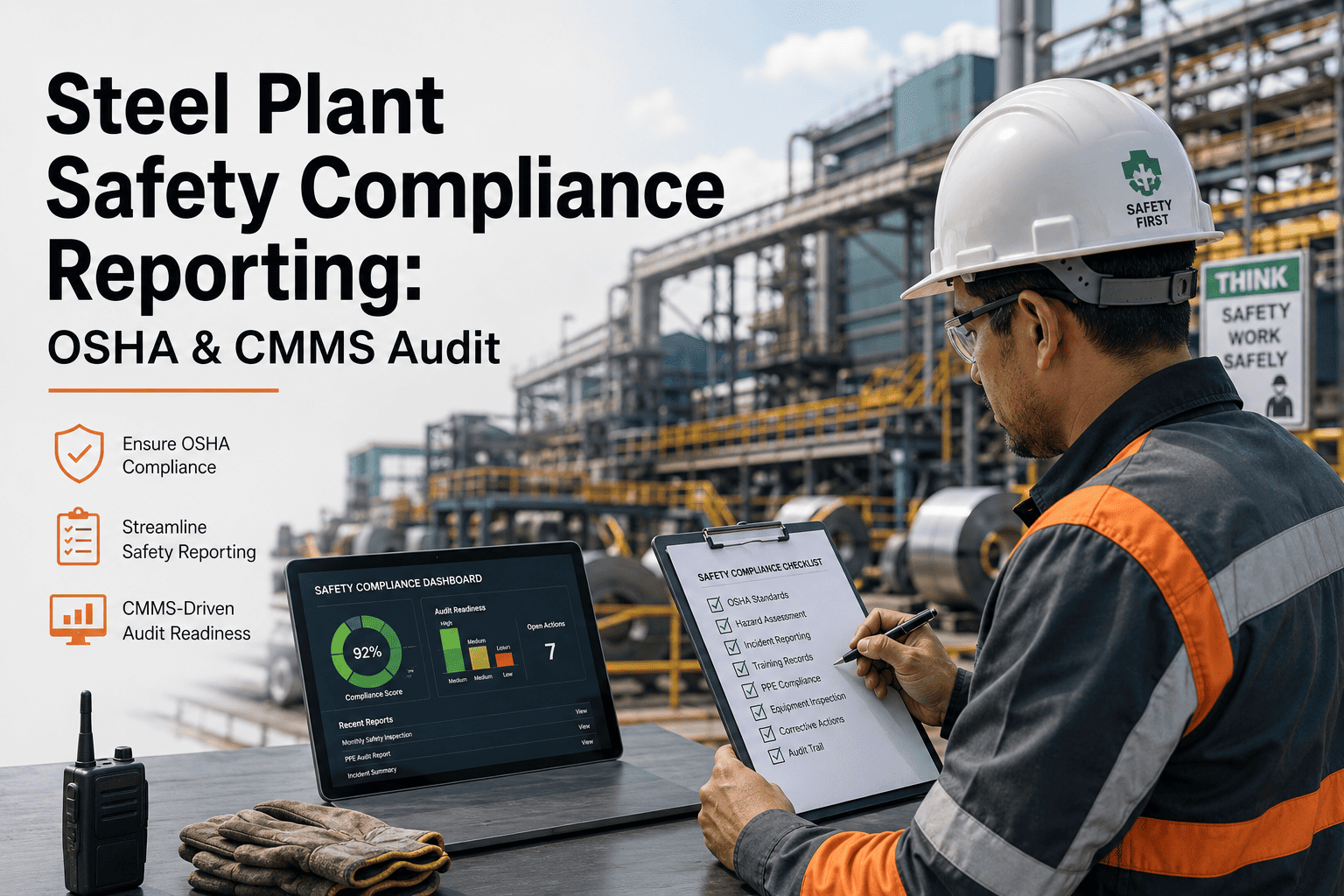
Dashboard shows daily inspection completion rate by crane by operator by shift. Missed inspections flagged automatically. 12-month compliance trend reports support OSHA audit readiness and plant safety goals.
Wire Rope Condition Tracking Database
All wire rope inspections (daily visual + monthly certified) stored in asset record with date, inspector, findings, and removal decision. Historical trend shows wire break accumulation rate to predict replacement timing.
OSHA 1910.179 Compliance Documentation Export
Audit-ready PDF reports generated on-demand showing all daily and monthly inspection records, certified findings, and maintenance closure documentation. Supports regulatory compliance proof in OSHA inspections.
Multi-User Role-Based Access Control
Operators complete daily checklists. Maintenance supervisors review findings and schedule corrective work. Plant engineers access trends and NDE test records. Managers see compliance dashboards. All roles in one unified platform.
60%
Reduction in emergency brake failures
achieved by detecting brake drift via daily CMMS monitoring vs. load tests alone
91%
Daily inspection compliance rate
maintained by CMMS automated reminders and mobile checklist accessibility
$340K
Average avoided emergency repair cost
per prevented catastrophic ladle crane failure event in North American steel mills
8h
OSHA audit preparation time reduction
from 40 hours manual record compilation to instant compliant documentation export
What is the exact OSHA definition of "daily" inspection for ladle cranes under 1910.179?
OSHA 1910.179(j)(1)(i) defines frequent (daily to monthly) inspections as visual and audbile tests performed before use or each shift. For ladle cranes, "daily" means before the first lift of the shift by the designated operator. Oxmaint's mobile checklist captures operator name, time, and shift designation to prove compliance with this requirement.
How do I document wire rope removal decisions under ASME B30.2 for OSHA compliance?
OSHA requires monthly certified inspection with written certification record including date, inspector signature, and rope identifier per 1910.179(j)(1)(ii)(B). Oxmaint stores this documentation in the asset record and auto-calculates removal criteria violations. Screenshot or export the CMMS record as your certified inspection document.
Can operators without formal crane certification complete daily OSHA inspections?
OSHA 1910.179(b)(8) requires designated personnel to operate cranes but does not explicitly require certification for daily visual inspections. However, best practice requires operators complete manufacturer training on removal criteria and defect recognition. Monthly certified inspections must be performed by a qualified person per OSHA standards.
What load testing interval is required for ladle cranes under OSHA 1910.179?
OSHA requires load testing before initial use and after repair or alteration. Most steel plants conduct monthly functional tests (50% rated load hold) and annual load tests (100% rated load) per manufacturer recommendations. Oxmaint schedules these based on usage history and maintenance intervals configured in your plant's asset record.
How do I identify when a ladle hook has reached its removal limit under OSHA standards?
OSHA 1910.179(j)(1)(ii)(B) requires visual inspection daily and certified monthly inspection. Hook removal criteria vary by manufacturer but typically include: 10% increase in throat opening, any visible crack, or permanent twisting. Oxmaint stores hook removal limits in the asset record and alerts when measurements approach threshold.
What is the penalty for missed daily crane inspections during an OSHA audit?
OSHA cites missed inspections under 29 CFR 1910.179(j)(1)(i) as a serious violation — typical penalty $8,000-$16,000 per violation per crane. If an incident occurs without documented inspections, OSHA may pursue willful violation penalties exceeding $100,000. Structured CMMS compliance documentation demonstrates due diligence and reduces penalty exposure.
How frequently should I replace wire rope on a ladle crane in continuous service?
Wire rope service life depends on usage intensity, thermal exposure, and maintenance. High-duty ladle cranes in steel mills typically replace rope every 3-5 years or when 6+ broken wires appear in 30 days per ASME B30.2. Oxmaint tracks wire break trends by crane — when acceleration is detected, preventive replacement can be scheduled 4-6 weeks ahead of failure risk.
Does OSHA 1910.179 require documented training for daily inspection operators?
OSHA 1910.179(c) requires operators to receive instruction before operating. While specific daily inspection training content is not mandated, industry best practice requires documented training on defect recognition and removal criteria. Oxmaint can link training certificates to operator user accounts to track compliance history.
"We were running at 45% daily inspection compliance — paper forms piling up in supervisor inboxes with no systematic follow-up. After deploying Oxmaint's daily checklist, we hit 94% compliance within 60 days. More importantly, we caught a brake drift issue during a digital round that paper inspections had missed for three weeks. That prevented a $320K emergency brake replacement. For any steel plant running ladle cranes, CMMS-based inspection is not optional — it's a liability issue."
— Lead Maintenance Coordinator, Integrated Steel Mill, USA Midwest
Ladle Crane Inspection Automation
Stop Running Ladle Cranes on Paper Checklists
Every OSHA 1910.179 inspection requirement can be captured in Oxmaint's mobile daily checklist — from wire rope break counts to hook dimensional measurements to brake drift assessment. Your inspection data automatically triggers monthly certified inspections, defect escalations, and compliance audit trails. Most steel plants see measurable improvement in inspection compliance and defect detection within 30 days. Start a free trial with your ladle crane asset data, or contact our steel plant specialist team to configure OSHA-aligned inspection templates for your specific crane fleet.




.png)