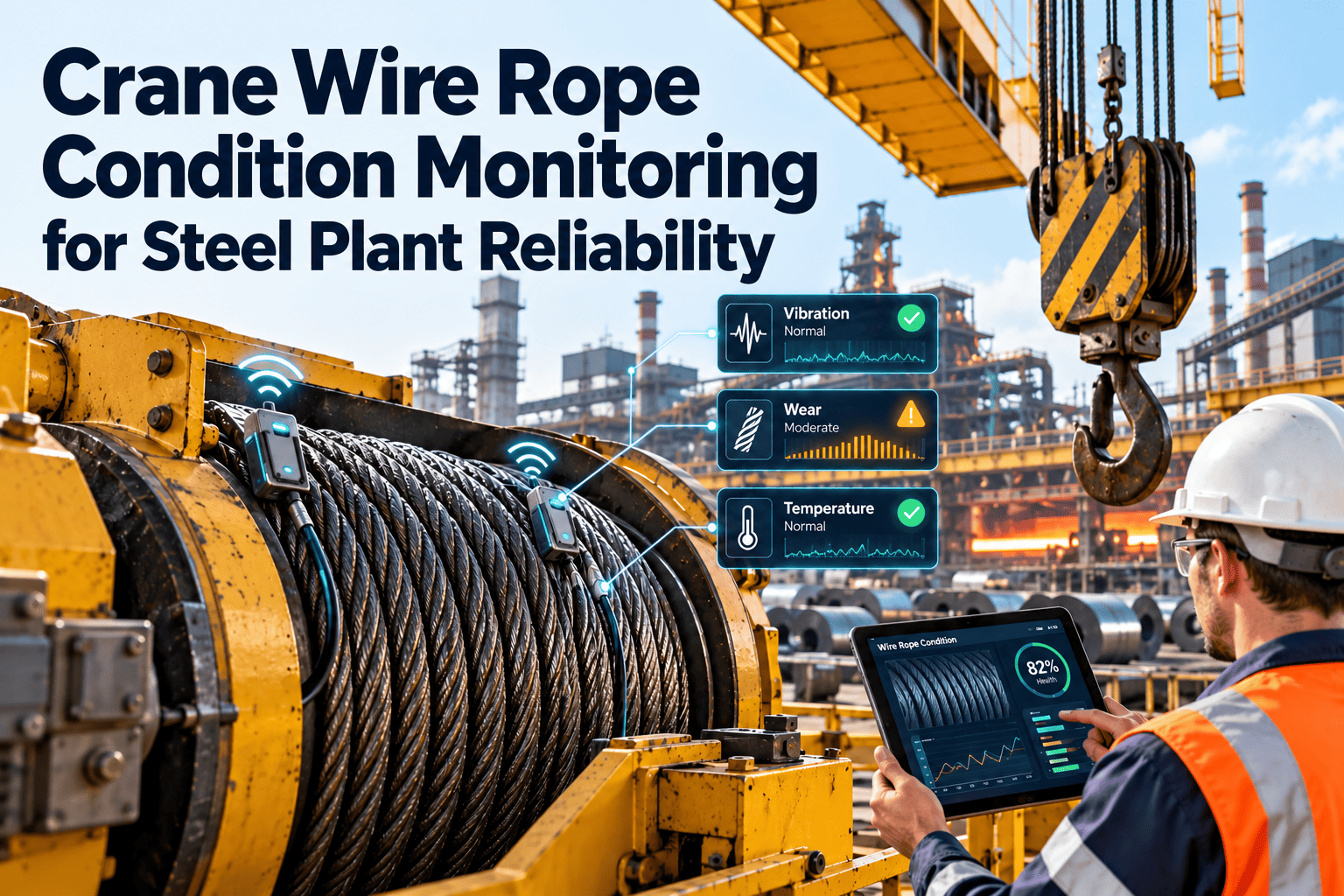
Overhead cranes carry ladles of molten metal, coils, slabs and billets above people and equipment, so the wire rope is a safety-critical component, not a consumable to run until it looks bad. In steel plants, heat, scale, dust, shock loads and long duty cycles wear ropes faster than in light industry. Condition monitoring turns scattered inspection notes into a clear picture of when each rope should be replaced. This guide explains what to inspect, how to record it, and how maintenance management software keeps lifting equipment inspections on schedule.
Crane Wire Rope Condition Monitoring for Steel Plant Reliability
Track wear, broken wires, corrosion, service cycles and replacement criteria for every steel plant overhead crane.
Inspect
Daily visual, periodic detailed.
Record
Findings logged against the rope.
Trend
Wear rate and cycles compared.
Replace
Planned before criteria are reached.
Why steel plant cranes are a special case
Harsh operating conditions
- Radiant heat near furnaces, converters and casting bays
- Scale and dust that work into rope strands
- Steam, water and corrosive atmospheres
- Frequent starts and stops under heavy load
High consequence of failure
- Ladle cranes carry molten metal over work areas
- A dropped load can injure workers and damage the plant
- Crane outages halt melting, casting and finishing flow
- Rope failure investigations are costly and disruptive
Rope life is not only a calendar question
A rope on a lightly used storage crane and one on a ladle crane may be the same age yet have very different remaining life. Cycles, load and environment matter more than elapsed time.
Rope damage types and what they indicate
| Damage | What to look for | Common steel plant cause | Typical action |
|---|---|---|---|
| Broken wires | Count in a defined rope length, clusters, valley breaks | Fatigue from bending over sheaves and drums | Compare with discard criteria, increase inspection |
| Diameter reduction | Local or general decrease against nominal diameter | Core deterioration, internal wear, heat | Measure and trend, plan replacement |
| Corrosion | Surface rust, pitting, slack strands | Moisture, aggressive atmosphere, poor lubrication | Clean, relubricate, assess severity |
| Kinks and distortion | Permanent bends, birdcaging, strand displacement | Shock loading, slack rope, incorrect installation | Usually requires immediate rope removal |
| Heat damage | Discoloured wires, lubricant burnt away | Hot metal radiation, splashes | Remove from service when confirmed |
| Drum and sheave wear | Rope marking, uneven spooling, grooved sheaves | Worn grooves, misalignment | Repair the cause, not only the rope |
Rope condition and hardware condition are linked
A damaged sheave can ruin a new rope in weeks. Inspection records should cover drums, sheaves, equalizers and terminations alongside the rope itself.
Inspection layers: from daily checks to detailed examination
Operator pre-use check
Visible damage, rope seating, unusual noise, abnormal drum spooling.
Frequent inspection
Regular visual review of rope sections in service, by a competent person.
Periodic inspection
Detailed examination with measurement, documented against the rope record.
Non-destructive testing
Magnetic rope testing to find internal wire loss that visual checks cannot see.
Follow the right standard
Inspection intervals and discard criteria depend on your region and crane type. Common references include OSHA 1910.179, ASME B30.2 and ISO 4309, plus manufacturer instructions and local regulation.
Put every crane inspection on a schedule
Assign inspections, record findings and keep rope history in one maintenance system.
What belongs in a rope history record
| Record item | Example | Why it matters |
|---|---|---|
| Rope identity | Construction, nominal diameter, length, supplier, certificate | Confirms the correct rope is fitted |
| Installation data | Date, crane, drum, fitter, reeving arrangement | Starts the service life clock |
| Service exposure | Lift cycles, hours, heavy lifts, hot-duty classification | Links wear to workload |
| Inspection results | Broken wire counts, diameter readings, corrosion notes, photos | Builds a wear trend |
| Lubrication | Date, product, method | Shows whether protection is maintained |
| Removal reason | Wear, broken wires, damage, planned renewal | Improves future replacement planning |
A record that follows the rope
Paper tags and spreadsheets often lose the history when a rope is moved or replaced. Tying records to the asset and the rope installation keeps the full picture.
Before and after a structured monitoring approach
Without structure
- Inspection sheets filed by crane, rarely compared
- Replacement based on habit or last failure
- Findings left open after the inspector leaves
- Ropes ordered after a defect is found
With structure
- Inspections scheduled and assigned automatically
- Wear trends compared against cycles and criteria
- Findings become corrective work orders
- Replacement ropes stocked before outages
Deciding when to replace a rope
Compare with criteria
Check broken wires, diameter loss, corrosion and deformation against the applicable standard and manufacturer limits.
Assess the trend
A rope approaching limits quickly needs earlier planning than one wearing slowly.
Consider the duty
Ladle and hot-metal cranes warrant a more conservative approach than light-duty handling.
Schedule the change
Plan the crane outage, spare rope, lifting plan and permits together.
Safety decisions stay with competent people
Software organizes evidence and reminders, but removal from service is decided by qualified inspectors under your site procedures.
Lubrication and rope care
- Use lubricants suited to rope construction and operating temperature
- Clean packed scale and debris before relubricating
- Lubricate at intervals driven by exposure, not only calendar
- Avoid over-application that traps abrasive dust
- Record every lubrication so gaps are visible
Reeving and handling matter
Poor spooling, slack rope and incorrect installation shorten life. Checklists for installation and first-load checks reduce early damage.
How Oxmaint supports crane rope maintenance
| Need | Oxmaint capability |
|---|---|
| Register cranes, ropes, sheaves and hoists | Asset management with hierarchy and history |
| Recurring inspections and lubrication | Preventive maintenance scheduling |
| Inspection findings in the field | Mobile inspections and checklists |
| Act on a damaged rope or sheave | Corrective work orders with priority |
| Hold replacement ropes and fittings | Inventory tracking and reorder control |
| Show inspection compliance | Compliance records, reports and dashboards |
Condition data can feed the workflow
Results from magnetic rope tests or load monitoring can be attached to the rope record and used to trigger follow-up work.
Measures that show whether the program works
Ladle and hot-metal cranes: extra layers of protection
Cranes that carry molten metal are usually built with redundancy, such as multiple rope falls, duplicate brakes and secondary safety devices. That design helps, but it does not remove the need for rigorous inspection.
What redundancy does
- Gives a margin if one rope or brake path is damaged
- Reduces the chance of a sudden drop
- Allows controlled lowering in some fault conditions
What redundancy does not do
- Hide uneven load sharing between rope parts
- Repair damaged drums, sheaves or equalizers
- Replace the need to inspect every rope part
Compare rope parts against each other
If one rope falls wears much faster than its neighbour, the cause is often uneven loading, misalignment or an equalizer problem. Recording each part separately makes that pattern visible.
Failure scenarios to design inspections around
| Scenario | Early warning | Underlying cause | Preventive step |
|---|---|---|---|
| Fatigue breaks near the drum or sheave | Broken wires appearing at repeated bend points | Many bending cycles under load | Track cycles, inspect bend zones closely, shift rope section where permitted |
| Internal wire damage | Reduced diameter, loss of rope elasticity, stiffness | Core failure, poor lubrication, heat | Add magnetic testing, plan earlier renewal |
| Rapid external wear | Flattened outer wires, polished surface | Worn groove, rubbing against structure | Fix groove or guide, review spooling |
| Corrosion fatigue | Rust between strands, pitted wires | Moisture, aggressive atmosphere | Improve lubrication, review storage and exposure |
| Termination failure | Broken wires at the socket, loosened clamps, deformation | Incorrect fitting, repeated shock | Inspect ends at every periodic check, re-terminate when needed |
| Heat damage | Colour change, burnt lubricant, brittle wires | Radiation or hot metal splash | Add shielding, shorten replacement interval |
Turn scenarios into checklist items
Each row above can become a checklist question with a pass, fail or measure field. That turns experience into a repeatable inspection.
The hardware around the rope
Drums
Check groove condition, flange damage, rope anchor point and neat layering.
Sheaves
Check groove profile, bearing play, cracks and free rotation.
Equalizers and blocks
Check pins, bushings and load sharing between rope parts.
End terminations
Check sockets, wedges, clamps and the rope entry point.
Hooks and lifting beams
Check wear, deformation, latches and markings as required.
One work order, several components
Rope replacement is the ideal time to inspect the hardware. Bundling these checks into one planned job avoids a second outage.
Magnetic rope testing: strengths and limits
What it helps find
- Loss of metallic cross-section along the rope
- Localized flaws such as broken wires
- Internal damage not visible from outside
- Changes between successive test runs
What to keep in mind
- Results need a trained operator to interpret
- Access to the full rope length can be difficult
- It supports, but does not replace, visual inspection
- Reports are only useful if stored with the rope history
Compare tests over time
A single test is a snapshot. Attaching each report to the rope record lets engineers see whether damage is stable or growing.
Safety devices checked alongside the rope
Rope condition is only part of hoist safety. Limit switches, brakes and load devices protect the rope from conditions that would damage it.
- Upper and lower limit switches prevent over-travel and slack rope
- Overload devices reduce shock and excessive loading
- Brakes hold the load and must be tested on a schedule
- Rope guides and guards keep the rope seated on sheaves
- Emergency stops and alarms should be functionally tested
Keep the checks in one routine
Combining rope and safety device checks in one inspection template prevents items from being forgotten and gives a complete record for audits.
Planning rope spares and replacement outages
Rope stock
Keep the correct construction and length for critical cranes, with certificates stored.
Terminations
Stock sockets, wedges and clamps matched to each rope type.
Storage
Store coils off the ground, dry and protected from heat and contamination.
Lead time
Set reorder points using supplier delivery times, not only usage.
Align replacement with production
Crane outages compete with production demand. Forecasting rope life from cycles and trend allows the stop to be booked weeks ahead rather than negotiated in an emergency.
Audit readiness for lifting equipment
- Inspector names, dates and findings stored against each crane
- Corrective actions linked to closure evidence and photos
- Rope certificates and test reports easy to retrieve
- Operator pre-use checks recorded and reviewed
- Repairs, modifications and approvals documented
Records should answer simple questions quickly
An auditor or investigator should be able to see when a rope was installed, how it was inspected and what was done about every finding.
Training operators and inspectors
Inspection quality depends on people. Operators notice early problems, while competent inspectors make the final judgement on condition.
Operators should know
- How to spot flattened, kinked or protruding strands
- Why smooth, controlled lifting protects the rope
- How to report a concern without delay
- When a crane must not be used
Inspectors should know
- How to count broken wires over the defined length
- How to measure diameter correctly and consistently
- How to identify internal damage indicators
- How to document findings so others can repeat them
Consistency beats heroics
Photographs, fixed measurement locations and standard wording let different inspectors reach the same conclusion. That consistency is what makes a trend trustworthy.
Common programme mistakes
- Replacing ropes by calendar alone, ignoring cycles and duty
- Inspecting only the visible rope length near the hook
- Leaving drum and sheave wear unaddressed after fitting a new rope
- Closing inspection tasks without raising corrective actions
- Failing to keep certificates and test reports with the rope
- Allowing overdue inspections to stay open without a documented risk decision
- Using different inspection wording on each crane, which makes results hard to compare across the bay
- Ordering replacement ropes only after a defect is found, which forces rushed outages
Fix the system, not just the rope
Each of these mistakes is a process gap. A shared maintenance system closes it by making the right step the default step.
Rollout checklist
- List every crane, hoist, rope and sheave as an asset
- Classify cranes by duty, such as ladle, charging or general
- Load applicable standards and manufacturer criteria
- Build inspection checklists with measurement fields
- Define who can approve continued service
- Link findings to corrective work orders
- Stock critical ropes and terminations
- Review rope life after every replacement
Frequently asked questions
What is crane wire rope condition monitoring?
It is the systematic inspection, measurement and recording of rope wear to decide when to replace it.
How often should ropes be inspected?
It depends on the crane type, duty and regulation, so follow the standard and manufacturer instructions.
Why are ladle cranes treated differently?
Failure risk and heat exposure are higher, so many sites apply stricter inspection and replacement rules.
Can software replace inspectors?
No. It schedules and records work. Book a demo to see inspection workflows.
Where do we start?
Register your cranes and ropes first. You can sign up and build checklists.
Keep lifting equipment safe and available
Bring rope history, inspections, work orders and spares into one maintenance system.