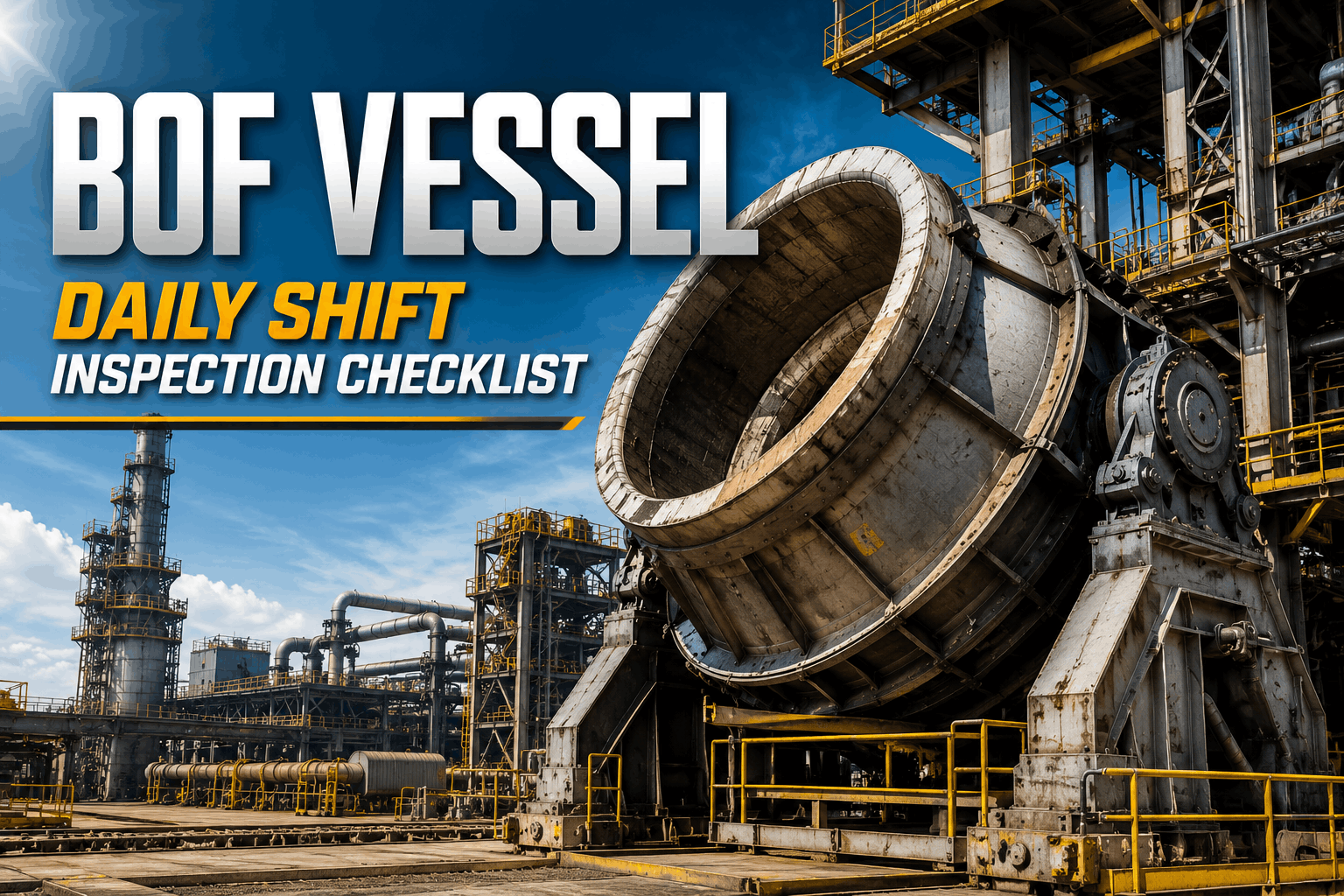
Charging Crane Daily Pre-Shift Inspection Checklist

By Alex Jordan on June 1, 2026

charging-crane-daily-pre-shift-inspection-checklist

Charging cranes operate in extreme thermal environments, loading scrap, hot metal, and alloys directly into electric arc furnaces (EAF) and basic oxygen furnaces (BOF). Ambient temperatures at crane level reach 60-80°C with radiant heat spikes exceeding 1,000°C near the furnace mouth, creating a hostile operating environment that accelerates component wear and corrosion. The electromagnetic field from arc furnaces further stresses hoist electronics and brake systems. OSHA 1910.179 mandates halved inspection intervals for furnace charging cranes due to this extreme duty — daily operator rounds must verify bucket attachment integrity, brake responsiveness, and heat-shield condition before each shift. Yet most steel plants operate charging cranes on generic overhead crane inspection procedures without acknowledging the thermal stress factors that make failure consequences more severe.

28%
of EAF charging crane failures occur due to missed thermal-stress inspections in first 4 years of crane operation
$85K
average cost of single bucket attachment failure dropping scrap charge into furnace during operation
2.3x
higher failure rate for charging cranes without half-interval OSHA 1910.179 compliance compared to mills with structured schedules
45%
reduction in emergency charging crane repairs after implementing CMMS-tracked thermal stress inspection rounds
Steel Plant Inspection Checklist · Charging Crane · EAF & BOF

Charging Crane Daily Pre-Shift Inspection Checklist

Bucket attachment, brake system, heat shield, and thermal-stress component inspection for EAF and BOF charging operations.

Critical Failures in Charging Crane Operations

Charging cranes experience failure modes unique to electric arc furnace duty that generic overhead crane inspections fail to capture. Electromagnetic interference from arc operations degrades hoist electrical insulation, high ambient temperatures shorten lubricant life and accelerate brake fade, and thermal cycling causes metal fatigue in bucket attachment points. When these failures occur during operation, the consequences are immediate — bucket detachment drops tonnes of scrap or hot metal into the furnace, destroying mold copper, contaminating the heat, and halting production for 8-24 hours while the furnace is cleaned.

01
Bucket Attachment Pin Corrosion and Fatigue Cracking
Pins connecting bucket to lifting frame experience both corrosive attack from scrap dust and thermal fatigue from 0-80°C temperature cycling. Corrosion reduces pin diameter by 1-3mm per year in heavy-duty furnace environments, reducing load capacity below safe levels for fully-loaded bucket charges.
02
Brake Fade Under Thermal Loading From Furnace Radiant Heat
Hoist brakes on charging cranes are exposed to radiant heat from the furnace that heats brake fluid and reduces friction material effectiveness. Brake fade develops gradually — a brake that holds a 30-ton bucket at room temperature may slip under 20 tons when furnace is at operating temperature.
03
Heat Shield Degradation Creates Exposure to Crane Mechanism
Heat shields on bridge and hoist protect electrical systems and mechanical components from radiant energy. When shields develop cracks or separation, unshielded wiring, motors, and bearings are exposed to intense radiant heat — causing insulation breakdown, bearing grease breakdown, and electrical faults.
04
Electromagnetic Interference From Arc Furnace Disrupts Hoist Controls
The high-current arc between electrodes generates strong electromagnetic fields that can induce erratic behavior in hoist pendant controls and limit switch circuits. Operators may experience unpredictable motion or control lag, creating a collision risk with furnace structure or nearby equipment.

Charging Crane Daily Inspection Protocol

01
Bucket Attachment Pin Inspection and Measurement
Impact: Prevents bucket detachment from corroded or cracked pins

Bucket pins support the full weight of the load during lift and transfer. Corrosion and fatigue are the two failure mechanisms. Daily inspection: (1) Visually inspect each pin for surface corrosion (orange-brown discolouration or pitting); (2) Measure pin diameter with caliper at three points per pin (top, middle, bottom) and record in CMMS — compare to baseline measurement from initial installation; (3) Check for cracks in the pin head or body (look for linear discolouration or visible separation); (4) Verify pin retaining devices (clips, cotter pins, or lock bolts) are intact and secure. If pin diameter has reduced by more than 2mm from baseline OR any crack is visible, remove bucket from service immediately. Perform baseline measurement during initial deployment and record in CMMS asset record.

Pin Removal Criteria
Diameter loss >2mm from baseline OR visible crack OR retaining device loose = Remove Bucket Immediately
02
Brake System Hot Soak Performance Testing
Impact: Detects brake fade before it occurs during thermal load event

Hoist brakes must hold load not only when cold but also when heat-soaked from proximity to furnace operation. Daily thermal-stress brake assessment: (1) Before furnace operation begins, lower empty bucket to 1/3 height and engage brake — bucket should not drift. (2) Lower to floor and disengage. (3) If furnace has been operating for >2 hours, allow crane to sit in furnace bay at idle for 10 minutes (to allow brake components to reach ambient furnace temperature). (4) Raise empty bucket to 1/3 height and engage brake — observe for 5-10 seconds. If any downward drift is detected when furnace is operating or in thermal soak state, brake has faded and must be serviced before loaded operations. (5) Listen for unusual brake engagement sounds that indicate pad wear or contamination. Document all brake assessments with furnace state (cold, operating, idle) in CMMS timestamp. Monthly load tests (50% rated load hold under 30+ minutes of continuous soak) identify developing fade patterns.

Stop Operation
Any brake drift observed in thermal soak state
Remove from service · Schedule brake service same day · Document finding in CMMS
Investigate
Unusual brake sounds or intermittent drift
Reduce load to 50% · Contact maintenance within 24h · Continue with caution
Normal Operation
No drift in cold or thermal soak states
Document test result · Resume normal loading · Daily assessment continues
03
Heat Shield Integrity Verification
Impact: Ensures electrical systems and bearings remain protected from thermal exposure

Heat shields are passive thermal barriers that prevent radiant energy from reaching sensitive components. Inspection: (1) Visually inspect all shield panels for cracks, separation, or missing sections (this should be done before furnace operation to see the shields clearly); (2) If furnace is operating, observe for any visible glow or heat distortion visible under heat shield — indicates shield gap or perforation; (3) Check for corrosion or rust-through in shield material (stainless steel or aluminium shields may show pitting or discolouration that reduces reflectivity); (4) Verify shields are securely fastened — bolts should not be loose or missing; (5) Ensure air gaps remain between shield and protected components (shields that touch hoist wiring or motor create thermal bridging). Any crack greater than 1cm, any rust-through hole, or any loose fasteners require shield repair or replacement before next furnace operation. Document shield condition photos in CMMS for trending.

04
Hoist Electrical System Insulation Check
Impact: Detects electrical degradation before it causes control faults or shock hazard

Hoist motors and control cables experience thermal and electromagnetic stress that gradually breaks down insulation. Daily check: (1) Feel the hoist motor housing with a heat-resistant glove — it should be warm but not too hot to touch (>50°C indicates bearing degradation or motor overload); (2) Look for visible damage to cable insulation (cracks, discolouration, or exposed conductor); (3) Smell near motor and cable routes — burnt or unusual odour indicates overheating or insulation breakdown; (4) Test pendant emergency stop button — should open circuit immediately; (5) Check for any visible smoke or arcing sound near hoist motor. Any insulation damage, overheating, or electrical smell requires electrical technician assessment before further use. Arc furnace operators should report any control lag or unpredictable pendant response to maintenance supervisor — this suggests electromagnetic interference affecting hoist electronics.

05
Pendant Control and Emergency Stop Responsiveness
Impact: Ensures operator can stop crane motion immediately in emergency conditions

Pendant controls are the operator's only interface to crane motion — electrical interference or mechanical degradation can cause unpredictable behaviour that creates collision or load drop risk. Daily control check: (1) With bucket empty and suspended 2-3 feet, press and hold hoist raise button — release and observe crane stops immediately; (2) Test hoist lower button the same way; (3) Test bridge movement in both directions — motion should be smooth with no lag or jerking; (4) Test trolley movement side to side; (5) Most critically, test emergency stop button — release of E-stop or pressing E-stop must immediately cut all power and lock brakes. If pendant shows any lag (delay between button press and motion start), intermittent response, or E-stop does not work, replace pendant and schedule electrical diagnosis before next lift.

06
Bridge and Trolley Wheel Rail Contact Assessment
Impact: Prevents wheel binding or rail damage that could halt crane mid-lift

Charging crane bridges sit directly over the furnace mouth and may experience thermal warping of the runway rails or bridge structure. Wheels must maintain constant contact with rails to ensure smooth motion. Daily assessment: (1) With crane at rest, look at the gap between bridge wheels and rails — gap should be uniform along the rail length (look for daylight under wheels); (2) Operate crane along the rail — motion should be smooth with no hesitation, jerking, or grinding sounds indicating wheel binding; (3) Check for visible debris, scale, or metal chips on the rails that could cause wheel binding; (4) Look for cracks or warping visible in the rail or runway structure; (5) Listen for unusual squeaking or grinding that indicates bearing wear in the wheels. If wheels are binding, rails are warped, or debris is present, remove crane from service and schedule maintenance — attempting to force motion risks wheels leaving rails or bridge becoming stuck mid-lift.

Charging Crane CMMS Integration for EAF & BOF Safety

Charging cranes operate under OSHA 1910.179 "Class D" duty (extreme severity) which requires halved inspection intervals — daily rounds become weekly, weekly become every 3 days, and monthly inspections must be every 2 weeks. Oxmaint's charging crane module tracks thermal-stress specific parameters (brake soak tests, pin dimensional trends, heat shield condition photos) that generic CMMS inspections miss. Alerts automatically escalate when brake fade patterns emerge or bucket pins approach removal thresholds.

Thermal-Stress Inspection Templates
Pre-configured daily checklists include brake soak testing, furnace state logging, and shield integrity photos. Templates auto-remind operators on halved intervals specific to charging crane duty class.
Bucket Pin Dimensional Trending
CMMS tracks pin diameter measurements daily. Alerts when corrosion rate accelerates or diameter loss exceeds 2mm from baseline — predicting removal need 4-8 weeks in advance.
Brake Soak Test Scheduling and Logging
CMMS auto-schedules monthly 30+ minute brake thermal load tests. Test results logged with furnace operational state. Trend analysis detects fade patterns before they become critical.
Heat Shield Photo Documentation
Mobile app allows inspectors to attach photos of heat shield condition. CMMS stores shield integrity trend over time — visible corrosion or separation is tracked and flagged for repair scheduling.
Electrical Control Response Assessment
Pendant responsiveness tests logged as pass/fail with notes on any lag or interference observed. Control quality trend alerts maintenance when electrical performance is degrading.
Multi-Location Charging Crane Fleet Comparison
For integrated mills with multiple furnaces and charging cranes, CMMS displays all cranes on a dashboard — identifying which equipment is over-stressed or running above normal failure rates.
Compliance Documentation for OSHA Class D Duty
CMMS export shows all halved-interval inspections completed, thermal test records maintained, and defect escalations acted upon — proof of Class D duty compliance during audit.

Charging Crane Reliability Transformation

Without Thermal-Stress Inspection Program
Daily rounds miss bucket pin corrosion — pins fail suddenly under load
Brake fade detected only after incident or failed monthly load test
Heat shield cracks go unnoticed for months — motor insulation degrades
Hoist electrical issues discovered via control lag during furnace operations
Standard OSHA 1910.179 inspection schedule applied (not halved intervals)
Emergency bucket replacement or brake service: $45K-$85K per incident
Charging crane downtime: 12-24 hours furnace idle per failure
Equipment failure rate: 2.8-3.2 failures per 1,000 operating hours
With CMMS Thermal-Stress Inspection Program
Daily pin diameter measurements trend corrosion — preventive replacement scheduled
Brake fade detected via soak tests in thermal environment before load operations
Heat shield inspection photos trend deterioration — damage detected and repaired
Hoist electrical response tests identify control lag — maintenance scheduled before incident
Halved inspection intervals enforced automatically by CMMS per Class D duty
Preventive maintenance scheduled 4-6 weeks ahead of failure risk
Charging crane downtime for PM: <2 hours planned vs. 12-24 hours emergency
Equipment failure rate reduced to: 0.3-0.5 failures per 1,000 operating hours
45%
Reduction in emergency repairs
after deploying thermal-stress inspection program via CMMS
$85K
Average cost avoided per incident
when bucket attachment or brake failure is prevented through early detection
6x
Return on CMMS investment
from single prevented catastrophic failure in integrated steel mill operations
92%
Inspection compliance rate
maintained with CMMS auto-reminders and thermal-stress template guidance

Charging Crane Thermal-Stress Inspection FAQs

What is OSHA "Class D" duty cycle and why does it require halved inspection intervals?
Class D duty (severe intermittent or severe continuous) includes cranes with high-frequency operation and/or exposure to extreme heat or corrosive environments. OSHA 1910.179(j)(1)(ii)(a) requires inspection at half the normal intervals — daily becomes weekly, weekly becomes every 3 days — because Class D service causes accelerated wear that ordinary intervals cannot catch.
How do I measure bucket pin corrosion and determine when replacement is necessary?
Baseline measurement should be recorded during initial crane setup — pin diameter at top, middle, and bottom of each pin. Measure quarterly or at each inspection. If diameter loss exceeds 2mm or if any crack is visible, remove bucket from service. Oxmaint stores baseline and trends the measurements automatically to predict replacement timing.
What brake testing method detects thermal fade best — air pressure tests or load hold tests?
Load hold tests under thermal soak conditions are most accurate — lower a bucket 1/3 height with furnace operating for 30+ minutes and observe for drift. Air pressure readings alone miss heat-degraded friction material. Monthly thermal load tests (50% rated load held for 30 minutes in heat) are industry standard for charging crane duty.
Can damaged heat shields be temporarily patched or must they be replaced immediately?
Temporary patches (mending plates or wire mesh) may be allowed if approved by equipment manufacturer and if the patch covers 100% of the damage and maintains air gap to protected components. Cracks or rust-through holes larger than 1cm should be repaired or shielded replaced — thermal bridging from contact between shield and equipment creates the hazard.
What should I do if the pendant shows electrical lag or unpredictable response?
Lag indicates electromagnetic interference from the arc or electrical degradation in pendant wiring. Replace the pendant and schedule an electrician to diagnose the root cause. Continue to operate the crane only at 50% load or lower until diagnosis is complete — lag during operation creates collision risk.
How often should charging cranes undergo comprehensive thermal imaging inspection?
Thermal imaging should be performed annually or after any major component replacement to establish baseline heat patterns. If hotspots appear (>5°C above surrounding area), an engineering assessment is required. Oxmaint can schedule thermal imaging inspections and store IR images in the asset record for trending.
Are charging crane inspections different for EAF vs. BOF furnaces or do the same protocols apply?
EAF charging cranes experience higher electromagnetic interference due to continuous arc operation. BOF cranes experience higher radiant heat from the converter mouth and higher duty cycle during scrap loading. Both require Class D halved-interval inspections but EAF cranes need additional pendant control testing while BOF cranes need more frequent heat shield checks.
"Our charging cranes were running on generic overhead crane inspection — we didn't know about Class D halved intervals and thermal-stress failure modes specific to furnace operations. Two bucket pin failures in 18 months cost us $170K and shut the furnace for 48 hours combined. After implementing CMMS with thermal inspection protocols and trending pin corrosion, we've gone 24 months without a single bucket failure. That's not luck — that's data-driven predictive maintenance."
— Operations Manager, Electric Arc Furnace, USA Midwest
Charging Crane Thermal-Stress Safety

Deploy Class D Duty Charging Crane Inspections

Charging cranes are not generic overhead cranes — they operate under extreme thermal and electromagnetic stress that requires halved OSHA inspection intervals and thermal-stress specific assessment protocols. Oxmaint's charging crane module automates Class D duty inspection scheduling, tracks thermal-specific parameters like brake soak tests and bucket pin corrosion, and escalates defects before they become failures. Start a free trial with your charging crane specifications, or contact our EAF specialist to review your current inspection program against industry best practices.

Share This Story, Choose Your Platform!