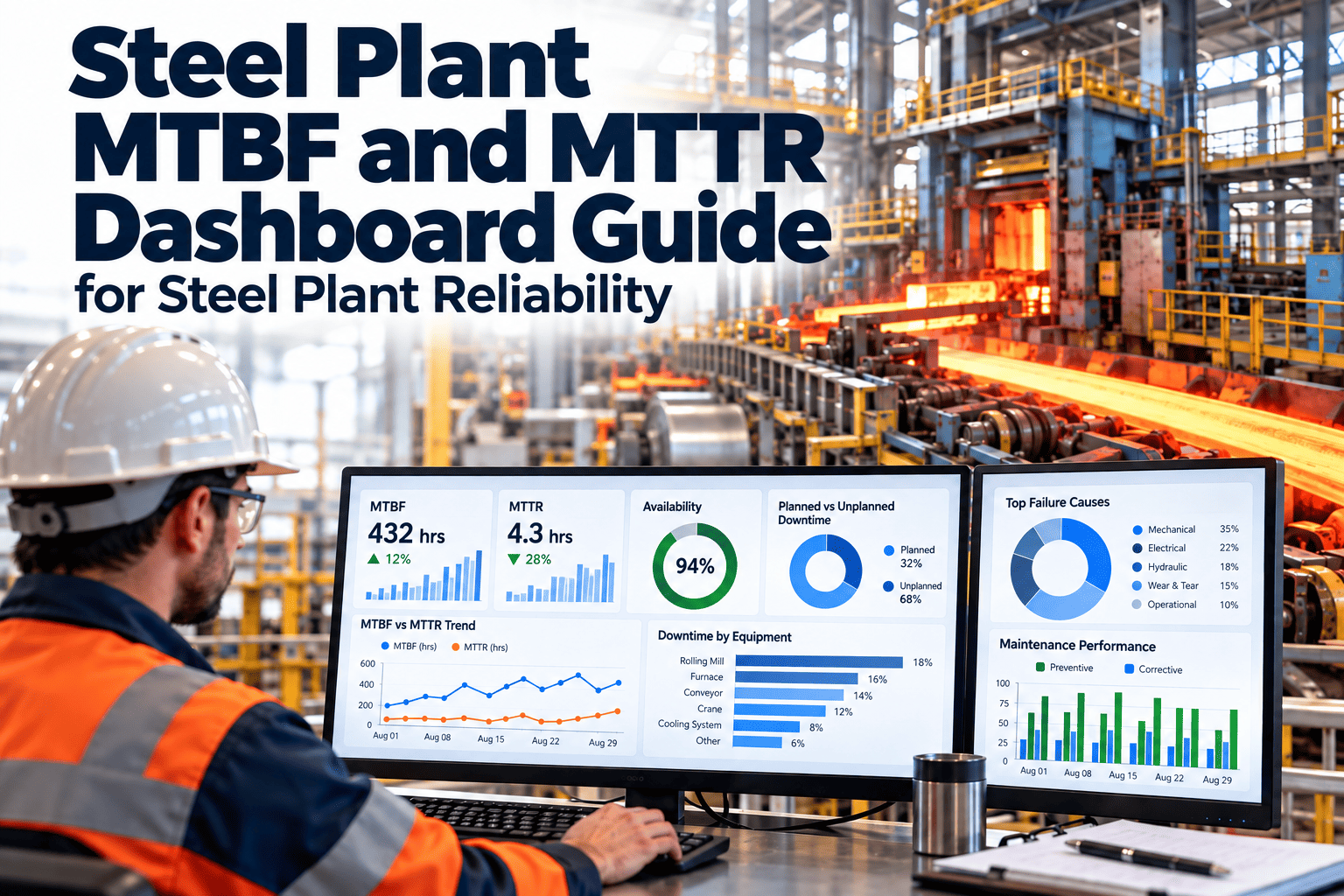
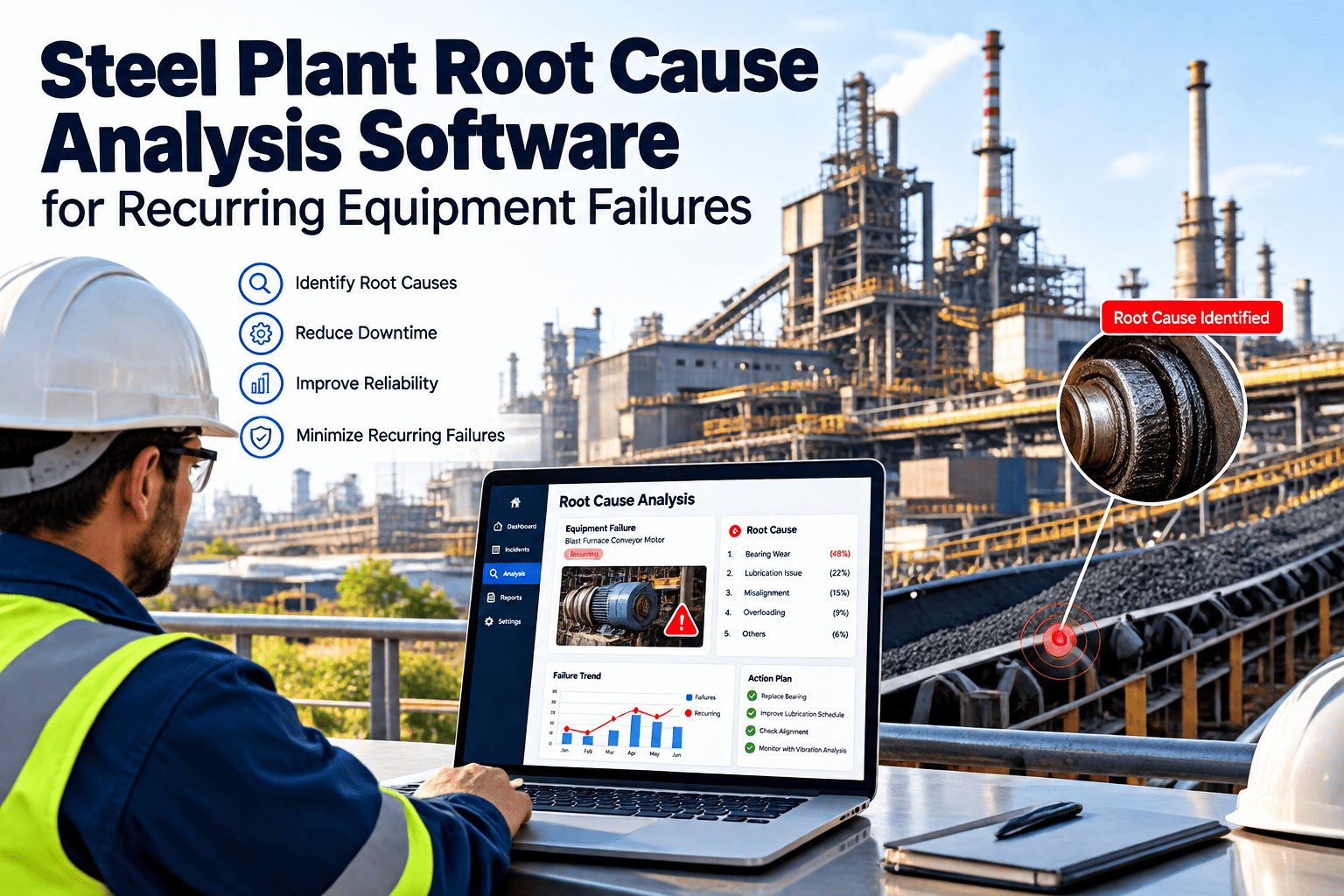
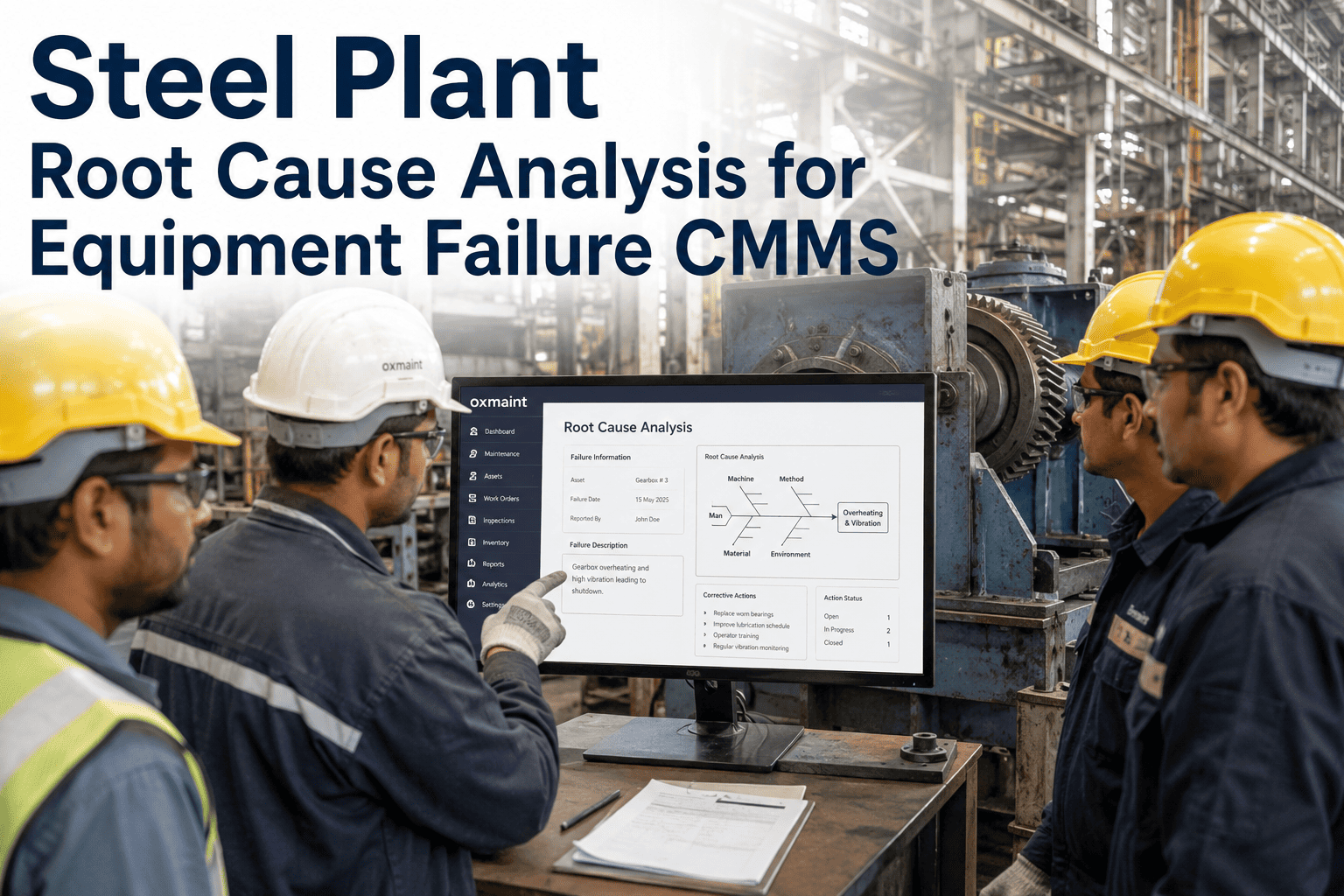
In a steel plant, every piece of equipment has a rhythm — it runs, it fails, it gets repaired, it runs again. The two numbers that define that rhythm are MTBF (Mean Time Between Failures) and MTTR (Mean Time To Repair). Together, they tell you everything about your equipment's reliability and your maintenance team's effectiveness. A blast furnace cooling pump with an MTBF of 8,000 hours is fundamentally different from one with an MTBF of 800 hours — even if they're the same model, same manufacturer, same installation date. The difference is maintenance quality, operating conditions, and the decisions made (or not made) between failures. Steel plants with mature MTBF/MTTR tracking programs achieve 15-20% higher equipment availability than those that don't track these metrics, translating directly to 50,000-200,000 additional tons of annual production capacity (World Steel Association, 2024). Yet a 2024 Plant Engineering survey found that only 29% of steel plants systematically calculate and trend MTBF/MTTR at the individual equipment level — the rest either don't track reliability metrics at all, or calculate them only at the plant or area level where individual equipment problems are invisible.
Implementing meaningful MTBF/MTTR analysis across a steel plant requires consistent failure data capture, precise downtime recording, standardized failure classification, and analytical tools that transform raw numbers into reliability improvement actions. Oxmaint CMMS automatically calculates MTBF and MTTR from work order data, trends both metrics over time for every asset, identifies degradation patterns before they become failures, and links reliability metrics directly to maintenance actions — turning measurement into improvement.
Reliability Metrics at a Glance
MTBF & MTTR Across the Steel Plant: What Good Looks Like
Every production area has different reliability targets based on equipment criticality, operating conditions, and production impact. These benchmarks represent achievable performance for well-maintained steel plant equipment:
Blast Furnace Systems
Cooling pumps, charging system, gas cleaning, stoves. Critical — any failure threatens furnace campaign. MTBF target: 6,000-12,000 hrs. MTTR target: 2-6 hrs. Availability target: 99.5%+.
Steel Making (BOF/EAF)
Vessel tilting, lance systems, ladle cranes, alloy handling. High thermal cycling, slag exposure. MTBF target: 3,000-8,000 hrs. MTTR target: 1-4 hrs. Availability target: 97-99%.
Continuous Caster
Mold oscillation, strand guidance, spray cooling, cut-off. Precision equipment, tight tolerances. MTBF target: 2,000-5,000 hrs. MTTR target: 1-3 hrs. Availability target: 96-98%.
Hot Strip Mill
Roughing/finishing stands, coilers, loopers, AGC hydraulics. High mechanical stress, vibration, thermal cycling. MTBF target: 1,500-4,000 hrs. MTTR target: 1-4 hrs. Availability target: 92-96%.
Utilities & Conveyors
Compressors, pumps, transformers, conveyor drives. Continuous duty, often without redundancy. MTBF target: 8,000-20,000 hrs. MTTR target: 2-8 hrs. Availability target: 98-99.5%.
Know Your Equipment's True Reliability — Not Just Its Age
Oxmaint automatically calculates MTBF and MTTR from your work order data, trends both metrics over time for every asset, and alerts you when reliability degrades — so you act before failure, not after.
The Five Reliability Measurement Mistakes That Mislead Steel Plants
Calculating MTBF and MTTR seems straightforward — until you do it wrong. These five common mistakes produce numbers that look precise but drive incorrect decisions:
Counting Only Catastrophic Failures
Many plants calculate MTBF using only events that completely stopped production — ignoring degraded operation, partial failures, and "nursed along" equipment. A hydraulic pump losing 30% of its rated flow isn't counted as a failure because the mill kept running (at reduced speed). A bearing making noise for weeks before seizure isn't logged until it seizes. This artificially inflates MTBF and hides the true reliability picture. The pump that "never fails" may actually be in chronic degraded condition — consuming more energy, producing lower quality, and one upset away from catastrophic failure.
Averaging MTTR Without Decomposition
A rolling mill gearbox shows an average MTTR of 12 hours. That number is useless for improvement. The 12-hour average might comprise: 3 hours waiting for the maintenance crew (response delay), 2 hours diagnosing the problem (because no failure history was available), 1 hour waiting for a part (because the storeroom was locked at night), 4 hours actual repair, and 2 hours testing and restart. Only 4 of those 12 hours are actual repair time — the other 8 hours are organizational inefficiency. Reducing MTTR requires attacking each component separately, but averaged MTTR hides where the real delays occur.
Plant-Level Averaging Hides Equipment-Level Problems
A steel plant reports "overall MTBF improved 8% this year." Hidden inside that average: the blast furnace cooling system MTBF declined 40% (critical risk), the hot strip mill roughing stand MTBF improved 50% (after a major rebuild), and everything else was roughly flat. The improvement in one area mathematically offset the degradation in another, producing a comforting aggregate number that masked a developing blast furnace crisis. Plant-level MTBF is a financial reporting metric — it tells the board something. Equipment-level MTBF is an engineering metric — it tells the maintenance team where to act.
Ignoring Failure Mode Distribution
A caster segment drive has an MTBF of 3,000 hours — calculated as total operating hours divided by total failures. But the failures aren't homogeneous: bearing failures occur at 2,000-hour intervals, seal failures at 5,000-hour intervals, and electrical faults are random. The single MTBF number of 3,000 hours is the statistical average of three completely different failure patterns, each requiring different maintenance strategies. Bearing failures are wear-out (predictable, CBM-addressable). Seal failures are age-related (time-based replacement). Electrical faults are random (redundancy and rapid response are the only defenses). One MTBF number applied to three failure modes produces the wrong maintenance strategy for all three.
Measuring Without Acting — The Report Shelf Effect
The most dangerous analytics failure is producing beautiful MTBF/MTTR reports that nobody uses to change anything. Monthly reliability reports are generated, distributed, filed — and equipment continues failing at the same rate. This happens when metrics aren't linked to action triggers: when MTBF declines, who is responsible for investigating? When MTTR exceeds target, what process kicks in? Without defined responses to metric deviations, measurement becomes an administrative exercise that consumes analyst time without improving reliability. Measurement without action is just expensive record-keeping.
The MTBF/MTTR Calculation Framework for Steel Equipment
Reliable calculation requires clear definitions, consistent data capture, and the right analytical approach for each equipment type and failure pattern:
From Formulas to Action — Reliability Metrics That Drive Improvement
Oxmaint CMMS automatically calculates MTBF and MTTR from your work order data, decomposes MTTR into its actionable components, trends reliability over time, and triggers investigation work orders when equipment degrades below threshold — no spreadsheets, no manual calculation, no report shelf.
What the CMMS Must Track for MTBF/MTTR Analysis
Reliable MTBF/MTTR analysis demands specific data architecture in the CMMS — without these elements, calculations will be either impossible or misleading:
Frequently Asked Questions
What is the difference between MTBF and MTTF, and which should steel plants use?
MTBF (Mean Time Between Failures) applies to repairable systems — equipment that is fixed and returned to service after failure. This is the correct metric for virtually all steel plant equipment: pumps, motors, gearboxes, hydraulic systems, conveyors, and cranes are all repaired and reused. MTBF includes both operating time and repair time in the cycle: the "between" in MTBF spans from one failure to the next failure, covering both the operating period and the repair period in between. MTTF (Mean Time To Failure) applies to non-repairable items — components that are replaced rather than repaired upon failure.
How do you calculate MTBF when equipment doesn't run continuously?
This is the most common calculation error in steel plant reliability analysis. MTBF must use operating hours, not calendar hours. A caster that runs 16 hours per day (two sequences with an 8-hour turnaround) accumulates 5,840 operating hours per year, not 8,760 calendar hours. If it failed 4 times in that year, MTBF = 5,840 ÷ 4 = 1,460 operating hours — not 8,760 ÷ 4 = 2,190 calendar hours. Using calendar hours inflates MTBF by 50% and produces a dangerously optimistic reliability picture. How to get accurate operating hours: The gold standard is run-time meters installed on equipment — they count only when the equipment is actually operating. Every critical motor, pump, and drive in a steel plant should have a run-time meter. Where run-time meters don't exist, use production schedule data as a proxy — if the hot strip mill ran 18 hours today, all mill-critical equipment accumulated 18 operating hours. Avoid using power consumption data as a proxy unless it's been validated — equipment drawing standby power appears "running" but isn't accumulating wear-related operating hours. Intermittent equipment adds complexity: A slag pot carrier crane that operates 200 cycles per day isn't meaningfully measured in hours — it should be measured in cycles or lifts. A batch process vessel (like a vacuum degasser) should count treatment cycles, not hours. CMMS configuration: Oxmaint allows configuring operating hour meters (manual entry or auto-feed from PLC/SCADA), cycle counters, and calendar-based tracking per asset — ensuring MTBF calculations use the correct operating basis for each equipment type.
What is a good MTBF target for critical steel plant equipment?
MTBF targets must be set based on equipment type, operating environment, and criticality — not by arbitrary universal standards. Benchmarks for well-maintained equipment in integrated steel plants: Blast furnace systems: BF cooling pumps: 8,000-15,000 hrs; hot blast stove valves: 12,000-20,000 hrs; gas cleaning electrostatic precipitators: 6,000-10,000 hrs; charging system (bell/hopper): 4,000-8,000 hrs. Steel making: BOF vessel tilting drives: 5,000-10,000 hrs; ladle turret: 3,000-6,000 hrs; argon stirring systems: 2,000-4,000 hrs. Continuous caster: Mold oscillation drives: 3,000-6,000 hrs; segment drives: 2,000-5,000 hrs; spray cooling pumps: 6,000-12,000 hrs; torch cut-off machines: 1,500-3,000 hrs.
How do you reduce MTTR in a steel plant environment?
MTTR reduction requires attacking each component of total repair time separately — because the bottlenecks are different for each and require different solutions. Decompose MTTR first (typical distribution in steel plants): Notification delay (15-25% of MTTR): The gap between failure occurrence and maintenance being informed. In paper-based plants, operators may wait until shift end to report non-critical failures. Fix: Mobile CMMS with instant work request creation; operator training on immediate reporting; automated failure detection from control system alarms feeding directly into CMMS work orders. Response time (10-20%): Time from notification to technician arrival. Driven by technician location, transportation across large plants, and shift coverage gaps. Fix: Mobile task dispatch with GPS-guided routing; strategically positioned satellite maintenance shops; adequate shift coverage (don't leave night shift with one technician for the entire plant). Diagnosis time (10-20%): Time spent identifying what failed and why. Driven by technician skill level and availability of equipment history.
How does CMMS software automate MTBF/MTTR tracking?
A properly configured CMMS transforms MTBF/MTTR from a quarterly spreadsheet exercise into a real-time, automated reliability management system. Automated calculation: Every time a corrective work order is closed with failure timestamps, the CMMS recalculates MTBF and MTTR for that asset — no manual data extraction, no spreadsheet formulas, no analyst time required. Oxmaint calculates on rolling 3-month, 6-month, and 12-month windows simultaneously, showing both current performance and trend direction. Operating hour integration: The CMMS connects to run-time meters (via PLC/SCADA feeds or manual entry) to use actual operating hours in MTBF calculations — not calendar time. For equipment without meters, configurable proxy rules (e.g., "this pump runs whenever the caster is in sequence") provide reasonable estimates.
Measure Reliability. Improve Reliability. Prove Reliability.
Join steel plants already using Oxmaint to automatically track MTBF and MTTR for every asset, identify degradation before failure, decompose repair delays into actionable components, and demonstrate measurable reliability improvement year over year.