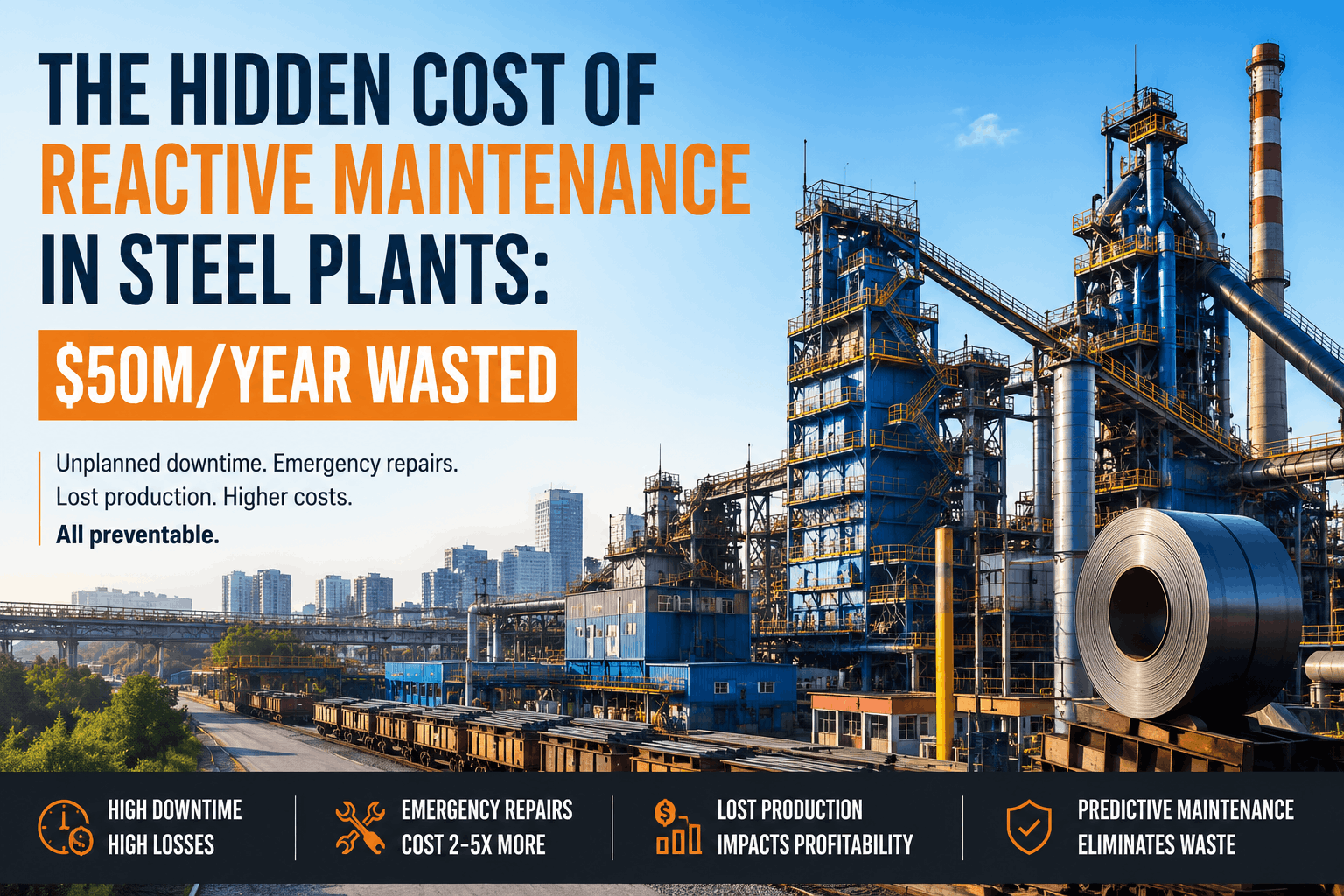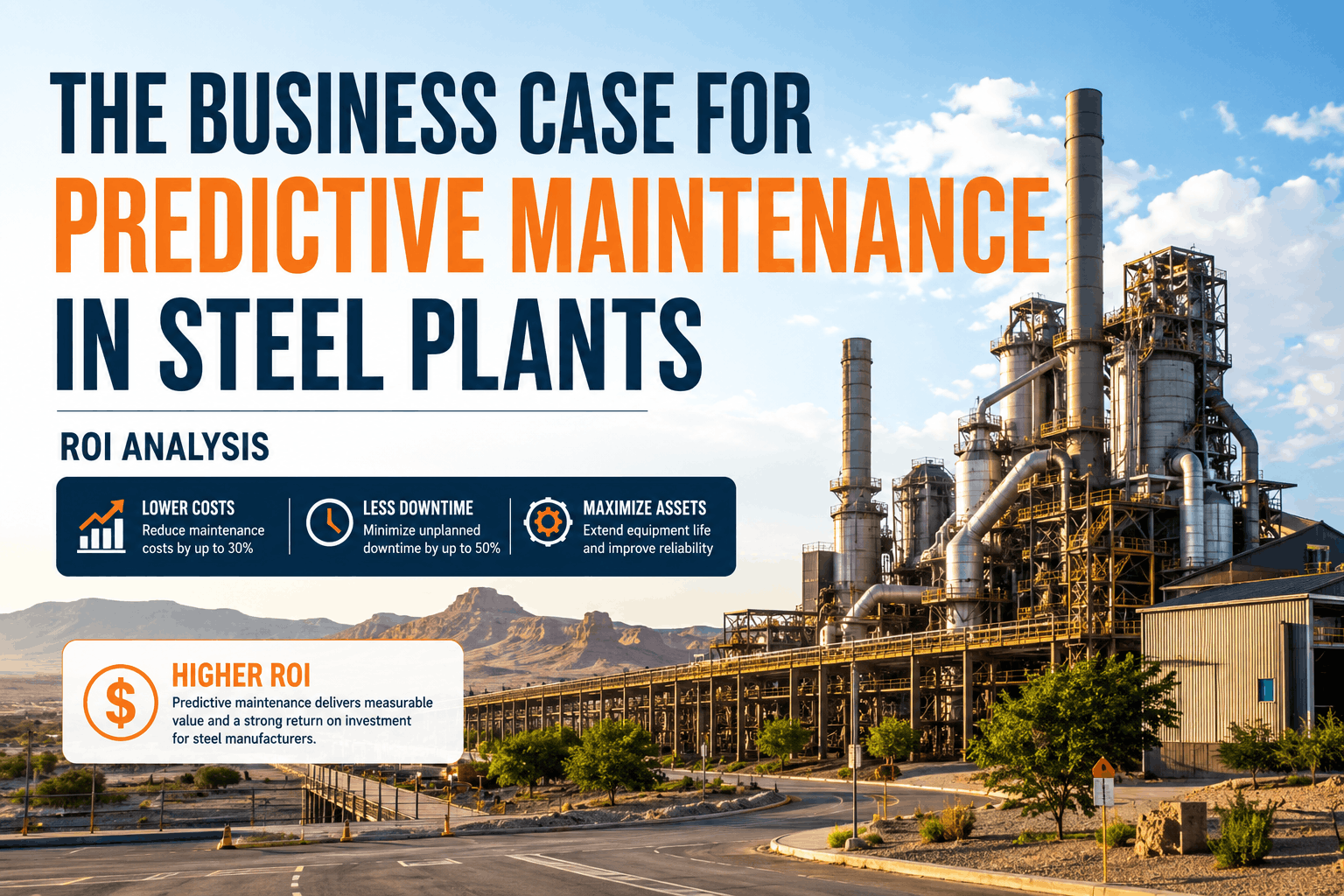
Steel plant operators face a critical business decision: continue reactive maintenance that costs $2-3 million annually in emergency repairs and lost production, or invest in predictive maintenance technology that detects failures weeks in advance. The answer appears counterintuitive to many plant managers—implementing predictive maintenance systems requires upfront software investment, sensor installation, and staff training. Yet the financial case is overwhelming. A typical U.S. steel mill with 50+ critical assets loses $180,000-$250,000 per unplanned equipment failure through combined equipment replacement cost, emergency labor premiums, and production downtime revenue loss. Predictive maintenance systems detect 85% of these failures 4-12 weeks before catastrophic failure occurs, enabling planned repairs during scheduled maintenance windows instead of emergency dispatch at 3 AM on a Sunday. The ROI calculation is straightforward: preventing 2-3 major failures annually more than justifies the entire predictive maintenance program cost. Steel plants that implement comprehensive predictive maintenance achieve 35-50% reduction in maintenance costs, 40-60% reduction in unplanned downtime, and 20-30% improvement in production throughput—translating to $500,000-$2,000,000 in annual financial benefit depending on facility size and production complexity. OxMaint's predictive maintenance platform automatically monitors vibration, temperature, oil condition, and operational parameters—identifying developing failures and triggering work orders weeks before equipment fails, transforming maintenance from crisis response to strategic asset protection.
Predictive Maintenance ROI: Building the Business Case for Steel Mills
Unplanned equipment failures cost steel mills $2-3 million annually. This comprehensive financial analysis demonstrates how predictive maintenance prevents 85% of catastrophic failures, delivering 35-50% maintenance cost reduction and 6-12 month ROI payback period through eliminated emergency repairs and extended asset life.
The Cost of Reactive Maintenance: Understanding the Steel Plant Baseline
Reactive maintenance is the default strategy at most steel mills: equipment operates until it fails, then a emergency maintenance team works overtime to restore operations. This approach appears economical because facilities avoid upfront monitoring system costs. The true cost of reactive maintenance is hidden in the consequences of failure. When a critical motor bearing fails on a rolling mill drive—a failure that predictive vibration monitoring would have detected four weeks earlier—the economic impact cascades across multiple cost centers. The failed bearing itself costs $8,000-$15,000 in replacement parts. The emergency motor repair contractor charges 2.5-3x their standard hourly rate for after-hours work, adding $12,000-$25,000 in labor costs. But the largest impact comes from production downtime: a rolling mill that normally generates $500,000-$750,000 daily in production revenue sits idle for 8-48 hours awaiting repair completion. Equipment failure that occurs Friday evening before a 3-day weekend might not be repaired until Tuesday, consuming $2,000,000-$2,250,000 in lost production revenue. The total economic impact of that single bearing failure: $2,020,000-$2,290,000 in combined equipment, labor, and revenue loss. Steel plants with 5-10 critical assets experiencing even 2-3 catastrophic failures annually incur $4-7 million in combined costs. This reactive cost baseline is the essential starting point for any ROI analysis—it represents the financial target that predictive maintenance must beat.
Financial Quantification: Measuring Failure Prevention Benefits
Predictive maintenance financial benefits flow from three distinct sources: elimination or deferral of catastrophic failures, reduction in planned maintenance costs through extended asset intervals, and production throughput improvement from increased equipment availability. The most straightforward benefit to quantify is catastrophic failure prevention. Consider a typical steel mill scenario: 60 critical assets operating continuously, historical failure rate of 3-4 major failures annually, average cost per failure of $250,000-$350,000 (combining equipment, labor, and production loss). Current annual failure cost baseline: $750,000-$1,400,000. Predictive maintenance systems detect 85% of developing failures 4-12 weeks pre-failure, enabling planned repair scheduling. Assuming predictive maintenance prevents 3 major failures annually at $300,000 average cost, the direct benefit is $900,000 annually. Secondary benefits include extended asset service life: equipment that would normally run 10 years operates reliably for 12-15 years with continuous condition monitoring and proactive maintenance. An asset costing $500,000 that operates 5 additional years represents $100,000 annual value (cost amortized across additional lifespan). Across a 60-asset portfolio, 30% of assets receiving extended life represents $1,500,000 in deferred replacement capital costs annually. Tertiary benefits include reduced planned maintenance intensity: continuously monitored equipment no longer requires calendar-based overhauls, shifting to condition-based intervals that reduce labor costs 20-30%. Annual maintenance labor reduction of $200,000-$400,000 is achievable on mid-size steel mill operations. Total financial benefit from these three channels: $900,000 + $1,500,000 + $300,000 = $2,700,000 annually for a typical facility. Against this benefit, predictive maintenance system implementation costs—software platform ($30,000-$80,000 annually), sensor hardware ($100,000-$200,000 for 60 assets), installation and integration ($40,000-$80,000), and staff training ($15,000-$25,000)—total $185,000-$385,000 for first-year deployment. ROI is 2.5-7x positive in year one, and improves dramatically in subsequent years when implementation costs are amortized. Payback period: 2.5-5 months for failure prevention alone.
Business Case Development: Justifying Predictive Maintenance Investment to Finance Leadership
Plant managers and reliability engineers understand the operational benefits of predictive maintenance intuitively: detecting bearing degradation weeks early prevents catastrophic failure and plant shutdown. Finance leadership requires a different conversation—one focused on capital allocation, ROI multiple, payback period, and risk-adjusted returns. The business case presentation begins with baseline documentation: collect historical failure data for the past 24-36 months, extract actual costs including parts, labor (with overtime premium rates), and lost production revenue. Document downtime duration and equipment availability impact. Calculate the facility's weighted average cost per failure—a facility that experienced 6 failures over 3 years costing $180,000-$450,000 each ($1.44M-$2.7M total) has an average failure cost of $240,000-$450,000. This becomes the financial target. Quantify unplanned downtime as a percentage of planned production: a mill that loses 5% annual production capacity to unexpected shutdowns is losing $750,000-$1,500,000 in annual throughput assuming $150,000-$300,000 daily production value. This downtime percentage is conservative to calculate because it includes both full production loss (rare) and partial throughput reduction (common). Present the predictive maintenance system cost explicitly: software platform licensing ($25,000-$80,000 annually for 3-5 year term), hardware and sensors ($80,000-$200,000 one-time capital), integration and training ($30,000-$60,000 one-time), ongoing technical support ($15,000-$30,000 annually). Establish clear financial performance metrics: reduction in unplanned failures (target 85%), reduction in unplanned downtime hours (target 40-60%), extension of asset service life (target 20-30% longer), reduction in emergency labor premiums (target 70-80%). Schedule a consultation with our ROI specialists to develop a customized financial analysis specific to your facility's asset portfolio and historical failure patterns.
Implementation Roadmap: From Business Case Approval to Operational Deployment
Predictive maintenance implementation across a steel facility typically follows a phased approach: pilot phase (3-6 months, 5-10 critical assets), expansion phase (6-12 months, 30-50 assets), and full-scale deployment (12-18 months, 100+ assets facility-wide). Pilot phase begins with asset selection: identify 5-10 of your most critical assets—equipment responsible for 40-50% of annual downtime or failure costs. Install vibration sensors, temperature monitors, and connect to the predictive maintenance platform. Monitor performance for 90-180 days to establish baseline patterns and validate detection algorithm accuracy. Within this pilot phase, you will likely observe 1-2 developing failures detected weeks before traditional symptoms become apparent. Document these detections and the maintenance actions taken, comparing outcomes to historical failure patterns. This pilot data becomes the essential proof point that justifies full-scale deployment to finance and operations leadership. Expansion phase integrates lessons learned from pilot: refine sensor placement, optimize monitoring intervals, establish clear escalation and response procedures, and scale technical support. Data quality becomes critical—incomplete or inconsistent monitoring data produces false alarms that undermine confidence. Establish data governance: who collects samples, who interprets results, who authorizes work orders, who verifies completion. Most facilities benefit from appointing a dedicated reliability engineer (0.5-1.0 FTE) responsible for predictive maintenance program coordination. OxMaint's implementation support provides guided pilot setup, technical training, and ongoing consultation to accelerate time-to-value and ensure measurable ROI achievement.
Case Study: ROI Achievement at Mid-Size U.S. Steel Facility
A mid-size steel mill operator in the Midwest (approximately 200 employees, $80M annual revenue, 60 critical production assets) implemented predictive maintenance across their facility following the three-phase roadmap. Pre-implementation baseline over 36 months: 11 major equipment failures, average cost $280,000 per failure ($3.08M total), average unplanned downtime 340 hours annually ($2.4M lost production revenue). Total annual cost of reactive maintenance: $1.86M. Pilot phase (months 1-6): 10 critical drive motors and gearboxes equipped with vibration and temperature sensors. Month 4 of pilot, system detected bearing degradation on a main mill drive motor—traditional monitoring would have detected failure within 2-4 weeks, but predictive system identified problem 8 weeks early. Facility scheduled bearing replacement during next planned maintenance window instead of emergency after-hours repair, saving $65,000 in emergency labor and parts expediting costs. Pilot validation successful: cost of pilot implementation ($85,000 including hardware, software, and integration) recovered within 90 days. Expansion phase (months 6-18): deployed to 50 additional assets. During this 12-month period, system detected 5 developing failures—3 bearing degradations, 1 imbalance condition, 1 oil contamination problem—preventing an estimated $1.4M in combined failures costs. Annual maintenance labor costs reduced from $1.2M to $780K (35% reduction) through shift to condition-based maintenance scheduling. Equipment downtime events reduced from 15-20 annual incidents to 3-4 planned events, improving production availability from 88% to 96%. Additional production throughput at this availability improvement level: $1.2M in recovered annual revenue. Full-year 2 financial result: $2.6M in combined benefits against $125,000 ongoing system costs (software, support, sensor replacements). Net benefit: $2.475M. Total ROI multiple: 18.6x. Payback period: 2.3 months. This facility is now viewing predictive maintenance not as a cost center but as a strategic competitive advantage—equipment reliability is marketing differentiation in their customer relationships.
Frequently Asked Questions — Predictive Maintenance ROI in Steel Plants
Transform Steel Plant Economics with Predictive Maintenance
OxMaint's predictive maintenance platform detects developing equipment failures 6-12 weeks before catastrophic breakdown occurs. Monitor vibration signatures, temperature profiles, oil condition, and operational parameters across your entire asset portfolio. Prevent 85% of major failures, reduce maintenance costs 35-50%, and extend asset service life 20-30%—delivering $500K-$2M annual financial benefit at typical mid-size facilities. Achieve 6-12 month ROI payback and protect your steel plant's competitive advantage.