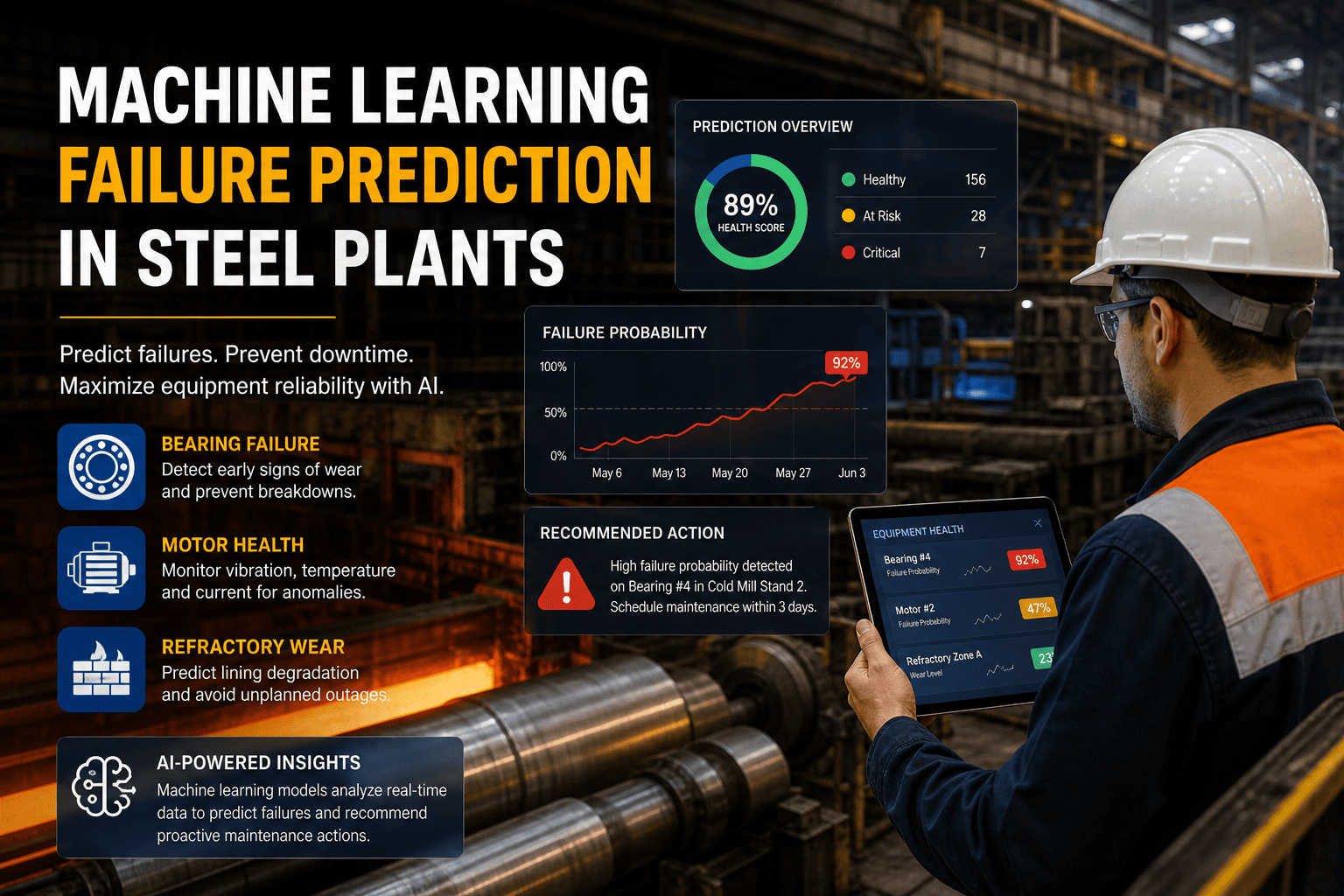
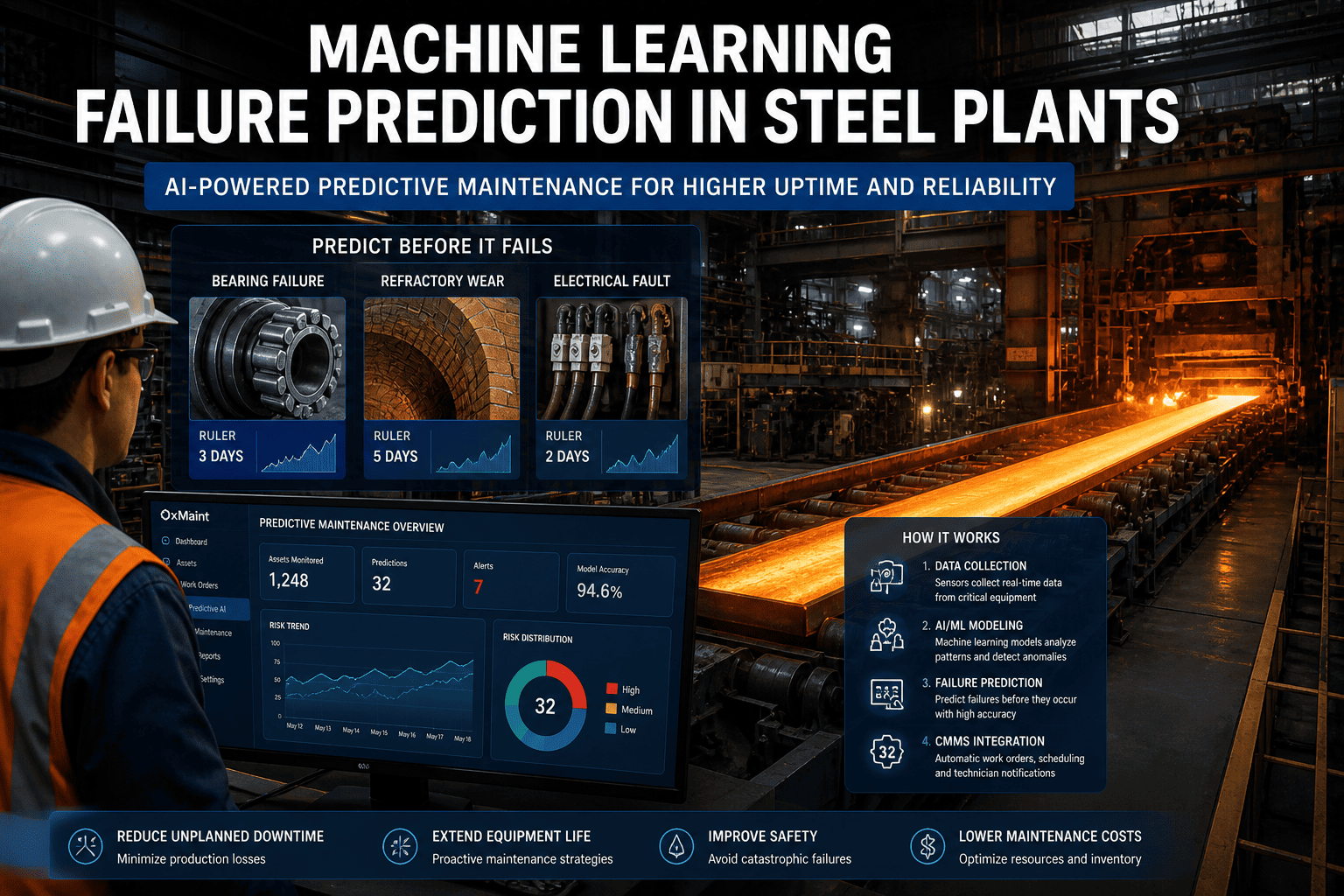
AI Predictive Maintenance for Steel Plants: Reduce Downtime with ML & IoT

By James smith on March 23, 2026

ai-predictive-maintenance-steel-plants-ml-iot

A ransomware group encrypted a German steel plant's blast furnace control systems in 2022 — causing physical equipment damage that took months to repair. The entry point was a phishing email to a maintenance coordinator. Your CMMS sits at the boundary between your IT network and your operational technology. That makes it both a critical tool and a potential attack vector. See how Oxmaint secures your maintenance data.

Active Threat Level: HIGH — Industrial control systems ranked top-5 most-targeted sectors globally in 2025. Steel and metals facilities saw a 300% increase in OT-specific cyberattacks since 2020.
Assess Your Risk
Security Intelligence Brief 2026

Steel Plant Cybersecurity: CMMS, OT & SCADA Under Attack

OT networks in steel production were designed for reliability — not security. IT integration for data access and remote monitoring created attack paths that did not exist a decade ago. This guide gives plant engineers and IT/OT managers the exact controls needed to close them.

Threat Impact by System
SCADA / DCS

Critical
CMMS Platform

High
OT Network Edge

High
Remote Access

Medium
Engineering WS

High
$4.7MAvg. OT breach cost
68%Industrial orgs breached in 12 months

The Three Attack Scenarios Steel Plants Face

Threat actors targeting OT environments use different playbooks depending on their objective — financial gain, sabotage, or intelligence gathering. Understanding each scenario helps prioritize which controls to implement first. Sign into Oxmaint to see which vectors your CMMS configuration currently protects against.

Scenario A
Ransomware — Financial Extortion
Critical
Real: German steel plant (2022) — Ransomware via engineering workstation. SCADA historian and backups encrypted. Blast furnace parameters modified. Physical equipment damage resulted.
Phishing emailExposed RDPUnpatched HMI

Production shutdown lasting weeks. Physical equipment damage. Ransom demands $2M–$50M. Regulatory investigation if safety systems affected.

Scenario B
Nation-State APT — Persistent Access
High
Real: CHERNOVITE/PIPEDREAM (2022) — Advanced malware designed for OT systems in steel and energy. Capable of disrupting PLCs from multiple vendors simultaneously without detection.
Supply chainVPN credentialsIT/OT boundary

Long-term intelligence gathering. Pre-positioned malware activatable during geopolitical escalation. Undetected for months or years.

Scenario C
Insider Threat — Privilege Abuse
Medium
Real: Multiple verified industrial cases — Disgruntled employees or compromised contractor accounts with standing OT access used to modify process parameters or exfiltrate configuration data.
Shared credentialsNo RBACMissing audit logs

Process manipulation. IP theft. Maintenance record sabotage. Difficult to detect without audit logging.

Your IT/OT Attack Surface: The Purdue Model

Attackers move downward through five network levels — from enterprise IT toward physical sensors. Most steel plants have weak controls at Levels 3 and 3.5 — exactly where IT meets OT. Each level transition is a chokepoint where security controls stop lateral movement. Book a demo to see Oxmaint's OT integration architecture for your environment.

L4
Enterprise Network
ERP (SAP/Oracle) · CMMS (Oxmaint) · Email · Business Intelligence · Remote Access
Internet-facing

IT/OT Boundary — Primary Attack Vector — Firewall · DMZ · Data Diode

L3
Operations / Site Network
SCADA Servers · Historian · Engineering Workstations · MES
High exposure

OT Internal Boundary — Lateral Movement Target — Network Segmentation · OT-aware IDS

L2
Control Room / HMI Level
HMI Terminals · DCS Controllers · SCADA Displays
Direct process control

Field Bus Boundary — Protocol Filtering · PLC Firmware Verification

L0/1
Field Devices — Physical Process
PLCs · RTUs · Sensors · Blast Furnace Controllers · Rolling Mill Automation
Physical consequences if compromised
Oxmaint integrates at Level 4 only — never directly to OT networks
Read-only API connections with TLS 1.3 encryption, OAuth 2.0 authentication, and IP allowlisting keep your plant floor isolated while giving maintenance teams operational data.

5 Controls That Stop 90% of Industrial Cyberattacks

Analysis of documented OT security incidents shows most share the same failure points — missing MFA, flat networks, no audit logging, or uncontrolled remote access. These five controls address each failure point and are required under both NIST CSF 2.0 and IEC 62443.

01
Must Have
Multi-Factor Authentication on Every Access Point
NIST PR.AA-01  ·  IEC 62443 SR 1.1

The 2022 German steel plant attack started with a phishing email. One compromised password gave the attacker access. MFA eliminates this path — even with a stolen password, the attacker cannot authenticate. Enforce on VPN endpoints, CMMS logins, engineering workstations, and every contractor remote session.

In Oxmaint: MFA enforced on all user logins, admin sessions, and API authentication. Supports TOTP authenticator apps, hardware security keys, and phishing-resistant passkeys.
02
Must Have
Network Segmentation Between IT and OT
NIST PR.IR-01  ·  IEC 62443 SR 5.1

A flat network where a blast furnace PLC is reachable from the corporate email server is the most common configuration — and the most dangerous. Segment using the Purdue Model. Industrial firewalls at the IT/OT boundary, unidirectional gateways for historian data feeds, and isolated segments for safety instrumented systems stop lateral movement cold.

In Oxmaint: Integrates through secure API at the IT layer only — never requiring direct OT network access. IP allowlisting restricts connection origins to approved locations.
03
High Priority
Role-Based Access Control Across All Systems
NIST PR.AA-05  ·  IEC 62443 SR 2.1

A maintenance technician working on rolling mill bearings does not need access to blast furnace control parameters or another plant's records. Define roles — Technician, Supervisor, Administrator, Auditor, Contractor — with explicit scopes. A compromised technician account should have minimal blast radius. Audit access quarterly and revoke dormant accounts within 24 hours of personnel change. Configure RBAC in Oxmaint free.

In Oxmaint: Granular RBAC with five built-in roles, custom role creation, time-limited contractor access, and zero standing admin access enforced.
04
High Priority
Immutable Audit Logging for All System Actions
NIST PR.PT-1  ·  IEC 62443 SR 6.1

You cannot investigate an attack you cannot reconstruct. Every login attempt, configuration change, work order modification, and API call needs a timestamped, immutable record stored outside the system it monitors. When regulators investigate, audit logs are your evidence. When insurers assess your posture, audit logs are your proof.

In Oxmaint: Full audit trail for all user actions and API calls. Tamper-evident export to external SIEM. 24-month default retention. SOC 2 Type II and IEC 62443 SR 6.1 compliant.
05
High Priority
Offline Backup Architecture Ransomware Cannot Reach
NIST RC.RP-1  ·  IEC 62443 Security Policy

Every ransomware attack on an industrial facility follows the same sequence: find backups, encrypt backups, then encrypt production systems. Air-gapped, immutable backups for SCADA configurations, engineering data, and CMMS exports are your last line of defense when every other control fails. Test restoration monthly — an untested backup is not a backup. Discuss backup architecture with our team.

In Oxmaint: Scheduled encrypted exports to customer-controlled storage. Compatible with air-gapped backup systems. Point-in-time data restoration available on Enterprise plan.

NIST & IEC 62443 Compliance: Where Oxmaint Covers You

This matrix maps the five controls above to the two dominant industrial security frameworks — and shows which are covered by Oxmaint versus which require plant-side implementation. Start your free trial to access Oxmaint's compliance documentation package.

Multi-Factor Authentication
NIST PR.AA-01IEC 62443 SR 1.1

Oxmaint: Fully supported — all login and API flows

Plant-side: Required for SCADA workstation access
Role-Based Access Control
NIST PR.AA-05IEC 62443 SR 2.1

Oxmaint: Granular RBAC with custom roles and least-privilege

Plant-side: Required for DCS and engineering workstations
Audit Logging
NIST PR.PT-1IEC 62443 SR 6.1

Oxmaint: Tamper-evident logs, 24-month retention, SIEM export

Plant-side: OT system logs require separate log aggregator
Network Segmentation
NIST PR.IR-01IEC 62443 SR 5.1

Oxmaint: IT-layer integration only — no OT network exposure

Plant-side: Industrial firewalls, DMZ, and conduit controls required
Data Encryption in Transit
NIST PR.DS-2IEC 62443 SR 4.1

Oxmaint: TLS 1.3 for all API and user connections

Plant-side: OT protocol encryption requires industrial network upgrade
Secure API Integration
NIST PR.DS-2IEC 62443 SR 3.1

Oxmaint: OAuth 2.0, rate limiting, IP allowlisting, scoped tokens

Plant-side: OPC-UA gateway security configuration required
The attack on the German steel plant was not sophisticated. It was patient. The attacker spent weeks mapping the network before triggering the ransomware. Most industrial environments have no monitoring that would have detected that reconnaissance — they would not have known until the blast furnace controllers went offline.
— Senior OT Security Analyst, German Federal Office for Information Security (BSI)
Secure by Design

Oxmaint Protects Your Maintenance Data Without Slowing Down Your Team

MFA, RBAC, audit logs, and encrypted API integration are built into every Oxmaint account — active from day one of your free trial. Your security team audits every control. Your maintenance team never feels the friction.
Frequently Asked Questions

Does connecting Oxmaint to OT data create a new attack surface?
Oxmaint integrates with OT data through read-only API connections at the IT network layer — the CMMS never requires direct OT network access. All connections use TLS 1.3, OAuth 2.0 tokens with limited scope, and IP allowlisting. A fully compromised Oxmaint account cannot write to OT systems by design. Book a security architecture review for your specific environment.
Is IEC 62443 compliance mandatory for steel plants?
Not universally, but increasingly required by insurers, supply chain customers, and regulation. EU NIS2 Directive and automotive supply chain TISAX requirements are pushing compliance upstream to steel and metals suppliers. Beyond regulation, IEC 62443 alignment substantially reduces cyber liability insurance premiums and simplifies incident response audits.
How does Oxmaint handle contractor access security?
Contractor access in Oxmaint is scoped through the Contractor role — time-limited, asset-restricted, MFA-required, and fully logged. Contractor accounts are deactivated instantly at contract completion. All contractor actions appear in the full audit trail, making supply chain attacks detectable and attributable. Start your free trial to configure contractor access controls today.
What should a steel plant prioritize first for OT security?
Start with an OT asset inventory — you cannot protect what you cannot see. Then enforce MFA on all remote access, segment OT from IT with industrial firewalls, and enable audit logging across CMMS and engineering workstations. These three steps address the most common initial access and lateral movement vectors before investing in advanced monitoring tools.

Share This Story, Choose Your Platform!