Rolling Mill Predictive Maintenance: Preventing Costly Breakdowns with IoT & AI
By Michael Finn on March 2, 2026
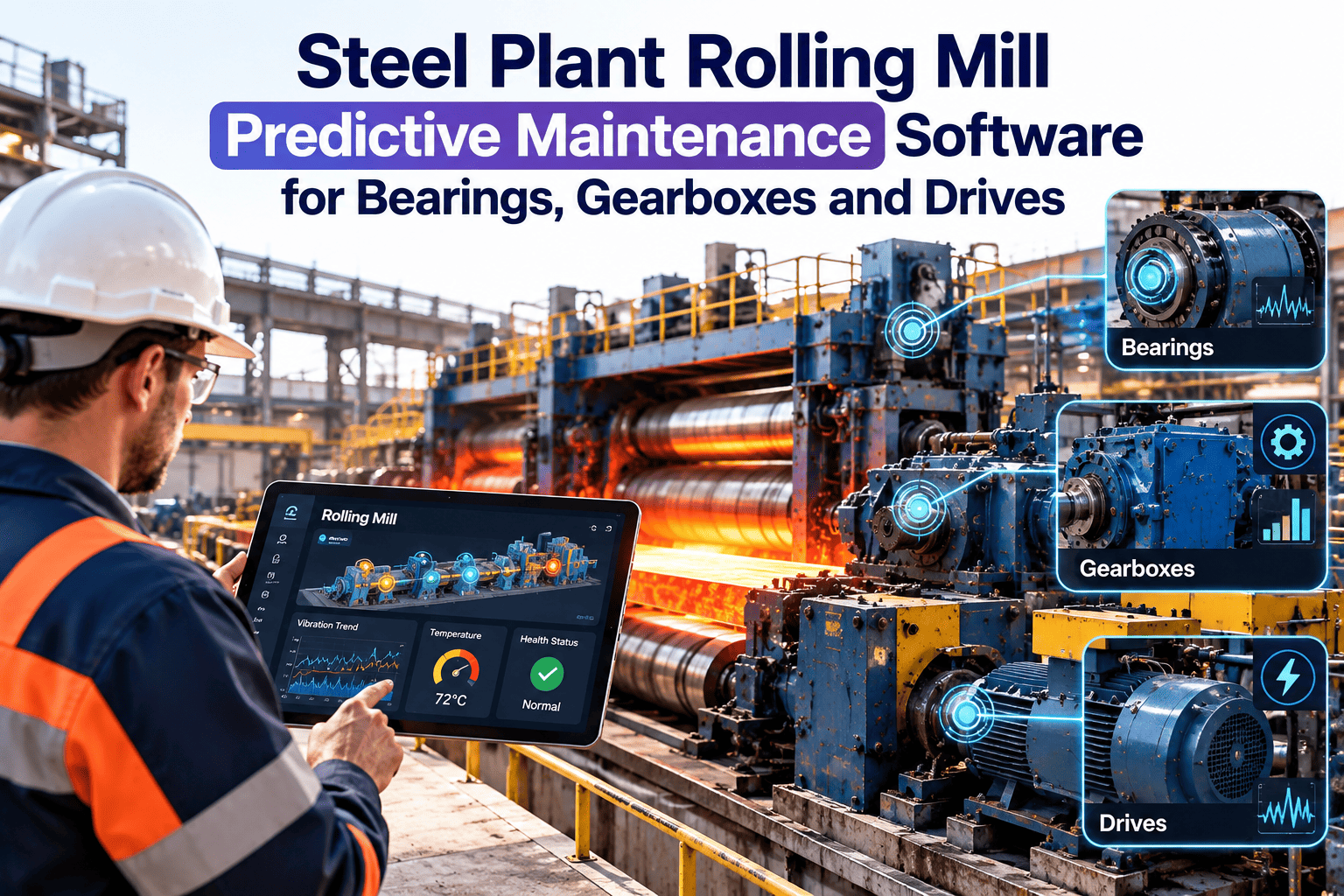
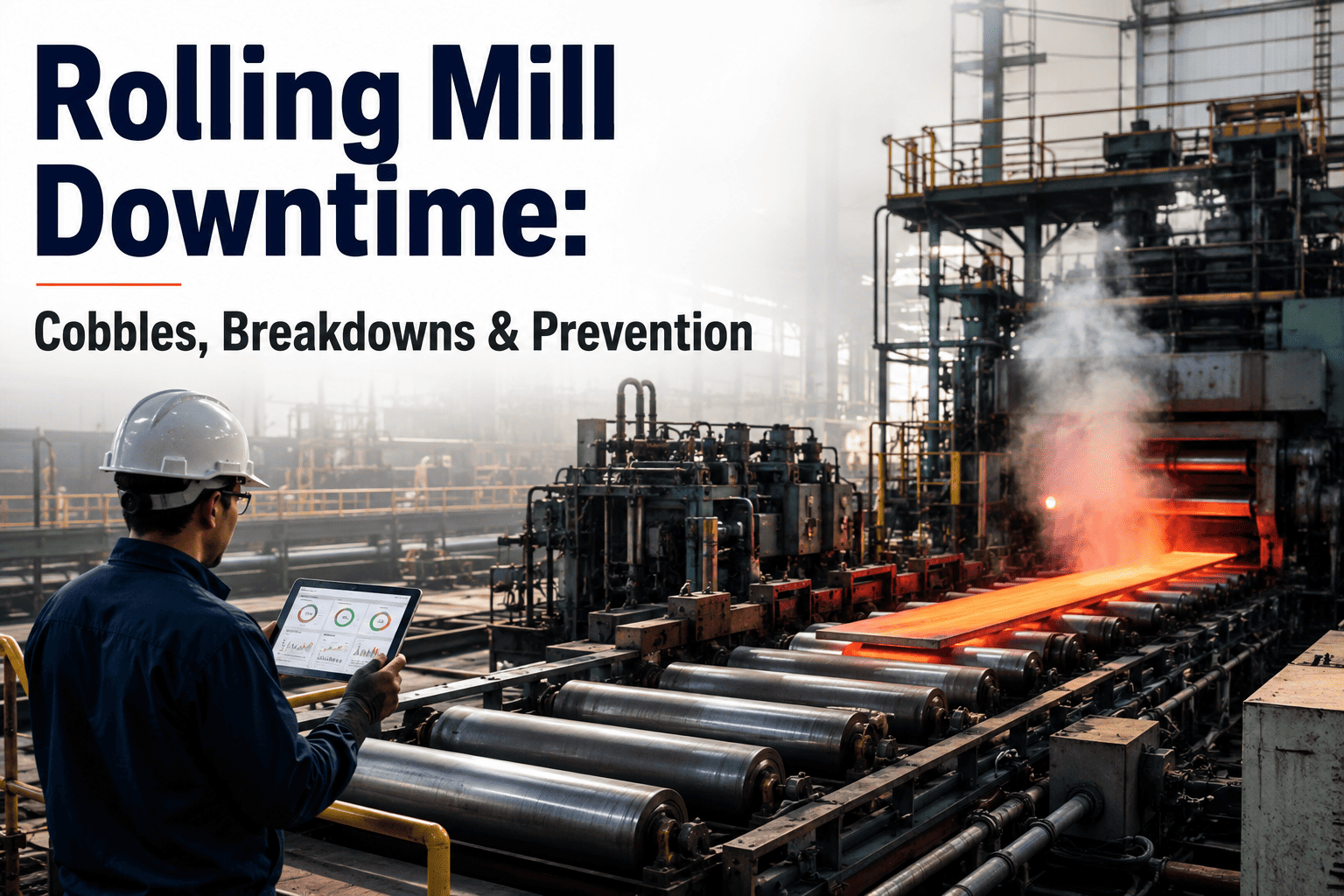
A hot rolling mill processes steel at speeds exceeding 1,000 meters per minute through seven finishing stands operating within ±0.02mm tolerance — while every bearing, gearbox, hydraulic cylinder, and drive motor is subjected to extreme mechanical load, thermal stress, and vibration. A single unplanned stand failure stops the entire mill for 8–72 hours at a cost of $6,000–$12,000 per hour in lost production. IoT sensors and AI analytics installed across the mill continuously monitor 200–400 critical parameters — vibration signatures, bearing temperatures, hydraulic pressures, motor currents, roll eccentricity, and gearbox oil condition — detecting the early signatures of developing failures 3–8 weeks before they become breakdowns. The result: maintenance teams fix problems on their schedule, with the right parts, during planned windows — instead of scrambling through emergency repairs at 2 a.m. while production hemorrhages $12,000 every hour.
3–8 wk
advance warning before failure — enough time to plan, source parts, and schedule repair
91%
reduction in unplanned mill stops when predictive maintenance replaces reactive response
$4.2M
average annual savings from predictive maintenance across a single hot rolling mill operation
400+
parameters monitored continuously across a 7-stand finishing mill with IoT sensor network
The Sensor Network: What Gets Measured Gets Predicted
Predictive maintenance is only as good as the data feeding it. Each sensor type detects a specific category of developing failure — and together they create a complete picture of mill health that catches 85% of failure modes weeks before they become breakdowns.
Vibration Sensors
80–120 per mill
Installed on every work roll bearing housing, backup roll bearing, gearbox housing, motor bearing, and spindle support across all 7 finishing stands plus roughing mill.
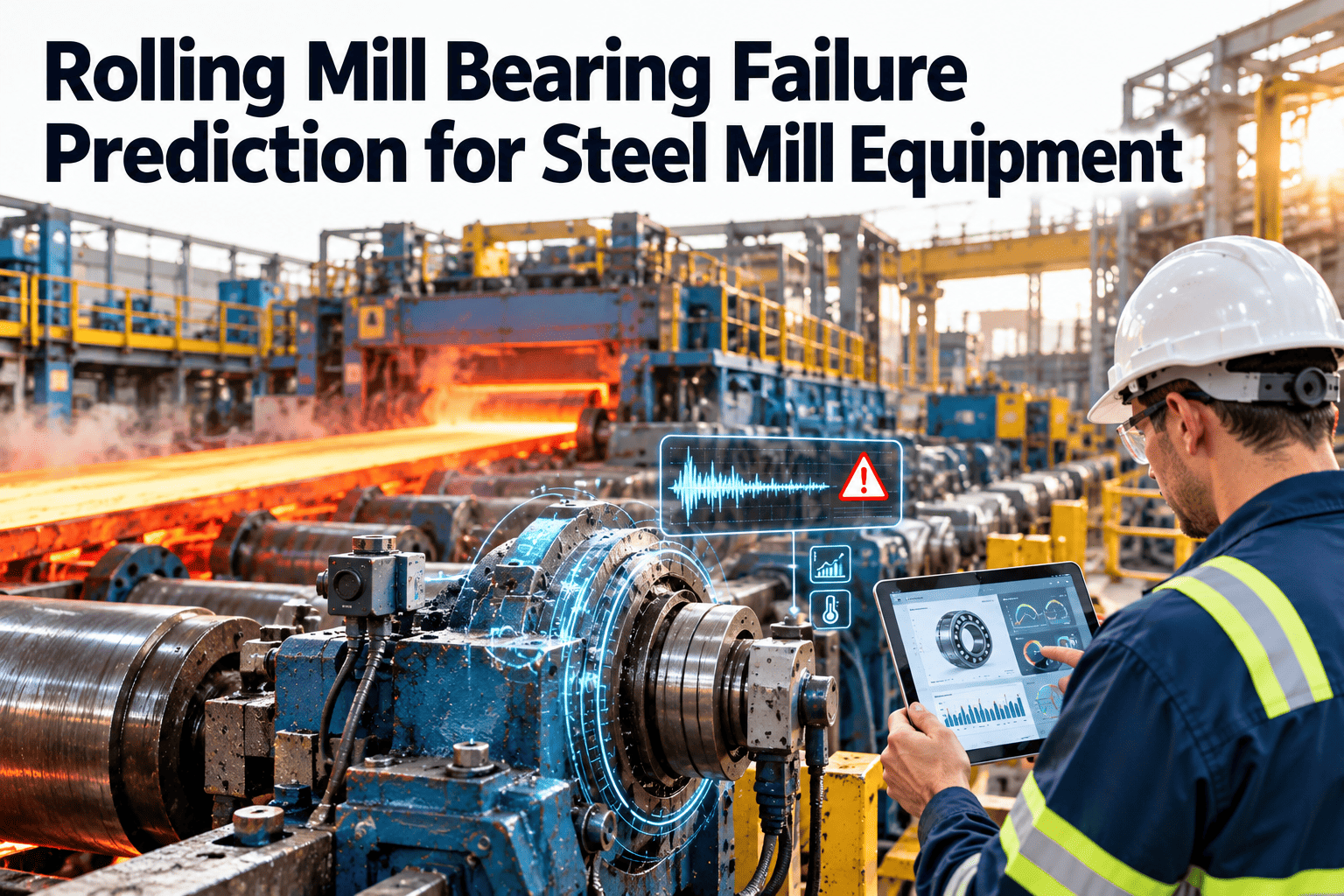
A skilled mill mechanic can hear a bad bearing and feel excessive vibration. But AI detects the bearing defect 6 weeks before the mechanic can hear it — because the earliest signatures exist in frequency domains that humans cannot perceive. Here's what AI pattern recognition finds that traditional inspection misses.
F3 Backup Roll Bearing — Outer Race Defect
AI Confidence: 94%
What the technician observes
"Bearing sounds normal. No perceptible vibration increase. Temperature reading 62°C — within normal range. Passed routine inspection."
What AI detects in the data
BPFO frequency amplitude increased 42% over 45 days. Overall vibration still within "normal" band, but bearing-specific defect frequency shows exponential growth characteristic of outer race spalling. Temperature rate-of-rise increased 0.3°C/week. At current progression rate, functional failure estimated in 5–7 weeks.
AI recommendation: Schedule bearing replacement within 4 weeks. Estimated repair: 6 hours during planned stop. Cost: $8,400. If deferred to failure: 18-hour emergency stop, $14,200 repair + $144,000 production loss.
"Strip gauge is holding spec. No quality complaints from the finishing side. AGC pressure looks normal on the HMI screen. No alarms."
What AI detects in the data
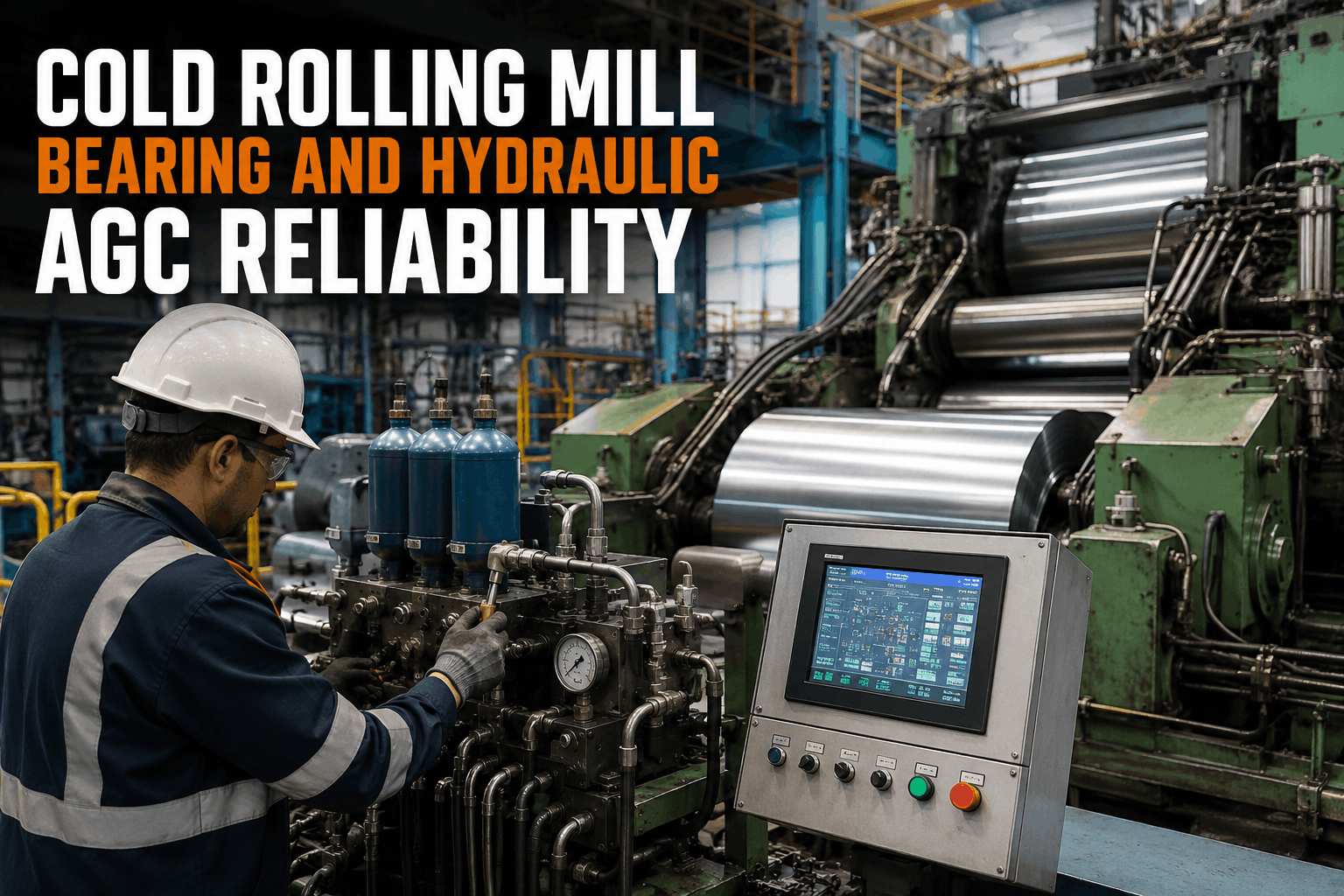
Servo valve response time increased from 12ms to 19ms over 60 days (58% degradation). AGC is compensating by increasing correction amplitude — masking the problem on the HMI. At current rate, response time will exceed compensation capability in 3–4 weeks, causing gauge deviation that triggers cobble risk.
AI recommendation: Replace servo valve at next planned roll change (F5 roll change due in 9 days). Cost: $6,200 for valve + 45 minutes installation within existing roll change window. If deferred: cobble event averaging $191,000 total cost.
F1 Main Drive Gearbox — Gear Tooth Pitting
AI Confidence: 86%
What the technician observes
"Gearbox sounds the same as always. Oil level is good. Last oil sample 3 months ago showed normal iron content. No external leaks."
What AI detects in the data
Gear mesh frequency sidebands appeared 8 weeks ago and are increasing at consistent rate. Online oil particle counter shows iron content rising from 18 to 34 ppm over same period. Vibration pattern matches Stage 2 gear tooth pitting. Estimated 8–14 weeks to gear tooth fracture if load maintained.
AI recommendation: Schedule gearbox inspection during next planned shutdown (6 weeks). Order replacement gear set now (8-week lead time for insurance). Reduce F1 load 10% until inspection confirms severity. Cost if planned: $85,000. Cost if catastrophic gearbox failure: $420,000 + 5-day mill stop.
Every Bearing Monitored. Every Trend Analyzed. Every Failure Predicted Weeks Before It Happens.
OxMaint integrates IoT sensor data with AI analytics to give rolling mill teams the advance warning they need — bearing defect detection, AGC response monitoring, gearbox health tracking, motor current analysis, and the automated work order generation that converts AI findings into scheduled maintenance actions.
All parameters nominal. Next scheduled service: 18 days.
F2
93
Minor hydraulic pressure fluctuation. Monitoring — no action required yet.
F3
74
Backup roll bearing BPFO trending. Work order generated — replace at next planned stop in 9 days.
F4
91
Roll cooling nozzle pressure slightly low — monitoring. 28% work roll life remaining.
F5
68
AGC servo valve response degraded 58%. Replace during F5 roll change in 9 days. Parts confirmed in stock.
F6
89
Looper motor amp draw trending +4% over 30 days. Within limits — review at next monthly analysis.
F7
95
All parameters nominal. Recent roll change completed. Vibration baseline established.
From Sensor to Scheduled Repair: The Data Pipeline
Raw sensor data is worthless without the pipeline that transforms it into maintenance action. Here's how IoT data becomes a work order with the right diagnosis, the right part, and the right schedule — automatically.
Continuous Data Collection
IoT sensors sample every 1–30 seconds depending on parameter type. Vibration captured at high resolution (25.6 kHz) for frequency analysis. Temperature, pressure, and current at 1–10 second intervals. 400+ data streams flowing continuously from every stand.
AI Anomaly Detection & Trending
AI compares every reading against equipment-specific baselines learned from historical normal operation. Rate-of-change analysis detects slow degradation trends invisible to threshold-based alarms. Pattern matching identifies specific fault signatures (BPFO, gear mesh, imbalance) rather than just "high vibration."
Fault Diagnosis & Severity Scoring
AI identifies the specific component failing, the type of defect, the current severity stage, and the estimated time to functional failure. Confidence score attached to every diagnosis (typically 85–96%). Multi-parameter correlation validates the finding — vibration + temperature + oil analysis pointing to the same component creates high-confidence diagnosis.
Auto-Generated CMMS Work Order
AI finding automatically creates a work order in CMMS with: diagnosed component, recommended action, estimated labor hours, required spare parts (with stock check), suggested scheduling window based on estimated time-to-failure, and the full diagnostic evidence trail. The maintenance planner reviews and approves — not troubleshoots.
The Cost Equation: Predictive vs. Reactive Per Event
Predictive Repair (planned)
Parts cost (standard procurement)$8,400
Labor (planned hours, day shift)$2,800
Production loss (during planned stop)$0
Collateral damage$0
Total: $11,200
Reactive Repair (emergency)
Parts cost (emergency premium +40%)$11,800
Labor (overtime, call-in, night shift)$6,200
Production loss (18 hrs × $8,000/hr)$144,000
Collateral damage to adjacent components$22,000
Total: $184,000
Annual ROI: What a Predictive Program Delivers
Unplanned Downtime Eliminated
$2.1M
91% reduction in emergency stops — from 24 events/year to 2, saving 340+ production hours
Bearing & Component Life Extension
$680K
Early intervention prevents cascade damage — components replaced before they destroy adjacent parts
Cobble Prevention
$940K
AGC monitoring prevents the servo valve degradation that causes 34% of all cobble events
Energy & Quality Improvement
$480K
Optimal equipment condition reduces energy waste and quality holds from gauge/surface defects
Total annual value: $4.2M against sensor + AI platform cost of $180K–$320K = 13–23× ROI in year one
Expert Perspective: The Mill That Predicts Doesn't Scramble
I've managed rolling mill maintenance for 20 years, and the transformation from reactive to predictive is the single largest improvement I've seen in reliability, cost, and team morale. Before predictive, my mechanics were heroes — pulling all-nighters to fix emergency breakdowns, solving mysteries under pressure, getting the mill running again against impossible odds. After predictive, my mechanics became strategists — scheduling targeted repairs with full diagnosis in hand, completing work during planned windows, never scrambling. Their first-time fix rate went from 58% to 94% because they're not guessing at the problem anymore — the AI tells them exactly which component, exactly what defect, and exactly how long they have. The one thing I'd tell any mill maintenance manager starting predictive: begin with the AGC servo valves and the backup roll bearings. Those two component types account for 55–60% of cobble-causing and stop-causing failures. Put sensors on those first, prove the value in 6 months, then expand. Don't try to instrument everything at once — pick the failures that cost the most and prevent those first.
Start With AGC + Backup Roll Bearings
These two component types drive 55–60% of high-cost failures. Sensor investment on these alone typically pays back within 4–6 months from prevented cobbles and avoided emergency bearing replacements.
Use Every Roll Change as a Maintenance Window
Planned roll changes create 20–45 minutes of stand access. AI-flagged items on that stand get bundled into the roll change window — servo valve swaps, bearing inspections, hydraulic checks — zero additional downtime for the maintenance work.
Track AGC Response Time as Your #1 Cobble Predictor
Servo valve degradation is invisible on the HMI because the AGC compensates by increasing correction amplitude. AI monitoring of actual valve response time (not just hydraulic pressure) catches degradation that operators and standard alarms completely miss.
Every Stand Monitored. Every Trend Analyzed. Every Failure Predicted. Every Stop Planned.
OxMaint delivers rolling mill predictive maintenance — IoT sensor integration across all finishing stands, AI-powered fault diagnosis with 85–96% confidence, automated CMMS work order generation from sensor findings, stand-by-stand health dashboards, and the data pipeline that converts developing failures into scheduled repairs weeks before they become emergency stops.
What sensors are needed for rolling mill predictive maintenance?
A complete IoT sensor network for a 7-stand finishing mill includes vibration sensors (80–120), temperature sensors (60–90), pressure transducers (40–60), current transformers (20–30), oil quality sensors (10–15), and displacement sensors (25–40) — totaling 235–345 sensors monitoring 400+ parameters continuously. Total sensor investment: $180K–$320K protecting equipment worth $50M+.
How far in advance can AI predict rolling mill failures?
AI provides 3–8 weeks advance warning for most mechanical failures (bearings, gears, servo valves). Oil quality changes provide the longest lead time at 4–12 weeks. AGC response degradation is detectable 2–4 weeks before cobble risk threshold. Overall, AI detects 85% of failure modes with actionable lead time.
What is the ROI of rolling mill predictive maintenance?
Typical annual savings of $4.2M from eliminated downtime ($2.1M), cobble prevention ($940K), component life extension ($680K), and energy/quality improvements ($480K). Against $180K–$320K in sensor and platform costs, this delivers 13–23× return in year one.
How does predictive maintenance prevent cobbles in rolling mills?
AI continuously monitors AGC servo valve response time — the #1 predictor of cobble risk. As valves degrade, response slows from 12ms to 18–20ms. The AGC compensates by increasing correction amplitude, masking the problem from operators. AI detects the degradation 2–4 weeks before the valve can no longer compensate, scheduling replacement during a planned roll change window. This prevents 34% of cobble events caused by AGC failure.
Can predictive maintenance work on older rolling mills?
Yes. IoT sensors are external, non-invasive devices that mount on bearing housings, hydraulic lines, and motor housings regardless of equipment age, manufacturer, or control system. Mills from the 1970s–1990s benefit the most because their aging components have the highest failure rates and greatest ROI from early detection.