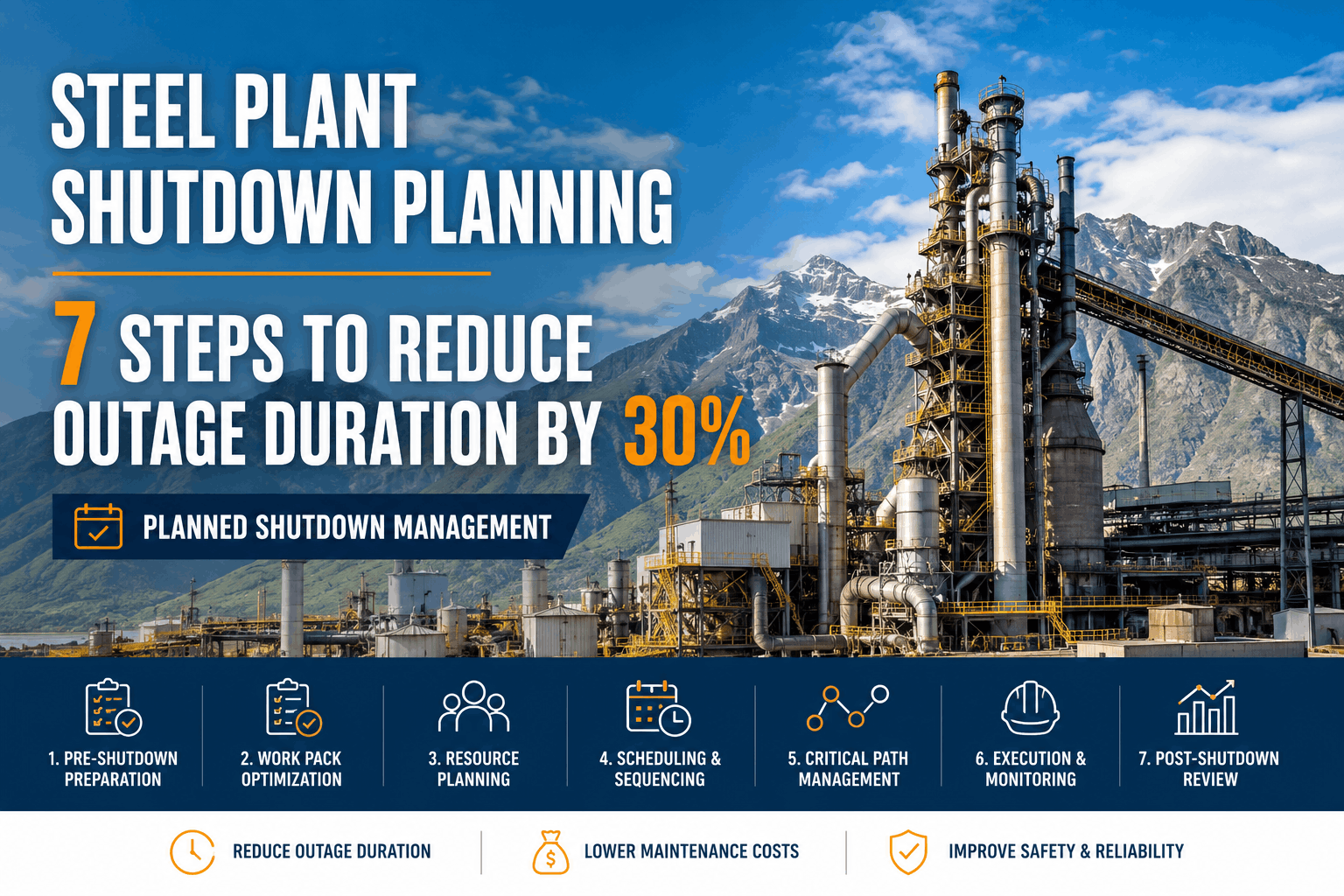
Planned shutdowns are the highest-stakes maintenance events in steel manufacturing. A single turnaround on an EAF or blast furnace can involve 500-2,000 individual work orders, 200-800 maintenance personnel, $2-15 million in direct costs, and 5-30 days of lost production worth $1-5 million per day. The difference between a shutdown that finishes on schedule and one that overruns by even 48 hours can be $2-10 million in additional lost production — more than the cost of the maintenance work itself.
Yet most steel plants still manage shutdowns with spreadsheets, whiteboards, and tribal knowledge. Work packages are built from memory, critical path tasks aren't identified until they're already late, material shortages surface mid-shutdown, and scope creep adds 15-30% to the original timeline. Oxmaint's shutdown management platform replaces chaos with control — giving shutdown planners a centralized system to plan, schedule, resource, execute, and close out every turnaround with the precision that a $5-15 million event demands.
48 Hours of Shutdown Overrun Costs More Than Most Capital Projects
Steel plant shutdowns are your most expensive maintenance events. Every hour saved is $40K-$200K recovered. Every missed task risks cascade delays that multiply costs exponentially.
Why Steel Plant Shutdowns Go Wrong
Shutdown overruns in steel plants aren't caused by a single failure — they compound from dozens of planning gaps, execution breakdowns, and coordination failures that cascade through the critical path. Understanding these root causes is the first step to eliminating them:
The Complete Shutdown Lifecycle: How Oxmaint Manages Every Phase
Flawless shutdowns aren't about working harder during execution — they're about building a bulletproof plan months in advance and executing it with real-time precision. Oxmaint manages every phase of the turnaround lifecycle:
Scope Development
Build the shutdown work list from three sources: backlog work orders tagged for shutdown, condition-based inspection findings, and regulatory/compliance requirements. Every task is linked to an asset, assigned a priority, and estimated for labor, materials, and duration.
Detailed Planning & Scheduling
Sequence all tasks by dependency, identify the critical path, and build the resource-loaded schedule. Assign craft trades, equipment, and contractors. Confirm all materials are ordered with delivery dates ahead of the shutdown start.
Pre-Shutdown Preparation
Execute all possible pre-work: scaffold erection, material staging, permit preparation, contractor mobilization, and safety briefings. Pre-fabricate assemblies that can be built off-line. Validate every work package is complete and ready.
Real-Time Execution Control
Track every task in real time via mobile updates from the field. Monitor critical path progress, flag delays instantly, reallocate resources dynamically. Manage scope changes through formal change control with instant impact analysis on schedule and budget.
Closeout & Lessons Learned
Systematic punch list tracking ensures nothing returns to service incomplete. Capture actual vs. planned for every metric: duration, cost, resources, and scope changes. Build the lessons-learned database that makes every future shutdown better.
Plan Shutdowns That Finish on Time and Under Budget
Oxmaint gives shutdown planners a centralized command center for scope, schedule, resources, materials, and real-time execution tracking — turning your highest-risk maintenance event into a predictable, controlled process.
Steel Plant Shutdown Types & Planning Requirements
Steel plants execute several types of shutdowns, each with different scope, duration, and planning horizons. Here's how Oxmaint adapts to each type:
EAF Campaign Turnaround
Full refractory reline, electrode system overhaul, roof and shell repairs, off-gas system maintenance, cooling panel replacement, and transformer inspection. Typically 300-800 work orders.
Rolling Mill Annual Shutdown
Complete mill overhaul: bearing replacements, hydraulic system rebuild, roll shop maintenance, cooling system overhaul, electrical inspections, and automation upgrades. 500-1,500 work orders.
Weekend Mini-Shutdown
Targeted maintenance on specific systems: compressor overhaul, crane inspection, cooling tower service, electrical testing, or specific equipment change-outs. 50-200 work orders with tight execution windows.
Shutdown Performance Benchmarks
These metrics separate world-class shutdown execution from the industry average. Use them to evaluate your current performance and set improvement targets for your next turnaround:
Shutdown Readiness Checklist by Countdown
Use this countdown checklist to ensure every critical preparation step is completed before your shutdown window opens. Each milestone is a gate that must be cleared before advancing to the next phase:
Your Next Shutdown Doesn't Have to Be Your Most Stressful Event
Oxmaint turns shutdown chaos into controlled execution. Plan months ahead, execute in real time, and close out with confidence that every task is complete.
Frequently Asked Questions
How far in advance should we start planning a major shutdown?
For major turnarounds (EAF campaign relines, annual rolling mill shutdowns), planning should begin 6 months (T-180 days) before the execution window. This allows time for scope development, long-lead material procurement, contractor sourcing, and detailed scheduling. Weekend mini-shutdowns require 60-90 days of planning. The general rule: every hour of planning saves 3-5 hours of execution time and eliminates $10K-$50K in avoidable delays.
How does Oxmaint handle scope changes during execution?
Every scope addition goes through a formal change control workflow: the requester submits the additional work, Oxmaint instantly calculates the impact on schedule, resources, and budget, and the shutdown manager approves or defers with full visibility into consequences. This eliminates "while we're in there" additions that bypass impact analysis. Plants using this process reduce scope creep from 25-40% to under 5%.
Can contractors update task status directly in Oxmaint?
Yes. Oxmaint provides role-based mobile access for contractor supervisors and crew leads. They update task progress, log completions, flag issues, and submit photo evidence directly from the field using their smartphones. This eliminates the 4-8 hour status lag that plagues radio-based tracking and gives shutdown managers real-time visibility into every active task.
How does Oxmaint prevent material shortages during shutdowns?
Oxmaint links every shutdown work order to its required parts via asset BOMs. The system generates a consolidated material list the moment the scope is frozen, compares it against current inventory, and auto-generates purchase requisitions for any shortfalls. Material delivery is tracked against the shutdown timeline, with alerts when deliveries slip. Material kitting verification ensures every work package has its parts staged and confirmed before T-0.
What's the typical improvement in shutdown schedule adherence?
Steel plants implementing structured CMMS-based shutdown management typically improve schedule adherence from 60-75% to 95-100% within 2-3 turnaround cycles. The first shutdown on the system usually achieves an immediate 10-15% improvement from better material availability and scope control alone. By the third cycle, the lessons-learned database and refined planning templates deliver near-perfect schedule performance.