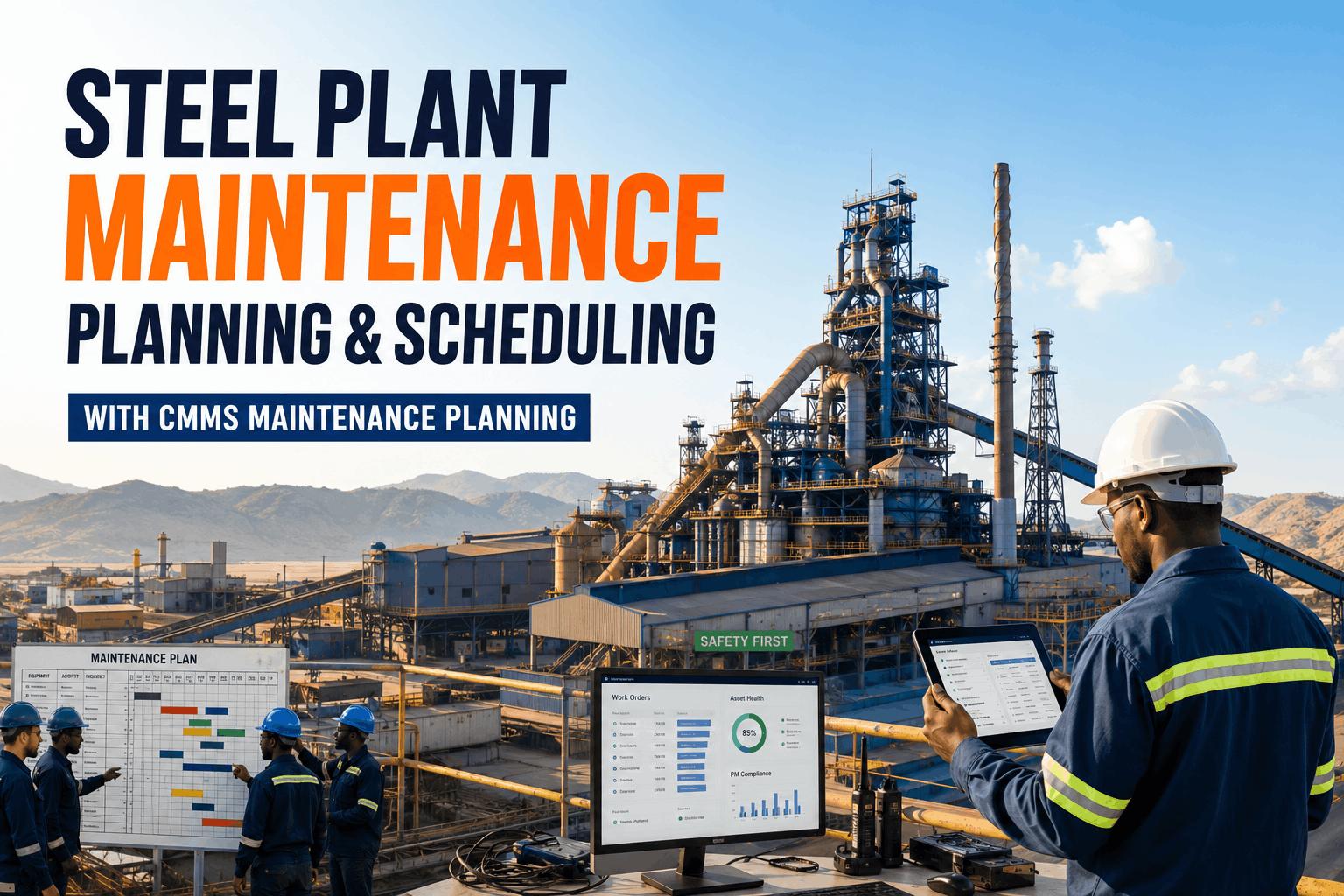
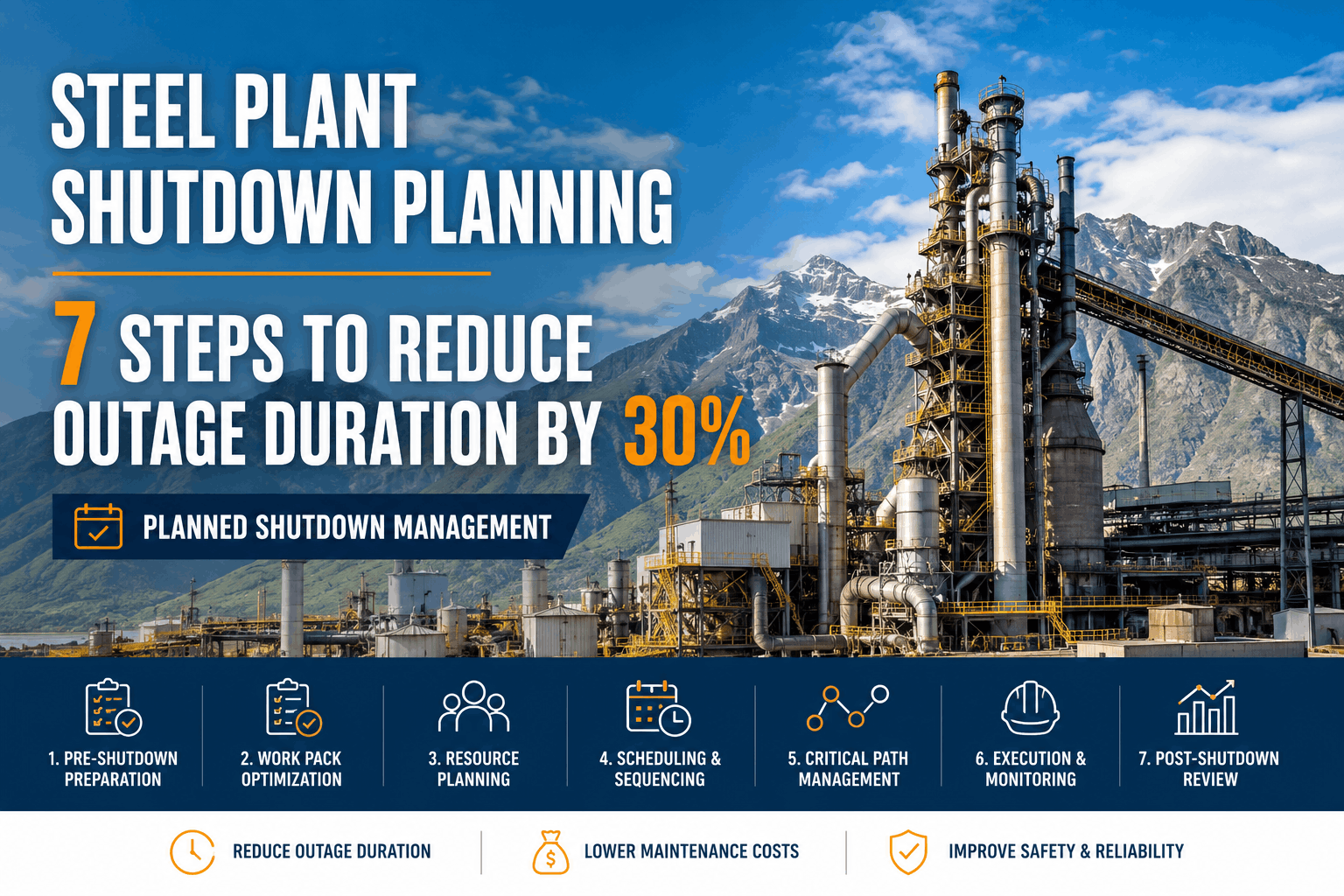
A blast furnace reline that runs 6 days over schedule costs more than the entire maintenance budget for the preceding quarter. A hot strip mill annual shutdown that returns equipment to service with 14% of the planned work incomplete is not a cost saving — it is next quarter's emergency breakdowns, pre-scheduled. Steel plant shutdowns and turnarounds are the highest-stakes maintenance events in the production calendar: concentrating months of deferred work, capital expenditure, and contractor resource into a compressed window where every hour of overrun carries a measurable production cost. The plants that consistently execute turnarounds on time, on scope, and on budget are not those with bigger maintenance teams — they are those with better planning systems. Every task pre-planned. Every resource pre-confirmed. Every critical path visible before the first vessel is opened. Book a demo to see how OxMaint's Shutdown Management module structures turnaround planning, resource loading, and live progress tracking for steel plant scheduled outages.
Maintenance Strategy · Steel Plant · Shutdown Management
Steel Plant Shutdown & Turnaround Optimization
Critical path planning · resource loading · scope freeze · live progress tracking · post-shutdown analytics
73%
Work Complete
↑ On schedule
Day 4/6
Timeline
↑ 2 hrs ahead
3
Open Holds
⚠ Parts awaited
94%
Budget Track
↑ Within target
Critical Path — Area Progress
Why Steel Plant Shutdowns Overrun — The Root Causes
01
Scope Not Frozen Before Start
Work added to shutdown scope after the start date is the single largest cause of overrun. Each late addition consumes contractor capacity, disrupts critical path sequencing, and introduces parts that were never staged. A shutdown that starts with 20% of scope "still being finalised" will overrun by at least that margin.
02
Critical Path Not Identified
Most steel plant shutdowns are managed as a task list, not a network. When a blast furnace reline, taphole repair, and stove inspection are all running simultaneously without a defined critical path, a one-day delay on the reline is not identified as schedule-threatening until Day 5 of a 6-day outage.
03
Contractor Resource Conflicts
Skilled refractory contractors, specialist inspectors, and hot work teams are shared resources. Without a resource-loaded schedule, two critical path tasks compete for the same 8-person team on the same shift — and the conflict is not identified until the morning of, when it is too late to resolve without extending the schedule.
04
Parts Not Staged at Start
A vessel opened on Day 1 that reveals a worn component requiring a part that takes 4 hours to locate in the warehouse represents 4 hours of productive contractor time waiting. Staged parts kits per work package, confirmed against storeroom inventory before the shutdown starts, eliminate this systematically.
05
No Live Visibility During Execution
Paper-based shutdown tracking — tasks ticked on a printed schedule in the shutdown control room — cannot identify a developing critical path delay in time to act on it. A 6-hour delay in the morning becomes an 18-hour overrun at shutdown completion because nobody had real-time visibility to redeploy resources while there was still time.
The 5-Phase Turnaround Management Framework
Phase 1 · T-12 to T-8 Weeks
Scope Development & Work Order Generation
Define the complete shutdown work list from inspection findings, deferred maintenance backlog, and capital improvement requirements. Generate a work order in OxMaint for every task with estimated duration, craft requirement, material list, and equipment access dependency. The shutdown scope must be 95%+ finalised at this stage — any scope addition after T-4 weeks requires a formal change control process with schedule impact assessment.
Phase 2 · T-8 to T-4 Weeks
Planning, Critical Path & Resource Loading
Build the work order network with predecessors and successors. Identify the critical path — the sequence of tasks whose total duration determines the shutdown length. Load contractor resources against the schedule and identify over-allocations. A rolling mill bearing replacement cannot start until electrical isolation is complete; refractory installation cannot start until the vessel has cooled to entry temperature. These sequencing constraints define the minimum possible shutdown duration.
Phase 3 · T-4 Weeks to Start
Procurement, Kitting & Pre-Shutdown Checks
Confirm all parts and materials are in stock or on confirmed delivery before the shutdown starts. Kit parts per work order and stage in the designated shutdown laydown area. Issue and pre-approve all permits. Confirm contractor arrival dates, mobilisation plans, and competency documentation. Conduct pre-shutdown risk assessment review. Any outstanding procurement or resource confirmation at T-1 week is a schedule risk requiring management attention.
Phase 4 · Shutdown Execution
Live Tracking, Daily Progress & Critical Path Management
Execute against the planned schedule with OxMaint tracking completion percentage per work order updated by technicians on mobile. Daily progress meeting compares actual vs planned using the live dashboard — not a manually updated spreadsheet. Any task running more than 4 hours behind schedule triggers a resource redeployment decision before the delay propagates to the critical path. Hold system manages scope additions with impact assessment before approval.
Phase 5 · Post-Shutdown
Completion Documentation & Lessons Learned
Document actual vs planned duration per task, cost vs budget, and all holds and scope changes with their impact. Generate the post-shutdown analytics report: which tasks drove overrun, which resource bottlenecks were encountered, which parts were missing at execution. This data feeds the planning for the next shutdown — a steel plant that learns systematically from each turnaround compresses its shutdown duration by 5–15% per cycle.
Every Hour of Shutdown Overrun Has a Price. OxMaint Makes It Visible Before It Happens.
From scope freeze to resource loading to live critical path tracking — OxMaint's Shutdown Management module gives every steel plant the structure that top-quartile turnaround performers use to finish on time.
Shutdown KPIs — What Top-Quartile Steel Plants Measure
| KPI |
Industry Average |
Top Quartile |
OxMaint Tracking |
| Scope freeze compliance |
60–70% frozen at T-4 weeks |
>95% frozen at T-4 weeks |
Scope change log with date, impact, and approver per addition |
| Schedule compliance |
Actual 115–130% of planned duration |
Actual 100–108% of planned |
Live actual vs planned per work order; daily variance report |
| Cost vs budget |
110–125% of approved budget |
100–110% of approved budget |
Real-time cost vs budget per work order and total shutdown |
| Parts availability at execution |
12–18% of WOs with missing parts at start |
<3% parts shortfall at execution |
Pre-shutdown parts confirmation report; hold flag on unconfirmed items |
| Work completion rate |
82–88% of planned scope completed |
>96% of planned scope completed |
Work order completion % updated live by technician on mobile |
| Rework rate (post-shutdown failures) |
8–14% of shutdown tasks require rework |
<4% |
Post-shutdown failure tracking linked to shutdown work order history |
"
The number I watch most closely when evaluating a steel plant's turnaround management maturity is not the shutdown duration — it is the scope freeze date compliance. A plant that has 95% of its work scope finalised at T-4 weeks almost always finishes on time. A plant that is still adding tasks at T-1 week almost always overruns, because late-added scope consumes the contingency buffer that was built into the schedule for legitimate unknowns. The second number is resource conflict density at the original schedule — the percentage of work packages with a shared resource allocation on the critical path. In OxMaint, I can see both numbers before the shutdown starts. If scope freeze is below 90% and resource conflicts are above 15%, I know we need to delay the start date or compress scope, because the mathematics of the schedule will not permit on-time completion regardless of execution quality.
Gerhard Schöttler, Dipl.-Ing., TÜV-Certified
Turnaround & Outage Planning Manager — ThyssenKrupp Steel Europe · 26 Years Blast Furnace and Rolling Mill Shutdown Management · Specialist in critical path optimisation, refractory campaign planning, and CMMS-based turnaround management for integrated steelworks
Frequently Asked Questions
How does OxMaint's Shutdown Management differ from standard PM scheduling?
Standard PM scheduling manages recurring tasks at defined intervals across normal plant operation. Shutdown management is a project management function — a time-bounded event with a defined scope, critical path, resource plan, and cost budget. OxMaint's Shutdown module treats each turnaround as a distinct project: work orders are grouped into a shutdown event, resource loading is visible across all tasks simultaneously, critical path dependencies are defined between work orders, and live progress is tracked against the planned Gantt at the task level rather than the daily summary level.
Book a demo to see the Shutdown Management module configuration for a blast furnace or rolling mill turnaround.
How far in advance should steel plant shutdown planning begin?
Major shutdowns (blast furnace relines, mill annual shutdowns) should begin scope development 12–16 weeks before the planned start date. Critical path analysis and resource loading at 8 weeks. Parts procurement confirmed at 6 weeks. Scope frozen at 4 weeks. Permits pre-issued at 2 weeks. Each stage has a specific deliverable that must be complete before the next stage can proceed effectively. Plants that compress planning timelines consistently overrun on execution. OxMaint's shutdown planning templates provide the phase-gate checklist and deliverable tracking for each planning stage.
Start a free trial to configure your shutdown planning calendar in OxMaint.
What is the typical shutdown duration reduction achievable with structured turnaround management?
Plants moving from unstructured (task-list) shutdown management to structured turnaround management using OxMaint typically report 15–25% shutdown duration reduction on the first structured turnaround. This comes from three sources: scope freeze compliance reducing late-addition disruption (5–8% duration reduction), resource conflict elimination allowing parallel work that was previously sequential (6–10% reduction), and parts availability eliminating contractor waiting time (4–7% reduction). Duration reduction compounds over successive shutdowns as the post-shutdown analytics feed more accurate planning data into each subsequent event.
Shutdown Management · OxMaint · Steel Plant Turnarounds
Your Next Shutdown Will Overrun or It Won't. The Difference Is What Happens in the 12 Weeks Before It Starts.
Scope freeze, critical path, resource loading, parts confirmation, and live progress tracking — OxMaint's Shutdown Management module gives every steel plant the operational structure that consistently delivers turnarounds on time, on scope, and on budget.