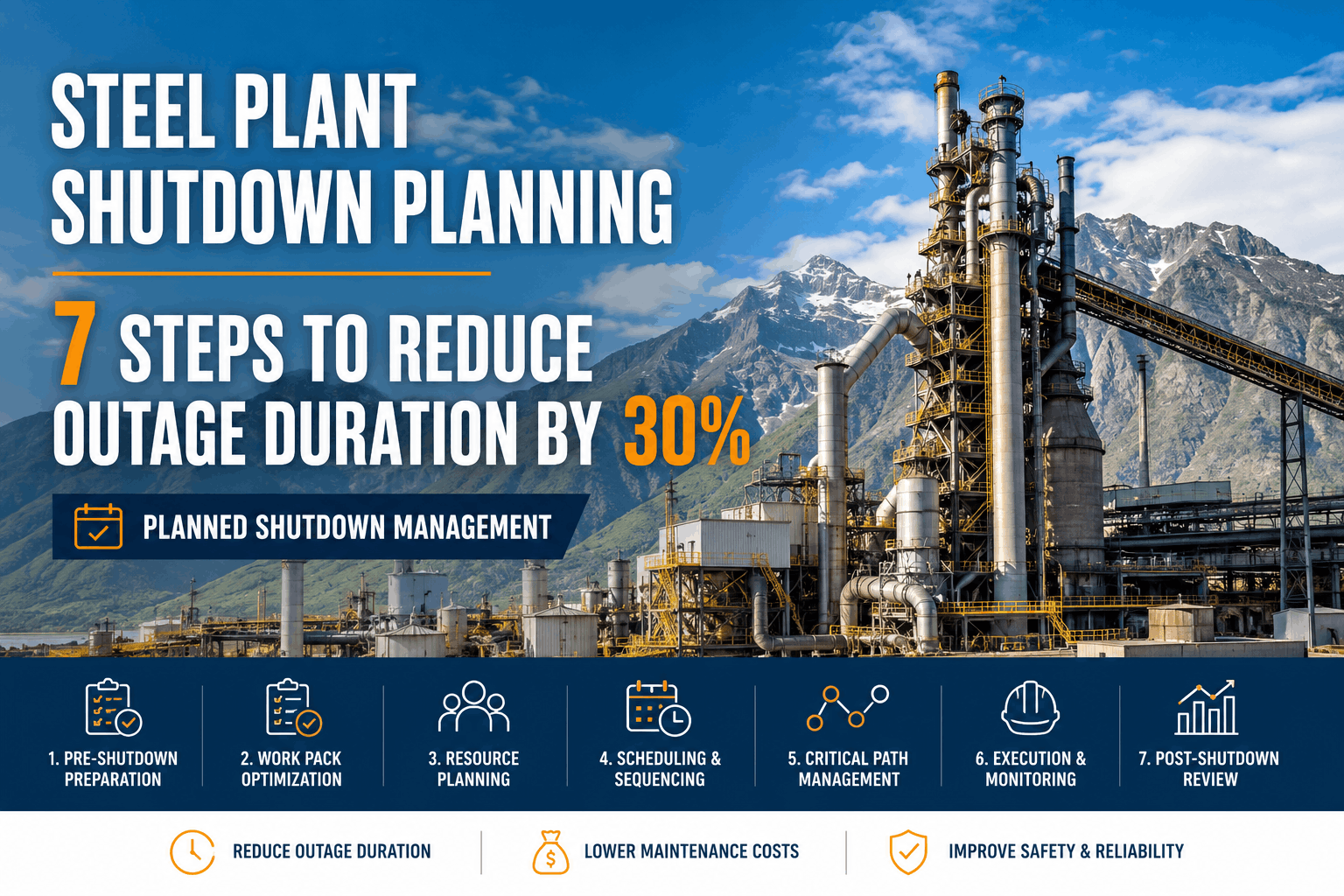
Planned steelmaking shutdowns and turnarounds are the most complex, high-stakes logistical events in manufacturing. A integrated steel mill executing a major planned shutdown must coordinate 200–500 contractors, schedule 1,000–3,000+ work items across equipment zones, manage critical path dependencies spanning 21–35 days, and optimize resource allocation to minimize outage duration while ensuring zero quality escapes and safety compliance. Yet 64% of steelmakers still manage shutdown planning with spreadsheets, email chains, and manual progress tracking—creating information fragmentation that delays decision-making, generates rework, and extends outage duration 5–15 days beyond planned windows. Start Free Trial with Oxmaint's shutdown planning module to centralize work pack definition, enable real-time progress tracking across all zones and contractors, and embed critical path analysis into daily decision-making. Schedule a Demo to see how leading steelmakers reduce planned outage duration by 25–35%, cut shutdown costs by $10M–$30M, and achieve first-cycle quality on 95%+ of completed work. This guide provides shutdown managers, reliability engineers, and capital project teams the framework to standardize shutdown planning, embed critical path logic, and eliminate the coordination gaps that drive outage overruns.
Why Steel Plant Shutdown Planning Directly Controls Outage Duration, Cost, and Production Recovery
Planned shutdowns in integrated steel mills are windows of opportunity to execute major capital projects, perform preventive maintenance on critical assets, upgrade equipment, and recalibrate production systems—but only if execution is flawless. A 35-day unplanned extension of a planned shutdown costs $50M–$150M in lost production, extended contractor fees, overtime labor, expedited capital spending, and delayed customer order recovery. Conversely, mills that compress planned outage duration by 5–10 days through rigorous shutdown planning capture $25M–$75M in production value recovery and reduce contractor and labor costs by 15–25%. The difference between a 35-day shutdown and a 28-day shutdown is precision planning, real-time progress visibility, critical path discipline, and immediate decision-making when obstacles emerge. Start Free Trial to build centralized shutdown management that defines every work package with clear success criteria, embeds task dependencies and resource requirements, tracks progress by zone and contractor in real time, and flags critical path risks daily. Mills implementing structured shutdown planning reduce outage duration 25–35%, achieve 95%+ work quality on first cycle, reduce rework by 60–75%, and eliminate post-startup surprises that extend production recovery by weeks.
Critical Shutdown Planning Failures and Why Steel Plants Miss Outage Windows
Shutdown delays are not accidental—they result from fragmented planning and execution processes that compound daily. Schedule a Demo to see how Oxmaint centralizes shutdown work packs, enables transparent contractor communication, and embeds critical path visibility into daily stand-ups.
Work packages lack clear success criteria, drawings, or acceptance standards. Contractors interpret scope ambiguously, leading to rework when quality expectations go unmet or scope disputes delay closure.
Critical path activities are not mapped; teams discover mid-shutdown that Task B cannot start until Task A completes, forcing sequence rework and extending timeline unpredictably.
No visibility to resource requirements per work package. Contractors arrive expecting equipment and crews that are allocated to competing tasks, forcing idle time or rework delays.
No real-time tracking system; site managers discover delays only when work falls 5–10 days behind schedule, leaving no margin for recovery or decision-making.
Each contractor manages their own tasks in isolation with no integration. Cross-contractor dependencies create bottlenecks when one contractor's delay cascades through 5–10 dependent tasks.
Quality escapes discovered during startup ramp delay recovery by 7–14 days as work is reworked. First-cycle quality often falls below 80% when work packages are not closed with formal inspection.
Shutdown Planning Excellence: Work Package Standards and Execution Framework
Steelmakers executing planned shutdowns within timeline implement rigorous work package definition standards, establish task dependency mapping, track progress transparently across all contractors, and embed critical path discipline into daily management.
| Shutdown Planning Element | Common Failure Mode | Structured Execution Practice | Control Frequency | Duration and Cost Impact |
|---|---|---|---|---|
| Work Package Definition and Scope Clarity | Vague scope, rework from quality misalignment | Mandatory work package template with equipment tag, drawings, success criteria, acceptance sign-off, resource requirements, and contingency logic defined pre-shutdown | Per work package; frozen 2 weeks before shutdown | 60–75% reduction in rework; 95%+ first-cycle quality on work packages |
| Task Dependency and Critical Path Mapping | Hidden dependencies discovered mid-shutdown; schedule rework | Network diagram (CPM) showing all task sequences, critical path activities, and slack time per task; daily critical path reporting to operations team | Created during planning phase; updated daily during execution | Eliminates 5–10 day rework delays; highlights schedule risk 14 days in advance |
| Resource Planning and Allocation Tracking | Resource contention; contractors idle or delayed start | Equipment and crew allocation matrix per task with conflict detection; daily allocation review ensuring no double-booking or unplanned resource shortage | Per day during shutdown | Zero idle time from resource conflicts; 100% contractor availability on schedule |
| Real-Time Progress Tracking by Zone and Contractor | Progress blindness until 2+ weeks behind; no recovery margin | Daily progress updates per work package with % complete, blockers, and forecast-to-completion; automated alert if any task is >3 days behind critical path | Daily update; real-time visibility | 5–10 day schedule recovery margin enables decision-making before full impact |
| Critical Path Risk Management and Decision Authority | Delayed decisions on critical path issues; schedule drift increases | Daily stand-up meeting with operations, engineering, and contractor leads; 30-minute decision window on critical path blockers with clear escalation protocol | Daily 6 AM stand-up | Critical path delays resolved within 1 day vs. 3–5 day delay without real-time escalation |
| Quality Checkpoint and Work Closure | Quality escapes discovered during startup; 7–14 day rework | Mandatory quality checkpoint and contractor sign-off before task closure; final walkdown by operations before handover to production | Per completed work package | 95%+ first-cycle quality; zero startup quality surprises; eliminates 7–14 day post-startup rework |
| Schedule Compression Contingency Planning | No pre-planned fallback for delays; 15–30 day overrun common | Identify parallel work opportunities to compress timeline; pre-plan fast-track alternatives if critical path slips 3+ days; pre-negotiate contractor overtime capacity | Planning phase; activated if critical path risk detected | 5–10 day duration recovery capability built into shutdown execution plan |
Building Steel Plant Shutdown Excellence with Integrated CMMS
Leading integrated steelmakers standardize work package definition, embed critical path logic into CMMS, track progress transparently, and manage contractor coordination through centralized planning systems. Schedule a Demo to see how Oxmaint centralizes shutdown planning and enables 25–35% duration reduction.
- Create master work package template including equipment tag, asset number, scope of work with drawings/sketches, success acceptance criteria, resource requirements (crew size, duration, equipment), and contractor assignment
- Populate all planned work packages (1,000–3,000+ items depending on mill size) and assign owners; lock scope 2 weeks before shutdown to prevent mid-shutdown scope creep
- Stage all work package data in CMMS with hyperlinks to drawings, permits, safety requirements, and acceptance checklists for contractor visibility
- Identify task dependencies using CPM (Critical Path Method) network diagram; establish sequence logic and duration estimates per task from historical data and contractor input
- Calculate critical path with zero-slack activities and identify total float for non-critical tasks; highlight critical path activities that control total shutdown duration
- Create dashboard showing critical path, major milestones (e.g., hot equipment cool-down, equipment removal, major installation dates), and schedule risk zones
- Create resource allocation matrix showing crew requirements, equipment needs, and facility requirements (scaffolding, staging areas) per task and day; identify resource conflicts or double-bookings
- Establish contractor coordination protocol with daily status meetings, progress update requirements, blocker escalation, and decision authority for critical path issues
- Configure CMMS alerts for resource conflicts and task dependencies; enable real-time visibility to contractor forecast-to-completion and blocker status
- Daily progress update from each contractor/zone with % completion, blockers, and forecast-to-completion; automated alert if critical path activity is >3 days behind schedule
- Daily 6 AM stand-up with operations, engineering, contractors, and logistics to review critical path status, resolve blockers, and authorize schedule recovery actions
- Real-time CMMS dashboard showing shutdown progress by zone, critical path status, resource utilization, and quality checkpoint completion; visible to all stakeholders
Shutdown Execution Best Practices and Quick Wins
Steel Plant Shutdown KPIs and Performance Metrics
Steel plants tracking shutdown execution KPIs directly link planning discipline to cost control and production recovery. Start Free Trial with Oxmaint's shutdown management dashboard to track duration, quality, and cost performance real time.
Actual shutdown duration vs. planned baseline. Mills achieving ±3 day accuracy demonstrate critical path discipline. Overruns >5–10 days indicate planning or execution gaps.
Percentage of work packages completing on or before scheduled date. Below 85% indicates resource contention or task dependency issues requiring mitigation.
Percentage of work packages passing quality checkpoint and accepted on first cycle with no rework. Below 85% predicts 7–14 day startup recovery extension.
Time from identification of critical path risk to mitigation action. Sub-1-day response enables schedule recovery; 3–5 day delays allow risk to materialize into 5–10 day overruns.
Actual shutdown cost vs. budget. Variance >10% driven by schedule overruns (extended contractor fees) or rework. Tight cost control correlates with schedule discipline.
Cost of rework discovered during production ramp-up vs. total shutdown budget. Below 5% indicates quality discipline. Above 10% forces 7–14 day production recovery delay.
Shutdown Success: Real Impact from Structured Planning and Execution
"Our last three planned shutdowns averaged 38–40 days, extending 8–12 days beyond plan. Contractors operated in silos; we had no critical path visibility. After implementing Oxmaint with centralized work packages, dependency mapping, and daily progress tracking, we executed our latest 35-day shutdown in exactly 28 days—20% ahead of plan. Resource utilization improved 34% through conflict elimination. Quality checkpoints caught 8–10 rework items before startup, saving $2M+ in post-startup recovery costs. First-cycle quality improved from 82% to 97%. We estimated the 7-day compression captured $25M in production value recovery and saved $8M in extended contractor and labor costs. The system has become indispensable for shutdown execution."