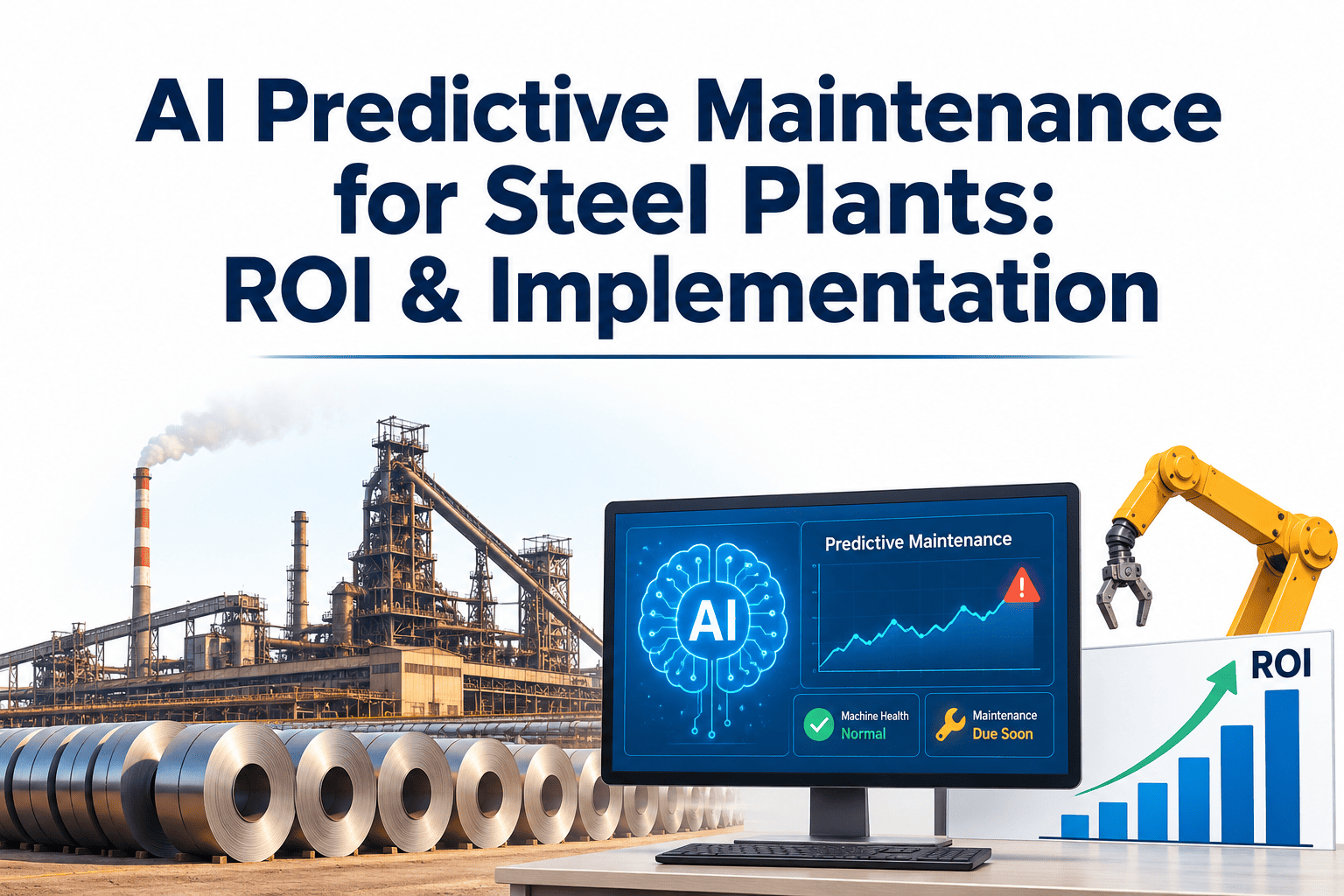
The Fourth Industrial Revolution is transforming steel manufacturing from isolated production islands into integrated smart factories where equipment, systems, and people communicate seamlessly in real-time. Smart factory technology—combining IoT sensors, AI analytics, cloud computing, and digital twins—enables steel plants to achieve operational excellence that was impossible just five years ago. From blast furnace optimization through predictive analytics to autonomous quality control in rolling mills, connected manufacturing delivers 20-35% productivity improvements while reducing energy consumption, scrap rates, and unplanned downtime. This comprehensive guide reveals how US steel manufacturers are implementing smart factory capabilities without massive capital expenditure or multi-year transformation programs. We'll break down the essential technology stack, prioritize high-ROI use cases, provide realistic implementation timelines, and show you exactly how to build a business case that proves smart factory investment delivers measurable returns in 8-16 months. Whether you're operating a 200-person mini-mill or a 2,000-employee integrated facility, this roadmap will help you compete with global steel producers through digital transformation.
The Smart Steel Plant Vision
Connected systems driving operational excellence across the production chain
The Smart Factory Technology Stack for Steel Manufacturing
Edge Devices & Sensors (OT Layer)
Equipment Monitoring:
- Vibration sensors on rotating equipment (motors, gearboxes, bearings)
- Temperature sensors on furnaces, motors, hydraulics (500-2,500°F range)
- Pressure transducers for hydraulic systems and compressed air
- Current sensors for motor load and electrical distribution monitoring
Process Monitoring:
- Laser thickness gauges on rolling mills (micron-level precision)
- Vision systems for surface quality inspection and defect detection
- Chemical analyzers for melt composition in real-time
- Flow meters tracking cooling water, hydraulic fluid, lubricants
Environmental & Safety:
- Gas detection systems (CO, CO2, combustibles)
- Thermal cameras for hot spot detection and energy loss identification
- Noise and vibration monitoring for OSHA compliance
- Air quality sensors tracking particulates and emissions
Edge Computing & Data Collection
Edge Gateways:
- Industrial PCs handling local data aggregation and preprocessing
- Protocol converters translating legacy equipment signals (Modbus, Profibus, OPC-UA)
- Edge analytics performing real-time calculations and filtering
- Local storage buffering data during network interruptions
Network Infrastructure:
- Industrial Ethernet backbone (redundant fiber optic rings)
- Wireless networks (Wi-Fi 6, private 5G) for mobile equipment and tablets
- Secure VPN tunnels connecting plant floor to cloud platforms
- Time-series databases optimized for high-frequency sensor data
Manufacturing Execution Systems (MES)
Core MES Capabilities:
- Production scheduling optimized across blast furnace, casting, and rolling
- Work order management with real-time status tracking
- Quality management integrating inline inspection data
- Genealogy tracking every coil/billet from raw material to shipment
Steel-Specific Functions:
- Heat tracking through entire production chain with temperature profiles
- Chemical composition tracking and automatic adjustment recommendations
- Rolling mill pass scheduling and force calculations
- Inventory management for work-in-process across production stages
Analytics & AI Platform
Predictive Analytics:
- Machine learning models predicting equipment failures 2-8 weeks early
- Anomaly detection identifying process drift before quality impacts
- Remaining useful life (RUL) calculations for critical components
- Energy consumption optimization through AI-driven setpoint recommendations
Digital Twin Capabilities:
- Virtual blast furnace modeling for burden optimization and fuel efficiency
- Rolling mill simulation testing new schedules without production risk
- Predictive quality models correlating process parameters to defects
- What-if scenario planning for capacity and throughput optimization
Enterprise Integration (ERP/CMMS)
ERP Integration:
- Production data flowing to SAP/Oracle for cost accounting
- Inventory movements synchronized with materials management
- Quality data integrated with customer order management
- Maintenance costs posted to financial controlling in real-time
CMMS Integration:
- Condition monitoring alerts auto-generating maintenance work orders
- Equipment sensor data enriching asset health scoring
- Maintenance schedules coordinated with production planning
- Spare parts usage tracked against equipment performance trends
8 High-Impact Smart Factory Use Cases for Steel
Predictive Maintenance
Vibration, temperature, and oil analysis sensors continuously monitor critical equipment. Machine learning models detect degradation patterns weeks before failure, triggering automated work orders in CMMS for planned intervention during scheduled downtime windows.
Energy Optimization
Real-time monitoring of power consumption across all major loads combined with AI optimization algorithms that adjust furnace temperatures, motor speeds, and HVAC systems to minimize energy use while maintaining production targets and quality standards.
Automated Quality Control
Vision systems and laser sensors inspect 100% of product at production speed, detecting surface defects, dimensional variance, and metallurgical issues. AI models correlate defects back to process parameters enabling automatic correction before scrap accumulates.
Production Optimization
MES systems coordinate production across blast furnace, casting, and rolling based on real-time equipment status, order priorities, and yield optimization. Digital twin simulations test schedule changes before implementation to maximize throughput without quality risk.
Inventory & Logistics Intelligence
RFID and GPS tracking monitors raw materials, work-in-process, and finished goods across the facility. AI predicts inventory needs based on production schedules and historical consumption patterns, optimizing just-in-time delivery and reducing working capital tied up in excess stock.
Workforce Productivity Enhancement
Mobile devices with AR overlays guide technicians through complex maintenance procedures. Digital work instructions eliminate paper manuals. Real-time dashboards provide operators instant visibility into equipment performance, quality trends, and production targets.
Compliance & Traceability Automation
Automated data capture creates complete audit trails for every heat and coil. Chemical composition, process temperatures, mechanical properties, and quality inspections linked to specific customer orders. OSHA/EPA compliance documentation generated automatically from sensor data and maintenance records.
Supply Chain Integration
Real-time production data shared with suppliers and customers through secure APIs. Suppliers receive automated replenishment signals based on actual consumption. Customers access live order status, quality certificates, and shipment tracking without manual intervention.
Ready to build your smart factory roadmap? Oxmaint serves as the CMMS foundation for smart factory initiatives—integrating IoT sensors, maintenance data, and production systems into unified operational intelligence.
Phased Implementation: 18-Month Smart Factory Transformation
Strategic Focus:
Establish data infrastructure and demonstrate quick wins
Key Activities:
- Deploy sensors on 25-40 most critical assets (vibration, temperature, current)
- Install edge gateways and configure data collection pipelines
- Implement CMMS with IoT integration (Oxmaint) for predictive maintenance
- Train maintenance team on condition-based monitoring fundamentals
- Establish baseline KPIs: equipment availability, MTBF, energy consumption
Strategic Focus:
Deploy AI/ML models and optimize production processes
Key Activities:
- Implement analytics platform with machine learning capabilities
- Develop predictive models for equipment failure and quality defects
- Deploy energy monitoring with optimization recommendations
- Launch automated quality inspection on primary production line
- Integrate MES for production scheduling and work order management
Strategic Focus:
Enterprise system integration and workforce enablement
Key Activities:
- Integrate MES with ERP for bidirectional data flow (SAP/Oracle)
- Deploy mobile applications and AR maintenance guidance
- Expand sensor coverage to B-level assets (100+ additional endpoints)
- Implement digital twin for blast furnace optimization
- Launch customer portal for order visibility and quality certificates
Strategic Focus:
Continuous improvement and advanced capabilities
Key Activities:
- Refine AI models based on 12+ months of production data
- Implement advanced process control (APC) on rolling mill
- Deploy supply chain integration APIs with key suppliers/customers
- Establish real-time operational dashboards for all stakeholders
- Document ROI and develop roadmap for next-phase capabilities
18-Month Smart Factory Investment Summary
Overcoming Common Smart Factory Implementation Challenges
Legacy Equipment Integration
Cybersecurity & OT/IT Convergence
Workforce Skills Gap
Data Quality & Governance
ROI Measurement & Justification
Integration Complexity
Start Your Smart Factory Journey with Proven Foundation
Oxmaint provides the CMMS and IoT integration layer that serves as the operational data backbone for smart factory initiatives—connecting equipment sensors, maintenance workflows, and production systems into unified intelligence that drives measurable results.
Frequently Asked Questions
What's the minimum viable smart factory for a mid-size steel plant?
A minimum viable program focuses on predictive maintenance and energy optimization—the two highest-ROI use cases. Deploy vibration and temperature sensors on 25-40 critical assets (rolling mill drives, blast furnace equipment, large motors). Implement CMMS with IoT integration for automated work order generation. Add energy monitoring on major loads with optimization recommendations. Total investment: $280K-$420K. This delivers 60-75% of full smart factory ROI while building organizational capability and proving value for subsequent phases. Expect 8-12 month payback from prevented catastrophic failures and energy savings alone.
How do you integrate smart factory technology with 30-year-old equipment?
Legacy equipment integration relies on retrofit sensors and protocol translation rather than equipment replacement. Wireless vibration sensors mount externally without modifying equipment. Clamp-on temperature and current sensors install non-invasively. For control system integration, edge gateways translate legacy protocols (Modbus RTU, Profibus) to modern standards (OPC-UA, MQTT). The strategy is monitoring and analytics rather than control—you extract operational intelligence without touching core equipment controls. This approach captures 80% of smart factory value at 20% of the cost versus full automation upgrades. Save control system replacements for end-of-life equipment replacement cycles.
What cybersecurity measures are essential for connected steel plants?
Steel plants require defense-in-depth security architecture: network segmentation isolating critical control systems from IT networks and internet, industrial firewalls with deep packet inspection at OT/IT boundary, encrypted VPN tunnels for cloud connectivity using site-to-site IPsec or similar, multi-factor authentication for remote access, intrusion detection systems monitoring for anomalous traffic patterns, regular security audits and penetration testing, and incident response playbooks specific to OT environments. Many insurance carriers now offer 8-15% premium reductions for documented cybersecurity programs, partially offsetting implementation costs. Budget $80K-$150K for robust industrial cybersecurity foundation plus $25K-$40K annual ongoing monitoring and updates.
Can smart factory initiatives be self-funded through early phase savings?
Yes—phased implementation enables early wins to fund later stages. Phase 1 (predictive maintenance foundation) typically prevents 1-3 catastrophic failures within 6-9 months, delivering $1.5M-$4M in cost avoidance against $280K-$420K investment. These documented savings build credibility for Phase 2 funding (analytics and optimization). By Month 12, cumulative benefits typically exceed total program investment, making subsequent phases self-funding from operational budget rather than requiring new capital approval. This approach also reduces risk—you validate ROI assumptions with real data before committing to full transformation, and leadership sees tangible results building confidence for continued investment.
How do you measure smart factory ROI when benefits span multiple departments?
Establish comprehensive baseline metrics before implementation across all impacted areas: maintenance (equipment availability, MTBF, maintenance costs), production (throughput, cycle time, yield), quality (scrap rate, rework, customer complaints), energy (consumption per ton, demand charges), and finance (working capital, inventory turns). Track monthly performance against baselines with attribution methodology—for example, prevented equipment failures documented through condition monitoring alerts clearly attributable to smart factory. Create executive dashboard showing cumulative investment vs. documented savings across all categories. Most successful programs appoint a smart factory program manager responsible for ROI tracking and reporting, ensuring benefits don't get lost in operational noise.
Transform Your Steel Plant Into a Connected Manufacturing Leader
Oxmaint serves as the operational intelligence foundation for smart factory transformation—integrating IoT sensors, maintenance data, and production systems to deliver predictive insights, automated workflows, and measurable ROI from day one.