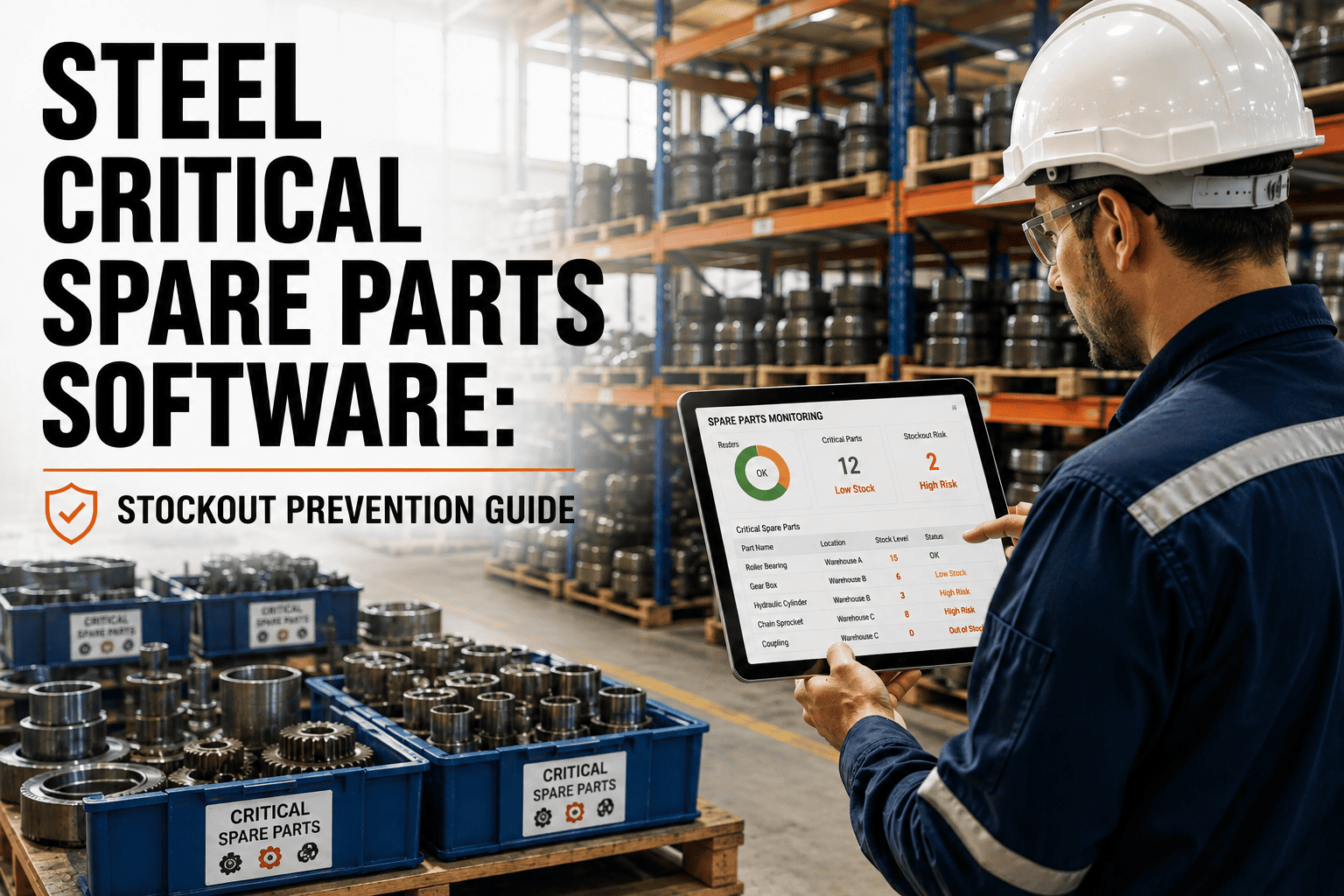
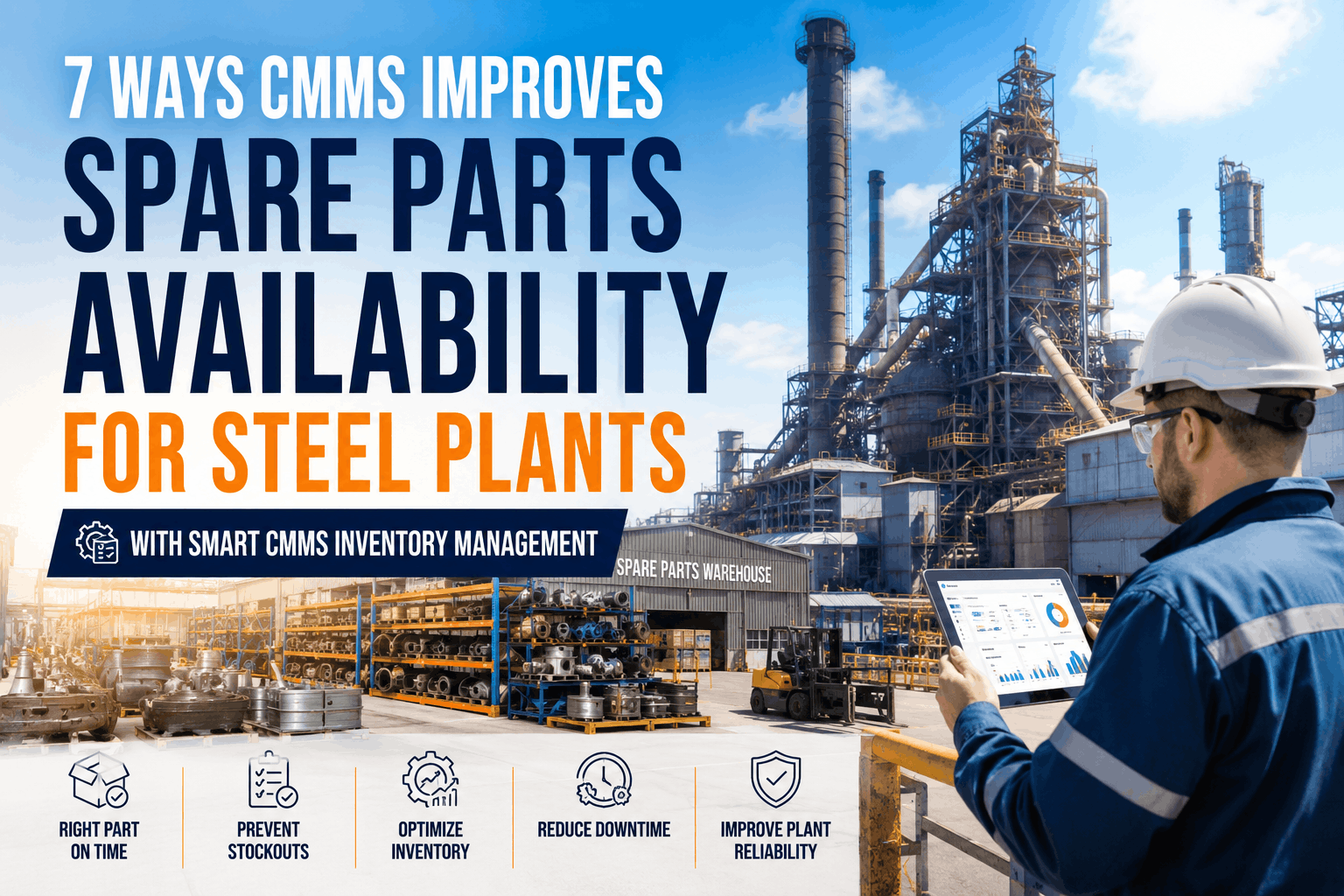
In a large steel plant, a single missing spare part can trigger a cascade that costs $23.9 million per day. Blast furnace downtime alone exceeds $500,000 per hour, and with 8 days minimum required for even a minor repair cycle (4 days cooling, 1 day maintenance, 3 days restart), one stockout of a critical component like a tuyere or a blower bearing can wipe out weeks of profit. Meanwhile, McKinsey estimates that 10-40% of MRO spare parts in heavy industry are slow-moving and rarely used, silently inflating carrying costs and tying up working capital that could be deployed elsewhere.
The spare parts management market is projected to grow from $1.02 billion in 2025 to $1.82 billion by 2030 (12.3% CAGR), driven by the shift to intelligent, data-driven inventory control. Steel plants that master spare parts management don't just avoid catastrophic stockouts — they free up millions in working capital, reduce emergency procurement premiums, and ensure every maintenance job starts with the right part on the shelf. Oxmaint's CMMS makes this possible with automated reorder triggers, real-time inventory tracking, and full equipment-to-parts traceability. Schedule a demo.
The Real Cost of Getting Spare Parts Wrong
Steel plants face a double-edged sword: stockouts cause catastrophic production losses, while overstocking silently drains working capital. Both extremes are expensive, and most plants struggle with both simultaneously across different part categories:
The Cost of Stockouts
- $500,000+/hour in blast furnace production losses
- $23.9M/day for non-catastrophic unplanned events
- 8-day minimum repair cycle (cool → fix → restart)
- Emergency procurement at 3-5x standard pricing
- Customer penalties for missed delivery deadlines
- Cascade failures when one breakdown triggers others
The Cost of Overstocking
- 10-40% of MRO inventory is slow-moving or obsolete
- Carrying costs at 15-25% of inventory value annually
- Dead capital trapped in warehouse shelves, not production
- Parts degradation — motors, seals, electronics degrade in storage
- Warehouse space consumed by parts that may never be used
- Obsolescence risk when equipment is upgraded or replaced
Steel Plant Spare Parts: A Classification Framework
Not all spare parts are equal. A classification system ensures critical parts are always available while preventing overstocking of low-priority items. Here's the framework that top-performing steel plants use:
Parts whose absence causes immediate production stoppage or safety hazard. Blast furnace tuyeres, hot blast valves, blower bearings, critical motor windings, cooling stave components, refractory emergency supplies.
Standard maintenance parts with predictable demand. Bearings, gaskets, filters, lubricants, V-belts, hydraulic hoses, electrical contactors, conveyor rollers, pump seals used across multiple assets.
Rarely needed parts with long replacement cycles. Specialized gearbox assemblies, large transformer components, specialized refractory shapes. Consider vendor-managed inventory or consignment stocking to reduce capital lock-up.
Parts for decommissioned equipment, superseded models, or items exceeding 24-month no-movement threshold. These account for 10-30% of total stock and inflate carrying costs with zero operational value.
Automate Your Spare Parts Strategy
Oxmaint links every work order to parts consumed, every asset to its bill of materials, and every spare to its reorder point. No more guessing, no more stockouts, no more dead stock.
How Oxmaint CMMS Transforms Spare Parts Management
The gap between "managing parts in spreadsheets" and "managing parts in a CMMS" is the gap between reactive firefighting and predictive optimization. Here's how Oxmaint closes that gap for steel plants:
Equipment Bill of Materials (EBOM)
Map every asset to its complete parts list. When a work order is created for a blast furnace blower, Oxmaint shows exactly which bearings, seals, and couplings are needed — and whether they're in stock. No more wrong parts, no more missing parts discovered mid-repair.
Auto Reorder & Min/Max Levels
Set minimum and maximum stock levels for every part. When inventory drops below minimum, Oxmaint automatically generates a purchase request with the correct vendor, part number, and quantity. No manual checks, no surprises at 2 AM when a night-shift repair needs a part.
PM-Driven Demand Forecasting
Every preventive maintenance schedule in Oxmaint consumes specific parts. The system forecasts upcoming PM parts demand weeks in advance, ensuring bearings, filters, and lubricants are on the shelf before the PM is due. Planned demand eliminates emergency procurement.
Real-Time Inventory Visibility
See exact stock levels across all storeroom locations — main warehouse, satellite stores near furnaces, and vendor-managed consignment stock. Barcode and QR scanning ensures every issue and return is logged instantly. No more phantom inventory or missing parts.
Consumption Analytics & ABC Reporting
Track which parts are consumed most, which assets eat the most spares, and which parts haven't moved in 12+ months. Automatic ABC classification identifies slow-moving inventory for disposal and high-turn items for buffer increases. Data replaces guesswork.
Steel Plant Spare Parts: What to Stock and Why
Steel plants contain thousands of unique components across dozens of asset types. Here are the critical spare parts categories with stocking strategies:
Never Miss a Part. Never Waste a Dollar.
From blast furnace tuyeres to rolling mill bearings, Oxmaint ensures the right part is on the shelf at the right time — every time. Stop firefighting, start optimizing.
Frequently Asked Questions
How much does spare parts mismanagement cost a steel plant?
Stockouts at a blast furnace cost $500,000+ per hour, with non-catastrophic unplanned events costing $23.9 million per day. A full BF reline triggered by component failure costs $15-40M in materials plus $50-150M in lost production. Overstocking ties up 10-40% of MRO inventory in slow-moving parts, adding 15-25% annually in carrying costs. Large steel manufacturers spend up to $4 billion/year on maintenance, with 20-25% going to unplanned events.
What is the ideal MRO inventory level for a steel plant?
Best practice is MRO inventory at ≤1.5% of Replacement Asset Value (RAV). This is calculated by dividing total MRO inventory value by RAV. Achieving this requires proper ABC classification, automated reorder points, PM-driven demand forecasting, and systematic disposal of obsolete stock. IBM reports that optimized spare parts management can deliver a 40% reduction in inventory costs and 50% reduction in parts-related downtime.
How does CMMS software improve spare parts management?
CMMS platforms like Oxmaint transform parts management through: Equipment Bill of Materials (EBOM) linking every asset to required parts, automated min/max reorder triggers generating purchase requests when stock drops, PM-driven demand forecasting predicting consumption weeks ahead, real-time inventory visibility via barcode/QR scanning, and consumption analytics identifying slow-moving items for disposal. This shifts from reactive procurement to predictive optimization.
Which spare parts should steel plants always keep in stock?
Class A (critical/insurance) parts must be 100% available at all times and cycle-counted quarterly. For steel plants: blast furnace tuyeres, hot blast valves, blower bearings, cooling staves, BOF/EAF refractories, lance tips, and critical motor windings. These are parts whose absence causes immediate production stoppage or safety hazards. Reorder triggers should be automatic to eliminate human error.
How can steel plants reduce obsolete spare parts inventory?
Start by flagging all parts with zero movement in 12+ months. Cross-reference against active equipment to identify parts for decommissioned assets. Options include: selling to other plants, returning to vendors, cross-referencing interchangeable parts that can serve multiple assets, and scrapping true obsolete items. The SPM market is growing 12.3% CAGR as companies adopt AI-driven tools to dynamically optimize stock, replacing static safety stock rules with usage-based intelligent buffers.