Compressed air keeps a steel plant moving — descale valves on the hot mill, mold oscillation on the caster, pinch-roll actuators, purge air on optical sensors, and dozens of pickling line dampers all draw from the same header. Yet most mills have never measured what that header actually costs, because nobody has run a real baseline. A proper steel compressed air audit starts by mapping flow and pressure shop by shop, then isolates leaks before they get blamed on "just how the system runs." Plants that skip this step routinely run 25-35% of generated air straight out through fittings, hose ends, and abandoned drops nobody has looked at in years. This guide walks through baselining the system, isolating leaks by department, and quantifying the savings case in a way a maintenance manager can defend to finance — and Oxmaint is built to hold that audit data long after the survey team leaves.
Steel Compressed Air Audit Software: Baseline, Isolate, Save
Turn a one-time air audit into a permanent maintenance discipline — track header flow, tag leaks by shop, and prove the savings quarter over quarter.
Why Compressed Air Hides In Plain Sight On A Steel Plant Budget
Compressed air rarely shows up as its own line item. It gets buried inside the electricity bill, split across melt shop, rolling mill, and finishing cost centers, and nobody owns it end to end. A single leaking quick-connect on a descale valve manifold does not trip an alarm or stop production, so it stays open for months. Multiply that across a plant with thousands of fittings, actuators, and hose stations spread across several shops, and the waste compounds quietly. An audit only works if it treats compressed air like a utility with its own meter, its own baseline, and its own owner — not a background service that runs itself.
Melt Shop & EAF
Panel cooling dampers, oxygen lance purge circuits, and slag door actuators run continuously and are rarely isolated for leak testing during a heat cycle.
Continuous Caster
Mold oscillation air, spray nozzle purge, and torch cutting stations sit close to heat and vibration, which accelerates fitting and hose failure.
Hot & Cold Rolling
Descale header valves, pinch roll cylinders, and coil wrapping stations cycle thousands of times a shift, wearing seals faster than scheduled PM catches them.
Pickling & Coating
Agitation air and sensor purge curtains run in corrosive atmospheres where standard fittings degrade well ahead of their rated service life.
Finishing & Shipping
Abandoned drops from decommissioned lines are frequently left open or capped poorly, bleeding air with zero production value.
Utility & Compressor House
Dryers, filters, and header pressure set points are often left at legacy settings from decades-old equipment that no longer matches current demand.
Stop Guessing What Your Air System Costs
Oxmaint gives your maintenance team one place to log baseline readings, leak tags, and shop-by-shop savings — from the first survey to the tenth audit cycle.
Baselining Your Steel Plant's Compressed Air System
A baseline is not a single flow reading taken on a quiet Tuesday afternoon. It has to capture the full operating envelope of the plant — peak production, changeover, and off-shift periods — because leak load is easiest to isolate when production demand drops to near zero and header flow should follow it down. If flow stays high while the mill is idle, that gap is your leak number before you even walk the floor.
Map the distribution network
Document every header, sub-header, and drop by shop, including pipe size, age, and known trouble spots flagged by operators.
Install flow and pressure logging
Place meters at the compressor house discharge and at each major shop takeoff point so demand can be attributed rather than estimated.
Log a full production cycle
Capture data across a heat cycle, a shift change, and a planned shutdown window to separate real demand from standing leak load.
Segment demand by department
Break total header flow down by melt shop, caster, rolling mill, and finishing so each area owns its own consumption number.
Calculate specific power
Convert flow and compressor kW draw into kW per 100 cfm so future audits can be compared on a consistent, apples-to-apples basis.
Record the baseline in your CMMS
Store readings against equipment records so the next audit cycle measures progress instead of starting from zero again.
Isolating Leaks Shop By Shop
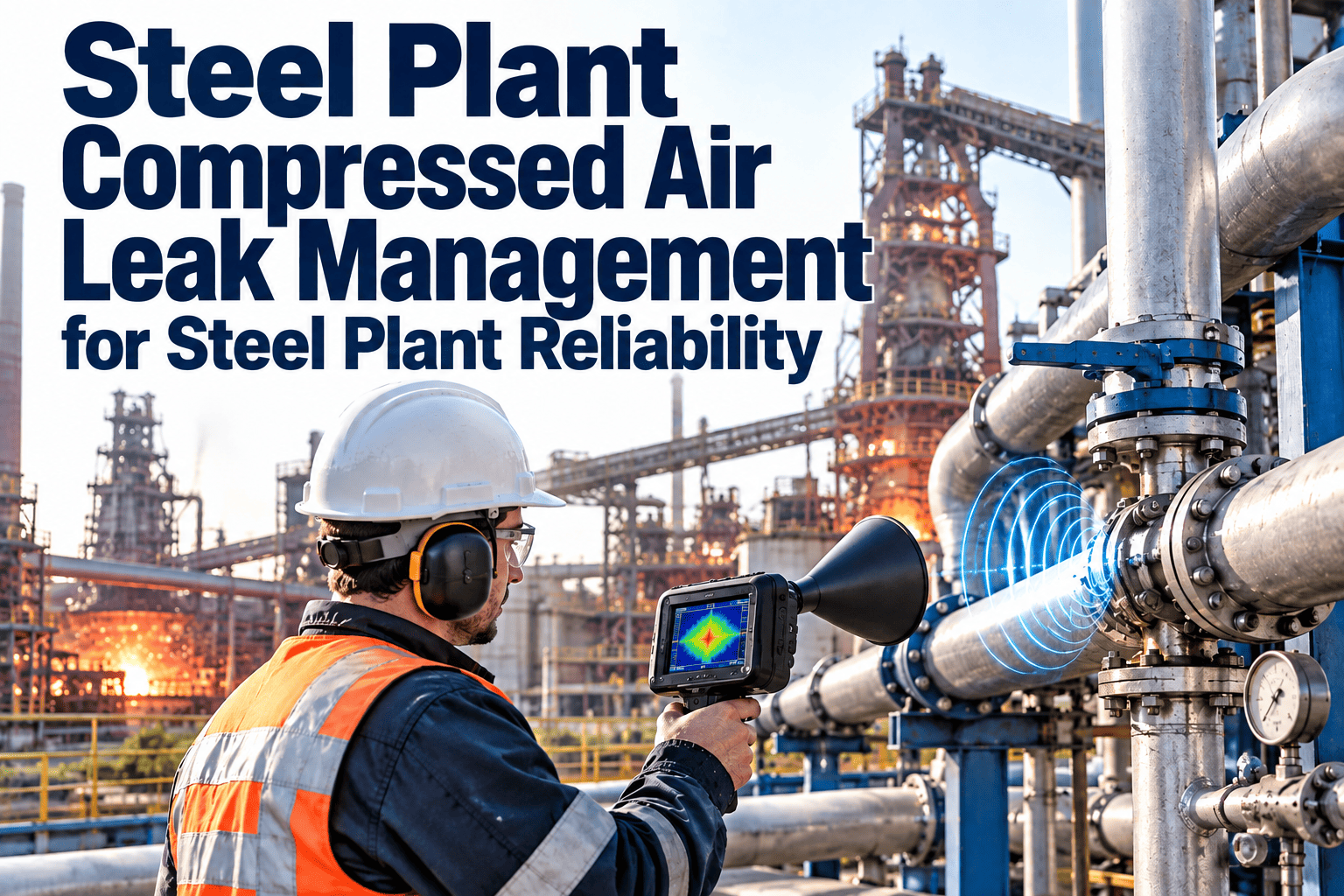
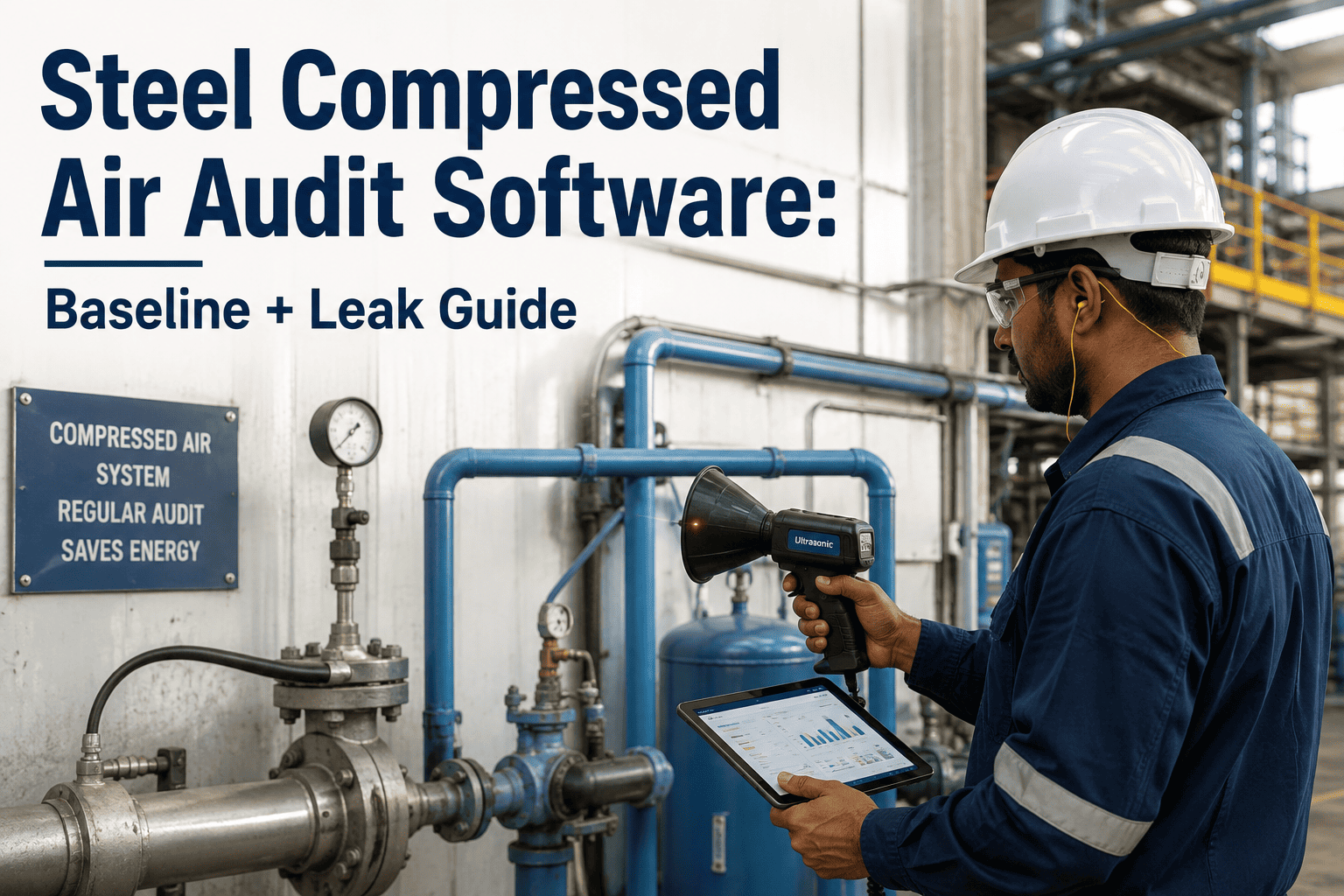
Once the baseline shows where demand is higher than production justifies, the next step is narrowing that gap down to specific shops, then specific circuits. Ultrasonic leak detection is the standard method on a steel plant floor because it works through ambient noise from rolling stands, cranes, and ID fans where a soap-and-bubble test is impractical. The table below shows how a typical isolation sweep breaks down across departments.
Quantifying The Savings Case
Finance will not fund a repair program on the strength of an ultrasonic gun report alone — the audit has to end in a number leadership can weigh against other capital requests. The model below reflects a mid-size integrated plant running a 40,000 SCFM compressed air system before and after a structured leak repair and pressure optimization program.
Before Audit
After Audit & Repairs
Our first walkdown found leaks we had been living with for years — a lance purge fitting in the melt shop alone was worth more than we expected from the whole survey. Logging every tag in Oxmaint meant repairs actually got closed out instead of sitting on a clipboard.
Maintenance Planning Lead, integrated steel plant
Keeping The Audit Defensible Over Time
A compressed air audit only holds value if it can be repeated on the same terms every cycle. ISO 11011 sets the reference methodology most industrial audits are measured against, covering how baseline, leak load, and specific power should be calculated and reported. ISO 8573 governs air quality classes relevant anywhere compressed air touches instrumentation or coated product. Neither standard enforces itself — that discipline comes down to whether your maintenance team logs readings consistently and closes leak tags on schedule.
ISO 11011
Defines the baseline, leak, and specific power calculation method so audits stay comparable year over year.
ISO 8573
Sets air purity classes for particulate, moisture, and oil content relevant to instrument and process air.
Internal Energy KPIs
Specific power and leak percentage tracked monthly give plant leadership an early signal before costs drift upward.
Audit Trail Documentation
Dated readings, tag closure records, and technician sign-off support internal reviews and customer sustainability requests.
Turn One Audit Into A Repeatable Program
See how a steel plant maintenance team uses Oxmaint to log baseline data, assign leak tags by shop, and track savings against the original audit numbers.
How Oxmaint Holds The Audit Together After The Survey Ends
The hardest part of a compressed air audit is not the first survey — it is making sure the second and third audits actually happen and actually compare against the first. Oxmaint gives maintenance teams a shared system of record for baseline data, leak tags, and repair closure so the program survives staff turnover and shift changes.
Leak Tag Tracking
Log every leak found during a sweep with location, estimated size, and shop assignment, then track repair status until it is closed.
Baseline & Trend Logging
Store flow, pressure, and specific power readings against each audit cycle so year-over-year comparisons are automatic.
Shop-Level Cost Attribution
Break down compressed air spend and savings by melt shop, caster, rolling mill, and finishing so each area owns its number.
Work Order Generation
Convert a leak tag directly into a scheduled work order with parts, priority, and assigned technician in a single step.
Energy KPI Dashboards
Track kW per 100 cfm and leak percentage on a rolling basis so drift gets caught before the next full audit cycle.
Audit Documentation Export
Generate a full audit history report in one step for internal reviews, energy program filings, or customer sustainability requests.
Frequently Asked Questions
How often should a steel plant repeat a compressed air audit?
What is the fastest way to estimate leak load without a full survey?
Why do leaks concentrate near the caster and hot rolling mill?
Can compressed air audit data be tracked in the same system as PM schedules?
Does reducing header pressure risk process quality?
Run Your Next Compressed Air Audit On Real Data
Baseline the system, tag every leak by shop, and prove the savings — all inside the CMMS your maintenance team already uses.