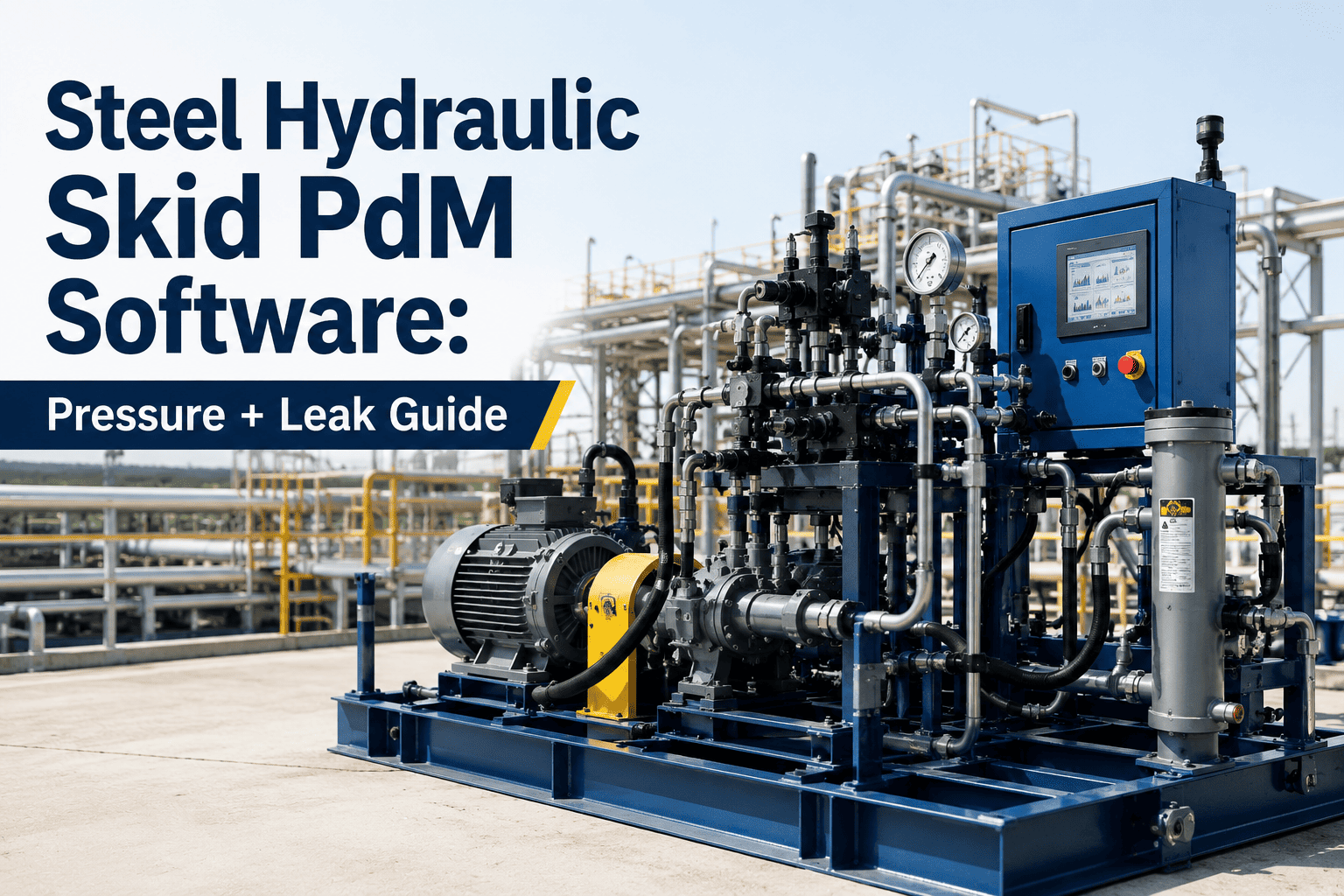
Every rolling mill and caster maintenance team knows the sound of a hydraulic skid running rough — pressure that drifts a little on every cycle, a valve that hesitates half a second longer than it should, a faint weep of oil pooling under a cylinder rod that nobody has time to chase down. In a steel plant, hydraulic skids drive the caster segments, coilers, shears, and roll stands that keep the line moving, and when one of them lets go mid-campaign the cost is measured in tons of scrapped product and hours of idle furnace time, not in the price of a seal kit. Predictive maintenance for hydraulic skids is not a generic vibration-analysis add-on borrowed from rotating equipment; it is a discipline built around three specific, trackable signals — cylinder pressure decay, valve response lag, and micro-leak trend data — that give technicians a warning window measured in shifts, not minutes. This guide walks through what steel plant hydraulic PdM actually monitors, how it differs from routine preventive maintenance, and how a purpose-built CMMS like OxMaint turns that data into a work order before a seal fails on the floor.
Hydraulic Skid PdM: Catch the Pressure Drop Before It Catches Your Line
The three signals that predict hydraulic failure in mill and caster hydraulics, why calendar-based PM misses them, and how to build a monitoring routine your maintenance team will actually follow.
Why Hydraulic Skids Fail Without Warning
A hydraulic skid rarely fails the way a bearing does. There is no single loud grinding noise building for weeks. Instead, a cylinder's holding pressure drifts down by two or three bar a shift, a directional valve starts taking an extra hundred milliseconds to shift, and a fitting on the return line starts weeping oil at a rate too slow to trip a low-level alarm but fast enough to strip additive package out of the reservoir over a month. None of these show up on a walk-through checklist. By the time an operator notices a segment lagging or a shear cycling slow, the skid is already in the failure zone, and the fix is an unplanned line stop instead of a scheduled swap.
The Three Signals That Predict Hydraulic Skid Failure
Hydraulic PdM in a steel plant comes down to watching three measurements over time instead of checking them once on a clipboard. Trended together, they turn a skid from a black box into a system that tells you what it needs next.
Most mills already collect pressure and cycle data somewhere — a PLC historian, a BMS tag, a technician's notebook. OxMaint turns that raw data into trended asset health for every hydraulic skid on the floor, with automated work orders the moment a signal crosses your threshold.
Hydraulic Skid PdM vs Calendar-Based Preventive Maintenance
Calendar PM was built for parts that wear at a predictable rate regardless of load. Hydraulic skids in a steel mill do not behave that way — a caster segment running three campaigns a week wears differently than one on a slower schedule, and a fixed 90-day seal-inspection interval either wastes labor on healthy skids or misses one that degraded fast under a heavy campaign.
| Maintenance Approach | Calendar-Based PM | Hydraulic Skid PdM |
|---|---|---|
| Trigger for inspection | Fixed interval regardless of actual wear | Pressure, lag, or leak trend crossing a threshold |
| Warning before failure | None — inspection may land after damage starts | 3–5 shifts typical, tied to the specific skid |
| Labor efficiency | Technicians open healthy skids on schedule | Work orders generated only when data justifies it |
| Contamination detection | Relies on periodic oil sampling | Continuous trend flags contamination between samples |
| Audit and history | Paper or spreadsheet logs, easily lost | Full trend history tied to the asset record |
| Unplanned downtime risk | Higher — fast-wearing skids slip through | Lower — every skid is judged on its own data |
How a Steel Plant Rolls Out Hydraulic PdM in Practice
Hydraulic PdM does not require ripping out existing sensors or a year-long capital project. Most mills already have pressure transducers, cycle timers, and reservoir level indicators on their hydraulic skids — the gap is almost always in trending that data against asset history and turning a threshold breach into a work order automatically.
What Hydraulic PdM Is Worth on the Floor
The value of catching a hydraulic skid early is not abstract — it is the difference between a scheduled seal swap on a maintenance window and an unplanned stop that idles an entire caster strand.
OxMaint logs pressure, response, and leak data against every hydraulic skid's own history, so a two-bar drift on a caster cylinder generates a work order the same shift it starts — not three weeks later on the next scheduled round.
Field Perspective
The skids that fail hardest are almost never the ones with an obvious problem. They are the ones running two or three bar low on holding pressure for weeks, quietly, because nobody was trending it against last month. The technology to catch that has existed on the plant floor for years in the form of a pressure gauge. What was missing was somewhere to log that reading against the asset's own baseline and turn a slow drift into a work order before a technician has to chase an emergency stop through three shift handovers. That is the entire value case for hydraulic PdM — it does not replace the mechanic, it gives the mechanic a three-shift head start.
Frequently Asked Questions
Give Your Maintenance Team a Three-Shift Head Start on Every Hydraulic Skid
Stop finding out about a failing seal when the line is already down. Log your hydraulic skids in OxMaint, set your pressure and leak thresholds, and let the trend generate the work order before the failure does.