Every steel plant runs a root cause investigation after a caster breakdown or a bearing seizure — and in most plants, that's where the story ends. The finding gets written into a report, filed away, and forgotten until the same failure repeats six months later. This gap between finding a cause and actually fixing it is an open corrective action loop, and it quietly drains millions from steel operations every year through repeat failures and missed audits. Closing that loop is what separates plants that keep bleeding money to the same failures from plants that eliminate them for good, and you can book a demo to see how.
Corrective Action Loop · Steel Plant CAPA · Close-the-Loop CMMS
Stop Filing RCA Findings. Start Closing the Loop.
OxMaint turns every root cause finding into a tracked, owned, and verified corrective action — inside the same CMMS your maintenance team already works in, with nothing lost between the investigation and the fix.
61%
of corrective actions raised after a steel plant RCA are never converted into a scheduled, owned work order
3.4x
higher repeat failure rate on equipment where the corrective action loop was never formally closed
$6.7M
average annual cost of recurring failures whose root cause was already identified but never permanently corrected
46 days
average time an open corrective action sits without an owner, a due date, or a status update in a typical steel plant
1 in 3
Nonconformances and near-miss incidents in steel plants are repeat events — meaning the corrective action from the first occurrence either was never implemented or was never verified. A closed-loop corrective action platform like OxMaint gives every finding a home, an owner, and a verification checkpoint, so "we already fixed this" is always true.
Where the Corrective Action Loop Actually Breaks
Most steel plants are not short on root cause analysis. Fishbone diagrams get drawn, 5-Whys get filled out, and investigation reports get signed off after every major breakdown. The loop breaks after the analysis, in the handoff between "we know why it failed" and "someone is fixing it." A finding sits in a report that maintenance never opens. A corrective action gets verbally assigned in a shift meeting and is never logged anywhere. A fix gets implemented but nobody checks six months later whether the failure actually stopped recurring. Each of these breakpoints looks small in isolation, but together they explain why the same five failure modes account for most of a steel plant's unplanned downtime year after year.
The Report Becomes a Dead End
RCA findings are documented in a Word file or a PDF that lives on a shared drive, disconnected from the CMMS where actual maintenance work gets scheduled and tracked.
No Named Owner, No Due Date
Corrective actions get assigned informally in a meeting. Without a system of record and a deadline, accountability quietly evaporates within a few weeks.
The Fix Is Never Verified
A part gets replaced or a procedure gets updated, but nobody tracks failure data afterward to confirm the root cause was actually eliminated, not just masked.
Knowledge Never Reaches Other Lines
A corrective action proven effective on one rolling mill never gets standardized into the PM plan or SOP for identical equipment elsewhere in the plant.
The Six-Stage Closed Corrective Action Loop
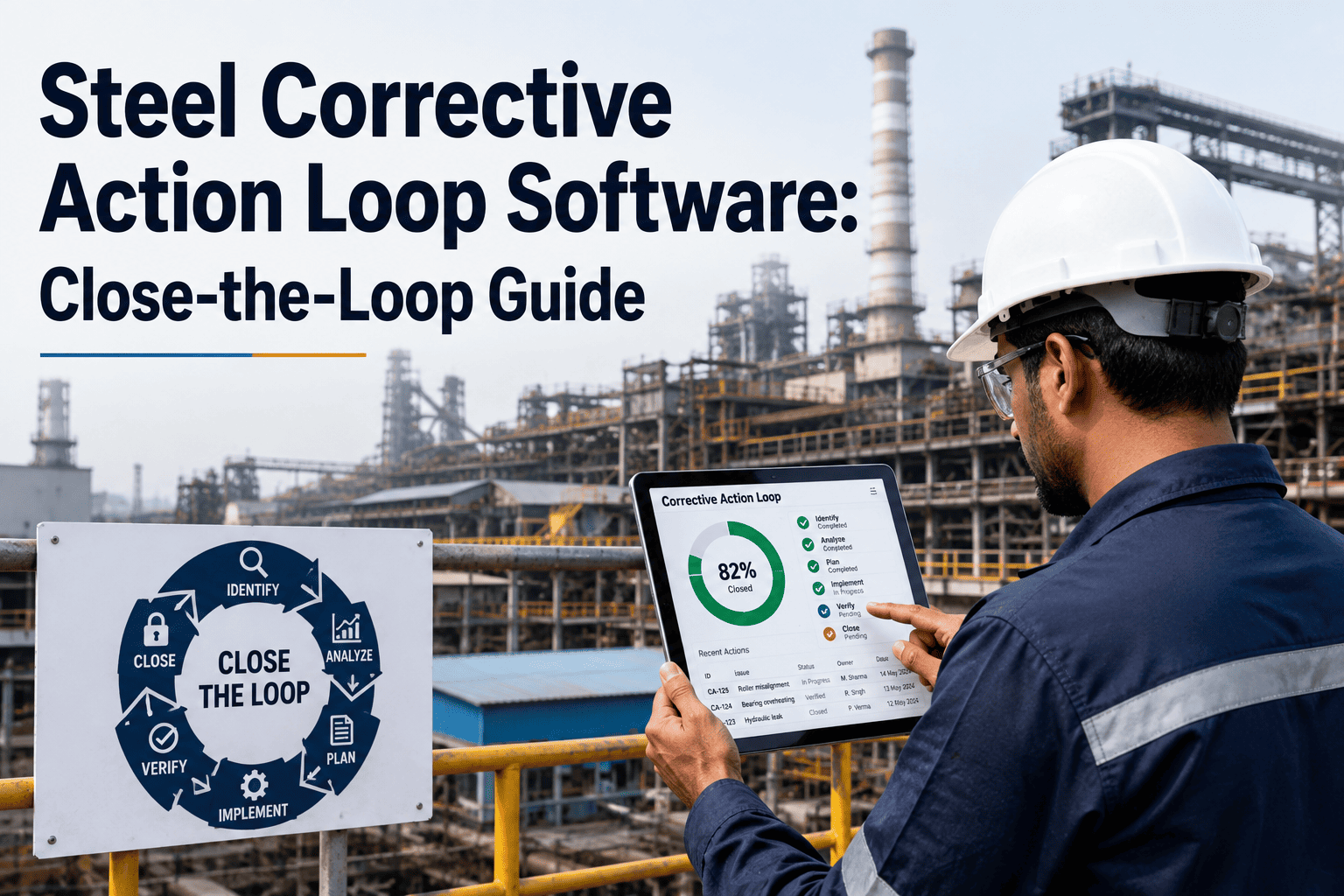
A closed-loop corrective action process is not more paperwork — it is a shorter path from finding to permanent fix. OxMaint structures every corrective action through six connected stages, so nothing is left to memory, shared drives, or shift-handover notes.
01
Capture the Finding
Every RCA, audit finding, safety near-miss, or quality nonconformance is logged directly in the CMMS the moment it's identified, with the failure evidence attached.
02
Assign Owner and Deadline
Each corrective action is routed to a named owner with a due date based on risk severity, removing the ambiguity that lets actions stall indefinitely.
03
Convert to a Work Order
The corrective action becomes a scheduled, trackable work order with parts, labor, and downtime windows planned — not a note waiting to be remembered.
04
Execute and Document
Technicians close the work order with evidence — photos, readings, parts consumed — creating an auditable record of exactly what was done and when.
05
Verify Effectiveness
A monitoring window tracks MTBF and recurrence on the affected asset after the fix, confirming the root cause was actually eliminated, not just patched.
06
Standardize the Fix
Verified corrective actions are pushed into updated PM plans, SOPs, and the plant knowledge base, so the same fix prevents failure on every similar asset.
Open-Loop vs. Closed-Loop Corrective Action — Steel Plant Comparison
| Metric | Open-Loop Process | Closed-Loop Process |
| Corrective Actions Converted to Work Orders | 35-45% | 92-97% |
| Average Days to Closure | 60-90 days | 12-18 days |
| Repeat Failure Rate on Same Asset | 28-34% | 6-9% |
| Corrective Actions With Effectiveness Verified | Under 20% | Over 90% |
| Audit Preparation Time | 2-3 weeks | Under 2 days |
Corrective Action Software · Built for Steel Operations
Every Finding Deserves a Fix, Not a Filing Cabinet
See how OxMaint routes your open RCA findings, audit gaps, and safety observations into tracked work orders with automatic effectiveness verification.
Why Generic Quality Software Doesn't Close the Loop in Steel Plants
Most CAPA tools were built for regulated discrete manufacturing — pharmaceutical batches, automotive parts, medical devices — where the corrective action is a document change or a training record. Steel plant corrective actions are usually physical: replace a bearing housing, redesign a guard, recalibrate a sensor, retrain a crew on lockout procedure. That means the corrective action tool has to speak the same language as the maintenance team's daily work order, not sit in a separate quality silo that maintenance never opens.
One System, Not Two
Corrective actions live inside the same CMMS as preventive maintenance and breakdown work orders, so maintenance never has to check a second system.
Built for Physical Fixes
Corrective actions link directly to parts, labor hours, and downtime scheduling — because a steel plant fix usually means hardware, not paperwork alone.
Automatic Escalation
Overdue corrective actions escalate automatically to supervisors and plant managers, so accountability doesn't depend on someone remembering to follow up.
Audit-Ready by Default
Every finding, owner, action, and verification is timestamped and stored automatically, turning weeks of audit preparation into a same-day export.
Before OxMaint, our RCA reports were technically excellent and practically useless — great analysis, no follow-through. We now close 94% of corrective actions on time, and repeat failures on our top ten problem assets have dropped by more than half in under a year.
Reliability Manager, Integrated Steel Mill, Ohio, USA
What a Closed Loop Delivers Over Time
| Timeframe | Corrective Action Closure Rate | Repeat Failure Reduction | Audit Readiness |
| Month 1-3 | 55-65% | 10-15% | Findings centralized |
| Month 4-9 | 75-85% | 25-35% | Same-week exports |
| Month 10-18 | 90-95% | 45-55% | Same-day exports |
| 18+ Months | 93-97% | 55-65% | Continuous readiness |
Every Kind of Finding, One Corrective Action Loop
A steel plant generates corrective actions from more sources than any single spreadsheet can track cleanly. OxMaint routes all of them through the same closed-loop workflow, regardless of where the finding originated.
Equipment RCA Findings
5-Why and fishbone conclusions from breakdown investigations flow straight into a corrective action with an owner and a due date.
Safety Near-Misses
Observations from safety walks and near-miss reports get tracked with the same discipline as a major equipment failure, not a checkbox.
Quality Nonconformances
Coil defects, dimensional deviations, and surface finish issues trace back to the equipment or process condition that caused them.
Internal and External Audit Gaps
ISO, safety, and customer audit findings get the same tracked ownership and verification as any other corrective action in the system.
Who Owns What in a Closed Corrective Action Loop
A corrective action stalls the moment ownership is unclear. Before OxMaint, most plants assign a corrective action verbally to "maintenance" or "the shift team," and no single person feels accountable for it. A closed loop assigns a specific role to each stage, so a finding always has a name attached to it, not a department.
Corrective Action Ownership by Stage
| Stage | Typical Owner | System of Record |
| Finding Capture | Investigator or Shift Supervisor | RCA record in CMMS |
| Action Assignment | Reliability or Maintenance Engineer | Linked corrective action |
| Execution | Maintenance Technician | Work order |
| Effectiveness Verification | Reliability Engineer | Monitoring window and MTBF trend |
| Standardization | Maintenance Planner | Updated PM plan or SOP |
Signs Your Corrective Action Process Is Already Broken
Most plants don't realize how open their corrective action loop is until they actually count the backlog. A handful of warning signs tend to show up long before repeat failures start driving the budget conversation.
Nobody Can List Open Actions
If a plant manager can't pull a current list of open corrective actions in under a minute, the actions are living in inboxes and meeting notes, not a system.
The Same RCA Gets Redone
Investigators re-analyze a failure that was already root-caused a year earlier because the original finding was never searchable or referenced again.
Audit Week Is All-Hands
Preparing for an ISO or customer audit takes the whole quality team days of manual compilation instead of a same-day export from one system.
"Closed" Doesn't Mean Fixed
Corrective actions get marked closed as soon as a part is replaced, with no data collected afterward to confirm the failure actually stopped happening.
Frequently Asked Questions
What is a corrective action loop in steel plant maintenance?
It's the full path from identifying a root cause to verifying the fix worked — capture, ownership, execution, and verification. You can book a demo to see the workflow on your own data.
How is a closed-loop corrective action different from a standard CAPA process?
A standard CAPA often stops at implementation. A closed loop adds mandatory effectiveness verification and standardization, so the fix is proven, not assumed, before the action is marked closed.
Does OxMaint replace our existing RCA or 5-Why process?
No. OxMaint keeps your existing investigation methodology and adds structured tracking after the analysis, converting findings into owned work orders automatically.
Can corrective actions be linked to existing CMMS work orders?
Yes. Every corrective action becomes a linked work order with parts, labor, and scheduling, so maintenance teams work from one system instead of two.
How quickly can a steel plant start closing the loop with OxMaint?
Most plants have their open corrective action backlog centralized within two to three weeks. You can start a free trial to begin logging findings immediately.
Turn Every Root Cause Finding Into a Permanent Fix
Repeat failures aren't a root cause problem in most steel plants — they're a follow-through problem. OxMaint closes that gap with a corrective action loop built into the CMMS your maintenance team already uses every day.