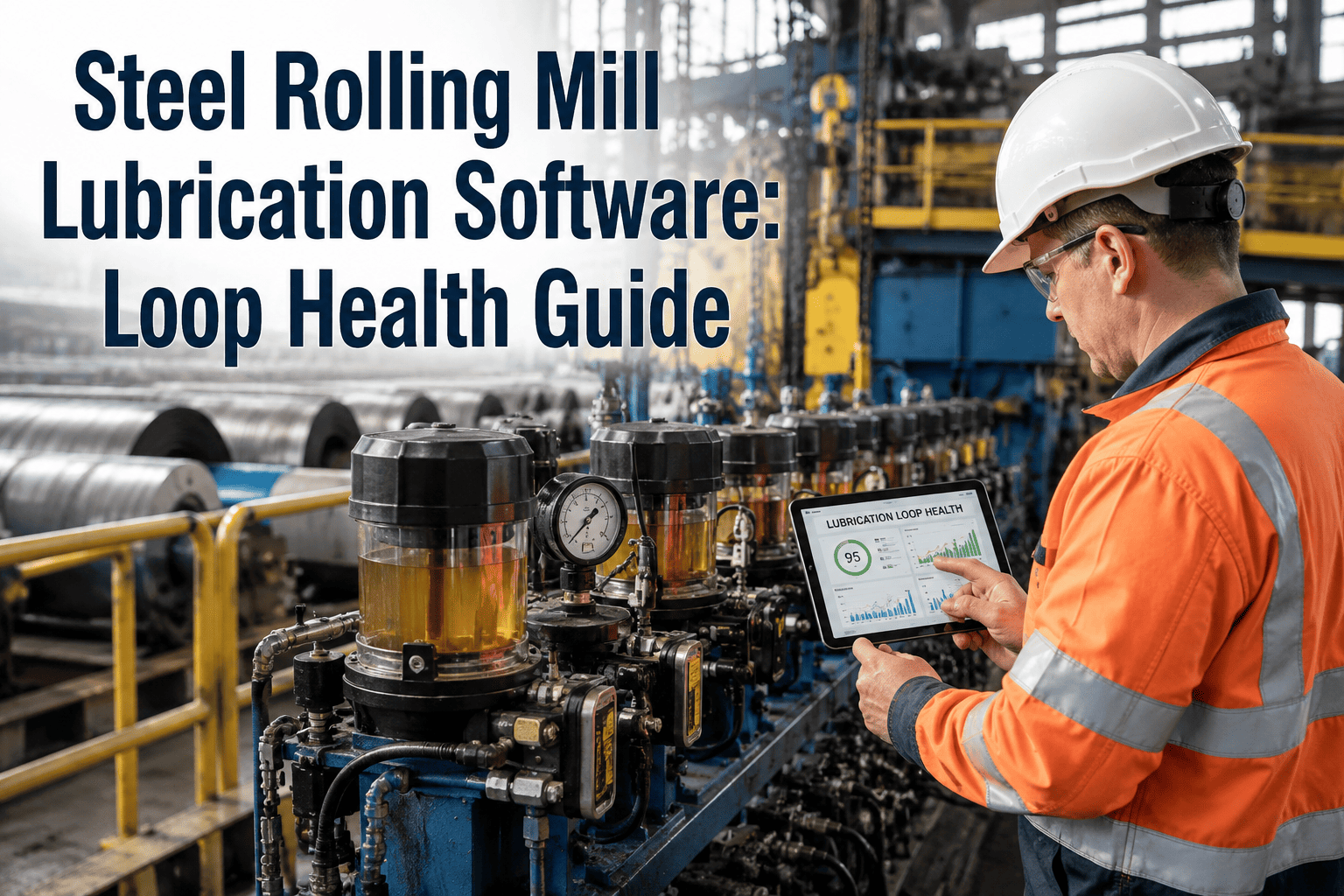
Most steel plants own plenty of lubrication knowledge and very little lubrication control. Grease guns, oil drums, sample bottles and OEM manuals exist in every area, yet intervals live in people's heads and a wrong lubricant can slip into the wrong reservoir unnoticed. In a mill where bearings run hot, wet and dirty, that gap shortens equipment life quickly. This guide shows how to centralize routes, specifications, contamination checks and oil analysis in Oxmaint maintenance management software so every lubrication point has an owner and a record.
Steel Plant Lubrication Management Software for Bearings, Gearboxes and Hydraulics
Turn scattered greasing habits into one controlled program. Specify the right lubricant, route every point, sample oil on schedule and convert findings into work orders before wear becomes a breakdown.
Six informal habits that quietly shorten bearing and gear life
None of these look dramatic on a daily basis. Together they explain why many lubrication-related failures are described as sudden when the cause had been building for months.
Intervals set once and never reviewed
A calendar copied from a manual ignores load, heat, washdown and contamination at that specific machine.
Wrong or mixed lubricant
Similar-looking products and unlabeled containers lead to incompatible greases and oils in one housing.
Over-greasing and under-greasing
Excess grease raises temperature and pushes through seals, while too little leaves the film unprotected.
Contamination ignored until failure
Dust, scale, water and coolant enter through breathers, seals and open transfer containers.
Oil analysis reports without follow-up
Lab results arrive by email, get filed and never reach a work order with an owner.
No proof the task was done
When a bearing fails, nobody can show when it was last lubricated, by whom, or with what.
Define the lubricant once, at the asset, and make everything inherit it
A specification register links each lubrication point to its approved product, quantity and method. Technicians then work from the register instead of memory or the nearest drum.
| Equipment class | Typical lubricant type | Main threat in a steel plant | What the register should hold |
|---|---|---|---|
| Caster roll bearings | Water-resistant, high-load grease | Spray water wash-out, scale, heat | Product, quantity per point, cycle, delivery method |
| Mill and fan bearings | High-load grease or circulating oil | Heat, vibration, dust | Product, interval, temperature notes, sample point |
| Gearboxes | EP gear oil of the specified viscosity grade | Water, wear metals, thermal aging | Grade, sump volume, breather type, drain and sample ports |
| Hydraulic systems | Anti-wear hydraulic oil | Particles, water, air, overheating | Grade, reservoir volume, filter spec, cleanliness target |
| Motors and small drives | Grease per OEM | Over-greasing, contamination | Product, shot count, interval, drive and non-drive end |
- Always follow OEM guidance for viscosity grade and base oil type. The table shows classes, not product recommendations.
- Label each point at the machine with the product code so a technician can confirm before applying.
- Record approved substitutes and compatibility notes, and block unapproved products from route tasks.
Build routes around people and areas, not around lists of assets
A good route covers a physical area in a logical order, matches a shift's time, and groups points by lubricant so technicians carry fewer products.
- Check central grease system pressure and reservoir level
- Confirm distribution blocks are cycling
- Inspect visible seals and grease return
- Record anomalies against the roll position
- Read sight glass level and oil color
- Check breather condition and desiccant
- Feel housing temperature or record a reading
- Note leaks at shafts and split lines
- Sample at the specified port with clean equipment
- Label with asset ID, hours and date
- Log the sample and dispatch to the lab
- Match results to the asset on return
ISO 4406 turns a vague worry about dirty oil into a number
The code reports particle counts per milliliter at three sizes, commonly 4, 6 and 14 microns. A reading such as 18/16/13 gives one range number for each size.
- Set a target code per system based on component sensitivity and OEM guidance, then trend against it.
- Hydraulic and servo circuits normally need much cleaner oil than open gear sumps.
- Test new oil on delivery, because bulk product is not automatically clean enough for critical systems.
- Let a breach of target create a work order for filtration, source investigation or oil change.
What each test tells you and which action it should trigger
| Test | Question it answers | Typical follow-up work |
|---|---|---|
| Particle count | Is the oil clean enough for this component? | Filter change, ingress source inspection, flush |
| Water content | Is moisture entering through seals, breathers or coolers? | Replace breather, fix seal, check cooler, dehydrate oil |
| Viscosity | Has the oil thickened, thinned or been mixed? | Verify product used, plan oil change |
| Acid number and oxidation | Is the oil aging or additives depleted? | Schedule change, check operating temperature |
| Wear metals | Which internal parts are wearing and how fast? | Raise inspection, tighten sample interval |
- Always sample from the same point and operating condition so results compare cleanly over time.
- Record machine hours with every sample, because wear rates make sense only against running time.
- Treat one abnormal result as a prompt to resample, and two consecutive ones as a work order.
Keep dirt and water out at three control points
It is cheaper to exclude contamination than to remove it. Assign a responsible owner and a recurring task to each point below.
Storage and handling
- Sealed, labeled containers per product
- Dedicated transfer containers per lubricant
- Clean, covered storage with stock rotation
- Incoming oil tested before use
Machine protection
- Desiccant or filtered breathers on sumps
- Intact seals and covers at inspection
- Clean grease fittings before every shot
- Sealed fill and sample ports
Filtration and removal
- Filter differential pressure checked on rounds
- Offline filtration for critical reservoirs
- Water removal when levels trend upward
- Filter change tied to condition, not habit
Calendar, running hours or condition: use each where it fits
| Method | Best used for | Weakness |
|---|---|---|
| Calendar based | Low-risk points with steady duty | Ignores real load and operating hours |
| Running-hour based | Equipment with variable utilization | Needs reliable hour meters or counters |
| Condition based | Critical assets with oil analysis or sensors | Needs sampling discipline and data review |
Condition-based lubrication does not mean fewer tasks. It means the right task at the right time, with evidence for any interval that gets extended.
What common lubrication findings usually point to
Technicians see warning signs on every round. A shared reference helps them record the finding consistently and choose the right follow-up instead of simply topping up and moving on.
| Finding on the round | Possible cause | Recommended work order |
|---|---|---|
| Milky or cloudy oil | Water ingress from a failed seal, breather or cooler leak | Inspect seals and cooler, resample, dehydrate or change oil |
| Dark, burnt-smelling oil | Overheating or oxidation | Check cooling, load and operating temperature, then plan an oil change |
| Hardened or dry grease at the fitting | Starvation, wrong grease or heat damage | Verify product, clear the line, review interval and quantity |
| Rising housing temperature after greasing | Over-greasing or early bearing damage | Reduce shot volume, trend temperature, request vibration check |
| Frequent top-ups on a reservoir | External leak or internal bypass | Trace the leak, log volume added and repair the source |
| Filter pressure drop climbing quickly | High contamination load or wrong filter | Find the ingress source, review filter specification |
Make every finding searchable
- Use a short pick list for findings so reports can count them across areas.
- Require a photo for any abnormal oil color, leak or grease condition.
- Link repeat findings on one asset so reliability engineers see the pattern, not isolated notes.
Add automation where manual checks cannot keep up
Automatic lubricators, online particle counters and temperature or vibration sensors reduce the gaps between manual rounds. They help only when their output reaches someone who can act on it.
- Suit hard-to-reach or hazardous points
- Need refill and function checks on a schedule
- Must be set to the correct discharge rate
- Failure is silent unless it is inspected
- Shows trends between manual samples
- Useful on critical reservoirs and gearboxes
- Alarms should create work orders, not emails
- Calibration and sensor health need tracking
- Confirms what sensors and lab data suggest
- Catches leaks, smells and visual changes
- Keeps technicians close to the equipment
- Remains essential even in automated plants
Automation changes the task, it does not remove it. An automatic lubricator that nobody refills is simply a hidden point of failure, so schedule its checks like any other asset.
Put every lubrication point on a route with an owner
Load your asset register, define lubricant specifications and schedule routes in a system technicians can use on the floor.
Bearings, gearboxes and hydraulics each need a different playbook
- Control grease quantity per shot and shot frequency
- Trend temperature and vibration after each greasing
- Watch for grease purge, discoloration or hardening
- Use central systems where access is difficult
- Check level, breather and leaks on rounds
- Sample oil on a schedule and trend wear metals
- Review operating temperature and cooler health
- Change oil on condition with documented evidence
- Hold a strict cleanliness target per circuit
- Monitor filter pressure drop and replace on trend
- Control water and air ingress at the reservoir
- Log fluid top-ups, because they signal leaks
Casting and rolling areas punish grease the hardest
Positions exposed to spray water and heavy load wash and degrade grease quickly. Plants typically rely on centralized grease distribution, air-oil systems or sealed relube-free units, and each option brings its own maintenance tasks.
| Approach | Strength | Maintenance burden to track |
|---|---|---|
| Centralized grease distribution | Continuous fresh grease reaches every point | Reservoir level, pump health, blocked lines, grease reaching cooling water |
| Air-oil lubrication | Small, controlled oil quantities and easier waste handling | Air supply, oil level, nozzle and line condition |
| Sealed relube-free units | Much less grease use and fewer lines to maintain | Condition monitoring and replacement planning, since there is no relube to adjust |
Whichever system you run, record flow checks, line blockages and consumption per area. A sudden drop in grease consumption is often a blocked line, not a saving.
What a complete lubrication record looks like
When this record exists for every point, root cause analysis stops being an argument about memory and becomes a review of evidence.
Lubrication management inside a single maintenance system
Asset management
Store lubricant specs, sample ports and point counts on each asset.
Preventive maintenance
Generate recurring greasing, level checks and sampling tasks by calendar or running hours.
Mobile work
Technicians complete routes, enter findings and attach photos from a phone or tablet.
Corrective work orders
Abnormal findings and out-of-limit oil results become prioritized, assigned jobs.
Inventory
Track lubricant and filter stock so tasks are never blocked by missing product.
Reports
See overdue routes, repeat contamination and results by area or asset.
Where does your lubrication program stand today?
Measure the program, not just the grease used
Start with critical assets and expand as the data proves itself
- Inventory points. Walk the critical areas and register every lubrication point with product and method.
- Standardize products. Reduce lubricant variety and label every container and fitting.
- Launch routes. Release daily and weekly routes on mobile and track completion.
- Add oil analysis. Start sampling gearboxes and hydraulics, then link results to work orders.
- Tune intervals. Adjust tasks using trends, and document each change with its evidence.
Steel plant lubrication software questions
What should a lubrication management system store?
Lubricant specifications, point locations, routes, intervals, sample results and technician completion records for every asset.
Can oil analysis results create work orders?
Yes. Results beyond target for cleanliness, water or wear metals can trigger prioritized jobs. Book a demo to see the workflow.
How do we prevent the wrong lubricant being used?
Register one approved product per point, label containers and fittings, and show the product code on every task.
Should intervals be calendar or condition based?
Use calendar tasks for low-risk points and condition-based tasks for critical assets where oil analysis supports the decision.
Where should we begin?
Pick one critical area, register its lubrication points and run routes for a month. Create your account to set it up.
Make clean, correct lubrication the default across your plant
Bring specifications, routes, oil analysis and technician records into one workflow and give every bearing, gearbox and hydraulic system a documented care history.