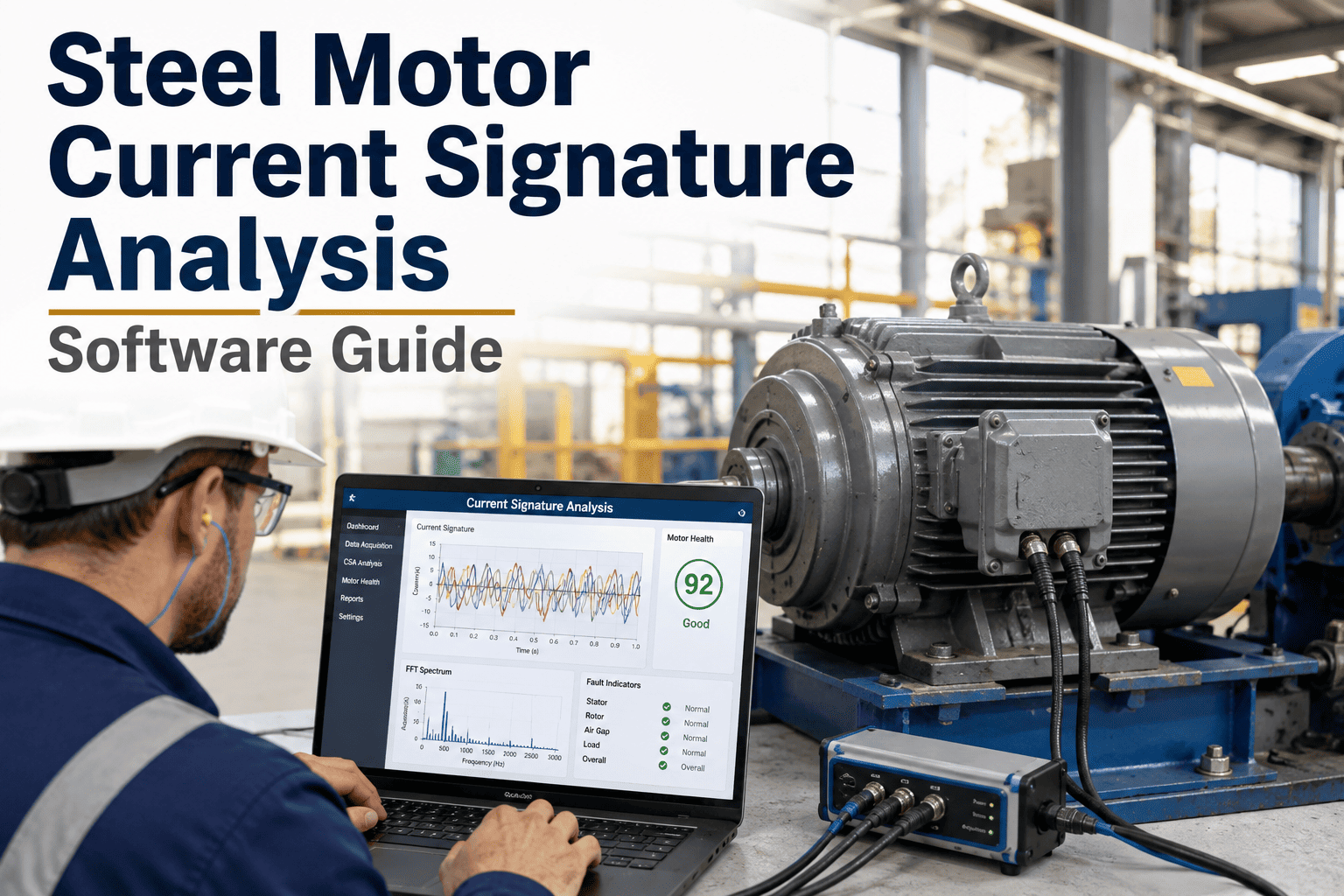
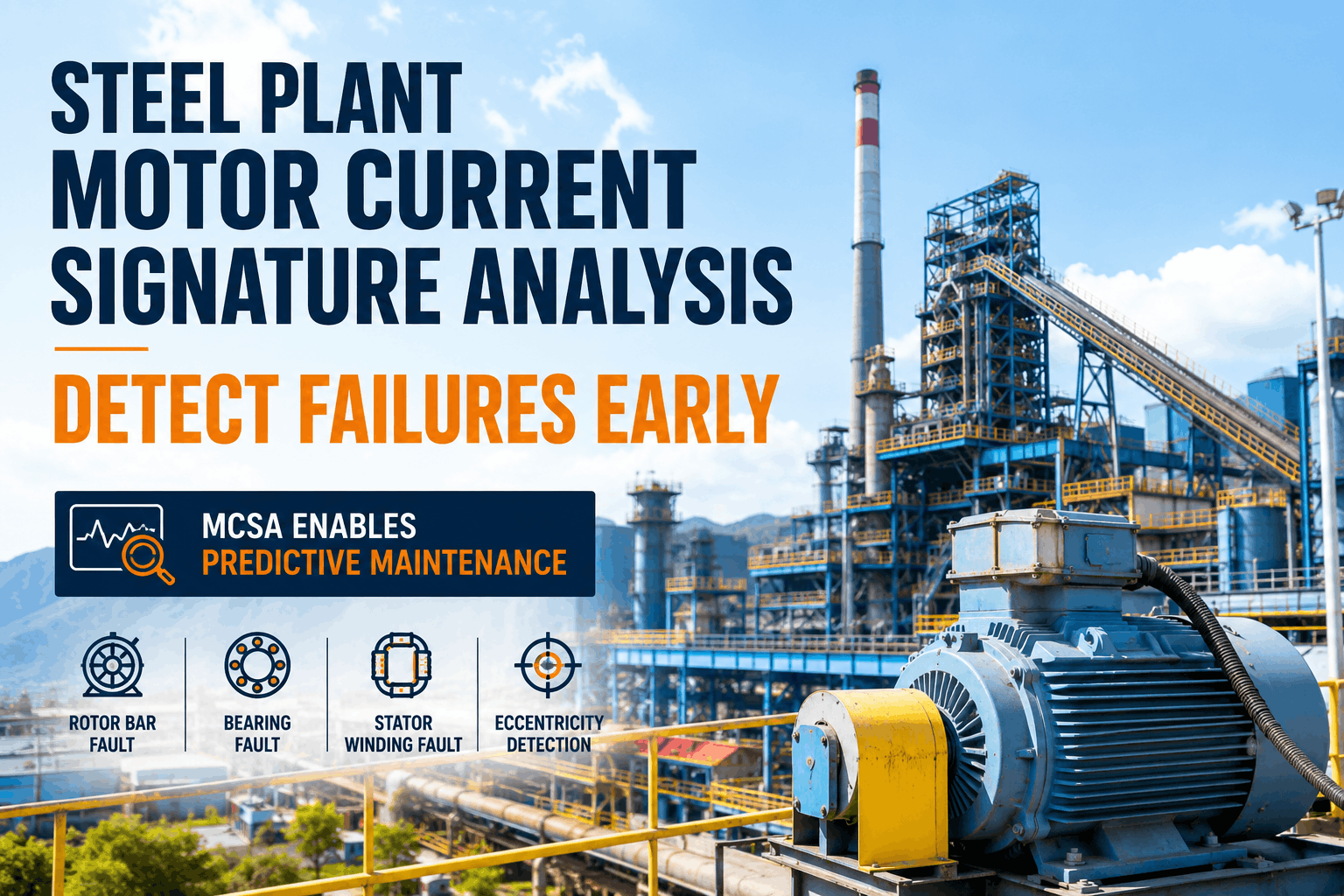
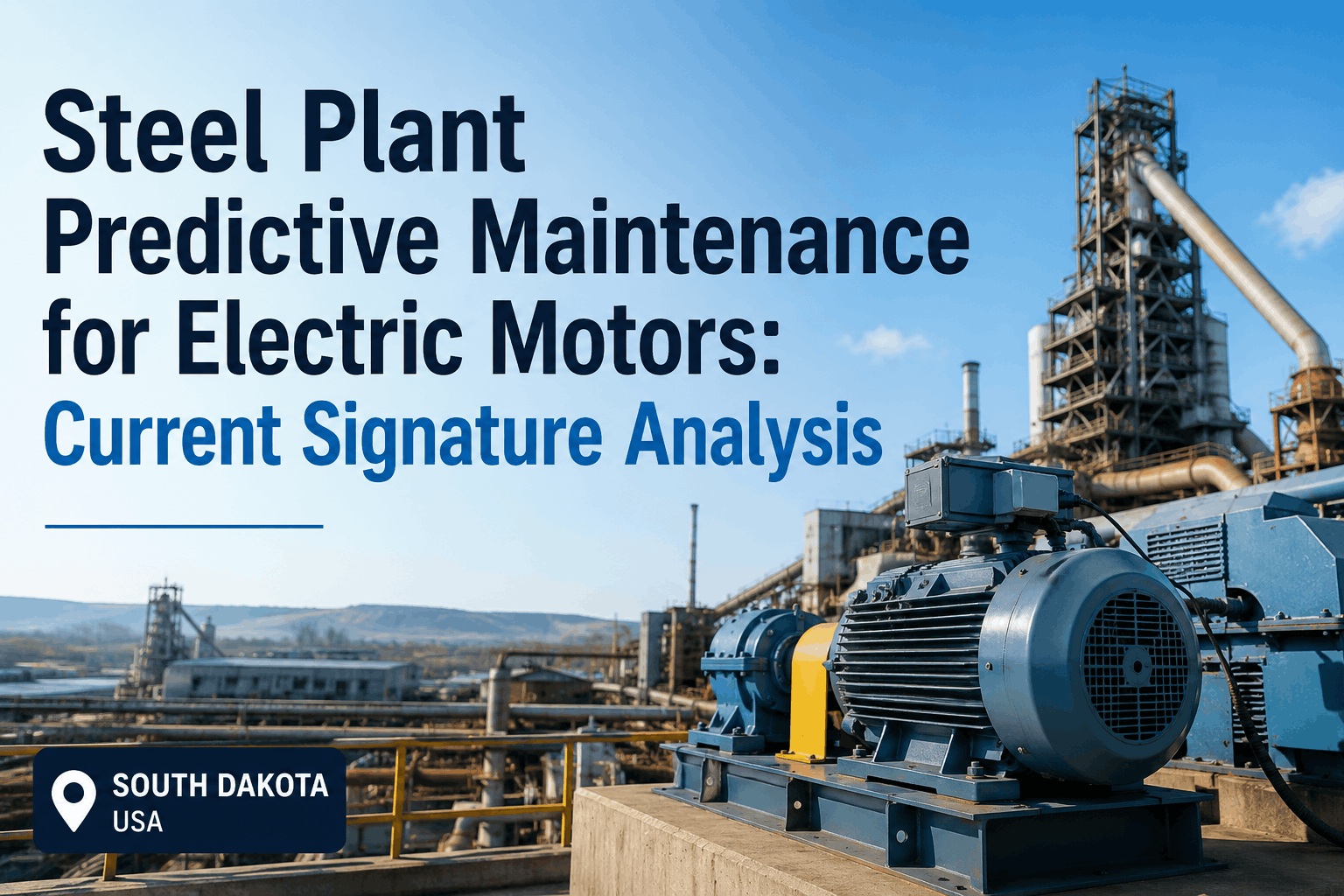
Every motor driving a fan, pump, mill stand, or conveyor in a steel plant is already broadcasting its own health data — through the current it draws from the supply. A broken rotor bar shows up as a sideband frequency around the line frequency. A stator winding short shows up as a negative-sequence current shift. Air gap eccentricity shows up as a frequency component tied to rotor speed, long before it becomes a rub between rotor and stator. Motor current signature analysis reads all three from the switchgear or drive, without decoupling the motor or mounting a single sensor on the housing. Start a free trial and connect your first motor current data stream to see what your fleet has been saying all along.
3
Major fault families MCSA detects: rotor, stator, and air gap
0
Sensors required on the motor housing — current is read at the switchgear
8–10 wks
Typical lead time between sideband detection and rotor bar failure
10%
Air gap asymmetry beyond nominal that defines an eccentric machine
Motor Current Signature Analysis, In Plain Terms
A healthy induction motor draws current at a clean supply frequency with balanced harmonic content. Mechanical or electrical faults disturb that symmetry and print a specific, repeatable signature into the current spectrum — one that Oxmaint's electrical diagnostics can read continuously, at the control center, across an entire motor fleet.
Broken Rotor Bar
A cracked or broken bar breaks the symmetry of the rotor circuit and produces a reverse rotating field, printing sideband frequencies around the line frequency at intervals tied directly to motor slip.
Escalates to torque fluctuation and starting failure if left unaddressed
Stator Winding Fault
An inter-turn short or abnormal phase connection unbalances stator impedance across the three phases, showing up first as a negative-sequence current shift long before a phase-to-ground trip.
Trended continuously instead of caught only at a protective relay trip
Air Gap Eccentricity
A rotor that is not centered in the stator bore — static, dynamic, or mixed — generates current components tied to rotor rotational frequency, and accelerates bearing wear and stator-rotor rub if unmanaged.
Classified by type so root cause, not just symptom, gets addressed
Bearing Defect
Bearing wear modulates the load torque in a way that reflects into the stator current spectrum, giving an electrical cross-check on a fault most plants only catch through separate vibration monitoring.
Vibration alone often only flags bearing defects at 18–24% degradation
Read Every Motor in the Plant From the Control Center
Oxmaint's AI-powered MCSA layer applies high-resolution spectral analysis to the current waveform your motors already generate — rotor bars, stator windings, air gap, and bearings, across your fleet, with zero installation downtime.
MCSA Against the Alternatives — Where Each Method Wins
MCSA does not replace vibration analysis or thermal imaging — it fills the gap both leave open on the electrical side of the motor.
| Method |
Best At |
Sensor Needed |
Blind Spot |
Typical Lead Time |
| Motor Current Signature Analysis |
Rotor bars, stator windings, air gap eccentricity |
None on housing — reads current at switchgear |
Purely mechanical faults with no electrical reflection |
8–10 weeks ahead |
| Vibration Analysis |
Bearing defects, misalignment, imbalance |
Accelerometer on housing |
Often flags bearing wear only at 18–24% degradation |
Weeks, later stage |
| Infrared Thermography |
Connection hot spots, cooling blockage |
Handheld or fixed IR camera |
Internal winding and rotor faults not yet surfaced as heat |
Days to weeks |
| Insulation Resistance Test |
Winding insulation degradation |
Megger, tested offline |
Only a snapshot — degradation between tests is invisible |
Point-in-time only |
From Sideband to Work Order — How the Signal Escalates
A fault signature does not stay flat. Oxmaint trends its amplitude against the motor's own baseline and escalates the response as the signature strengthens.
Baseline signature
Logged as the motor's healthy reference spectrum
Early sideband growth
Flagged for trending, no work order yet
Sustained deviation
Work order generated, inspection window opens
Confirmed fault growth
Planned repair scheduled ahead of forced outage
Untreated fault
Unplanned trip, the outcome every earlier stage exists to prevent
Stop Waiting for a Protective Relay to Tell You About a Motor Fault
Negative-sequence current trending, sideband amplitude tracking, and eccentricity classification — all logged against each motor's own history in one CMMS, so every new reading makes the next prediction sharper.
Frequently Asked Questions
Does MCSA require stopping or decoupling the motor?
No. Current is measured at the switchgear or drive while the motor runs under normal load, which is one of the main reasons plants prefer it as a first-pass screen across a large motor fleet.
Book a demo to see fleet-wide screening in action.
Can MCSA detect a bearing fault as well as vibration analysis?
MCSA can pick up bearing-related load modulation reflected into the current spectrum, but vibration analysis remains the more direct method for pure mechanical bearing faults — the two are complementary, not competing.
What counts as a significant air gap eccentricity?
A machine is generally considered eccentric once asymmetry exceeds roughly 10% of the nominal air gap length, at which point noise, vibration, and electromagnetic stress rise measurably.
How early can a broken rotor bar be caught?
Sideband amplitude tracking can flag a developing rotor bar fault around eight to ten weeks before it would otherwise cause a forced outage, giving enough lead time for a planned repair window.
Which motors in a steel plant benefit most from MCSA?
Large induction motors on continuous or high-consequence duty — mill drives, blowers, fans, and pumps — benefit most, since a fault on any of them tends to stop a production line rather than just one machine.
Start a free trial to prioritize your fleet by consequence.
Your Motors Are Already Talking. Oxmaint Listens Continuously.
Motor current signature analysis inside Oxmaint turns the current every motor already draws into a rotor, stator, and air gap health record — trended per asset, escalated automatically, and closed out with a work order before a relay trip does it the expensive way.