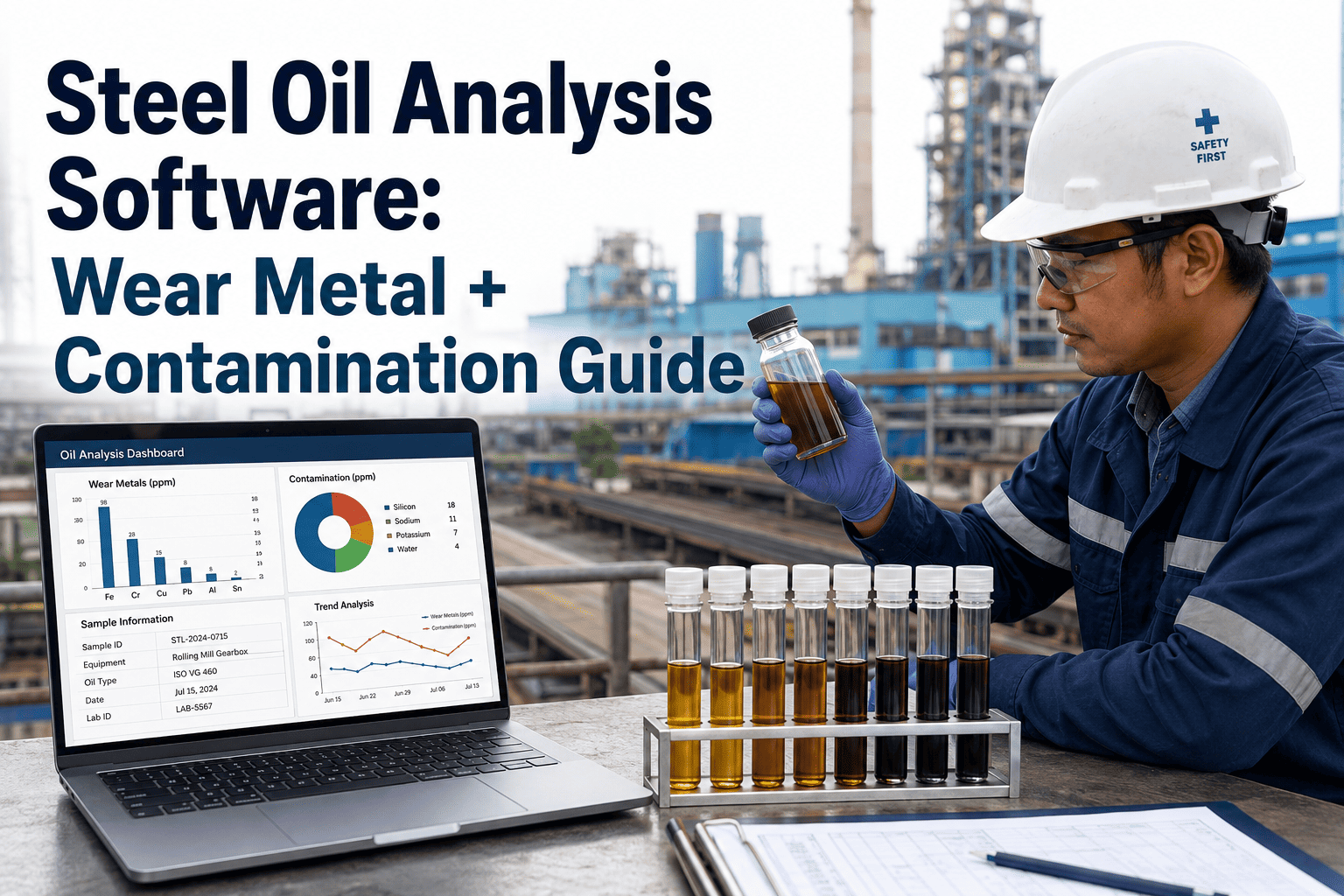
A rolling mill gearbox does not fail without warning. Weeks before a bearing seizes or a gear tooth spalls, microscopic iron and copper particles begin showing up in the lubricating oil, water creeps past a worn seal, and viscosity drifts outside its rated band. Steel plants that read these signals early replace a bearing during a planned outage instead of losing a shift to an unplanned one. Steel plants that miss them find out the hard way, usually mid production run. The discipline that catches this early is oil analysis — sampling, lab testing, and trend tracking for every wear metal, contaminant, and fluid property that predicts mechanical failure. See how wear metal and contamination data becomes an automatic work order inside OxMaint.
Steel Plant CMMS · Oil Analysis & Wear Metal Intelligence
Catch Wear Metal and Contamination Trends Before They Become a Gearbox Failure
Steel oil analysis software pulls every lab result, wear metal reading, and contamination alert into one asset record — so iron trending upward on a rolling mill gearbox turns into a scheduled work order instead of a buried email attachment.
85%
of lubrication-related failures caught before unplanned downtime with a structured program
6–16 wks
of lead time a wear metal trend gives before mechanical failure sets in
30–50%
less lubricant consumed once oil changes move to condition-based scheduling
3–5x
longer equipment life reported versus fixed, calendar-based oil changes
The Real Problem
Why a Wear Metal Trend Gets Missed Long Before It Gets Investigated
Most steel plants already run an oil analysis program. The gap is not the sampling — it is what happens after the lab hits send. A commercial lab emails a PDF report to whichever inbox is on file. A reliability engineer scans it between shift handovers, or does not. Iron climbs from 40 to 65 to 110 parts per million across three quarterly samples on a rolling mill pinion gearbox, and each number lives in a separate email with no line connecting them. Nobody is wrong, exactly — nobody has the job of comparing sample four to sample one. That is the integration gap between lab chemistry and maintenance execution, and it is where most preventable gearbox failures actually happen.
Oil does not lie. Chemically, a lubricant is a continuous record of everything a machine's internal surfaces are shedding, everything getting past its seals, and everything happening to the fluid itself under heat and pressure. A single sample is a data point. A trend, compared against that specific asset's own baseline and its OEM wear limits, is a prediction. Steel oil analysis software exists to make that comparison automatically, every time a result lands, instead of relying on someone remembering to open a spreadsheet.
What a Sample Reveals
Every Oil Sample Is Reporting on Three Things at Once
01
Wear Metals
Iron, copper, lead, and chromium concentrations reveal which internal component is degrading — a gear tooth, a bushing, a bearing cage — and how fast it is happening.
02
Contamination
Water content, particle counts, and silicon levels show how something is getting into a system that is supposed to be sealed, and where the breach likely sits.
03
Fluid Health
Viscosity, acid number, and additive depletion show whether the oil itself can still protect the machine, or whether it has broken down past its usable service life.
Wear Metal Reference
What Each Element on the Lab Report Is Actually Telling You
Not every wear metal points to the same failure. Reading a report correctly means knowing which element correlates with which internal surface, so the right technician gets dispatched to the right component instead of a generalized inspection order.
| Element |
Typically Wears From |
Caution Signal |
Root Cause to Investigate |
| Iron (Fe) |
Gears, races, cylinder liners |
Steady rise across samples |
Gear mesh wear, coupling misalignment, abrasive ingress |
| Copper (Cu) |
Bushings, bearing cages, oil coolers |
Sharp jump between two samples |
Bearing cage wear, cooler tube leak, thrust washer wear |
| Lead (Pb) |
Babbitt bearings, bronze bushings |
Rising trend on hydraulic units |
Bearing overload, thin oil film, low reservoir pressure |
| Chromium (Cr) |
Hardened rings and races |
Steady increase on rolling elements |
Ring or race spalling, corrosion pitting |
| Aluminum (Al) |
Pumps, pistons, thrust washers |
Rising alongside silicon |
Pump wear accelerated by dirt ingression |
| Silicon (Si) |
Not a wear metal — a contaminant |
Any measurable increase |
Breather failure, seal damage, dirt ingression |
Contamination Guide
Contamination Thresholds That Actually Justify a Work Order
Water Content
Above roughly 500 ppm on hydraulic and gearbox oil is treated as an active leak or seal failure investigation, not a routine oil change.
Particle Count
A rising ISO 4406 cleanliness code on hydraulic fluid points to filter bypass, a failed breather, or internal components generating fresh debris.
Acid Number (TAN)
A TAN reading drifting from baseline signals oxidation, common in gearboxes running hot or past their oil's realistic service life.
Viscosity Drift
A deviation beyond roughly 15% from rated viscosity, in either direction, usually means the wrong oil was topped off or the fluid has broken down.
Condition-Based vs Calendar-Based
Stop Changing Oil by the Calendar When the Oil Itself Can Tell You
A fixed oil change interval is a guess dressed up as a schedule. Some gearboxes run light duty and could go well past their scheduled change with the oil still inside spec. Others run hot, dirty, or overloaded and are already degraded weeks before the calendar says to touch them. Time-based intervals treat both the same way, which means the plant is either changing good oil early and paying for it in lubricant and labor, or leaving degraded oil in service and paying for it in bearing failures.
Condition-based changes replace the guess with the actual sample result. Oil stays in service as long as wear metals, water content, particle count, and viscosity stay inside limits, and it gets changed the moment any of them do not — whichever comes first. Steel plants that make this switch typically cut lubricant consumption meaningfully and extend the working life of the equipment itself, because the oil that stays in the machine is oil that is still doing its job.
The Workflow
From Sample Bottle to Scheduled Work Order
01
Sample Pulled
A technician draws oil from a gearbox, hydraulic reservoir, or bearing housing on a scheduled sampling route.
02
Result Logged
Wear metals, water content, particle count, and viscosity land against the asset record, from lab or on-site instrument alike.
03
Trend Compared
Each new reading is checked against that asset's own history and OEM limits, not a single generic threshold.
04
Work Order Created
A caution-level result opens an inspection order; a critical result opens a repair order with parts already staged.
Stop Losing Wear Metal Alerts in a Filing Cabinet
Connect your lab, your on-site instruments, and your maintenance team to one asset record. Every sample result becomes a tracked, assignable work order the moment it crosses a limit — not a PDF someone has to remember to open.
Where It Applies
Built for Every Oil-Wetted Asset in the Mill
01
Rolling Mill Gearboxes
Roll stand and pinion gearboxes carry some of the highest replacement costs in the plant, so trending iron and chromium here protects the production line directly.
02
Hydraulic Presses & Shears
Water content and particle count trending catches seal failure and filter bypass before a press loses pressure mid-cycle on a production run.
03
Continuous Caster Segments
Oil analysis on segment bearings fills the gap vibration analysis leaves at low rotating speeds, catching wear months before it affects strand quality.
04
Cranes & Conveyor Drives
Slow, hard-to-access gearboxes benefit most from condition-based changes, since sending a crew up for a calendar-based change is expensive on its own.
Side by Side
PDF Lab Reports vs Oil Analysis Built Into Your CMMS
| Capability |
PDF Reports & Spreadsheets |
Steel Oil Analysis Software |
| Result visibility |
Emailed to one inbox, easy to miss |
Logged against the asset record instantly |
| Trend tracking |
Rebuilt manually in a spreadsheet |
Trended automatically against asset baseline |
| Work order creation |
Manual, after someone reads the report |
Automatic at caution and critical levels |
| Multi-source data |
Lab and on-site readings kept separate |
Lab and on-site readings share one history |
| Audit trail |
Scattered across email threads |
Timestamped from sample to closed order |
From the Field
What Reliability Teams Say After Connecting Oil Analysis to Their CMMS
5 / 5
We were tracking wear metals across three separate spreadsheets on three different shifts, and by the time someone noticed iron climbing on the No. 2 stand gearbox, we were already looking at an unplanned outage. Now every sample lands against the asset automatically, and a caution-level result opens an inspection order the same day the result comes in.
RE
Reliability Engineer
Integrated Steel Mill, Rolling Division
4 / 5
Our hydraulic presses used to go down for the same reason every time: water in the oil that nobody caught until the pump was already scored. Tracking water content against a fixed threshold instead of waiting for a calendar date cut that failure mode dramatically in the first year we ran it this way.
MP
Maintenance Planner
Hot Strip Mill
Common Questions
Steel Oil Analysis Software — Frequently Asked Questions
Does oil analysis software replace our lab, or work alongside it?
It works alongside your lab. Steel oil analysis software takes results from a commercial lab, on-site instruments, or both, and ties every reading to the asset so trends carry across sample sources.
Start a free trial to connect your first feed.
How is a wear metal trend different from one high reading?
A single reading tells you a level; a trend tells you a rate. Two samples with the same iron level can mean very different things depending on whether that number has been flat for a year or doubled in one quarter.
What happens when a sample crosses a caution or critical limit?
Caution-level results open an inspection work order for a technician to confirm the finding, and critical results open a repair order with parts staged.
Book a demo to see the routing rules in action.
Can different equipment types use different wear metal limits?
Yes. A rolling mill gearbox, a hydraulic press, and a caster segment bearing do not wear the same way, so limits are set per asset type against OEM guidance and each asset's own baseline history.
How often should steel plant equipment be sampled?
It depends on criticality and oil volume. High-criticality gearboxes and large hydraulic systems are commonly sampled quarterly or every 500 to 1,000 operating hours, while smaller or less critical units can run on a longer interval.
Steel Plant CMMS · Oil Analysis & Wear Metal Intelligence
Turn Every Oil Sample Into a Protected Asset
Stop letting wear metal trends sit in an inbox between shift changes. Connect your lab and on-site instruments to one asset record, and let caution and critical results generate the work order themselves.