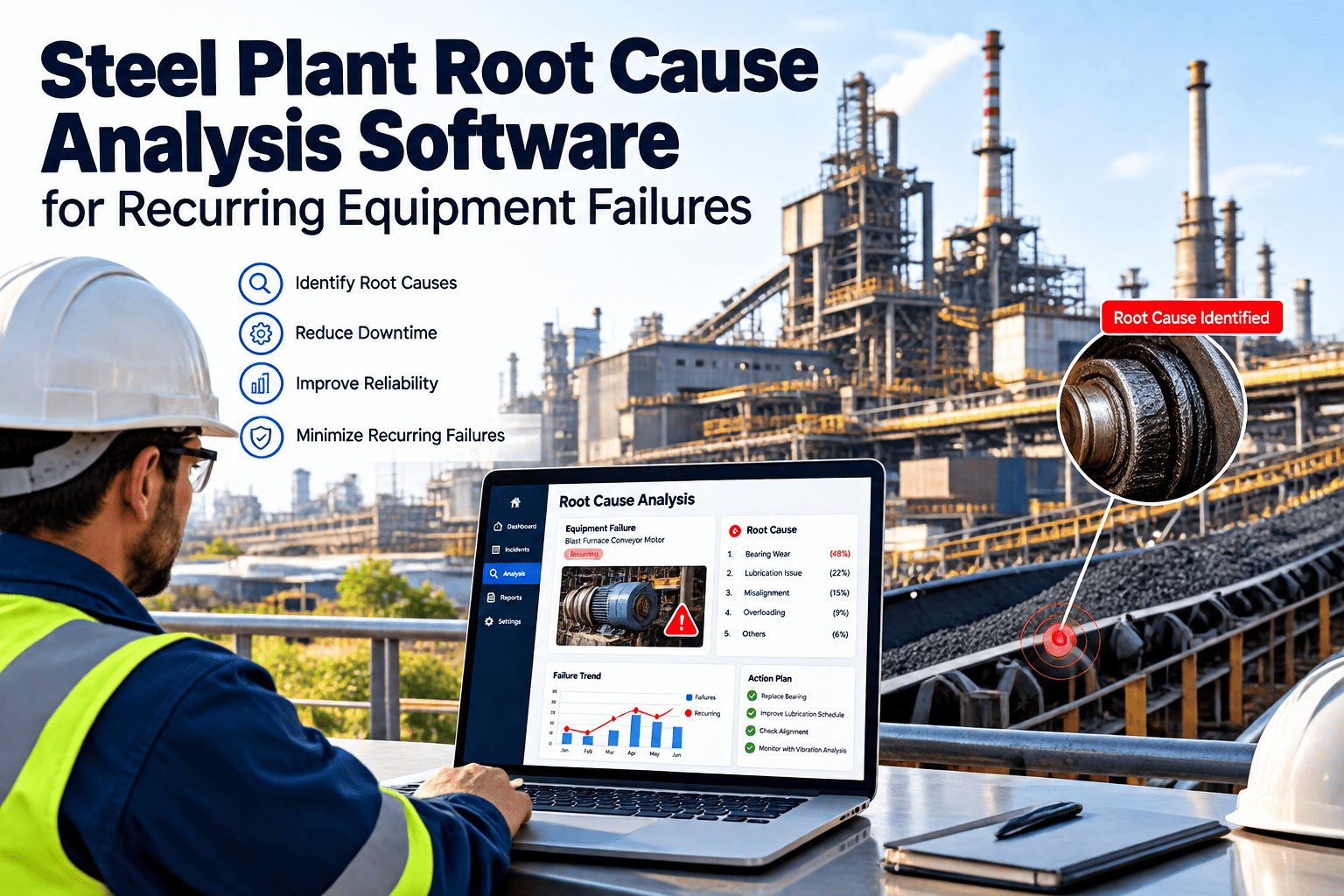
Steel plants lose more production to the same ten failures happening again and again than to anything truly unpredictable — a coupling that fails every eleven weeks, a hydraulic seal that weeps on the same shear three times a year, a motor bearing that cooks itself on the same conveyor drive. Root cause analysis software gives reliability and maintenance teams a structured way to capture those repeat failures, tie them to a real cause instead of a guess, and prove the corrective action actually worked, and a platform like Oxmaint can carry that workflow from the first defect report through to a closed-loop fix.
Stop repairing the same steel plant failure four times a year
A structured RCA workflow — failure codes, evidence capture, 5-Why and fishbone logic, and repeat-failure tracking — turns scattered breakdown reports into a record that actually prevents the next one.
Why the same steel plant failures keep coming back
Most plants do not lack maintenance effort — they lack a record. A breakdown gets a work order, a technician swaps the part, and the plant moves on. Nobody links this month's gearbox failure to the one from four months ago because the two work orders were written by different people, on different shifts, with different words for the same problem. Steel plants are especially prone to this gap because of how the equipment fleet is distributed — a caster, a rolling mill, a reheat furnace and dozens of material handling assets, each maintained by a different crew with its own habits and shorthand. A root cause that gets identified on the caster in January has no natural way to reach the crew working the mill in July, even if the failure mode and the underlying cause are identical.
Four patterns behind the repeats
No shared failure vocabulary
"Bearing failed," "bearing seized," and "bearing burnt out" describe three different events in three different logbooks, so the CMMS never recognizes them as the same failure mode.
Repairs close the work order, not the defect
The technician restores function under shift pressure. The underlying cause — misalignment, contamination, an undersized part — is never asked about, let alone fixed.
Evidence disappears with the shift
Photos of the failed part, oil samples, vibration trends and operator notes exist for a day, then get overwritten by the next breakdown competing for attention.
No one owns the corrective action
A root cause gets identified in a meeting, but without a tracked action against an asset record, the fix is a memory, not a change.
What a repeat failure actually costs a steel plant
A single repeat failure rarely looks expensive in isolation. It is the third, fourth and fifth occurrence — plus the lost heats, the overtime callouts and the expedited parts freight — that turns a minor defect into a line item finance asks about.
Building a failure code taxonomy that actually catches repeats
A repeat-failure system only works if every technician logs the same failure the same way. The table below shows how a steel plant maps equipment class, failure mode and detection method into codes a CMMS can query — instead of free text a search can never match.
| Equipment class | Common failure mode | Failure code example | Typical detection point |
|---|---|---|---|
| Conveyor drive motor | Bearing overheating | CV-MOT-BRG-01 | Thermal scan, motor current signature |
| Furnace hydraulic system | Seal weeping / external leak | FN-HYD-SEAL-02 | Visual inspection, pressure drop |
| Continuous caster segment | Roller bearing spalling | CC-ROL-BRG-03 | Vibration trend, spray water pattern |
| Rolling mill gearbox | Gear tooth pitting | RM-GBX-GER-04 | Oil analysis, vibration envelope |
| Overhead crane hoist | Wire rope wear / fraying | CR-HST-ROP-05 | Visual inspection, load test |
Once every work order is tagged this way, the CMMS can surface any asset that has hit the same code three or more times in a rolling twelve months — the exact definition most plants use to flag a bad actor for formal RCA.
A five-step RCA workflow that fits a live production floor
Formal RCA has a reputation for being slow and meeting-heavy. In a steel plant, it has to fit inside the pace of shift handovers and planned outages, which is why the workflow below is built around the asset record, not a standalone report.
Capture the failure with a code and evidence
The technician closing the work order selects a failure code, attaches a photo or reading, and notes what was observed before and during the failure — not just what was replaced.
CMMS flags the repeat
When the same asset and failure code appear for the third time within twelve months, the system auto-flags the asset for formal RCA and notifies the reliability engineer.
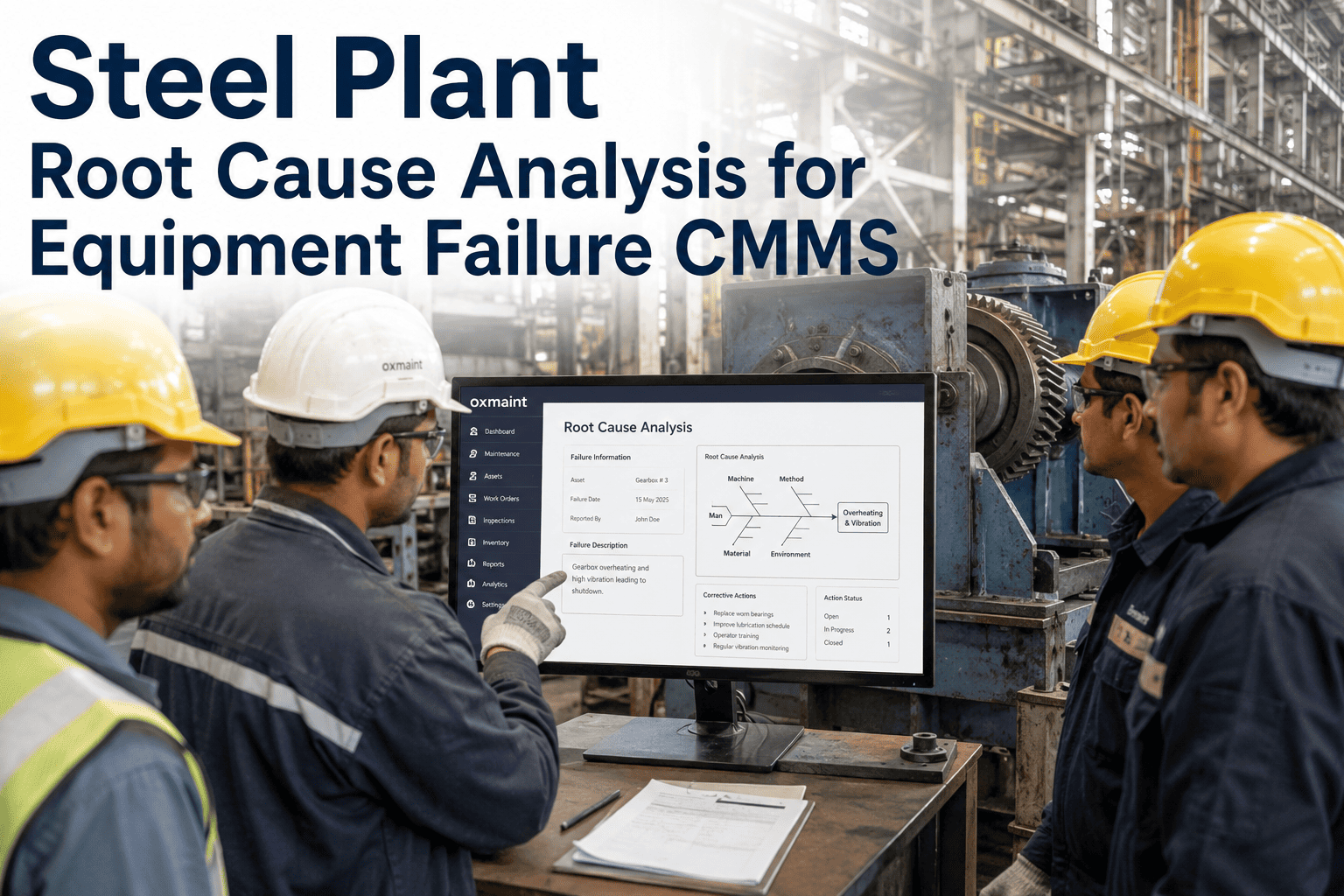
Run 5-Why or fishbone against the evidence
The engineer works through the attached photos, oil reports and vibration history rather than relying on memory, and records each "why" against the asset's failure history.
Assign a corrective action, not just a finding
A confirmed root cause — misalignment tolerance, wrong lubricant, undersized bearing — becomes a scoped action with an owner, a due date and a linked work order.
Verify the fix on the next cycle
The asset record carries the RCA forward. If the same failure code appears again after the corrective action, the CMMS reopens the RCA rather than treating it as new.
5-Why versus fishbone: choosing the right RCA tool for the failure
Not every failure needs the same depth of analysis. Matching the method to the failure's complexity keeps RCA fast enough that maintenance teams will actually use it on the floor instead of skipping it under time pressure.
5-Why
Best for single-cause, mechanical failures with a clear chain of events — a seal that failed because a filter was clogged because a PM was skipped. Fast, done at the asset, usually closed within a shift.
Fishbone / Ishikawa
Better for failures with several plausible contributing factors — man, machine, method, material, measurement, environment — such as a recurring caster breakout with no single obvious trigger.
Pareto on failure codes
Used across the whole asset register to rank which failure modes consume the most downtime hours, so the reliability team spends RCA effort on the 20% of codes driving 80% of the losses.
KPIs that prove the RCA program is closing failures, not just documenting them
A root cause analysis program is only as credible as the numbers it moves. These are the metrics a steel plant reliability team should pull from the CMMS every month, not just present at year end, since a monthly cadence catches a stalled corrective action while there is still time to intervene rather than after the next repeat failure has already happened.
| KPI | What it shows | Target direction |
|---|---|---|
| Repeat failure rate (same code, same asset, 12 months) | Whether corrective actions are actually preventing recurrence | Falling year over year |
| Mean time between failures (MTBF) by asset class | Underlying reliability trend independent of any single event | Rising |
| RCA closure time | How long a flagged bad actor sits without a confirmed cause | Shrinking |
| Corrective action completion rate | Whether identified fixes are actually being executed, not just logged | Above 85–90% |
| Open bad actors (3+ repeats, no closed RCA) | Backlog of known problems not yet addressed | Near zero |
The root cause categories behind most steel plant repeat failures
When steel plants actually complete formal RCA on their bad actors, the confirmed causes tend to cluster into a small number of categories year after year. Knowing these patterns in advance helps a reliability engineer ask the right questions instead of starting from a blank page every time.
Lubrication and contamination
Wrong grease type, missed relube intervals, or water and dust ingress into open gearboxes and bearing housings — a leading cause on dusty, high-heat steel plant floors.
Alignment and installation error
A coupling replaced without checking shaft alignment, or a bearing pressed in slightly off-tolerance, produces a failure that looks random until the installation record is checked.
Design or specification mismatch
A part specified for a lighter duty cycle than the asset actually sees — undersized bearings, the wrong seal material for the process temperature — fails predictably under real load.
Process-driven overload
Upstream process changes — a heavier product mix, a tighter production schedule — push equipment past the duty it was maintained for, without maintenance intervals ever being adjusted.
Tracking confirmed root cause against these categories, rather than leaving the field blank or generic, lets a plant see whether its biggest reliability gap is lubrication discipline, installation practice, or an engineering spec that needs revisiting — three very different fixes that a repeat-failure count alone cannot distinguish.
Before and after: what a closed RCA loop changes on the floor
Before — reactive logbook culture
Free-text work orders, no failure codes, evidence lost within days, and the same gearbox failing on a roughly quarterly cycle with no one connecting the dots between occurrences.
After — coded, evidence-linked RCA
The third occurrence auto-flags the asset, the engineer reviews attached vibration trends and photos, confirms a lubrication cause, and the PM schedule is updated with a shorter relube interval.
Outcome tracked, not assumed
The asset record carries the corrective action forward. If the failure code reappears, the RCA reopens automatically instead of the plant assuming the fix worked and moving on.
Give every failure a code, an owner and a closed loop
Set up failure codes and RCA workflows on your top bad-actor assets this month and watch the repeat rate move.
Rolling out RCA without stalling the maintenance floor
Plants that try to implement formal RCA everywhere at once usually stall within a quarter — the paperwork outpaces the willingness of technicians and supervisors to keep filling it in. Starting narrow and proving value first keeps the program alive long enough to become routine.
How Oxmaint supports steel plant RCA workflows
A CMMS built for RCA does more than store work orders — it structures the data that root cause analysis depends on. Oxmaint lets maintenance teams tag every work order with a standardized failure code, attach photos and readings directly to the asset record, and set automatic thresholds that flag an asset once it repeats a failure a defined number of times.
From flagged asset to closed corrective action
Reliability engineers can open an RCA directly against the asset's failure history, assign a corrective action as a linked work order, and track completion the same way any other maintenance task is tracked. Dashboards roll this up into repeat-failure counts, MTBF trends and open bad-actor lists by area, so the plant manager sees which lines are improving without waiting for a quarterly report. Mobile work orders mean the evidence — a photo of a spalled bearing, an oil sample reading — gets captured at the asset, not reconstructed from memory a week later.
Frequently asked questions
How many repeats before a failure counts as a "bad actor"?
Most steel plants use three or more occurrences of the same failure code on the same asset within a rolling twelve months. You can Get Started and set that threshold to match your own reliability policy.
Do we need a dedicated reliability engineer to run RCA?
No — a maintenance supervisor can run 5-Why on straightforward mechanical failures once trained on the method. Fishbone analysis on complex, multi-factor failures benefits from a reliability engineer's involvement, but the CMMS workflow, failure coding and evidence capture stay the same either way, so a plant without a dedicated reliability role can still build a working RCA habit.
What evidence should be attached to a failure report?
Photos of the failed component, any relevant readings (vibration, oil, thermal), operator observations before the failure, and the failure code. This is what turns a work order into usable RCA input later.
How does RCA software integrate with existing preventive maintenance schedules?
Corrective actions from a closed RCA can update the PM schedule directly — a new lubrication interval, a tighter alignment check, an added inspection point — so the fix becomes a permanent part of the asset's maintenance plan.
Can we see this workflow before rolling it out plant-wide?
Book a Demo and we will walk through failure coding, RCA flagging and corrective action tracking on one asset class first.
Turn your worst repeat failures into closed corrective actions
Start logging failure codes and evidence on your top bad actors, and give every RCA a tracked, verified outcome.